Tenure is a strange concept. Imagine — a job for life!
Not many professions support the idea of tenure. Outside of education, Federal judges work with a lifetime guarantee, as long as their behavior is “good” (a term that can be widely interpreted). Some clergy, and some research scientists may enjoy tenured positions, and some union workers, with especially strong contracts, may be assured lifetime employment, but the term tenure does not officially apply to them.

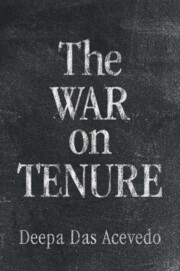
Mostly, tenure is used to describe the employment guarantee associated with teaching. K-12 teachers are afforded tenure, so even if their current compensation is lower than it might be in other professions, there is a assurance that it will go on for a very long time (and there is often an ample rest-of-life pension following that employment). Tenure is also associated with teaching at the college or university level, but the situation may not be simple, may be messy, and seems to be losing favor. This, according to Deepa Das Acevedo, a law associate professor at Emory University, and author of a new book entitled, The War on Tenure. It’s a world of work that’s largely unfamiliar to most people, except, perhaps when a professor’s private life is revealed in a movie or TV series.
Tenure applies to a very small portion of the overall population, but that doesn’t stop political campaigners from including the abolition or undermining of tenure in their speeches. When a scholar (assume all professors are scholars) works for a public university, they are, in fact, state employees. This may generate political conflicts — almost anything taught in a classroom these days may be deemed controversial and inappropriate by somebody — and that often affects stable employment.
Of course, it’s easy enough for any university to sweep away a current batch of pre-tenure or non-tenure employees with simple budget cuts, or in more difficult situations, through workplace pressure. This pressure can be strategically timed so that an individual scholar may believe they are on the path to tenure, only to find that state or board of governors or a third party has the power to erase the track completely. And then, of course, there is a question of academic integrity — at some point, many university scholars are required to make an ugly decision. Do they do what has been demanded and keep the pre-tenure or tenure job, or do they refuse, and place themselves on the job market with a vague black mark on their record?
There are lots of reasons why tenure may be denied, or pulled. These include academic misconduct (including plagiarism, which is now exceedingly difficult to sort out, given the growing role of AI), sexual misconduct (including, for example, well-founded or unfounded claims by students), or unprofessional conduct (such as bullying, which is often difficult to prove or disprove). When a university decides to shuffle departments, perhaps reorganize because their academic offerings require updating, tenure may disappear. Ditto for financial hard times for the institution.
So, tenure is not really a forever job. It may be better than most. Until it’s not. And when it’s not, a scholar with a fairly specific area of study may find themself difficult to place in another institution. That’s one reason why we have tenure in the first place — to support the many academic scholars whose fields of study are narrow but whose work is important. (But is all work important? How important?)
For the person seeking tenure, the path begins as an undergraduate. There is future value in selecting a program of study at a respected, sometimes specialized, institution. Often, this comes at a cost (and so, the debt begins to accumulate). Then, there’s graduate school, first for the master’s degree, then for the doctorate. Again, there is debt, and because these activities are so time-consuming, little opportunity to earn significant money in the process. So the debt becomes larger. There is a term for this situation: “PhD poverty.” Many institutions of higher learning operate food pantries. Hunger is a real issue. For those who come from low income poverty, “keeping mind and body together” is a real problem.
Then comes the post-doc phase: cheap labor for universities, and a necessary step if you want to become a professor. You may know post-docs by other names, such as fellows, lecturers, and visiting assistant professors.
The odds are lousy. Maybe 1 in 8 people make it to tenure track. As for the others — including the many who invest heavily, take on significant debt, and watch their dreams of an academic life go astray — there may be staff jobs at the university (that is, non-tenure track, and often, without the same prestige), or jobs in the larger marketplace (without tenure, and often not repaying the investment made by previously hopeful student).
Why should we care? Assume there are about 1.4 million college professors in the U.S., and about a third of them are tenured. Is that a lot? And why does this whole issue matter? Why write a book about tenure?
It matters because knowledge matters, because these people are the keepers of our knowledge, and they are the people who construct new knowledge, presumably with high standards in mind. Their work is different from other peoples’ work. They go deep. They think and construct models, then challenge one another’s models so everyone can think even more clearly. Their time horizons are different from other workers’ — they may take 10 or 20 years to work out what needs to be known, or done, and may work for lifetime, often with colleagues, to accomplish a very specific goal. Without institutional stability, and employment stability, this becomes very difficult to do. Why? In part because there aren’t many alternative ways to get this work done. Yes, it’s different. No, not every tenured scholar is producing essential knowledge. And no, it’s not a perfect system. But this is a situation where the perfect can easily become an enemy of the good. Although they are currently under attack, and always seem to be coping with the low hum of criticism, universities have a role, and scholars have a role, too. Which is why, in the end, we should be working to improve the system, and not tear it down.
 was an extraordinarily clear thinker about things that matter. That clarity, and her passion, and her just-plain-good writing are the reasons why I will spend the winter reading every one of about fifty articles and essays in a book that her daughter Nona put together. It’s called “The Essential Ellen Willis.” I’m guessing you won’t find it in many bookstores despite the best efforts of the University of Minnesota Press, but it’s certainly available online. For someone who enjoys smart writing with more than a small dose of social conscience, it’s an ideal holiday choice.

 Digital Insider