Around the World with Joe Boyd

Every night, for the past two months, I have gone to bed with Joe Boyd. He wrote a book that’s more than 900 pages long — far too cumbersome to be read anyplace except on my pillow.

Here’s a photo of the author, the UK cover art, and the US cover art.

As it happens, it’s a terrific book, and I loved every minute of it. The title is: And the Roots of Rhythm Remain: A Journey Through Global Music. Basically, this is a social and political tour, a history of the cultures that produced music we’ve come to associate with Jamaica, D.R. Congo, Brazil, Mexico, and dozens of other places around the globe whose artists have defined the concept of “world music.” The terminology is cumbersome, but the storytelling is not. It’s clear, and as engaging as any good history book, but this particular book explains, for example, how and why the likes of reggae, flamenco (see below), and the cha-cha are all part of a hyperlocal and a wonderfully global story. Happily, the story goes back a ways — back to the fifteenth century in some cases.

For example, you’re probably familiar with flamenco music, from Spain. Well, not exactly from Spain. Flamenco is more like gypsy music than Spanish music, but where’s the gypsy connection? And what, exactly, is a gypsy? The word gypsy derives from Egyptian, because that’s where these people sometimes claimed they had originated. But they didn’t. They came from India, but they often played on the streets, and saying they were Egyptian caused the people who were listening to give them more money. So, sure, they’re from Egypt. Or maybe they’re from Hungary — part of their story takes shape, there, too, which leads to Béla Bartók, and later, to world music star Márta Sebestyén. So, back to India: there were about 10,000 musicians imported from India to what becomes Pakistan, then dismissed when they were no longer wanted in Pakistan due to change of regime. So they traveled toward Europe, scattered, stayed close to one another, and continued to perform music for themselves and to earn the money they needed to stay alive. Later, when the king of Spain forbade the use of the term gitano in the late 18th century — the gitanos were gypsies — he determined that they were from Flanders, hence the term, flamenco. But that’s such a small part of the story, and music is only one aspect of the gypsy culture — if there even is a single gypsy culture because the people scattered to so many different places in Europe (and often seeded what is perceived to be music of specific local cultures).

The reason I love this book is simple. It’s not a linear history. Instead, it’s the grand story of interwoven cultures, places, peoples, instruments, political pressures against certain kinds of music (in many places, at various times in history, rulers prohibited the use of drums, for example). And so, the Rastafarians connect Ethiopia to Jamaica, and Cuba is connected to the Congo, Senegal and Ghana to England, and England to what was the empire.

In one chapter, we’re on the dance floor in the Latin jazz clubs of New York City, or in Cuba when Cuba was still an exciting place to visit and do things that might not be okay at home. In another, jazz saxophone player Stan Getz is making a record with João Gilberto, building a foundation that would solve a problem for middle-of-the-road singers as they tried to make their way through the 1960s. Traditionally, these singers relied upon songwriters we now associate with the great American songbook — Gershwin, Rogers & Hart, Rogers & Hammerstein, Cole Porter — but those sources had aged out, and they were replaced by rock musicians who wrote and performed their own material. The older singers needed a new source of fresh material — and found it in, of all places, Brazil. When Brazilian musician Sergio Mendez recorded a song by Antonio Carlos Jobim, the likes of Tony Bennett and Frank Sinatra paid close attention. Jazz provided the bridge. And, of course, jazz was rooted in blues, and blues was rooted in music brought from Africa.

Joe Boyd is a wonderful storytelling, and a well-organized historian, but he is also a music producer who was often in the room where it happened — because he was the one who flew to Bulgaria or India, attended the performance of a magical artist with a spectacular local following, gained their trust, signed them, and got them into the studio to make records. Those backstage stories are fascinating because, more often than not, they take place in clubs and other venues in far away places with magic of their own.

You probably know at least some of the musicians in the book, but many others are likely to be new to you. Heck, I wrote a book (for Billboard Books) about world music CDs, and many of the names are now on my buy lists (yes, I still buy CDs). My sloppy list would certainly include Los Van Van, Ali Farka Touré (from Mali, in Africa, along with many other musicians from that vital country), Celia Cruz, Ravi Shankar, Nusrat Fateh Ali Khan, Fela Kuti, Tabu Ley Rochereau, Kanda Bongo Man — so many names, so much music that I want to hear again and again (much of my world music listening took place in the previous century!)

I should probably mention the many unlikely names in this book, too, because their stories provide a lot of valuable connective tissue, and lots of points of entry: Desi Arnaz, Igor Stravinsky, Dizzy Gillespie, Fidel Castro, Nikolai Rimsky-Korsakov…

This is not a book to read on a lazy weekend afternoon, but each (long) chapter is filled with a lovely combination of deep history and context. Taking it slow and easy is my recommendation. And, I would suggest you do something that I should have done — take notes. You will want to hear a lot of the music that the author discusses, but over nearly 1,000 pages, you will forget most of what you wanted to hear. Now, I find myself going page-by-page, constructing a proper list, finding some of the music on YouTube and some of it in my own collection, and, inevitably, buying more. It makes me very happy to buy a CD of ¡Cubanismo!, used, for $1.99, and to find out that there are concert videos on YouTube if I want to listen more, or listen for free.

That is: reading a very good book about music is not the end of the journey. It’s only the beginning.
Living in the Mechanical World

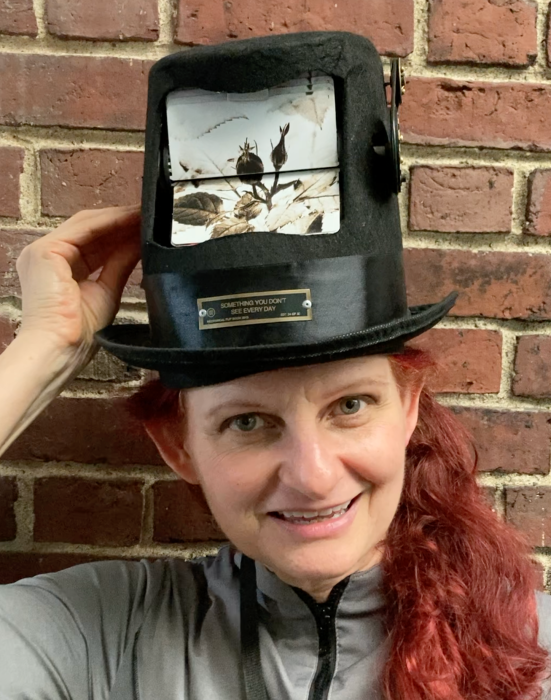
Wendy is walking around in top hat. The hat contains a window. Inside the window, there is a rosebud. During our brief conversation, the rosebud blooms into a full-sized red rose. With her partner, Mark, they have found a niche, making very clever flip books that capture the heart and the imagination. At their display table at the recent Automatoncon, an animal travels from one flip to another and another, employing mechanics and images printed on paper to bring ideas to life. In fact, anybody can do it — they sell a popular D-I-Y Flip-o-Scope that allows children, parents, and creative souls to animate images, and bring them to life.

That’s the whole point of automatons — you may recall the automaton in the center of the HUGO movie directed by Martin Scorsese, which was based upon the delightful picture book, The Invention of Hugo Cabret, by Brian Selznick — to simulate life through mechanical means. Every two years, AutomataCon provides a gathering place for wonderfully creative souls to compare notes, talk tech (which, in their world, is not digital), and show off their latest work. Significantly, the event is held at the small Morris Museum in Morristown, New Jersey, which houses one of the world’s largest collections of Murtogh D. Guinness Collection of historic mechanical musical instruments and automata. Mr. Guinness, of the famed brewing family, was a collector so serious about his prized assets, he built a building for the Morris Museum in exchange for a promise to keep the collect intact, alive, and productive.

Part of the promised outreach effort is AutomataCon, which brings, for example, Cecilia Schiller from her workshop in Northern Wisconsin to northern New Jersey. Cecelia’s long history in puppetry, theater special effects, and exhibits (such as a magical Christmas display, held annually in St. Paul, Minnesota’s Macy’s Department Store).

A puppet simulates life with the help of a talented human operator, but Cecilia’s sense of story takes her further with a full-scale puppet show that includes several children, puppets in a Punch and Judy stage, an puppet operator controlling those two puppets, and a colorful assembly of gears and operators down below the stage. All of it is control with a crank. It is magnificent. The images below provide some sense of what it does and how it works.

Dave Bowman discovered automata by visiting the Morris Museum. That was eleven years ago. Now, he makes magnificent metal automata of his own. We begins with Meccano parts — similar to an Erector set — but he uses only older sets because the steel girders are better for his purposes, and because the gears are brass-plated. Two recent favorites: a viking ship and a large bird, each with its own elaborate back story. He does not plan the creations. Instead, he engages in a long conversation with the imaginary beings. “You bond with them. You spend so much time creating them.” As with puppetry, the line between reality and fantasy can become blurry.

And yes, that is a real animal skull that forms the head. And, below, the made-up history is worth reading.

Of course, there is much more to discover. More artists whose work mimics real life. If you haven’t seen the movie HUGO, that’s a good place to start. And if you’re curious about AutomataCon, be sure to visit their website.

Next Spring, Near Paris

Start saving your money. Next May, go to Paris. Leave early on the morning–there’s an 820AM from Paris’s Saint-Lazare Station to Vernon, and then, there’s the taxi. The train arrives at 9:05AM at Vernon, and the cab will get you to the front entrance of Monet’s home and gardens by about 9:15AM. You want to arrive early, perhaps catch the mist rising from the water garden, perhaps take a few pictures or just gaze before the crowds populate every view. (Get there earlier, if you can; it’s always best to arrive first-in-line here.)

Sigh.

Summer is ending. There is autumn color: the purples and luminous yellows, the garish reds and the beginnings of orange trees reflected in the water. But there is nothing like spring.

In 1883, Claude Monet settled in Giverny, a village fifty miles outside paris. He rented a house with an orchard, the future Clos Normand, the flower garden at the front of the house that broke with the traditional idea of a pleasure garden.

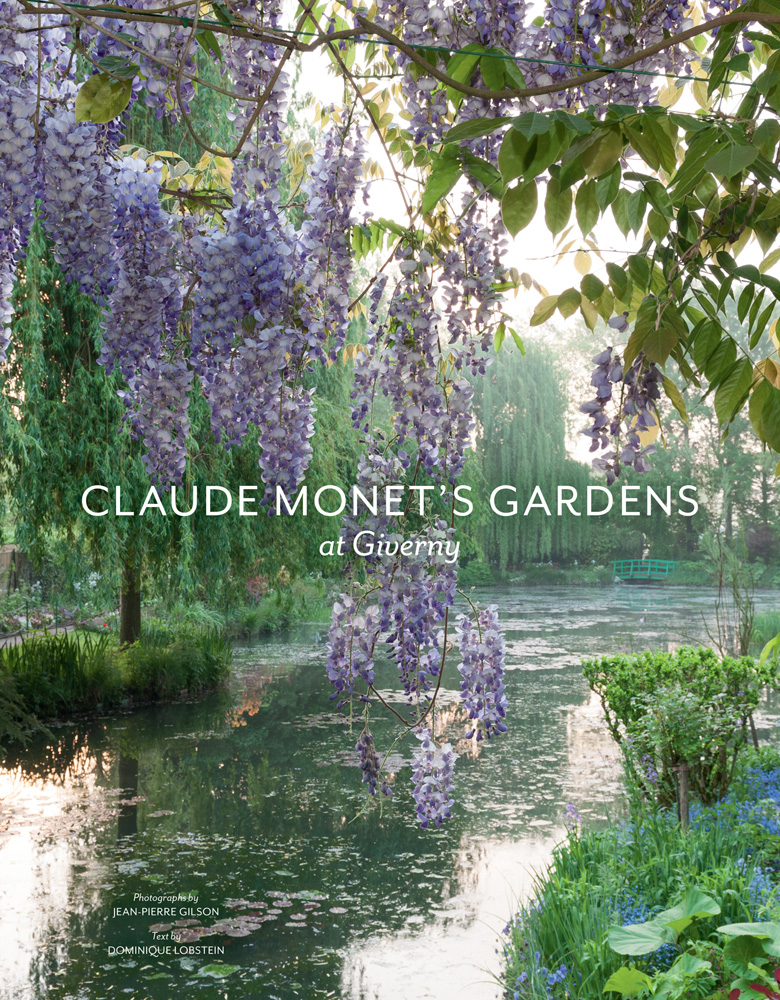
9781419709609So begins the tale, told mostly in large, vivacious images, of Claude Monet’s extraordinary gardens (and home), told with love and with style through Jean-Pierre Gilson’s photographs, with text by Dominique Lobstein. Published by Abrams–one of the best in the world at this type of book, the visual tour begins, as it should , in the purple haze and tangled wisteria branches hanging over the famous Japanese bridge. The photograph is subdued; there are no bright colors yet. On the next two-page spread, there are brightly–colored bushes and their quiet reflections, house peeking out of the background behind some trees. Flip to the next of these several two-page spreads and it’s a riot of roses, glowing in the sun, red, pink, nearly white, braced by green leaves so dark and sometimes so nearly translucent, bold as can be. The text begins.

And on the next spread, so does spring. After the prelude, spring commences with a field of pink tulips, clean green fences and stair rails, dark green-blue leaves, and the stunning-but-simple house with its own pink facade and blue-green shutters. The effect is stunning, as if in a painting–and here, that’s precisely the effect that the master painter intended. To be at Giverny is to live inside a Monet painting, at least for a morning.

It’s not all cluttered with noisy flowers and oh-so-subtle impressionist gardening. “Monet wanted a garden that could ‘breathe’ with flowers, bushes and an open vista…” so he removed the many trees from the old orchard, and replaced them with Japanese cherry trees that yield, at least for a brief time in the spring, lighter-than-air blossoms, punctuated, here and there, as in any number of his paintings, with spots of bright color; here, red and purple tulips.

I wish I knew the name of every flower (and I wish the author’s captions included this information!). The phenomenal two-page spread showing yellow towers of flowers two stories high, dappled with pink-and-purple irises, golden yellow somethings (frustrated…), and it’s followed by several more. (I want to it to be spring today, and I want to go to Giverny tomorrow.)

And then, when your head is beginning to explode because Monet was such a genius, there’s a pair of small green rowboats, a field of happy daffodils, and in the distance, the Japanese bridge that he painted so often. Here, with a less exhausting spectrum, it’s possible to rest and reflect, and observe. The yellowy green of the locust leaves in contrast with the deep green of the background trees–with just a hint of small violet flowers to set the counterpoint.

The flighty, wavy petals of mauve tulips surprise me every time I see them. Here, they’re pictured with the famous lily pad pond in the fuzzy distance, and the sharp, sun-dappled orange wallflowers in the foreground. Another two-page spread, one of my favorite two-page spreads in the book.

Just checking–I’m not even half way through the book. Some surreal lily pad images–two look as though they were made for a science fiction film, but they are real–and then, with a page turn, there are paths of dry ochre leaves on the ground, paths with strong color of fall, not spring. The quiet beauty of barren trees and cool skies, the yellowing willow and golden hour light, it’s bittersweet. Moreso because the last set of images show the house with shutters now closed tight.

But then, we get to go inside. A row of old copper pans artfully hung in front of a blue-and-turquoise tiled wall with cabinets. A yellow dining room whose walls are filled with Japanese prints (Monet collected them, and they are a highlight of every Giverny tour, but few people spend the time to look at them as closely as the artist once did). It’s a classy old country home, less formal than most. And then, there’s a small staircase leading down to a room with Persian carpets on the floor and a whole lot of miscellaneous Monet paintings almost haphazardly scattered on the walls. It’s his studio.

The book closes with snow. Which means spring is coming again. Soon.

Digital Travel Guides and the Future of Publishing

As the Kent & Sussex chapter of a traveler’s eBook begins, the page shows the current temperature. Just a hint of what’s to come in digital travel guides…

Not enough room in the suitcase? Maybe it’s time to ditch the travel guidebook and try the eBook version instead. I did, and learned a lot about what a traveler’s eBook ought to be.

Travel guides are very different from other types of fiction and nonfiction books. They are only partially read. They are intensely used, but only for a few weeks. They are out of date shortly after they are published. And if you’re doing a lot of traveling, they can become quite heavy.

An eBook on an iPad? Less weight. Full color. An opportunity to integrate with digital maps and Trip Advisor, build an itinerary, make reservations, maybe connect with chapters in history or nature books.

Well, we’re not there yet, but we are seeing the beginning of a new era in travel guides.

Lonely Planet has yet to make its big move into iPad publishing, but they offer one excellent idea: the purchase of individual chapters as PDF files for just under $5 a piece. For example, Lonely Planet’s digital England book can be purchased for $17.49, or you can buy the Devon & Cornwall chapter for $4.95. Either way, it’s mostly well-written text with very helpful guidance, plenty of links, and, take note, designed for iPhone with only with 2x magnification feature on.

Fodor’s London Travel Guide is a full-featured app with plenty of maps, color images, lists with links, and easy access to places to visit, lodgings, restaurants, and nightlife. In fact, the app is organized so that it’s easy to read the text blurb about the London Zoo, then quickly refer to a restaurant map to find Lemonia, a highly-regarded Greek restaurant nearby. Read the description of Portobello Market, click, then there it is on a full-screen map. It’s easy to use and effective.

Working with an eBook design firm called Inkling, Frommer’s offers a more ambitious take on the digital travel guide. The eBook is organized in chapters, but each chapter begins with several points of entry: favorite moments in the region, a three-day trip, a five-day journey, favorite sites to visit, popular destinations in detail, and more. Choose the Cotswolds village of Moreton-on-the-Marsh and there’s a well-written description of the village, tips about what’s nearby, quick access to area maps, and an overall design that’s clearly designed for digital devices. This series is called “Day by Day”, so I expected an itinerary planner to coordinate with my iPad’s Calendar app. That’s not yet a feature, but I suspect it was discussed during this superior product’s design phases.

I used all three guides, often and successfully, and never once missed the books that I did not carry with me. My favorite: Frommer’s. But I suspect that next week’s BookExpo will find publishers to introducing the next generation of interactive travel guides.

What’s next? Certainly, full integration with Google Maps, Trip Advisor, Kayak and other reservations systems, Calendar, email. Those seem to be within reach, but they only scratch the surface of what could be done. There’s a gigantic social network opportunity here, whether it’s couch surfing or house swapping, or simply asking whether anybody in the Pembrokeshire area feels like taking a hike today. Right now, publishers are cautiously experimenting with books that become books on screens, but this caution may result in the demise of yet another industry. Travel publishers possess a unique opportunity to bring places to life, to involve community members (think Zagat’s but on a massive scale), to truly invent the future of publishing on a large, interactive scale. It’s interesting to contemplate whether this work can be done, or will be done, by travel publishers owned by much larger publishing conglomerates, or whether smaller, more flexible and potentially more innovative publishers will map this particular journey into the future.