Green, Blue, and Extremely Portable

One side is green and the other is blue. It stretches so your chroma-key productions have a lightweight, flat background. But it’s a good idea to stretch even more with clips.

Or: chroma-key, anywhere.

It’s amazing how easy portable video production has become. You can shoot high definition video with a smart phone, a tablet, a FlipCam (and similar products), an inexpensive video camcorder, a digital still picture camera… The list goes on.

Most of the time, the recorded video is real life… people in action, scenery, and so on. Sometimes, it’s interesting to explore new creative domains. Often, these explorations involve the placement of people or objects in imagined places, and this is often achieved through a technical miracle called chroma-key.

What can you (and some kids) do with chroma-key? Here’s a step-by-step example that’s fun to watch. (Click to watch the video.)

You know chroma-key: it’s the technology used to place your local meteorologist in front of a digital weather map. The subject performs in front of a green screen, and then, all of the green is (miraculously) dropped out of the image so that it can be replaced with your choice of alternative video. In fact, any color can be used as the chroma-key color, but most often, a deeply saturated green or blue is used because these colors are not (usually) seen in the colors of human skin or hair or eyes. The colored area is usually painted, or created with a cloth stretched very tightly and lit evenly. When using chroma-key, folds and shadows cause difficulty.

With these challenges in mind, I had very high hopes for the FlexDrop2 from Photoflex. The portable package is a big, lightweight fabric disc, not quite a yard in diameter. It sets up with not much more than the flick of a wrist, and opens to a taut five foot by seven foot panel. Very cool.

Mostly, the FlexDrop is flat, but the use of a small clamp here and there is necessary to eliminate all visible shadows and wrinkles. Unfortunately, it’s not a standalone device…it is designed to be attached to a lighting stand or other pipes or tubes (and these are rarely lightweight).

Hands on, FlexDrop2 really works. One person can stand in front of a field of nothing but blue (one side) or green (the other), and then, live or with a good edit application, the chroma-key process can be used to drop out the blue or green and drop in any video still, animation, graphic, or footage. Two people? Hang the FlexDrop2 horizontally. Another good use: as a background for stop-motion animation, but you will need to dress the tabletop surface with an additional green or blue cloth (exactly the same color as FlexDrop2).

At $165, the FlexDrop2 is a nice-to-have, a bit expensive unless you use it often. And, of course, there are less costly ways to make chroma-key happen: buy a cloth and stretch it yourself, paint a wall, etc. But this one is handy, portable, stretches nicely, stores without taking up much space, and does the job in a professional manner. One catch: it’s not so easy to collapse and pack away. This video shows you how to pack it up.

BTW: Thanks to Kristy and to Rebecca for their help with this article.
I Want to Watch TV on My iPad (The Plot Thickens)

Here’s the original story published on March 6, 2012:

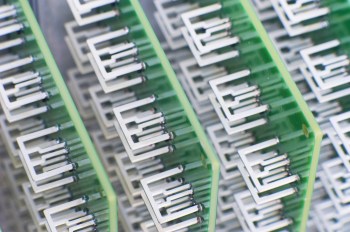
You’re looking at an array of television antennas. These antennas are used to capture local broadcast signals that you can watch, if you pay a monthly subscription fee, on your computer, tablet, or phone. Aereo (formerly Bamboom) is the company behind the scheme, and, as you might expect, they’ll be spending a lot of time in the legal system as they argue with broadcasters regarding the rights and wrongs of live retransmission (that is, if Aereo is to survive, the broadcast networks want to see monthly cash–just like they receive from the cable operators).

Ah, the free airwaves, the ones that broadcasters use for the public good. Ah, the intellectual property that broadcasters carry over those airwaves, the IP that cable service providers pay to carry. Ah, the unresolved legal gotcha!! Any company that attempts to make those signals available via a secondary distribution scheme must pay for the right, or so say the broadcast networks.

The price for the service? $12 per month. The debut date? March 12. The place: for now, the New York metropolitan area.

For cord cutters, this may be a terrific deal. But it’s unclear whether the courts will block Aereo’s progress, as they have with ivi.tv and others who attempted to climb the walls of the castle without paying the required tribute (or, as I’m adding in my updated version of this article… others who attempted to challenge the current system of copyright and payments for distribution rights to intellectual property).

Slingbox? That’s okay. Over-the-air mobile TV? That’s not ready yet, except in a few markets on a test basis. Watch over-the-air TV? Sure. Watch via cable or satellite? As long as you’re paying for the privilege. Watch on another device? Nope, not yet. Or, maybe the answer is yes. We’ll find out in a few weeks.

_____

Here’s the update that I wrote on March 12, 2012:

From Bloomberg: Predicting a “great fight” with traditional media companies, billionaire Barry Diller said he plans to expand his new Aereo Web-based television service to 75 to 100 cities within a year, reports Bloomberg.

Diller, speaking at the South by Southwest Interactive festival in Austin, Texas, noted that efforts by Walt Disney Co. and other media companies to cite copyright violations were “absolutely predictable,” since entrenched companies always protect their turf, the story says.

Want to know more? Here’s a bunch of links:

The tech explanation:

http://www.techspot.com/news/47467-aereo-offers-tv-over-internet-with-antennas-engineered-to-comply-with-law.html

The consumer angle:

http://www.forbes.com/sites/dorothypomerantz/2012/02/29/how-much-are-you-willing-to-pay-to-cut-the-cord/

The business story:

http://online.wsj.com/article/SB10001424052970204059804577229451364593094.html?mod=wsj_share_tweet#printMode

The investment story:

http://www.bizjournals.com/sanfrancisco/news/2012/02/14/iac-l20-million-aereo-barry-diller-vc.html?s=print

_____

Here’s the update as of July 17, 2012

Again from Bloomberg (July 13, 2012): “A U.S. district judge this week allowed Aereo to continue operating while television networks pursue a copyright lawsuit against the company. Aereo captures broadcast signals with small antennas and streams them to devices such as Apple Inc. (AAPL)’s iPad, without paying for the programming.” As a result of the ruling, Diller is now planning a nationwide rollout.

As I pondered what all of this might mean, I read an essay on TV NewsCheck’s website, written by television executive Lee Spieckerman. I contacted him, and we spoke for a while about the ruling and its implications. In short, he believes that Judge Nathan bungled the decision:

“We see loopy rulings from Federal judges all the time, and I think this fits into that category… She misread the governing law!”

Spieckerman’s argument is based in part upon law and in part upon common industry practice. His legal argument tracks back to a 1993 law which requires operators of paid television systems to secure the necessary rights from local broadcasters. The concept is called “retransmission consent” and that ruling has proven to be something of a windfall for local broadcasters as a result of the fees paid by cable operators in exchange for this consent. According to  Spieckerman, these fees are now worth about $2 billion to the commercial broadcast network, plus an additional several billion dollars to local stations. This, plus the additional revenues from political advertising resulting from the Citizens United decision, provide the advertising base necessary for local television news to survive. (Seems to me, we should all understand the economics and consequences of this new approach to journalism funding–a worthwhile topic for a future article). Back to his other argument: “there is no tradition in this country for renting antennas–nobody rents antennas!”

Digging deeper with Mr. Spieckerman, and the real argument emerges. This is all about copyright infringement, and protection of distribution rights associated with intellectual property. Judge Nathan’s ruling begins to disrupt a system by which cable operators compensate owners of cable networks and local stations. ESPN receives $4.69 per cable subscriber–do the math and that’s about $50 per year per subscriber multiplied by 100 million subscribers, and that’s $5 billion per year in subscription fees. Spieckerman believes local broadcast station fees to be 20-50 cents, but acknowledges that these deals are confidential. (Consider that Comcast, Time Warner, and other cable operators charge consumers charge those 100 million subscribers over $1,000 per year–1o0 million x $100 = $100,0o0,000,000, or $100 billion, also good raw material for another Digital Insider article.)

Of course, the local station operators are anxious to negotiate with Diller’s Aereo. And Diller is anxious to go with the Judge’s ruling because it requires no fees. For now, according to Bloomberg,

We’re going to really start marketing… Within a year and a half, certainly by ’13, we’ll be in most major markets.”

To which Mr. Spieckerman counters:

Who is going to be next? This is a pandora’s box, and when you start circumventing and tearing down the few elements there are in the industry and inviting the destruction of an important industry. If I have any intellectual property that I want to distribute, I do not want anybody able to steal my material.”

Apple TV in 2012?

Here's one of several pictures of the current Apple TV interface. For more, visit http://www.apple.com/appletv/

Apple has been experimenting with home television since 2006, when the company introduced Apple TV. Released last year, second generation Apple TV has sold over 2 million units. Apple TV is an accessory. The new product will be a complete solution: a TV set with an Apple logo, Apple software, and Apple’s reinvention of yet another product category.

For those unfamiliar with Apple TV, here’s the Apple blurb:

“With Apple TV, everything you want to watch — movies, TV shows, photo slideshows, and more — plays wirelessly on your widescreen TV. No managing storage. No syncing to your iTunes library. HD movies and TV shows from iTunes and Netflix play over the Internet on your HDTV, and music and photos stream from your computer. All you have to do is click and watch.”

According to Smarthouse, there will be three Apple models: 32″, a mid-size, and 55″. It will include “A totally new software interface has been written that allows users to call up programs using voice commands via the new Siri personal assistant app…” It may be operated by your existing iPad or iPhone (provided it’s Siri-ous).

Add Apple’s FaceTime and the TV becomes a big-screen video conferencing center, fully compatible with millions of iPhones and iPads.

How might the new TV look? The first place that answers come together tends to be MacRumors, my favorite Mac site for its up-to-the-minute coverage, its willingness to republish rumors from reliable sources (often with smart commentary), and the site’s Buyer’s Guide, which tells consumers when to buy each Mac and Apple portable device.

How much will it cost? I’m guessing $1,199 for the low-priced model, and $1,99 for the high, with a $1,499 price point for the in-between model. Just a guess based upon Apple’s past practices. If I was in charge of television at Sony, or any other high-priced television manufacturer, I would be very, very concerned. And I would not bother to convince myself that, somehow, DroidTV (or whatever) is likely to win the race.

Why?

1. With the iPad turning three years old, Apple’s huge base of early adopters will be ready for a new, high-priced toy.

2. For a decade, Apple has been studying this market, figuring out the best integrated hardware, network, usability, operating system and app plays.

3. Apple already sells an accessory product with the base functionality already in place and operating in two million homes (three or four million by launch time).

4. Apple has a well-developed retail network–people like to see a TV before buying. Best Buy, Radio Shack, and Target sell Apple products.

No competitor enjoys these advantages.

Moyers to Public TV: Reinvent Yourself!

These are some of my favorite excerpts from an inspiring speech by one of public television’s long-term heroes, Bill Moyers. He delivered the speech in November, 2010 at a gathering of public television programming executives…

“The core problem is that we still don’t have an expansive national vision of what we’re about, where we want to go and what we want to become. Until we are able to say clearly and comprehensively what it is we really want to do, how much it will cost, and how we intend to get there, we can’t blame Congress, the White House or even the foundations for not supporting us more fully.

…There’s a huge vacuum between the [public television] system, nationally and locally, and the big foundations and no one has yet been inspired or capable enough to link the two at the level of a consensus national plan.

There are always people who remain afraid of change or an unknown process, fearful of where it might lead.  But by contrast, the British and Canadians go through periodic charter reviews that invoke a national conversation; there’s a culture of discussion and planning for public media in those nations that help them survive even the worst assaults from detractors or vested interests. This could be a reason that public support for public media in nations like the U.K. exceeds $80 per capita, while we’re still limping along on $1.49 per capita.

…In the meantime, I’m here to tell you that even within the fiscal crisis public television currently faces, we have an opportunity to serve the public — to renew our bond to our communities.

You may not have money for in-depth documentaries or other high-end productions but you have cameras, microphones, studios and the trust of the community. You can be the ombudsman for the public within your reach, provide the venue for forums, teach-ins, town meetings, and debates over the issues that matter to people where they live, telecast in an atmosphere of openness and clarity without the mean and mindless rhetoric or cant that are so triumphant today. Civic engagement is the lifeblood of democracy and the bedrock of its legitimacy. No media can nurture, foster, and empower it the way we can.

…Meanwhile, let me offer just a few other ideas for you to consider:  Take a whole evening of primetime and give it to a forum for the fight in your neighborhoods over charter schools. Do the same for other distressed public institutions — your libraries, for example.

Or how about one week inviting as many social workers as you can get into your studio and asking them to share what they see every day — how people are coping each day with these worst hard times?  Do a series of workshops on Occupy Wall Street, pro and con.  Out there in Iowa, find the lady carrying the placard I saw last weekend on television that read: “I couldn’t afford to buy a politician so I bought this sign.” Bring her into the studio with her local member of Congress — have them talk frankly to each other about their different perceptions of money in politics. Do an evening of primetime on the fight going on right now in your state over redistricting — gerrymandering — the outcome will influence your state’s position and power for the next 10 years. Get folks aware and involved. If you don’t, who will? Certainly not the commercial stations in your market, that’s for sure.

…since David H. Koch of Koch Industries is on the board of both WGBH and WNET, I’d ask him to round up his billionaire buddies — and in a nonpartisan spirit reach out to civic-minded progressive billionaires like George Soros — and together create an independent, fully endowed, self-governing production center (free of any partisan strings or influence) for American drama that would bring our epic history and culture to the screen just like we’ve brought over the Brits’ Downton Abbey, make room for Jefferson’s Monticello! Now, there’s an Upstairs Downstairs story the public would make a pledge to see.

…What we need is a makeover of our own — a rebirth, yes, of vision, imagination, and creativity, but above all a structure and scheme for the 2lst century, one that uses the resources that the digital platform provides to realize the goals of our founders: diversity, public access, civic discourse, experimentation, a welcoming place for independent spirits.

The whole speech–including his idea for public television’s equivalent of a constitutional convention– can be found here:

http://www.current.org/pb/pb1122moyers-remarks.html

The Inadequacy of TV

Last night, I watched a PBS documentary about an extension of 19th century learning at Chautauqua and another about 21st century learning in several advanced schools.

People living in the 20th century may have been amused, engaged and enthralled by the miracle of television’s ability to deliver Chautauqua or in Science Leadership Academy into their living rooms, but living here in the 21st century, both television experiences left me cold.

Helen Gayle, C.A.R.E.

I had questions. I wanted to get in touch with Helene Gayle, the C.A.R.E. CEO whose family had been vacationing at Chautauqua for generations. Every morning, Chautauqua features a speaker at 10:45 a.m., and I wanted to access Gayle’s speech–and the ones by David McCullough and Daniel Pink, too. I wanted to take a walk with McCullough, or do the virtual equivalent. Sound bites in a documentary? That’s all we get from television? It’s not enough. Not any more. Not in the era of the iPad and YouTube and TEDTalks.

I wanted to see a full class at Science Leadership. I wanted a full-scale Q&A with some students, some teachers, some parents. Cutesy camera angles don’t make television a modern medium. Neither does HDTV. It’s the connection that makes my “post PC device” magical. And that’s not TV. Not now, not at this 21st century moment.

Rules of the Digital Road

Last week, the leader of a national new organization was taken down under dubious circumstances.

Apparently, a filmmaker set a trap, edited the resulting footage for a desired effect, and ignited an anti-NPR fuse that resulted in the explosion of its leadership.

Whether you are an NPR fan or against them, the situation highlights a significant disconnect between technology, ethics, and current law.

Today, I can invite you to lunch, ask any number of leading or embarrassing questions, record your every word without your permission, edit your responses so that you seem to be the embodiment of evil, include a closeup shot of your credit card and signature, distribute the resulting video throughout the world, publicize it throughout the blogosphere and the news media–all without your knowledge, and with little if any vetting by any responsible editor, gatekeeper, or other adult supervision.

And, I would be within my rights to do so. And, there is little you could do about it–without drawing even more attention to a miserable situation.

We’ve launched a global system of instant communications, based upon low-cost, high-access tools in an environment where free speech trumps all. Errors, whether by omission or commission, result in revision, or deletion of a few references, but never erasure.

It may be that this is our new reality. And it may be some sort of ultimate test of free speech rights. We don’t want to place a gate between bloggers and their readers. Without a gate, readers have no way to evaluate truth, fact, or bias; with a gate, those decisions are made by others who, presumably, possess the necessary time, training and ethical policies to assume such responsibility in our free society. Without a gate, every opinion can be heard (or, read)–right, wrong, biased, malicious, disguised, or squeaky clean. With a gate, there is control and protection–terms we like when they’re used in transportation, not so much when they’re used in communication. With digital media, transportation and communication converge–and we need to define some rules of the road.