Every night, for the past two months, I have gone to bed with Joe Boyd. He wrote a book that’s more than 900 pages long — far too cumbersome to be read anyplace except on my pillow.

As it happens, it’s a terrific book, and I loved every minute of it. The title is: And the Roots of Rhythm Remain: A Journey Through Global Music. Basically, this is a social and political tour, a history of the cultures that produced music we’ve come to associate with Jamaica, D.R. Congo, Brazil, Mexico, and dozens of other places around the globe whose artists have defined the concept of “world music.” The terminology is cumbersome, but the storytelling is not. It’s clear, and as engaging as any good history book, but this particular book explains, for example, how and why the likes of reggae, flamenco (see below), and the cha-cha are all part of a hyperlocal and a wonderfully global story. Happily, the story goes back a ways — back to the fifteenth century in some cases.
For example, you’re probably familiar with flamenco music, from Spain. Well, not exactly from Spain. Flamenco is more like gypsy music than Spanish music, but where’s the gypsy connection? And what, exactly, is a gypsy? The word gypsy derives from Egyptian, because that’s where these people sometimes claimed they had originated. But they didn’t. They came from India, but they often played on the streets, and saying they were Egyptian caused the people who were listening to give them more money. So, sure, they’re from Egypt. Or maybe they’re from Hungary — part of their story takes shape, there, too, which leads to Béla Bartók, and later, to world music star Márta Sebestyén. So, back to India: there were about 10,000 musicians imported from India to what becomes Pakistan, then dismissed when they were no longer wanted in Pakistan due to change of regime. So they traveled toward Europe, scattered, stayed close to one another, and continued to perform music for themselves and to earn the money they needed to stay alive. Later, when the king of Spain forbade the use of the term gitano in the late 18th century — the gitanos were gypsies — he determined that they were from Flanders, hence the term, flamenco. But that’s such a small part of the story, and music is only one aspect of the gypsy culture — if there even is a single gypsy culture because the people scattered to so many different places in Europe (and often seeded what is perceived to be music of specific local cultures).
The reason I love this book is simple. It’s not a linear history. Instead, it’s the grand story of interwoven cultures, places, peoples, instruments, political pressures against certain kinds of music (in many places, at various times in history, rulers prohibited the use of drums, for example). And so, the Rastafarians connect Ethiopia to Jamaica, and Cuba is connected to the Congo, Senegal and Ghana to England, and England to what was the empire.
In one chapter, we’re on the dance floor in the Latin jazz clubs of New York City, or in Cuba when Cuba was still an exciting place to visit and do things that might not be okay at home. In another, jazz saxophone player Stan Getz is making a record with João Gilberto, building a foundation that would solve a problem for middle-of-the-road singers as they tried to make their way through the 1960s. Traditionally, these singers relied upon songwriters we now associate with the great American songbook — Gershwin, Rogers & Hart, Rogers & Hammerstein, Cole Porter — but those sources had aged out, and they were replaced by rock musicians who wrote and performed their own material. The older singers needed a new source of fresh material — and found it in, of all places, Brazil. When Brazilian musician Sergio Mendez recorded a song by Antonio Carlos Jobim, the likes of Tony Bennett and Frank Sinatra paid close attention. Jazz provided the bridge. And, of course, jazz was rooted in blues, and blues was rooted in music brought from Africa.
Joe Boyd is a wonderful storytelling, and a well-organized historian, but he is also a music producer who was often in the room where it happened — because he was the one who flew to Bulgaria or India, attended the performance of a magical artist with a spectacular local following, gained their trust, signed them, and got them into the studio to make records. Those backstage stories are fascinating because, more often than not, they take place in clubs and other venues in far away places with magic of their own.
You probably know at least some of the musicians in the book, but many others are likely to be new to you. Heck, I wrote a book (for Billboard Books) about world music CDs, and many of the names are now on my buy lists (yes, I still buy CDs). My sloppy list would certainly include Los Van Van, Ali Farka Touré (from Mali, in Africa, along with many other musicians from that vital country), Celia Cruz, Ravi Shankar, Nusrat Fateh Ali Khan, Fela Kuti, Tabu Ley Rochereau, Kanda Bongo Man — so many names, so much music that I want to hear again and again (much of my world music listening took place in the previous century!)
I should probably mention the many unlikely names in this book, too, because their stories provide a lot of valuable connective tissue, and lots of points of entry: Desi Arnaz, Igor Stravinsky, Dizzy Gillespie, Fidel Castro, Nikolai Rimsky-Korsakov…
This is not a book to read on a lazy weekend afternoon, but each (long) chapter is filled with a lovely combination of deep history and context. Taking it slow and easy is my recommendation. And, I would suggest you do something that I should have done — take notes. You will want to hear a lot of the music that the author discusses, but over nearly 1,000 pages, you will forget most of what you wanted to hear. Now, I find myself going page-by-page, constructing a proper list, finding some of the music on YouTube and some of it in my own collection, and, inevitably, buying more. It makes me very happy to buy a CD of ¡Cubanismo!, used, for $1.99, and to find out that there are concert videos on YouTube if I want to listen more, or listen for free.
That is: reading a very good book about music is not the end of the journey. It’s only the beginning.
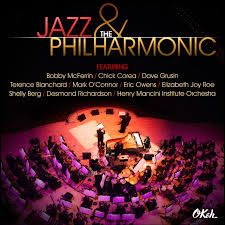 New CD + DVD set: “Jazz & The Philharmonic,” recorded in Miami, dozens of performers doing a lovely job with jazz, classical (with a modern twist), traditional music, beautifully produced and engineered. You may have seen it on PBS—last February—but if you are among the many millions who missed out, this is a gift that you might consider for this year’s holiday season. Notably, it is one of the last recorded works supervised by Phil Ramone, whose list of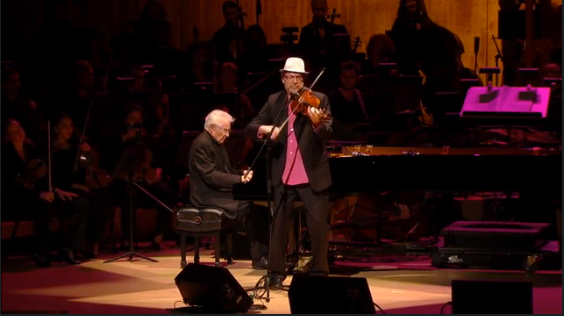
 Geri Allen is one of those extraordinary jazz musicians whose influence runs wide and deep, but somehow, has not become as well-known as it ought to be. She’s a pianist with a resume that begins with a serious educational foundation: a master’s degree in ethnomusicology that has served her well (easy for me to see this because I’m approaching her life’s work some 35 years into a very good story). Her professional work begins with Mary Wilson and the Supremes in the early 1980s, and Brooklyn’s
  The awards began to roll in. Allen was in and out of the remaining avant-garde, which sounds much less radical now than in 1996 when she recorded “Hidden Man” with Ornette Coleman’s Sound Museum. In fact, by 1999, she was sounding very comfortable in a commercial setting, recording her popular CD, The Gathering, with Wallace Roney on flugelhorn and trumpet, Robin Eubanks on trombone, Buster Williams on bass, and Lenny White on drums, and others whose names are well-known from mainstream jazz records. A 2010 record, “Flying Toward the Sound,” made it to the top of many critic’s best-of-the-year lists.
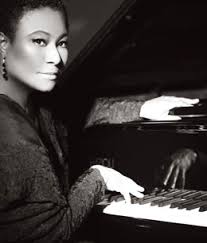 Geri Allen has been one of those artists that I’ve wanted to know more about. Now that I’ve written this article, now that I’ve done some concentrated listening, I’m realizing that I am just beginning to understand what she’s all about. The latest album is elegant and wonderful, soulful and reflective, sophisticated and consistently interesting, but my collection is now woefully incomplete. I have listened to the two predecessors in the trilogy, but I want them for my very own. The same is true for the work she did with Paul Motian and Charlie Haden, and for the work she did in 2010 with her group, Timeline.

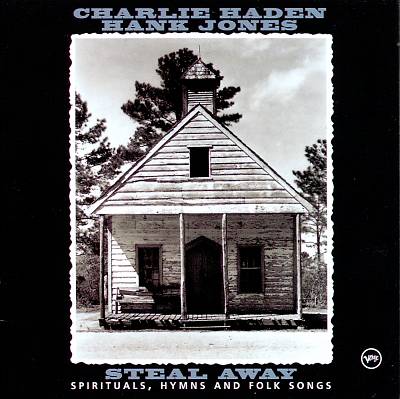
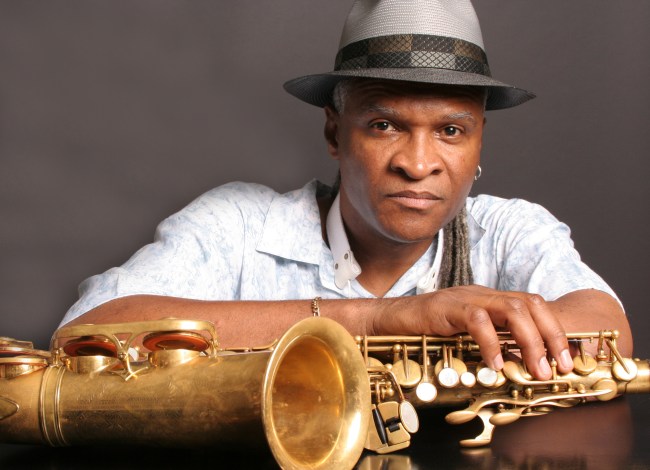
 The most ambitious track is Secrets of the Sun (Son) featuring wonderful vocal work by formidable performer, vocal arranger and composer
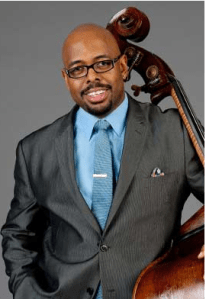 Now that I’ve written that title, let me check.
 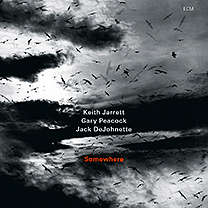 Jarrett’s work is immediately magical, glorious in its improvisation and sonic exploration. He’s been doing these albums for decades, and yet, every time I put a Jarrett CD on (or, for that matter, an LP), I’m immediately transported into the filagree of his imagination, sipping a drink at an after-hours jazz bar where the player is extraordinary and I just don’t want the evening to ever end. Recorded live at the KKL Luzern Concert Hall, the CD called Somewhere begins with the mind-bending “Deep Space,” and here, it’s Jarrett’s show with just the right additional color and light provided by double bassist Gary Peacock and drummer Jack DeJohnette; later in the track (the second part is Miles Davis’s “Solar,” their interplay moves the music into an even more interesting exploration, a testament to the extreme skill, experience and love of experimentation that these three musicians consistently offer. So that’s one track, again the first, and again, a favorite. (And I suppose I should mention that the sonic fidelity of these recordings is at such a high level, it would be difficult to imagine a disc sounding any better.) There are some favorite standards here (mine, anyway); it’s difficult for me not to be captivated by Leonard Bernstein’s “Somewhere;” and the less-often-heard “Stars Fell on Alabama” and the Jimmy van Heusen- Johnny Mercer tune, “I Thought About You.” Ooops–I’m listening to the wrong track–that’s really catchy, and less schticky than I remembered: “Between the Devil and the Deep Blue Sea”–well, a little schtick for me. Back to the dark night sky and mystery of “Stars Fell…” and my mind easily drifts to Perseids and stardust. What a lovely album.
 The old guy in the crowd–Gary Burton is 70 to Keith Jarrett’s 68–opens with a Antonio Sanchez’s rocking drum, instantly establishing a more ambitious, brighter tone for the new Guided Tour, also from Mack Avenue. This is a quartet with Burton leading as one might do with a piano. Sanchez really drives this music. It’s a bigger sound than you would typically expect from a quartet. Burton is leading an exploration not entirely different from Jarrett, but more clearly articulated, more melodic, catchier. The difference is the way that Julian Lage is playing electric guitar, almost as if he’s playing in the style of Burton and his vibes on “Jane Fonda Called Again,” never passive or receding or relaxed, but instead, aggressive and punchy. Yes, they play pretty, too, working the pastoral mood on “Jackalope,” and the Latin romance of “Helena” (especially nice guitar from Lage on this one), but it is so much more fun when these guys really go for it, with Burton playing fast and strong. Best example is probably the last track, written by drummer Sanchez, called “Monk Fish.” Scott Colley is the capable, but less showy, bassist; tough to get a word in edge-wise when the other players are clearly having so much fun. Far livelier than the other two CDs, Guided Tour is a terrific introduction to the Burton’s massive catalog.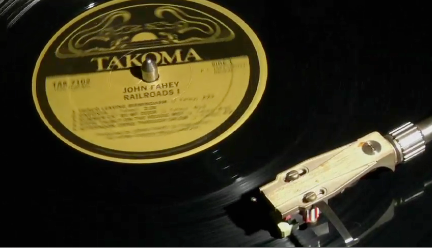



 Digital Insider