Storytelling through Maps and Timelines

Creative Commons license: Nicholas Kenrick

Bagan today. Creative Commons license: Nicholas Kenrick

In the year 1100, the largest city, by far, was Kaifeng, which was twice the size of its nearest competitor, Constantinople, three times the size of the third city on the top five list, Marrakech, which was, at the time, about the size of Kalyan and Cairo. Never heard of Kaifeng or Kalyan? If today’s Kaifeng was located in today’s United States, it would be the nation’s second largest city; in China, where it has been a significant city for a very long while, it would be in the top forty or fifty cities. Kalyan is now part of Mumbai. A hundred years later, Bagan makes the list–it’s no longer an active city, but the site is as popular in Cambodia as Angkor Wat. Add another 100 years and the first of the European cities makes the top five list: Paris. By 1492, just as Europe is waking up to the possibility of its role as a global power, there are no European cities on the list. Instead, it’s Beijing with over a half-million people in the number slot followed by Vijayanagara, Cairo, Hangzhou, and from the Americas, Tenochtitlán.

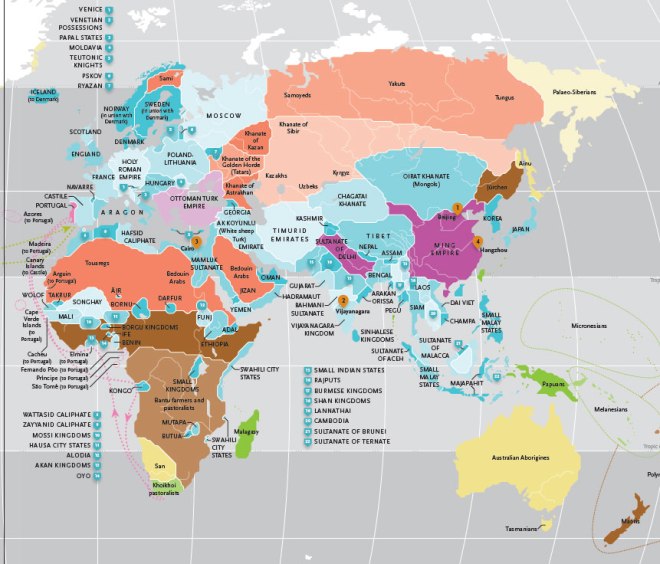
In 1492, the world map is a fascinating place filled with vaguely familiar names. A large swath of what is now Russia was then the Khanate of Siber; the Mongols are firmly in control of the large area that is now Mongolia; the only people in Australia are Aborigines; and the Caribbean and much of South America are under the control of the Arawak people (who will be killed, in large numbers, by European invaders and their diseases, the first of whom is Columbus). You’ve probably heard of Catherine of Aragon, a Henry VIII wife (remember “Divorced, beheaded, died; divorced, beheaded, survived?”–Catherine’s the one who Henry divorced, setting up a major tiff with the Pope). Anyway…Aragon occupies the eastern half of the Iberian Peninsula in 1492. The Inca are all along the Pacific side of what becomes South America, and the Mayas and the Aztecs are all over what becomes Central America and Mexico. Japan is Japan, Korea is Korea, and remarkably, Poland is a large country–actually a kind of joint project, so the place is called Poland Lithuania.

How do I know all of this? Because I’m having a blast browsing through a new combination of world atlas and history book. It’s called The New Atlas of World History: Global Events at a Glance and it’s been put together by research fellow at England’s Lancaster University named John Haywood.

NewAtlas World HistoryQuite sensibly, Mr. Haywood has produced a book whose broad horizontal pages alternate between an atlas view of the world at various intervals, and a timeline of significant events that describe that time in greater detail.

His story begins around 100,000 when ice sheets covered much of today’s Canada, all of today’s United Kingdom, and the rest of northern Europe. From the ancestral starting place in eastern Africa, homo sapiens migrate first into Asia and China, then across two land bridges, one to what becomes North America and the other (who knew?) across present-day Indonesia and the Indian Ocean across to Australia (which is how the place become populated with Aboriginal peoples). In fact, Europe was settled, or, at least, visited in large numbers, about 5,000 years after Australia. It took even longer for the people who took the now-Alaska land bridge to make their way all the down through the current United States and Mexico, eventually finding themselves in what is now South America.

Looking way ahead to, say, 1900, it’s again a fascinating map and story: there is no Poland, for example, because it has been obscured by the giant Russian Empire, and also, if I’m reading the map correctly, by the Austro-Hungarian Empire, too. On that map, Africa is a collection of colonies belonging to Belgium, Holland, Germany and other countries whose international colonization efforts were ended by a pair of wars that provided plenty of good reason to focus on life at home.

So here’s a rough look at the 1492 map of the world (click on it to see a full-screen PDF with far better detail):
Atlas_Map_Smaller

And, to accompany that layout, here’s a look at the adjacent page, this time providing a timeline view of events that mattered at the time (same story, click to see a PDF that’s easier to read):
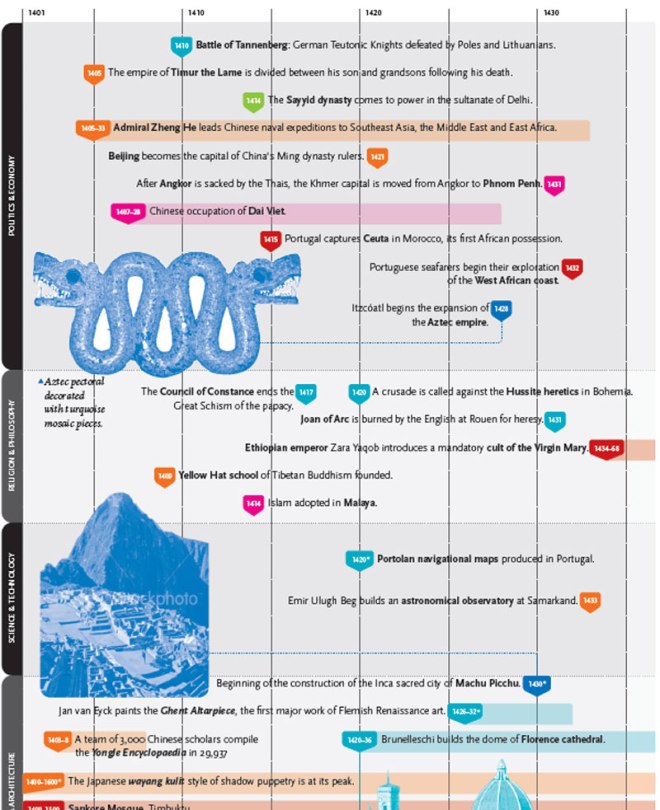
Timeline

Of course, the book offers more than just these two layouts. One of my favorites shows the migration routes to the United States, mostly from Europe, circa 1900. The same map contains the sobering stories of indentured servants leaving India for British colonies in Africa. Subsequently, a young attorney and activist named Mohandas Gandhi will understand his power by correcting the situation in South Africa (then, the Cape Colony) before returning to his native India.

So: here’s the history of the world in just over 200 pages, full-color, filled with fascinating stories told in some text, but mainly, through descriptive maps and pictures. It’s a thoroughly modern way to tell our story, and, as you might imagine, it has become a favorite. You’ll get some flavor of the work’s value by clicking on some the links on the book’s catalog page, but there’s really nothing quite like having the whole of it in front of you on a hot Sunday afternoon in the cool shade, preferably with an equally cool drink from some far-off land close at hand.
Big History

After admitting that we cannot yet answer the  obvious–and seemingly unanswerable–question about how and why everything   began, University of Sydney Professor David Christian begins with the creation of the universe about 13 billion years ago. It’s not every historian who would admit, simply:

About the beginning, we can say nothing with any certainty except that something happened.”

He continues explaining this madness: “We do not know why or how it appeared. We cannot say whether anything existed before. We cannot even say that there was a ‘before’ or a ‘space’ for anything to exist in (in an argument anticipated by St. Augustine in the fifth century CE) time and spare may have been created at the same time as matter and energy.”

After that, the big news is not so much the Big Bang Theory (explained here in detail that can be easily understood), but the shift to a neutral electrical charge, enabling the creation of atoms, first simply (mostly, hydrogen and helium atoms), then, in increasingly complicated ways. I like this quote:

Hydrogen is a light, odorless gas which, given enough time, changes into people.”

Leaping ahead, the sun and the planets show up around 4.56 billion years ago, and, helpfully, Professor Christian helps us to understand an earth bombarded by small planetesimals (excellent word, new to me) and without much atmosphere.

The early earth would indeed have seemed like a hellish place to humans.”

As the mix of gases shifted from methane and hydrogen sulfide to carbon dioxide, the early atmosphere would have appeared red–that is, the sky would have seemed to be red, not blue. The blue sky came about because the new oceans–made possible by a drop in temperatures below 100 degrees celsius–allowed oceans to form, and those oceans absorbed much of the CO2.

How about the question of the beginning of life on earth? Again, Christian offers a coherent answer:

Living organisms are constructed, for the most part, from compounds of hydrogen and carbon. Carbon is critical because of its astonishing flexibility. Add hydrogen, nitrogen, oxygen, phosphorous, and sulfur, and we can account for 99 percent of the dry weight of all organisms. It turns out that when conditions are right and these chemicals are abundant, it is easy to construct simple organic molecules, including amino acids (the building blocks of proteins, the basic structural material of all organisms) and nucleotides (the building blocks of genetic code).”

Of course, it’s one thing to assemble the building blocks and another to assemble these parts into a wooly mammoth, or even an amoeba. Christian admits that this is the tricky part: complexity is the appropriate term that causes contemporary scientists to scratch their heads and wonder. The pieces seem to be there, but the complexity of their union and the spark of life may not be so simple.

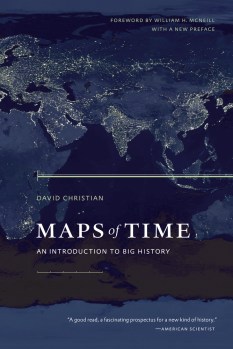
Maps of Time

Book: Maps of Time: An Introduction to Big History by David Christian

Sure, multi-cell animals are interesting footnotes, but really, isn’t history all about us? Not exactly, not according to the good professor. Turns out, we are just one of many species, and in the scheme of big history, humans are a kind of, well, a kind of weed. We just keep growing, taking everything over, killing off other species, treating the whole earth as our own private amusement park. Within our lifetimes, there will be 10 billion humans on earth, an astonishing increase given that there were, in 1800, just a billion of us. Every dozen or so years, we add another billion or so.

As humans began to migrate into Europe and Asia from their original home in Africa, large animals became extinct because we hunted them down, ate them, used their hides for clothing, used their bones for tools. Giant sloths in the Americas, giant wombats and kangaroos in Australia, mammoths in Siberia. We killed them faster than they could reproduce, and so, they’re gone.

So what makes us so special? Is it really all about thumbs? Sure, thumbs make a difference, but it’s something else entirely. Professor Christian uses the term “collective learning” to describe our “pooling and sharing of knowledge…the types of knowledge that, over time, have given humans their unique power to manipulate the material world. Two factors stand out: the volume and variety of information being pooled, and the efficiency and speed with which information is shared.” Here, he’s not referring to the digital age, but the era before we developed any meaningful form of writing, drawing, or communicating with anything resembling a modern language.

By now, we’re about halfway through the book. Next will come the domestication of animals–in which humans figure out that an animal that is killed for its meat is useful only in the short-term, but an animal that is kept alive for its milk is useful in the long-term. This concept of domestication applies not only to meat/milk animals, but to others whose wool, or other production, can be used not only to satisfy basics needs, but also for exchange to other humans. In time, it’s the idea of exchange that becomes the driver, resulting first in local trade between tiny settlements, then trade routes as fewer people are tied to subsistence farming or hunting/gathering and more are available (typically, more men are available) for pursuits involving trade, travel, and, in time, the accumulation of wealth.

Along the way, humans attempt to understand how and why their world works. Since the ground, the soil, the earth provides the food we eat, we begin to explain the world in terms of an earth spirit. Similarly, the sky seems to contain the origins, the mystical, the unknowable, and so, this, too, becomes a kind of spirit. In time–and mostly within a period of just a few thousand years, mostly in southwestern Asia–we gather these beliefs in the form of religions.

As we, as contemporary, educated humans with every conceivable benefit, attempt to understand our world, and its big history (now a common term combining history and science, by the way), Professor Christian readily admits to what he has done. He has wrapped our beliefs, our knowledge, our stories into what calls “a modern creation myth.”

You Know, A Lot Can Happen In A Century

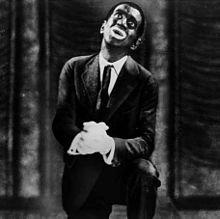
In his time, Al Jolson was a superstar. We've managed to get past the need for blackface, and although it keeps changing, showbiz marches on.

In his time, Al Jolson was a superstar. Thankfully, we’ve managed to get past the need for blackface. Show business keeps changing, adapting to times and tastes. And until recently, there was one place to read about these changes, day after day, year after year. Now, that’s changing, too. How? Read on. (You ain’t heard nothin’ yet!)

Today, we’re digital. We live in modern times. These times, we believe, are so new, so unique, that they have no historical precedent. The mythology is tempting, but that’s because the history is just beyond the edge of our ken. We focus on the new. We forget what happened before. Until, of course, we’re reminded of our history as the result of a really good documentary, or a really good book.

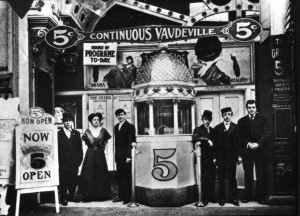
vaudeville theatre

A hundred years ago, minstrel shows were just beginning to lose their luster, but it was unclear whether theater audiences would eventually prefer skating rinks, a vaudeville industry based upon national tours (new, in 1906), or bawdy burlesque as a the most popular ways to spend leisure time. Movies were just starting out with an industry of tiny, dubious start-ups and few places where they could be seen by anyone. Live theater was the popular entertainment; actors traveled from one city to another to perform in popular plays, just as they had since the time of John Wilkes Booth. It was a confusing time… The Great War was just beginning and the large theater lobbies were as useful as recruiting stations as they were for pre-performance gatherings. After the war, everything seemed to coalesce. Charlie Chaplin, who had debuted in a US theater in 1910, was sufficiently powerful by 1918 to join forces with movie stars Douglas Fairbanks, Mary Pickford, and director D.W. Griffith to form United Artists. Then as now, everything happened quickly.

Prior to the 1920s, just about all entertainment was live. The movies were beginning to change that, and as the decade began, a new idea called radio was began as a kind of experiment, it’s post-military use future not yet clear. The year 1920 was one of vaudeville’s best ever. By 1925, radio was becoming popular, but its business model was entirely unclear. From a July 1925 article:

the broadcasters and radio manufacturers continue to tell Department of Commerce officials that no broadcasting station in the country is making money.

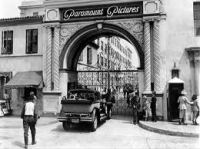
Paramount theaterParamount studioBy 1930, 40 percent of US households owned a radio, and by 1940, radio’s penetration was more than 80 percent. By 1930, there was a bona fide motion picture industry with large studios (Fox, Paramount, Loew’s/MGM, RKO and Warner), each with an elaborate distribution network of theaters throughout the country and a distribution infrastructure to service the nation and parts of the world. At the same time, the new NBC and its lesser rival CBS had built a similar structure for radio broadcasting. This structure supported the next level of development: a star system. Lon Chaney, Al Jolson, Fatty Arbuckle, Theda Bara, Duke Ellington, James Cagney, Fred and Adele Astaire, so many others became household names.
The industry grew. There were cartoons from Warner Bros, and Disney, comedy shorts from Hal Roach (Our Gang, Laurel and Hardy), child stars including Shirley Temple, and within a decade, major long-term successes including Gone with the Wind and The Wizard of Oz. There was Mussolini, Hitler, FDR, the Roaring Twenties followed by the Great Depression.

Variety bookVariety covered it all. This small, speciality newspaper, a trade rag, was always at the center of it all. When anything happened in or near show biz, Variety told the world. Everybody in “the business” read it, and to be mentioned in it was a clear indication of career success (I was in it, at lease once, and I still have the clipping).

This week, Variety announced that it would cease publishing its daily edition (the weekly remains in print, at least for the foreseeable future). This is not simply a cost cutting measure. Variety, once the trendiest of publications, has been badly beaten in the online entertainment journalism game, and some industry insiders question its survival as a 21st century brand.

Given its illustrious past, I suspect Variety has more fight in it than pundits allow. If you have any doubt, you must spend some time with a book about Variety’s history published by Rizzoli in a tidy coffee table format. The book is entitled Variety: An Illustrated History of the World from the Modt Important Magazine in Hollywood. The last headline in this volume: “Comcast buys 51% of NBC Universal.” I think it’s interesting to note that neither Comcast nor NBC nor Universal existed when Variety’s story began, and even more interesting to consider just how much has happened over the span of a single century. (Parallels with today’s innovative world are particularly fascinating).

Okay, why not? Here’s one of my favorite Variety headlines. This one was on the front page on July 12, 1950:

VIDEO NOW VAUDE’S VILLAIN
Acts and Agents Fear TV Inroads

Can’t help but wonder about a headline that could be written for July, 2050:

WEB, VID DEAD
TV and internet replaced by…

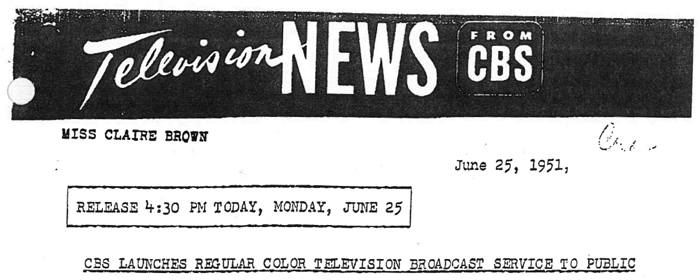
FROM: Miss Claire Brown, 6/25/1951……RE: Color TV

History marked time for one memorable hour today, and within its span, the promise of the greatest of all the miracles of mass communication became a reality.

At 4:30 PM, Eastern Daylight Time, color television’s triumphal entry into the public domain was emblazoned officiallyacross the log of man’s progress. In the 60 minutes that followed, this newest ,miracle among the electronic marvels was born.

Premiere, the Columbia Broadcasting System’s widely heralded full hour of star-studded entertainment, featuring Arthur Godfrey, Ed Sullivan, Faye Emerson, Garry Moore, Sam Levenson, Patty Painter, Robert Alda and Isabel Bigley, the New York City Ballet, the Bil Baird Marionettes, and Archie Bleyer’s Orchestra, took its place in history as the first commercial color television broadcast to the public. Brief addresses by Wayne Coy, Chairman of the Federal Communications Commission, William S. Paley, Board Chairman of the Columbia Broadcasting System; and CBS President Frank Stanton signalized, in a dedicatory vein, the start of regular color television broadcast service to the public by the CBS-TV Network.

The history-making broadcast was carried in New York by WCBS-TV, as well as by CBS-TV Network stations in Boston, Philadelphia, Baltimore and Washington, D.C., the color signals going out over the stations’ regular transmitters and on their regular channels.

Originating in CBS-TV’s Studio 57, at 109th Street and Fifth Avenue, New York, the color program was transmitted from Studio 57 by coaxial cable to CBS-TV’s Master Control in the Grand Central Building, New York, and carried from there by telephone cables to the WCBS-TV transmitter and by cable to the network. Thousands of the public, as wellas public and industry leaders and members of the press, saw the color inaugural in the five cities carrying Premiere. Many of the public who had completed home made conversions of their black-and-white sets also wereable to see the historic broadcast in color in their homes. Typical were the two junior high school youngsters in Newark who last week revealed they had been watching CBS color television transmissions for the past 18 months.

In New York, Mrs. Eleanor Roosevelt and Bernard Baruch were among the dignitaries and newspapermen who watched the inaugural on color receivers installed at CBS headquarters. There were also several showings in New York by dealers who are making color television eqUipment which they soon will have ready for the public. Among these were Colortone Inc., which had more than 400 dealers watching the inaugural on sets installed in its downtown headquarters, and Muntz-TV, which showed its new companion-piece in action to the public at its Queens headquarters.

In Boston, the public watched the program on a receiver set up in the Jordan Marsh Department Store, first store in the country to order color television equipment florstore use; Boston public leaders the press viewed the broadcast on CBS-Columbia sets installed in the Hotel Somerset’s Grand Ballroom.

The Philadelphia public saw the color show on a set installed in the lobby of WCAU, CBS affiliate, with clients, public leaders are press watching the program on another color set in the WCAU Auditorium. Baltimoreans viewed the show on sets installed by WMAR-TV in the lobbies of the new Sun Building and the old Sun Building. In Washington, D. C., WTOP-TV had sets in the Warner Building and at its transmitter at 40th and Brandwyne. In addition top government officials viewed the color inaugural on a set in the Hotel Carleton.

The Premiere broadcast was a breathtaking spectacle. His famous red hair and freckles lent an added brilliance to the wit and charm ofArthur Godfrey as he sang and quipped; a  bronzed Ed Sullivan greeted a new audience in a. setting vibrant with full, natural color; Faye Emerson was hostess. On still another stage that brought to viewers all the richness of paintings from the Metropolitan Museum of Art and ·the Museum of Modern Art; and members or the New York City Ballet “were ecstatically colorful in Maurice Ravel’s “La Valse,” staged by Sol Hurok with choreography especially for television by George Balanchine.

“Photo Credit: Ralph Morse / Time & Life Pictures / Getty Images”
“Licensed by Getty Images to Ed Reitan” – (photographed off the screen)
George Balanchine Ballet from “Premiere”
The first commercial CBS Color Television System Colorcast
June 25, 1951

Garry Moore and Sam Levenson added a note of comedy mixed with philosophy, against a setting as vivid as their artistry; Robert Alda and Isabel Bigley of the smash Broadway musical Guys and Dolls sang a duet; the Bil Baird Marionettes cavorted in a riot of hues; and “Miss Color Television” herself, Patty Painter, a. veteran of more than 1,000 CBS color demonstrations and transmissions, brought to life the full, rich, rich colors of the commercial products introduced by the new medium’s pioneer advertisers.

Sixteen national advertisers participated in the epoch-making inaugural, constituting what is believed to be the largest such group ever to sponsor collectively a single network broadcast. The pioneering advertisers were General Mills, Lincoln-Mercury Division of the Ford Motor Company, Longines-Wittnauer Watch Company Inc., Pabst Blue Ribbon Beer, William Wrigley Jr. Company, Revlon,Thomas J. Lipton Inc” National Biscuit Company, Toni Home Permanent, Monarch Finer Foods, Procter &Gamble Company, Standard Brands Inc., Quaker Oats Company, Best Foods Inc., Pepsi-Cola Company and Liggett & Myers Tobacco Company.

Fred Rickey, executive producer for color at CBS, produced Premiere and shared directorial duties with Frances Buss, under the over-all supervision of Jerry Danzig, CBS color program supervisor. Set designers were Paul Sylbert and Michael Baronoff.

The launching of CBS’ regular color television broadcast service to the public was accomplished merely by the addition of the three color cameras, plus monitors and associated control room equipment, to black-and-white studio facilities already existing before the inaugural program in Studio 57, which was chosen for the color broadcast simply because it had suitable time availabilities.

So effortless was the inauguration or regular color television service that the necessary technical work and installations in the studio were made in a 12hour period, between 10:00 PM last Wednesday, and 10:00 AM, the following morning, when rehearsals for the first commercial color telecast started.

A cue, thrown this afternoon from the control room of CBS·TV’s Studio 57 to technical personnel on the studio flooritself, opened the color Premiere. A still life picture of an orchid and a book was transmitted to waiting thousands, and the curtain was raised on history’s first commercial color television broadcast.

Today’s inaugural broadcast, establishing regular color television service to the public by CBS-TV, will be followed by daily morning and afternoon network-programs, commercial and sustaining, beginning tomorrow. A pattern of gradual expansion will be carried out, with a color schedule of approximately 20 hours a week expected by fall.

First of the regularly scheduled color programs, which will have its premiere tomorrow (Tuesday, June 26), is titled The World Is Yours! and features Ivan T. Sanderson, noted naturalist. The five-times-weekly show (CBS.Color TV, 4:30-5::OO PM, EDT. Mon. thru Fri.), “starring the earth’s natural treasures,” will be sponsored in its initial telecast by General Mills. Frances Buss will direct the CBS production, in cooperation with Ivan Sanderson Productions Inc. The World Is Yours! will present the wonders of the animal, vegetable and mineral worlds as “a sort of intellectual vaudeville show, informal in manner and functioning without benefit of script, featuring Ivan Sanderson and his “friends, II who comprise a bewildering array of nature’s creatures, including distinguished representatives of the human species. A frequent Visitor and featured participant will be Patty Painter, “Miss Color Television.”

Second or the regularly scheduled color programs, Modern Homemakers,” will make its bow before the color television audience, as a five-a-week series, on Wed., June 22 (CBS-Color.TV, 10:30-11 AM, EDT Mon. thru Fri,).

A cookery and homemaking program conducted by culinary expert Edalene Stohr, Modern Homemakers will specialize in menu-planning, food preparation, and demonstrating the eye-appeal of well-prepared foods, with emphasis on other facets of homemaking as well.

Opening of regular color broadcasting acted as an additional spur to the public to order color equipment from television dealers. Manufacturers or color TV adapters and converters reported they are receiving thousands of calls for such equipment. Typical was Arnold H. Klein, Vice President of Colortone Inc., who said his company was turning its full facilities over to the production of adapters, and that he expected to have 3,000 units in the hands of distributors by the weekend. He said he had received calls for more than 5,000 sample units from leading department stores and distributors from all over the country.

More info. A complete rundown on color TV’s early history. And, a review.

Food: The Meta-layer

Past few months, everybody’s talking about the meta-layer. We don’t just watch TV. We add a meta-layer, tweeting about the Academy Awards, commenting on comments–ideas piled on ideas. We’re learning to comment on everything, with or without the requisite knowledge of the facts involved, rarely with the research needed to form a coherent opinion.

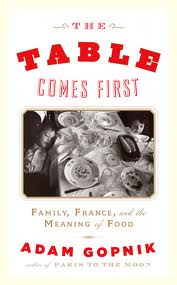
Not so with Mr. Gopnik, whose past stories about his young family’s life in Paris (Paris to the Moon) and their return to Manhattan (Through the Children’s Gate) are among my most-recommended books, and whose 2011 book, The Table Comes First: Family, France, and the Meaning of Food has provided several months of nourishing food for thought, or thoughts about food, probably some of each.

Where did restaurants come from? Who came up with the idea of not just eating outside the home, but dining there? (Long answer, begins around the French revolution). Quite rightly, he compares the restaurant customer to an aristocrat, accustomed to being served (and served beautifully). Gopnik delights in grazing through the thoughts of Brillat-Savarin and Grimod–two early, influential writers about food and dining–but I like the bit that he found in Robert Frost best:

“Home is a place where, when you have to go there, they have to take you in. A restaurant is a place where, when you go there, they not only have to take you in but act as though they were glad to see you. In cities of strangers, this pretense can be very dear.”

This is a book in which New Yorker writer Adam Gopnik thinks about food, and thinks about how others think, and have thought, about food. He goes deep, with some chapters so mired in philosophy or history that they eventually become indigestible. Fortunately, these are exceptions. And when the going becomes thick, he pauses for to write an email to Elizabeth Pennell, who wrote with intelligence and wisdom about food about a century ago; these chatty emails cover the true benefits of cinnamon, the best ways to cook lamb, the extraordinary use of hot air in the hard-to-find and hard-to-cook pommel soufflés, his dog Butterscotch’s love for steak, and other lighthearted stuff.

Adam Gopnik is a regular contributor to The New Yorker.

This is not a book to read over a single meal. It is, instead, book to be savored, bit by bit, over several months. There is simply too much information, too many glimpses and meta ideas, too much richness and provocation and serious research, to be enjoyed quickly. It is slow food for the brain–imagine that, in an era of emails and tweets–much of it about topics I’ve never really thought much about.

For example, Gopnik compares “cook it at home” recipe books that restaurants sell with the home game version of, say, Hollywood Squares. Certainly, there is a resemblance, but the resources and the spicing are entirely different, and so is the experience. He tells a long and funny/odd story about his search for a live chicken that can be purchased, cooked, and eaten within the bounds of New York City, and another about the cleverness of farming tilapia to feed large urban populations, then adds the zesty meta-layer, invoking Adam Smith and the total cost associated with what he believes to be a current fad for localism. And so:

“If Kenyan greens take less total energy than Plattsburgh tomatoes, then we should revel in them no matter how far they have to travel.”

And so it goes, through questions about whether we really can taste the differences between wines (or whether the situation and the artifice overpower the actual human capacity for taste), the imperfection of memory as it applies to the fancy French restaurants of 20th century Manhattan, why sugar was used mostly to flavor tea in England but became the impetus for the pasty industry in France, the various ethical arguments for and against the slaughter of animals for human consumption, and so much more.

As with his own food choices–today, spicy beans and rice, tomorrow, a complicated and challenging attempt at a classic French dish from a century ago–some sections are rich with friendly storytelling and some are thick with pretense, serious thinking, and historical reconsiderations. Unlike Twitter, you need not absorb every idea in an instant. There is time enough to consider the meta-layer, to appreciate the fine writing that has long been Gopnik’s strong suit, time enough to think about what Gopnik has said about what others have said and done, and perchance, to learn something about their ideas by reading Brillat-Savarin in the original (on my list, but not for this year).