
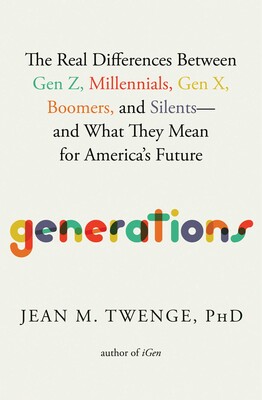
According to the charts and analysis in Jean W. Twenge’s new book, Generations, some disturbing patterns are emerging. In this case, we seems to be the children and teenagers, our offspring, the people who will manage peace and prosperity as they engage in human progress. Perhaps “will” is an unreasonable term because, in many ways, that progress has already begun.
There has been a precipitous drop in 12th graders who attend religious services once a week or more. For many years, until around 2015, the percentage hovered around 60 percent. Today, it’s about 30 percent. Anyway, that’s the trend for Black Americans. It’s worse for White Americans (gee, I hate these terms, but that’s another story). The drop among White Americans has been more-or-less steady since 1982 or so, with a brief bump around 2000, but just for a while. Pretty much, there’s half as much interest as there was before. Certainly, religion is not a perfect solution to sense of self and community engagement, but it’s an indicator, and it’s not heading in a healthy direction. Among people 18-25 in the U.S., belief in God has dropped from about 85 percent in the early 1970s down to about 55 percent today. No problem if religion has been replaced by an equally distinguished philosophical basis for life. However, if we just drop the idea altogether, then we don’t think much about ethnics, or beyond ourselves, outside of the often-self-serving political arena. One hopes there is more to life than that.
Next institution: government. Back in 2000 or so, about 25 percent of U.S. adults were dissatisfied with government. Today, about 70 percent are dissatisfied. Big change, and that’s across the whole adult population, not just the younger ones.
Twelfth-grade boys have become far more politically conservative — in the late 1970s, conservative applied to about 40 percent of boys, and now, it’s up to over 60 percent. At the same time, girls start in the early 170s at about 35 percent, and they’re now DOWN to about 30 percent. So, we’ve got a lot more conservative males and a lot fewer conservative females growing up.
Comparing U.S. children, ages 2-5, from 2010 to 2019, less than 10 percent were physically active less than four days a week in 2010, but the number is now 18 percent — a big change in just a decade. The situation is worse for kids 6-11 — in 2012, it was 14 percent and now it’s 28 percent.
Some good news — in 1959, about 28 percent of children lived in poverty, and that number has been cut in half. Unfortunately, adults have not fared as well — 18 percent in 1959 compared with 10 percent today (so, a cut of 1/3).
There are many more lonely 15 year olds today than there were in 2000 or so — about 10 percent then, and about 35 percent now. Many more 15-25 year olds are unhappy now (about 20 percent) than there were in about 2005 (less than 5 percent).
Far fewer people who are 20-24 years old are getting married in the U.S. — nearly 70 percent of females were married around 1970, down to about 15 percent today. Good reasons why, certainly. As for men, it’s 45 percent down to 8 percent.
It may not be surprising to learn that the percentage of high school students identifying as lesbian gay or bisexual has been steadily increasing. In 9th, 10th, 11th and 12 grades, the 2015 figures looked like about 8 or 9 percent, then, and about 14 or 15 percent now. Soon, those numbers will approach 1 in 5 high school students. This seems to be true in both red and blue states.
These are among the biggest changes I found in Twenge’s new book. What do they mean? More independent decision-making among young people. Less reliance upon institutions. Less support for decisions that diverge from older established ways. Good reasons for fear that the world is, indeed, changing — and veering away from tradition. The book looks at each generation alive today, and considers the changes each group has experienced.
Trying to frame clear, concise, straightforward opinions based on the information in this book is very hard to do because, in the end, everyone is so different from one another. It’s become difficult to make blanket statements about any generation — and this may have always been true. Still, reviewing the many graphs and explanations in this book is provocative, good stuff for deeper thought, challenging assumptions, and changing one’s mind about long-held beliefs. It’s a good read, and because so much of the real estate is filled with graphs (lots and lots of them), it’s a book that reads fairly quickly, but this does not diminish the book’s value.


 Digital Insider