Just So We Don’t Forget…

Living in the Mechanical World

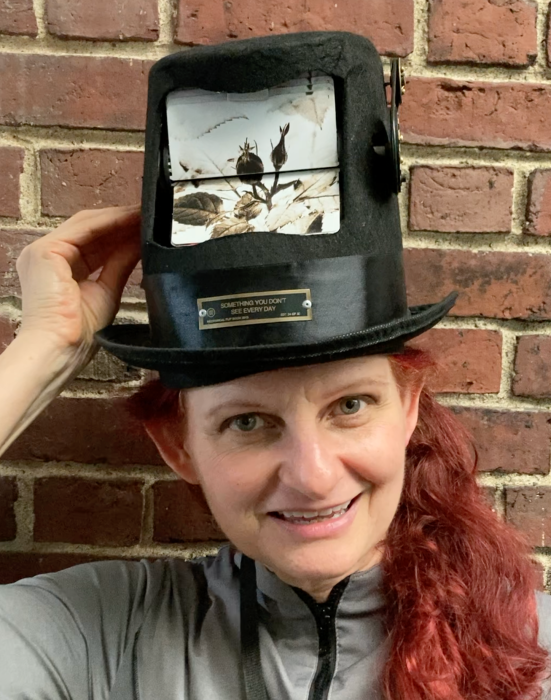
Wendy is walking around in top hat. The hat contains a window. Inside the window, there is a rosebud. During our brief conversation, the rosebud blooms into a full-sized red rose. With her partner, Mark, they have found a niche, making very clever flip books that capture the heart and the imagination. At their display table at the recent Automatoncon, an animal travels from one flip to another and another, employing mechanics and images printed on paper to bring ideas to life. In fact, anybody can do it — they sell a popular D-I-Y Flip-o-Scope that allows children, parents, and creative souls to animate images, and bring them to life.

That’s the whole point of automatons — you may recall the automaton in the center of the HUGO movie directed by Martin Scorsese, which was based upon the delightful picture book, The Invention of Hugo Cabret, by Brian Selznick — to simulate life through mechanical means. Every two years, AutomataCon provides a gathering place for wonderfully creative souls to compare notes, talk tech (which, in their world, is not digital), and show off their latest work. Significantly, the event is held at the small Morris Museum in Morristown, New Jersey, which houses one of the world’s largest collections of Murtogh D. Guinness Collection of historic mechanical musical instruments and automata. Mr. Guinness, of the famed brewing family, was a collector so serious about his prized assets, he built a building for the Morris Museum in exchange for a promise to keep the collect intact, alive, and productive.

Part of the promised outreach effort is AutomataCon, which brings, for example, Cecilia Schiller from her workshop in Northern Wisconsin to northern New Jersey. Cecelia’s long history in puppetry, theater special effects, and exhibits (such as a magical Christmas display, held annually in St. Paul, Minnesota’s Macy’s Department Store).

A puppet simulates life with the help of a talented human operator, but Cecilia’s sense of story takes her further with a full-scale puppet show that includes several children, puppets in a Punch and Judy stage, an puppet operator controlling those two puppets, and a colorful assembly of gears and operators down below the stage. All of it is control with a crank. It is magnificent. The images below provide some sense of what it does and how it works.

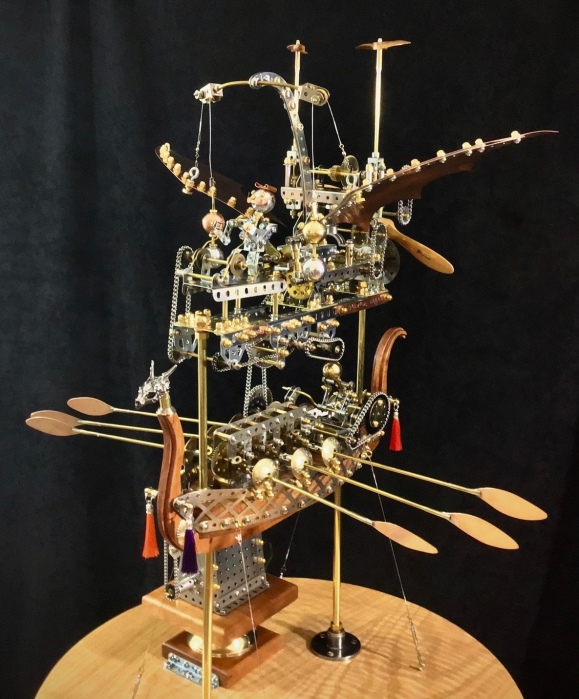
Dave Bowman discovered automata by visiting the Morris Museum. That was eleven years ago. Now, he makes magnificent metal automata of his own. We begins with Meccano parts — similar to an Erector set — but he uses only older sets because the steel girders are better for his purposes, and because the gears are brass-plated. Two recent favorites: a viking ship and a large bird, each with its own elaborate back story. He does not plan the creations. Instead, he engages in a long conversation with the imaginary beings. “You bond with them. You spend so much time creating them.” As with puppetry, the line between reality and fantasy can become blurry.

And yes, that is a real animal skull that forms the head. And, below, the made-up history is worth reading.

Of course, there is much more to discover. More artists whose work mimics real life. If you haven’t seen the movie HUGO, that’s a good place to start. And if you’re curious about AutomataCon, be sure to visit their website.

Goodbye Charlie

test

Several days after his passing, bassist Charlie Haden’s website hasn’t heard the news. But I know. And a few minutes before midnight during the week after his death, I feel it in my heart. I suppose the sense of loss struck me when I listened to the first track of one of my two favorite Haden CDs. The track is a spare version of “Here’s Looking at You” from an album celebrating the songs of the 1940s, in contemporary settings. I especially like the track because it opens the album with lush strings, the simplicity of Ernie Watts’ plaintive, lovely, long tenor sax reaching from the past, nostalgic, perhaps the best thing that Haden and Quartet West recorded. Alan Broadbent, the pianist who arranged the strings, is every bit as lovely for his solo. And there’s Haden, subtle but always there, just enough bass for me to follow his line as Watts comes in for his second theme. Not quite visible, but always a presence.

Haden recorded in a lot of settings, but I think I liked him best when he played an album of spirituals with Hank Jones. Just the two fo them, sounding as if they’re in an old church in South Carolina or Mississippi instead of Radio Canada’s Studio B in Montreal. “Steal Away” is an album of “spirituals, hymns and folk songs.” It’s one of my very favorite albums, and after , their work together on “We Shall Overcome” gets me every time.

From the liner notes: “They were called ‘Sorrow Songs’ because ‘they tell of death, suffering and an unvoiced longing toward a truer world, of misty wanderings and hidden ways…” yet (W.E.B.) DuBois…knew that ‘through all of the sorrow of the Sorrow Songs there breathes a hope, a faith in the ultimate justice of things. The minor cadences of despair change often to triumph and calm confidence.”

I listen to “I’ve Got a Robe, You Got a Robe (Goin’ to Shout All Over Heav’n)” and I find comfort in the music that Haden and Jones made twenty years ago. I listen to “Steal Away” and I hear the soul of a good man, a provocative artist whose range of experimentation spanned so many forms, a family man who carried a show business tradition, someone who made me think and gave me pleasure.

I hope you will be inspired to listen, first in a quiet room to the whole “Steal Away” CD, then to the joy-filled “Now is the Hour” by Haden and Quartet West.

Finishing up the article, I wandered over to the website. And I smiled. Two reasons why. First, it caused me to remember the dozen or so Haden CDs that are sitting on my shelves, and I want to listen to them all, again. Second, I realized that there were at least a dozen more CDs that I’ve never bought, never heard. So there’s more of Charlie Haden for me to discover. And that makes me very happy.

MI0000071308


In a Word, “Curious”

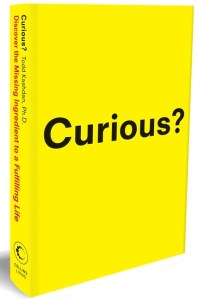
CuriousWhat’s the secret of life? Of course, the answer is in a book with a single word title, Curious? The back cover has nine words, 58 characters: “Embrace uncertainty. Attract love and abundance. Master your life.”

All of this makes me want to write an answer book called “Seriously?” but the author, a clinical psychologist and professor at George Mason University deserves more than the Twtr-obessed publisher allows. His name is Todd Kashdan, and although I suspect curiosity may not be, as the subtitle promises, a way to “Discover the Missing Ingredient to a Fulfilling Life” (shouldn’t that “to” be “in” or “for”?), there’s too much good stuff in this book for me to pass it by.

Mostly, like every creative person, I’m curious about curiosity. I seem to have it in larger doses than most people, and I think I like that about myself. My friends tend to be curious, too, and they tend to value this in themselves. In fact, I enjoyed a long telephone conversation with a friend not six months ago on this very subject—he was analyzing generational differences in the workplace, and thought our generation pursued curiosity with greater energy than the current one.

Of course, Dr. Kashdan touches  school as curiosity-killer (“Do it now, ask questions later. Stay away from strangers. Avoid controversial topics and hot-button issues”), but I think he’s better when he’s positive, and consistent with the thinking of the positive psychology movement in academia, where he plays a part. When describing how and why “Curiosity is about recognizing and reaping the rewards of the uncertain, the unknown and the new…,” he explains that there is a “simple story line for how curiosity is the engine of growth.”

By being curious, we explore.

By exploring, we discover.

When this is satisfying, we are more likely to repeat it.

By repeating it, we develop competence and mastery.

By developing competence and mastery, our knowledge and skills grow.

As our knowledge and skills grow, we stretch who we are and what our life is about.

So “curiosity begets more curiosity.” Fair enough. But that’s just the starting place. When he offers curiosity as the opposite of certainty, and broadens the argument to society’s need for closure, specific answers, one way of looking at the world, his arguments become insights:

Curiosity creates possibilities; the need for certainty narrows them.

Curiosity creates energy; the need for certainty depletes.

Curiosity results in exploration; the need for certainty creates closure.

Curiosity creates movement; the need for certainty is about replaying events.

Curiosity creates relationships; the need for certainty creates defensiveness.

Creativity is about discovery; the need for certainty is about being right.

At first, I didn’t think much of this list, but the more I worked on a new project about knowledge and understanding, the more I realized the value of Dr. Kashdan’s insights.

Photo of the author, Todd Kashdan, by Adam Auel

It’s easy to see how this material can be brought into a wider domain: curiosity results in personal fulfillment, happiness, a healthy mental outlook, a purpose to life, and so on. He encourages openness in the style of so many self-help books, and here’s where my fascination begins to wane, mostly because I’ve read it all before: “When walking outside the house, I will gently guide my attention so I can be intrigued by every bodily movement and whatever sights, sounds and smells are within my range.” I don’t understand why anybody who is taking a walk would fill their ears with music, but that’s because I enjoy listening to the natural world. Does experience open my mind to every possibility? Not sure. I think I’m listening to birdsong, looking at autumn leaves and winter branches, and taking whiffs of honeysuckle when it’s in season. That’s enough for me.

If you find self-help books useful, you might add this one to your library. There are chapters about “The Rewards of Relationships” and “The Anxious Mind and the Curious Spirit,” and, almost inevitably, “Discovering Meaning and Purpose in Life.”

I think curiosity is powerful on its own terms: as an antidote to the routine, a door that opens to creative and divergent thought, as a pathway to learning lots of things. Secret of life? Maybe. I’ll leave that one up to you.

Watercolor Artist Mark Stewart

Mark Stewart - Pink Dress GirlEvery once in a while, I’ll find an artist on the web whose work I truly admire. I recently stumbled upon a Texas watercolorist named Mark Stewart, and I thought you might enjoy seeing some of his work. Of course, there’s no reason why you should read any of what I have to say… just go directly to his gallery pages and see for yourself.

At this level of excellence, artists are one-of-a-kind, but stylistic comparisons with other artists are part of the viewing experience. Somewhere between the watercolors of Andrew Wyeth and the southern portraiture of Mary Whyte (the subject of an upcoming article; watch this space), I find pleasure in the simplicity and near-realism of Stewart’s fine work.

Mark Stewart farmhouse

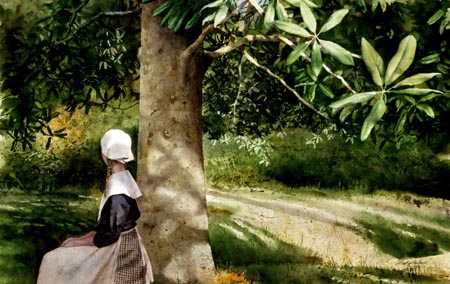
Here’s a painting called Colonial Day. Bear in mind that these are watercolor paintings–a medium notorious for its free-flowing, mind-of-its-own paint. What I suppose I like best here: the artist’s willingness to combine go-with-the-flow with an extreme level of precision and control. If you’ve looked twice and wondered whether you are, in fact, seeing a photograph, look more closely as the drape of her skirt, the green patch on the right side of the road, and you’ll find yourself in a watercolor-photographic dreamland. The artist is in control of your imagination. As life should be.

10014_450

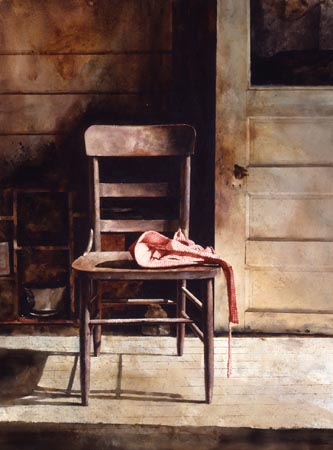
One more simple pleasure: a still life that seems to want to tell its full and detailed story. It’s called Bonnet Chair.

Bonnet Chair

So who is this man? He’s a working artist, one of perhaps a few thousand who can claim that distinction within the specialized world of watercolors. He makes his living by selling paintings, greeting cards, prints, and books–just like so many other artists who find their own way. For those who wish to dig deeper, he and his wife Sue enjoy writing about their lives, his process, his art, her feelings, and more. They do in book form (read it online), and also as a kind of ongoing dialogue. The conversations and interactions add texture to the visuals, but in the end, it’s the visuals that are so very compelling because they are so plain and so elegant. Here’s another, but I do hope you will visit the site and browse the gallery, and perhaps, support the artist as well.

Mark Stewart Flag

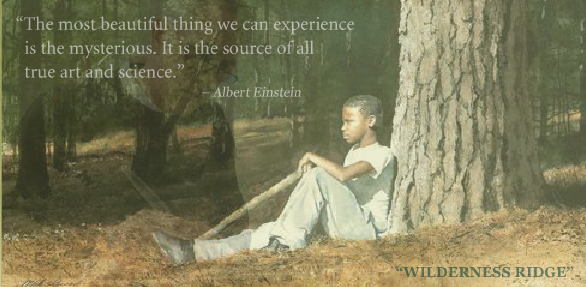
One final note: I started a meeting today with a favorite quote (which appears in many different forms) from Albert Einstein:

The most beautiful experience we can have is the mysterious–the fundamental emotion which stands at the cradle of true art and true science.”

I’m writing this blog article at the very end of the day, just before bedtime. As I was closing up shop for the day, I happened to glance back at Mark Stewart’s website, and I saw this quote, image, and artist’s photo blend together. A nice way to end the day.

Einstein-Stewart

Next Spring, Near Paris

Start saving your money. Next May, go to Paris. Leave early on the morning–there’s an 820AM from Paris’s Saint-Lazare Station to Vernon, and then, there’s the taxi. The train arrives at 9:05AM at Vernon, and the cab will get you to the front entrance of Monet’s home and gardens by about 9:15AM. You want to arrive early, perhaps catch the mist rising from the water garden, perhaps take a few pictures or just gaze before the crowds populate every view. (Get there earlier, if you can; it’s always best to arrive first-in-line here.)

Sigh.

Summer is ending. There is autumn color: the purples and luminous yellows, the garish reds and the beginnings of orange trees reflected in the water. But there is nothing like spring.

In 1883, Claude Monet settled in Giverny, a village fifty miles outside paris. He rented a house with an orchard, the future Clos Normand, the flower garden at the front of the house that broke with the traditional idea of a pleasure garden.

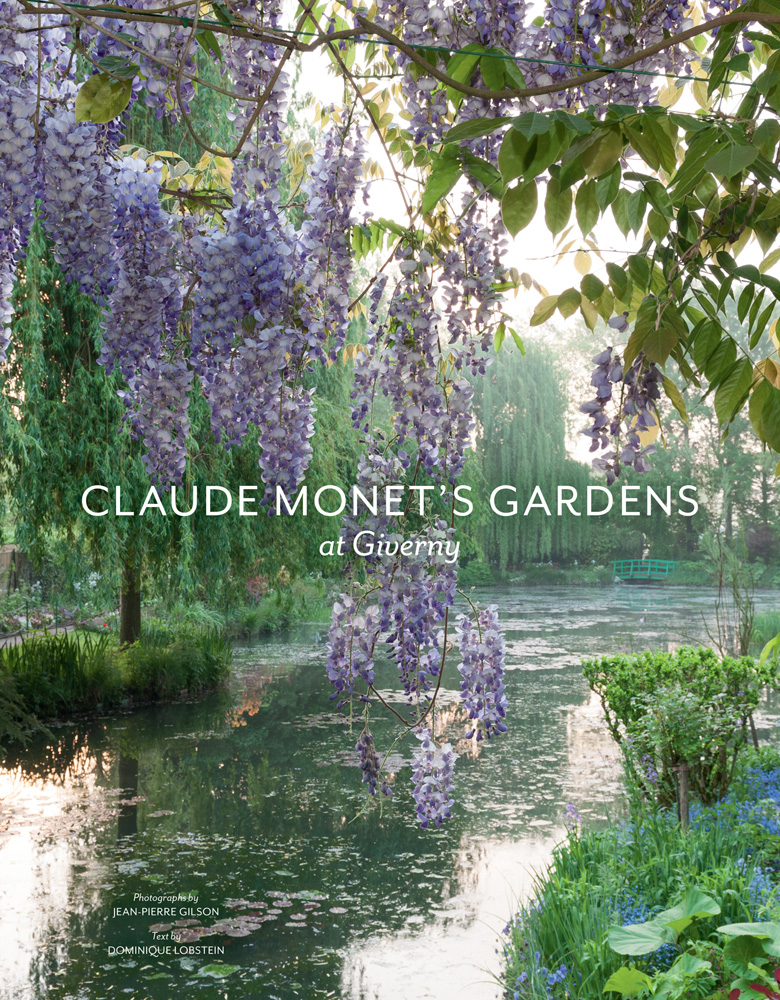
9781419709609So begins the tale, told mostly in large, vivacious images, of Claude Monet’s extraordinary gardens (and home), told with love and with style through Jean-Pierre Gilson’s photographs, with text by Dominique Lobstein. Published by Abrams–one of the best in the world at this type of book, the visual tour begins, as it should , in the purple haze and tangled wisteria branches hanging over the famous Japanese bridge. The photograph is subdued; there are no bright colors yet. On the next two-page spread, there are brightly–colored bushes and their quiet reflections, house peeking out of the background behind some trees. Flip to the next of these several two-page spreads and it’s a riot of roses, glowing in the sun, red, pink, nearly white, braced by green leaves so dark and sometimes so nearly translucent, bold as can be. The text begins.

And on the next spread, so does spring. After the prelude, spring commences with a field of pink tulips, clean green fences and stair rails, dark green-blue leaves, and the stunning-but-simple house with its own pink facade and blue-green shutters. The effect is stunning, as if in a painting–and here, that’s precisely the effect that the master painter intended. To be at Giverny is to live inside a Monet painting, at least for a morning.

It’s not all cluttered with noisy flowers and oh-so-subtle impressionist gardening. “Monet wanted a garden that could ‘breathe’ with flowers, bushes and an open vista…” so he removed the many trees from the old orchard, and replaced them with Japanese cherry trees that yield, at least for a brief time in the spring, lighter-than-air blossoms, punctuated, here and there, as in any number of his paintings, with spots of bright color; here, red and purple tulips.

I wish I knew the name of every flower (and I wish the author’s captions included this information!). The phenomenal two-page spread showing yellow towers of flowers two stories high, dappled with pink-and-purple irises, golden yellow somethings (frustrated…), and it’s followed by several more. (I want to it to be spring today, and I want to go to Giverny tomorrow.)

And then, when your head is beginning to explode because Monet was such a genius, there’s a pair of small green rowboats, a field of happy daffodils, and in the distance, the Japanese bridge that he painted so often. Here, with a less exhausting spectrum, it’s possible to rest and reflect, and observe. The yellowy green of the locust leaves in contrast with the deep green of the background trees–with just a hint of small violet flowers to set the counterpoint.

The flighty, wavy petals of mauve tulips surprise me every time I see them. Here, they’re pictured with the famous lily pad pond in the fuzzy distance, and the sharp, sun-dappled orange wallflowers in the foreground. Another two-page spread, one of my favorite two-page spreads in the book.

Just checking–I’m not even half way through the book. Some surreal lily pad images–two look as though they were made for a science fiction film, but they are real–and then, with a page turn, there are paths of dry ochre leaves on the ground, paths with strong color of fall, not spring. The quiet beauty of barren trees and cool skies, the yellowing willow and golden hour light, it’s bittersweet. Moreso because the last set of images show the house with shutters now closed tight.

But then, we get to go inside. A row of old copper pans artfully hung in front of a blue-and-turquoise tiled wall with cabinets. A yellow dining room whose walls are filled with Japanese prints (Monet collected them, and they are a highlight of every Giverny tour, but few people spend the time to look at them as closely as the artist once did). It’s a classy old country home, less formal than most. And then, there’s a small staircase leading down to a room with Persian carpets on the floor and a whole lot of miscellaneous Monet paintings almost haphazardly scattered on the walls. It’s his studio.

The book closes with snow. Which means spring is coming again. Soon.

Touched by an Eagle

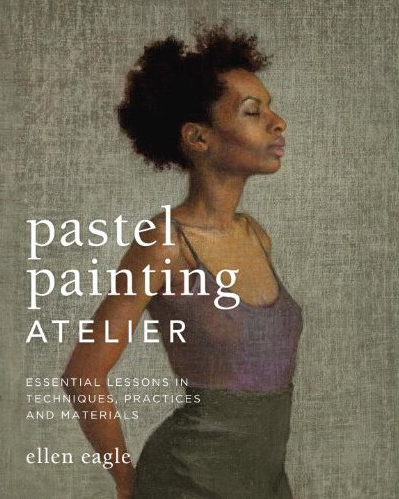
I was quite taken with Ellen Eagle’s new book, Pastel Painting Atelier.  It’s a classy book, hardcover and quite beautiful, as this atelier series tends to be. Unlike most books about art, unlike most books written for creative people, this one provides several hours of quiet time with the artist at work in her studio, in her mind, with her eyes, with her hands.  She sees beauty in the tiniest of details: the curve of the silhouette of a woman’s face, the arrangement of the old pipes beneath the even older sink in the corner of a Manhattan studio, the private thoughts that take shape in a best friend’s eyes.

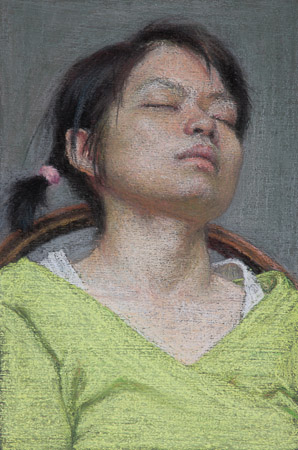
Here and there, the book is an instructional work for artists who wish to perfect their pastel technique, but that’s a small part of the whole. (In fact, the obligatory step-by-step demonstrations that end the book are its least essential part). The best parts are small comments that accompany the many sensitive images, often of women who might, in a glance, be dismissed as ordinary. Eagle describes her model, Mei-Chiao, as follows: “the inward gesture of the head to the chest was beautiful to me, and the backward pull of the shoulders is balanced by the triangular opening blouse neckline.” Minor details become a beautiful painting. Same girl, different painting, one that I found by exploring Ellen Eagle’s portrait website, an endeavor I recommend when you have the time to look carefully…

Ellen_Eagle052

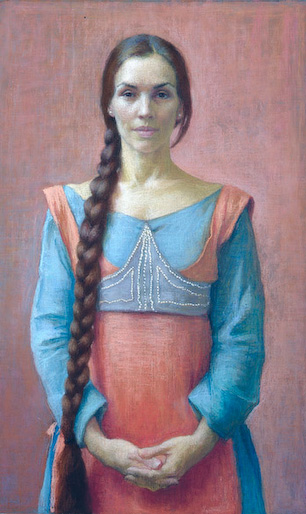
The artist’s use of line and color is quite masterful, and throughout the book, it’s easy to get lost in page after page of exquisite, often subtle, portraits. She has a knack for capturing women especially well, almost as if she is drawing and painting their minds as well as their fine features. One of my favorites is below, also taken from her website. She describes the painting below as follows: “In Roseangela’s flesh, I saw warm yellow-greens co-mingling with touches of cool violets and pinks. The planes that faced the light contained color pinks, blues, and greys. Warm tones ran throughout the flesh. Warm, dark burnt sienna defined the depths of her eye sockets. Where the orange dress caught the light, the colors took on a cool temperature. The weight of her clasped hands pulled the dress inward, causing a slight angle away from the light, and the cooler tones gave way to warmer ones.” It’s almost as if she’s writing a poem with colors.

018ee39

This is a gentle book, an inspirational one with the promise of some instruction for the visual artist, but you need not be an artist to see what she sees, and to enjoy the way that Ms. Eagle perceives and so lovingly sees the world.

Here’s the cove. The image on the cover is another favorite. The artist was especially taken with the pose struck by the model. Be sure to visit  Eagle’s website to see the uncropped version.

book

Lens in One Hand, Camera Phone in the Other

Earlier this week, Sony introduced a very different way to think about your cell phone as a portable camera. The DSC-QX100 is the kind of innovative product that engineers love, and marketers don’t love because it is, well, kind of hard to explain, understand, and justify in terms that makes sense to consumers.

Basically, Sony’s engineers have, quite reasonably, identified the tiny lens as the weakest part of the idea of an in-camera phone. The phone must be small, and the lens wants to be as large as possible (to allow more light to reach the sensor, allowing better image quality and greater control over depth-of-field, and more). Sony’s solution: a full-size lens that works with any smartphone.

“Works with” is the key phrase here. You can physically connect the lens with the phone so that the whole rig resembles a traditional compact camera, as below.

Sony-Cyber-shot-QX100-Premium-“Lens-style-Camera”-4-1024x768

Here, the phone’s screen becomes the camera’s viewfinder–essentially, this is the way any camera phone works, except here, there is a full-sized Zeiss lens attached. Again, I’m choosing words carefully. The lens is attached, but not connected to the camera in the traditional way. The sensor is inside the lens, and so is the memory card. The camera is used ONLY as a viewfinder.

And that introduces an interesting variation on the theme. The phone can be held in one hand, and the lens in the other.

sony-dsc-qx-100-1

In fact, there are two different models. The better one, the QX-100, contains a healthy 20 megapixel 1-inch sensor, a fast f/1.8 lens, and costs about $500. The lesser one, the QX-10, contains a lesser 2/3 of an inch sensor and offers an ordinary lens, less well-suited to low-light, and costs half as much.

How does the signal make its way from the lens to the phone? NFC if the phone offers that type of (newer) connectivity. If not NFC, then Wi-Fi (thank goodness it’s not Bluetooth).

How’s the image quality? Think in terms of the image quality that you could buy for about $600 in a compact digital camera, and that’s the QX-100. For the lesser lens/camera (or whatever these contraptions are called), think in terms of what you could buy at Best Buy for two or three hundred dollars.

So now that we both understand how these new devices work, the obvious question re-enters the room. Is this a good idea? Basically, you’re buying a lens with a built-in sensor and a slot for a memory card, but no way to actually see what you’re shooting unless you connect the thing to a smartphone. Seems kinda goofy to me, but under some circumstances, for the right people who, for reasons that are still unclear, cannot, will not or should not purchase a traditional compact digital camera.

How the heck did the marketing people get talked into this one?

The Spacey McTaggart Lecture

So here’s Kevin Spacey telling the truth about the television industry, the movie industry, and the new reality that places creative people in control of their relationship with the audience. He is harsh, realistic, funny, and deeply experienced–and full of wisdom and insight gained through his Netflix deal, his work with the Old Vic theater in London, and a career that began, with the help of actor Jack Lemmon, at age thirteen.

I especially enjoyed Spacey’s celebration of “the third golden age of television” that began, more or less, with Hill Street Blues, extends through The Sopranos, on through House of Cards. Just in case you’ve missed one or two, he runs through a dozen-plus excellent television series whose connection to the audience is the result of powerful creative risks taken by creative people, and by the small number of laudable television executives with the guts to protect those creators.

Spacey connects the dots in a pattern that’s  obvious to anyone who is willing to face the truth about the television industry–and devastating to those who still believe in the status quo, appointment viewing, watercooler conversations, and television networks as the fundamental organizing principle of the home entertainment industry. Time and again, he celebrates the creative people…and resets expectations for the next generation.

The new generation of creatives is different. We’re no longer living in a world where someone has to decide if they’re an actor, writer, director or producer. These days, kids growing up on YouTube can be all of these things…

The James McTaggart Memorial Lecture opens the Edinburgh Festival. This lecture is 49 minutes long. I encourage you to watch the whole thing.

Let me tell this another way: he tells a heck of a good story.

(Here’s a link to the text version.)

The Brilliant Douglas Engelbart

Douglas Engelbart passed away recently. His name may be unfamiliar. His work is not.

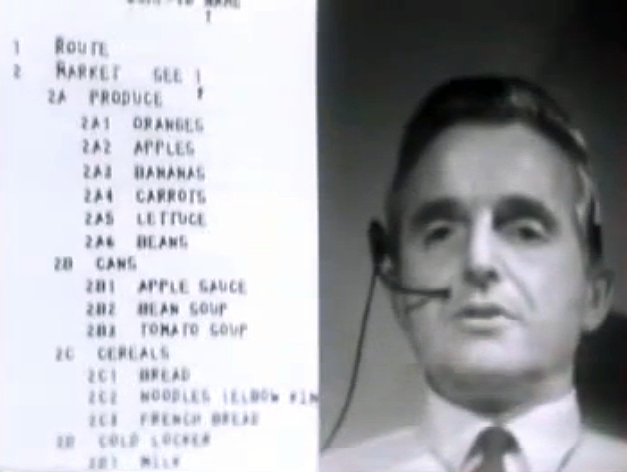
Engelbart was an engineer who invented, among other things, your computer’s mouse, and, by extension, his work made the trackpad possible as well. In his conception, the mouse was a box with several buttons on top and the ability to move what he called an on-screen “tracking point.” In 1968, this idea was radically new. I encourage you to watch Mr. Engelbart in action by screening the video, now widely known as “The Mother of All Demos” in the hardware and software community because of all that he presents. Among the innovations: a video projection system, hyperlinking, WSYWIG (what you see is what you get–the basis of word processing and more), teleconferencing and more. He’s clearly having a wonderful time with this demo, very proud of what has been accomplished, keen on the possibilities for a future that we all now accept as routine.

Douglas Englebart in "The Mother of All Demos," as this hour-plus presentation has come to be known.

Douglas Engelbart in “The Mother of All Demos,” as this hour-plus presentation has come to be known.

You’re actually able to point at the information you’re trying to retrieve, and then move it

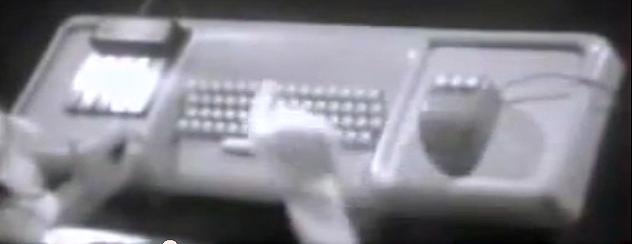
Intrigued? Here’s a look at the input station. On the right is the mouse; at the center is the keyboard; and on the left is an interesting five-switch input device that allows quick typing by holding down each of the five keys in various combinations to enter characters without using the keyboard (some of these ideas were later revised for current trackpad use).

A very early version of a computer mouse as explained by its inventor, Douglas Engelbart.

A very early version of a computer mouse as explained by its inventor, Douglas Engelbart.

Still unsure about whether this video is worth your time? Think of it as a TED Talk, circa 1968.

Hungry for more? Watch this video on the Doug Engelbart Institute website. Here, he speaks about collective learning and the need for a central knowledge repository. The video was recorded in 1998, shortly after the internet first became popular. His vision recalls the era when we all dreamed about what the internet might someday be.

The complexity and urgency of the problems faced by us earth-bound humans are increasing much faster than are our aggregate capabilities for understanding and coping with them. This is a very serious problem; and there are strategic actions we can take, collectively. – Doug Engelbart