One version of our story begins in 1874, midway between Cleveland and Buffalo, about 20 miles inland from Lake Erie, on the shore of Lake Chautauqua. Another version begins a half-century earlier, in 1826, in a town called Millbury, just south of Worcester, Massachusetts. The third takes shape in 1904 in Iowa and Nebraska, in part because small towns could now be reached by the railroads out of Chicago.
Here’s what happened.
“In an age when most Americans had acquired only a grade school education,” two educators who were involved with Sunday schools “recognized the power of education to elevate, enlarge and enrich lives.” They were Reverend John Heyl Vincent, a Methodist minister who had become Secretary of the Sunday School Union, and Lewis Miller, a former teacher who became a businessman (farm machinery) who served as the Superintendent of Sunday School and at his church and President of the Board of Education in his hometown of Akron, Ohio. Together, on the pretty shore of Lake Chautauqua, they put together a conference for 2,500 Sunday school teachers for two weeks during the summer of 1874, mostly to listen to lectures and seminars about religion. When they did it again the following year, they added music from the Tennesseans, who sang plantation songs from the American South, and non-religious lecturers, notably President Ulysses S. Grant (he had been a former parishioner at Miller’s church in Illinois). A year later, there were lectures about chemistry, geology, and astronomy.
When I visited Chautauqua in 2014, I wrote about the experience. If I had stayed the full nine-week season in 2019, I would have attended lectures by public radio’s Krista Tippett and Ira Glass; Middlebury College President Laurie L. Patton; comedians David Steinberg and Lewis Black; author and activist Bill McKibben; writer and author James Fallows; author of The Death and Life of the Great Lakes Dan Egan. I would have gone to concerts featuring Judy Collins, Madeleine Peyroux, Bela Fleck and Abigail Washburn, Diana Ross, the Lincoln Center Jazz Orchestra with Wynton Marsalis; and a lot of vocal and chamber groups whose names are unfamiliar. I would sit in on each morning’s lecture/sermon by a notable Chaplain, watched performances of several operas (The Barber of Seville, and Figaro), and just walked along the beautiful shore. If you’d like to imagine what you would have done, every season since 2007, follow this link and enjoy. They are now planning their 2021 summer season. And they’ve introduced an online version that I’ll write about in the future; it’s called Chautauqua Assembly.
Yes, it’s amazing that this bit of 1870s culture remains vibrant and remarkably successful 150 years after it began, but that’s only part of our story.
Now, let’s jump back to the late 1820s and 1830s–where the roots of today’s public radio reside (GBH began just ten years later). Somewhat similar to today’s TEDTalks, the Lyceum circuit provided lecturers to more than 3,000 theaters and public spaces all over the country. There were big stars on the circuit: Mark Twain, P.T. Barnum, Susan B. Anthony, Frederick Douglass, Abraham Lincoln, and other U.S. Presidents, and lots of lesser-knowns. But there was a problem. No air conditioning. No climate control for hot indoor spaces during the summer–so the Lyceum circuit was, mostly, a wintertime activity. Until one day…
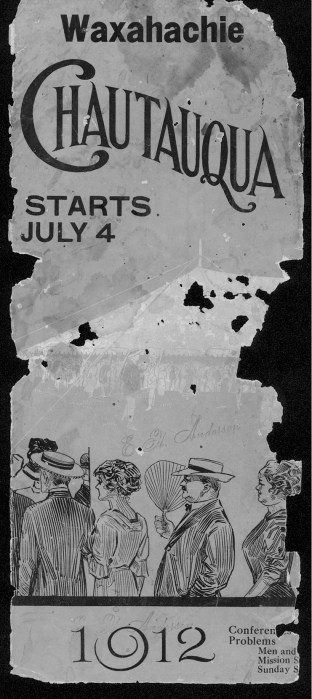
Keith Vauter, who managed western states and territories for a booking agency that supplied the Lyceum Circuit with talent, decided to try a new approach. The Chautauqua concept in upstate New York had inspired summer chautauquas in other places. He figured he could book his talent during the summer, and expand his business. His first attempt–in 1904–failed because the logistics of moving so many performers to so many locations was just too expensive. As Vauter improved the logistics and came up with a way for local communities to guarantee the cost of their own chautauqua, the concept took off. Borrowing ideas from traveling circuses, vaudeville, and theater troupes, they devised what became a very popular idea: the traveling chautauqua. At least until 1929, when a combination of talking motion pictures and the Depression more-or-less ended the fun. For about 25 years, traveling Chautauqua “served to provide small towns with a deeper sense of self, community, nation, the world, and God. They spanned the silent movie era, the Progressive Age, and the transportation shift from horse-and-buggy to automobile.”
There is great wisdom in the chautauqua movement, and in the Lyceum movement, and in their intermingled roots of what has since become radio, television, some of the Internet, some of the entertainment industry, and more. When I started to become curious, I found two extraordinary experts who knew the culture and the whole story. The first was Harry P. Harrison, who was among the first “platform superintendents” for the new Chautauqua circuit way back in 1903. He wrote, or dictated, a book to co-author Karl Detzer, a professional writer; it’s called Culture Under Canvas: The Story of Tent Chautauqua (published in 1958; I found an autographed copy for $3 in a used bookstore). The second is newer, written by a college professor who worked with music students in summer Chautauqua for many years. It’s called The Traveling Chautauqua, and the author is Roger E. Barrows. The material quoted in this article comes from that book.

So: what was it like, going to a tent chautauqua for a week in the 1920s?
From Missouri’s Joplin Globe: The most famous Chautauqua speaker was the founder of Temple University, Russell Conwell. Conwell is said to have given his “Acres of Diamonds” speech 6,150 times between 1882 and 1925. Much in the spirit of self-improvement found in chautauquas, Conwell emphasized that developing his talents and skills is what made a man successful — or diamonds could be found in one’s own backyard. He and perennial presidential candidate William Jennings Bryan were two of the most sought-after speakers.”
Harrison tells stories about the many performers who helped make his career. Barrows breaks it down by type of performer, provides many more pictures, and also includes excerpts from their scripts.
“Madame Ernestine Schumann-Heink sweeps onto the stage. She is a large woman whose presence dominates the platform. Her rich voice, with its wide range…begins with the spring aria from the Saint-Saens opera, Samson and Delilah.” (“When the movement began in 1874, all music was live.”) “To the perpetual spinning sounds of the piano, Madame Schumann-Heink becomes Gretchen at the spinning wheel, expressing her mounting heartache as she comes to realize the emptiness of Faust’s promises…Schubert’s art song travels from the Austrian metropolis of Vienna to the small towns of Texas and Ohio…The artist would later recount how, in the midst of her signing, she could hear the mooing of cows…”
Bohumir Kyrl, who had played with Sousa, conducted his own popular band and became a star performing on cornet. College girls, on an adventure for the summer, would sing classical, art, and popular songs. The Jubilee Singers (the Fisk University group was one of several) would “harmonize a cappella;” “they had heard tales of slavery from their parents’ laps, and…had personal experiences with racism, (as they expressed) the “anguish and sorrow of the original singers.” There were authentic Indian princesses who performed on piano, sang songs, and shared legends of their people. The Raweis were Native New Zealanders on tour through the American hinterlands. At a time when actors were not welcome in God-fearing small towns, Lucille Adams was an “interpreter,” also called a “reader,” who read and spoke expressively, but didn’t quite “act.” In time, the circuit tried a Shakespearean acting troupe led by Ben Greet, a legitimate Shakespearean actor, and they became popular, famous, and well-traveled, introducing Shakespeare’s work to audiences who had never seen anything quite like it. Eugene Laurent was a popular magician on the circuit.
There were cooking lessons, many lecturers who specialized in a loving life at home, and plenty of preachers. Billy Sunday was a former professional baseball player who converted to evangelical Christianity and became one of its most famous spokespeople. Lots of souls were saved in the chautauqua tents, of lives transformed. Many religions were represented; Rabbi Emil Hirsch of Chicago’s Sinai Congregation helped non-Jews understand his religion.

One of the most famous speakers relied upon religion with a more old-time flavor, not only for his tremendous success on the circuit but also as the basis for three runs for U.S. President–William Jennings Bryan, at the time, one of the best-known American citizens. (You’ll recall his name and presence from the Scopes Trial and the play, Inherit the Wind). Reformer Jane Addams was on the circuit in 1909 and 1919. Women’s suffrage was a hot topic on the circuit, too. Jeanette Rankin often spoke about that–she being the first woman elected to the U.S. Congress.
From 1909 to 1912, Peter MacQueen talked about his adventures hunting for big game with Teddy Roosevelt in Africa. Around the same time, Frederick A. Cook spoke–more than 350 times–and claimed to be the first man to reach the North Pole (Peary was second). Booker T. Washington spoke about progress through education at chautauquas around 1914, and a few years earlier, Florence Mayrick talked about her life in an English prison. When the chautauaqua was in town, everyone was elevated, educated, and thrilled. Truly, this was something special in towns where not much special happened very often.
And then, it was over. This huge chunk of American education for adults, and for the entire family, just went away. Radio took its place with an even wider variety of education, religion, entertainment and more. And then, television, and then, the internet.
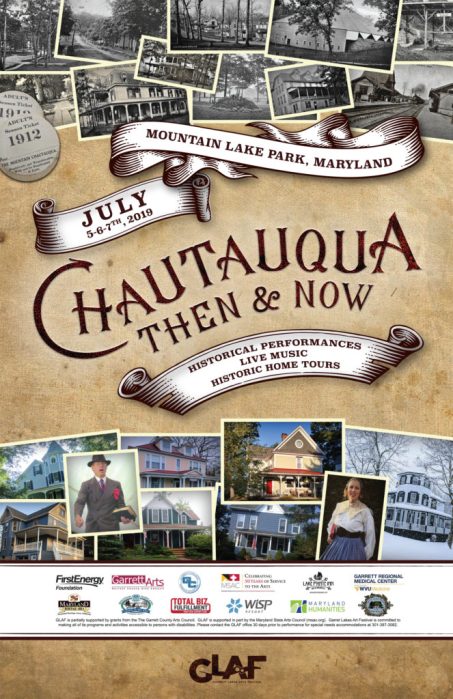
The best way to experience a chautauqua is to buy a ticket for several days, or longer, for the original that still runs in New York State. The second best, which may be pretty darned good, is to find yourself a local chautauqua like the one that the Wythe Arts Council runs in Wytheville, Virginia, or the weekend festival in Madison, Indiana, or the one that feels intentionally old-fashioned in Mountain Lake Park, Maryland, an old B&O Railroad town and former resort that was, in the day, home to an original Chautauqua traveling show. As soon as things open up again, they’re on my list–and if you know of any others, please add them to the comments below.
AND–for even more fun–check this out! It’s an industry trade magazine from June 1922–and it’s chock full of advertisements, news stories, photographs, listings of booking agents, and so much more. The magazine is called Lyceum Magazine: For the Lyceum and the Chautauqua.
 Yesterday afternoon was busy with reading on the Hotel Atheneum’s wraparound porch, studying the lake, selecting the perfect rocking chair, becoming distracted by what sounded like a full orchestra nearby. Wandering is what folks do on a summer’s day at Chautauqua, so I followed the music to the amphitheater where a rehearsal of Madame Butterfly kept me and perhaps two hundred other people busy for an hour. On Saturday night, the theater will be filled with nearly four thousand people, mostly residents who either spend their summers here, or, at least, several weeks each year. I was reluctant to linger: I wanted dinner before heading to the theater. Back at the
 Me? I’m off to Sol Messinger’s “Yiddish Language Conversation” back up near the main road at the relatively new (few Chautauqua structures are new) Emerson Jewish Life Center, built in 2009. Sol is sitting at a conference table with four or five people, interviewing each of them, each of us, about our family history. He is speaking in Yiddish. I understand only a bissel—the tiniest portion—but just the act of listening is joyful. Here and there, one of the people at the table translates key ideas for me. The conversation drifts in and out of English. The people are not young. I wonder what will happen to Yiddish, but only for a moment. My head is filled with ideas, but the yellow broadsheet—the detailed schedule for this Chautauqua week, contains far too many things for me to do, so I keep moving, grab a quick quiche at the informal lunch place above the bookstore (not wonderful: Chautauqua’s food for short-term visitors is a weak link), and manage to get to Philosopher’s Hall in time to get a seat just on the perimeter. It has been raining, so some seats are wet. I sit on my Daily, my bun is a little wet for a while, but I quickly forget my personal issue when the speaker begins. He’s compelling—
 No time to linger. A Chautauquan keeps busy, does not lollygag (except when the day is beautiful and there is a book to be read under a century-old tree while children are racing around on bicycles and otherwise living a perfect small town American life). That glimpse of what America might have been is just that—a glimpse—for there is music to be enjoyed in one of the old churches. An hour of art songs performed by students from Chautauqua’s music school on the north side of town (no time to visit, but I understand practice sessions and rehearsals are open, and a bit like Tanglewood). Then, at 5:00PM, I wander back to the hotel for a daily wine tasting. I was invited by my new friends at last night’s Community Table. Mostly, my contribution to the table of six chatty people was recommendations of novels by Reynolds Price because one of the women was interested. Then, we headed down to dinner in the hotel’s main dining room. Steak dinner. Fresh cut.
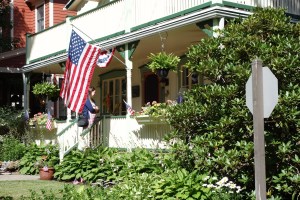 Next morning, it’s up at 7:00 am for the Farmer’s Market, then a spiritual bit, then a visit to the Methodist House (many religions, many houses, used for residents and for small events) for a July 4 lecture about the specific wording of the Declaration of Independence. I intended to stay for just a few minutes, but stayed for an hour and learned a lot about what Thomas Jefferson wrote and what Richard Henry Lee wrote. Half of the people in the audience seemed to know the speaker as a friend. I suspect he was a long-time Chautauqua resident or visitor, and that revealed one more piece of this fascinating puzzle: the people who attend Chautauqua are not just visiting because the lake is pretty in July. They attend because the combination of leisure and learning, family and fellowship, curiosity and creativity is, for nine special weeks every summer, available here and almost nowhere else.

 Digital Insider