(Digital) Money, Honey

We pay for just about everything with a credit card, a debit card, PayPal. Even parking meters accept card payments. Cash is dirty, difficult to store, easy to lose, and (for better or for worse) leaves no trace. The end of money has been predicted for a long time. Maybe now’s the time that money, like photographic film, drive-in theaters, and typewriters, fades away.

That’s the theory behind WIRED contributing editor David Wolman’s book, The End of Money published by Da Capo. The book is an easy read, filled with anecdotes, interesting histories, and a great many examples of alternatives to our current cash-and-coins conception of valuable exchange. Wolman points out the present system is, in fact, quite new, and that most of human history did not involve pennies, pfennigs, or pesos. He estimates that one of every twenty British coins is counterfeit. He points to cash on ice both in Alaska Senator Ted Stevens’ freezer and also in a visit to the fallen Icelandic economy. (There are so many wonderful slang terms: cold hard cash among them). He explores alternative currencies. The one about Liberty Dollars–“a private voluntary free-market currency backed entirely by silver and gold.”–is a long trip through the complexities of alternative currencies and contemporary Federal conceptions of money.

There’s discussion–not enough for my taste–about smart cards and the use of mobile devices as digital wallets. Here, the focus is on the many small daily transactions that remain cash-intensive, and the potential for a simpler, less costly, more manageable system based upon digital transactions. The upside: you’re never short a quarter for the parking meter; the downside: every time you park your car, you’re making an entry into your permanent record.

Be sure to read the crazy story. It’s just one paragraph on Wikipedia.

It’s interesting to muse on the current use of simulated currencies, if only to understand our possible future behaviors: accumulating gold coins in games, such as World of Warcraft; the possible connections between gamefied badges and currency that can be exchanged for real or virtual goods and services; the use of Quids on the (now gone?) website Superfluid, where “they’re placeholders for favors” (perhaps not unlike the favor/exchange economy that drives power and accomplishment in the nation’s capital). Where might frequent flier miles fit into the money equation? Or Disney Dollars that pay for fun in Orlando (now largely replaced by Disney Gift Cards because they yield far more digital data, and because the residue is easily converted to profit.) How about the barter economy that has been so well-nourished on the internet: you build my website, I do your taxes.

How does taxation fit into any of this? None of us love taxes, but we’ve certainly become attached to, say, our interstate highway system. I suppose most transactions will be digital, and so, there is a trackable moment of exchange, and at that moment, the tax authorities can step-in (digitally) and collect. How about pay checks? Direct deposit eliminates the old-fashioned notion of “cashing the paycheck”–and, perhaps, acknowledging the weirdness of Big Brother, preparing one’s own personal tax return may seem equally old school (armed with your entire digital financial life, the government could certainly outsource your tax return, mine to, to an outfit in Malaysia or Peru).

Are coins and cash going away? Not this year, but maybe in ten years. It’s fascinating to contemplate the possibilities. And, along the way, it’s fun to browse or read The End of Money.

It’s also fun to watch the CBS Sunday Morning report that was inspired by the book. If you can find the link, let me know and I’ll post it (couldn’t find it on the CBS Sunday Morning site).

What about Black-and-White?

Back in the analog stone age, shooting in monochrome was a creative choice made in advance. You’d buy a few ISO 400 rolls of Ilford HP5 or Kodak Tri-X, and head out for a day of serious photography, hoping for just one image worthy of framing.

In fact, black-and-white analog photography offers several advantages. There is at least four times as much picture information, so contrasts can be stronger, textures can be more refined, and enlargements can be, well, larger. About half of this work is done in the field, mostly by selecting and composing with intelligence, and by selecting an appropriate optical filter to place on the lens. For example, sky contrast can be dramatically increased by using a red filter, but sometimes, detail in shadows is lost with a red filter, so an orange filter may be more suitable. Corrections are then made in the analog or digital darkroom, a trial-and-error process that becomes easier after a lot of hours of experimentation and instruction.

Working with a digital camera, the best black-and-white images are derived from color images, but maybe not in the way you’d think. The adventure begins with a digital camera that can shoot RAW images–so plan to spend at least $500 on the camera. Lesser cameras, and less-than-serious photographers with better cameras, shoot in JPG to jam more images onto an SD card. If you start with a JPG created in the camera, your black-and-white images will lack detail, clarity and snap. Your expensive digital camera offers an instant monochrome option. No, you shouldn’t use it, not if you are serious about your photography.

Instead, you can achieve miracles by post processing your RAW image in Aperture, Photoshop, or other software capable of handling RAW images. With desktop software, you can add the equivalent of colored filters and gradient filters, with a level of precision unavailable in the field, and unavailable in old school darkrooms.

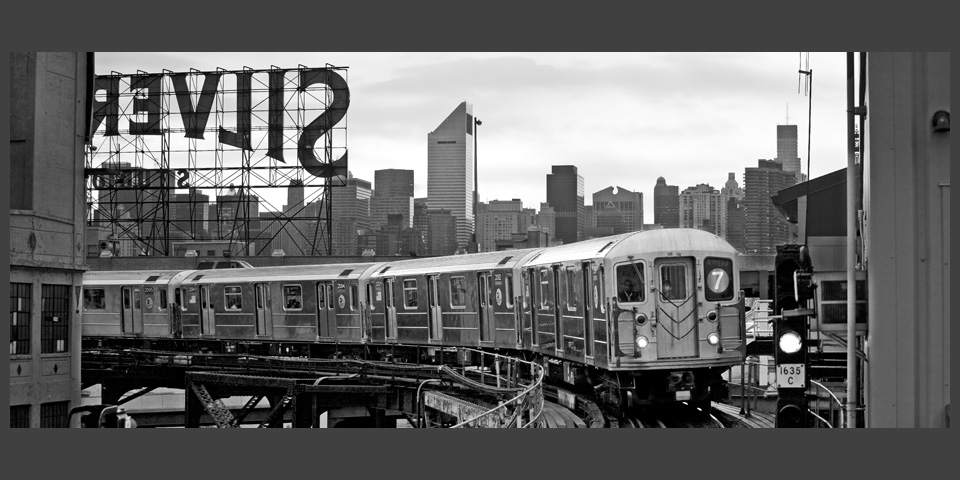
In his book, Hoffmann goes into considerable detail about how this picture was made, and why it is so effective. He’s a very good teacher.

Is it worth the time? It’s worth the time if you train yourself to create the best possible images by learning a lot about composition, mood, street photography, landscape work, architectural photography, and abstract work from a master teacher. I’ve spent the past month or two studying the second edition of a fine book entitled The Art of Black and White Photography by Torsten Andreas Hoffmann, published by Rocky Nook Press. He provides the necessary technical information, but spends most of his instructional time on important photographic ideas: how to avoid the cliché, achieving balance, dealing with visual irritations that cannot be moved, capturing people in their natural surroundings, visual rhythm, form and composition. Hoffmann is especially effective when he writes about, and photographs in, a strongly graphic style: strong contrasts, superior use of line and form, repetition to suggest speed or solidity. (Study the three Hoffmann images in this article, and notice, for example, the repeated pattern of small verticals–the fence posts in the top image, the decorative balusters in the second, and the train doors in the third supported in the distance by the verticals of the Manhattan skyline). These are not snapshots–they are photographs–and if there was any doubt about a blurry line between those two ideas, it disappears here. These are advanced ideas, most suitable for the experienced photographer or for the ambitious newcomer. The reward is in the learning, of course, and also in the tour of Hoffmann’s portfolio, which is sampled in this article and offered in expansive form on the photographer’s website.

The photographer is based in NYC. This image is one my favorites, but it comes from his website, and does not appear in the book.

Save the Country!

In our hearts, we know what’s wrong, and we know that it’s not about Democrats or Republicans. It’s about the money that flows into political campaigns, the revolving door between industry and agencies that should be regulating without industry influence, the political bashing that obscures the real issues, the real reasons why our food is unsafe, our cellphones were never properly tested to assure that they do not produce cancer, why our financial system collapsed, why the jobs went away and people lost their houses while the big banks and the big car companies somehow made out okay.

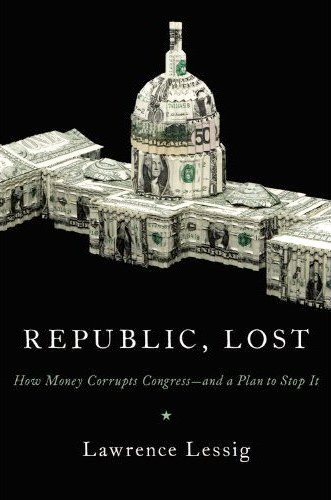
Sometimes, it takes a smart professor to parse the issues, and present them in a way that makes logical sense. Here, the professor is Lawrence Lessig, well-known for his work in the synchronization of copyright issues with the realities of new technologies. Lessig has shifted focus. In his new book, Republic, Lost, Lessig explains how and why we have accomplished the decimation of our democracy, and what we ought to do about it. This is not a book about politics. Instead, it’s a book about economics, foolish decisions, and fundamental thinking about what a country ought to do, ought to be.

The fundamental problem is relatively simple. Special interest groups, including big companies, big industries, unions, and others with vast money to spend, now control the agenda, and the decisions, made by our legislators. This is accomplished by funding political campaigns that now cost so much money, candidates are unable to raise the funds in any other way. Money is distributed not as bribes, but within a “gift economy,” in which lobbyists control the flow of funds, favors, and even the words in legislation that few legislators ever manage to read before voting. The size of this gift economy is spectacular in its size and influence, resulting in a sustained distraction for even the best-intentioned legislators whose time and decision-making processes are, according to Lessig, dominated by this system.

Where Lessig is clear about what the problem is, why and how it has gobbled up our representative form of government, and how much money is involved, he is less wonderful when it comes to solutions (which is to say, Lessig is clear thinking and often quite brilliant in his assessment of the current situation, but even his big brain struggles with what the heck we should do now). Still, he does present several seemingly sensible ideas.

Of course, the first solution is the simplest: let’s eliminate large contributions, and instead, share the burden with many small contributions. (In this regard, Obama had the right idea.) The Grant and Franklin project would allow each person in the U.S. to contribute $50 (Grant) of their Federal taxes plus $100 (Franklin) more to one or more individual candidates, or to their favorite political party. No more PAC or political party funding–candidates can receive a maximum of $150 per person. Here’s the kicker: for candidates, this would be voluntary. That is, each individual candidate would decide to follow the Grant and Franklin path–and those who do not, well, the American people would know who they are. Lessig: “If a substantial number of candidates opted into this system, then no one could believe that money was buying results.”

Then, the “clever lawyer” part of Lessig kicks in with an idea that’s intriguing, if not altogether practical (why should we rely upon practical ideas?–this is nation built by dreamers!). Lessig again: “Here’s a quiz. What’s required to be elected to the House of Representatives? You’d think that one requirement is that you be a resident of the district from which you’re to be elected. All the Constitution requires is that at the time fo the election, you be ‘an inhabitant of that State in which you shall be chosen'” And with that, Lessig is off and running…

Why not, he asks, run one candidate in several districts with a flash of anarchy in his or her midst. The only reason he or she is running is to force the other candidate to “publicly commit” to the Grant and Franklin approach. And for those candidates who do manage to get elected (inevitably, some will), he or she commits to: holding the government hostage until Congress enacts a program to remove the fundamental corruption that is now the rule in our government, and once that program is enacted, he or she will resign from office.

Lessig goes further: he wants a constitutional amendment.  Here, he enters a deeply analytical, harshly critical approach to his own idea, using his legal powers to define a path that could make an amendment possible. And, he reckons, some rich and powerful people are likely to come along for the ride.

He’s better on describing the cause and current situation than he is on prescribing the proper solution, but it’s unreasonable to expect one person, however smart, well-educated and clever, to define a plan to rebuild the republic. But he has taken the first step: he has clearly detailed the current situation and analyzed it in ways that break through any specific political dogma or belief system or party affiliation. And I know that his thinking has affected my thinking, and, presumably, some tens of thousands of other people’s thinking, and that’s a start.

So here’s the question from my side: I buy the analysis, and I want to be part of the solution. My starting place follows Lessig’s suggestion: I need to spend some time visiting a few websites, and figure out how I might insert myself into the process. His suggested websites:

Call a Convention

Public Citizen

Voters First Pledge

Fund for the Republic

Rootstrikers

BTW: The publisher is Twelve Publishers. It’s an imprint of Hachette, a larger publisher, but Twelve is delivering on a small, powerful idea: publish a dozen important books each year.  And make them count. I like their approach enough to include it here:

  1. Each book will enliven the national conversation.
  2. Each book will be singular in voice, authority, or subject matter.
  3. Each book will be carefully edited, designed, and produced.
  4. Each book will have a month-long launch in which it is the imprint’s sole focus.
  5. Each book will be nationally advertised.
  6. Each book will have a national publicity campaign.
  7. Each book will have a digital strategy.
  8. Each book will be worthy of the attention of discerning book reviewers.
  9. Each book will have the potential to sell at least 50,000 copies in its lifetime.
  10. Each book will be marketed and distributed by the Hachette Book Group, the company with the best hit ratio in the American publishing business.
  11. Each book will be promoted well into its paperback life.
  12. Each book will matter.

Tools: Publish your own eBook (or, iBook)

Within the next 30 days, I am going to publish my first eBook. How I wish Mashable had published this chart of eBook publishing software applications before I got started. I struggled through Adobe InDesign and gave up. I would have used Apple iBook Author but it was not available. For me, Scrivener was the best available solution–and it seems to be working, but Apple has upped the game with its (and free) software.

Have a look, and be sure to pass this post on to anyone who might be considering their first eBook.

A chart comparing all the ePub tools available to users.

How iBooks Author Stacks Up to the Competition [CHART]