You may not know the name Paul McGowan. If you’re interested in high-end audio, and/or you listen to a lot of recorded music, Paul is someone you ought to know. He’s the “P” in “PS Audio,” a leading maker of quality loudspeakers. He and his team have designed and built all sorts of audio products. And he’s been doing this for a half-century. That experience is now captured in a library of ten (!) volumes of a series called The Audiophile’s Guide. They’re available as a set (www.theaudiophilesguide.com) and as individual books. Each book is substantial — several hundred pages long, and costs about $40.
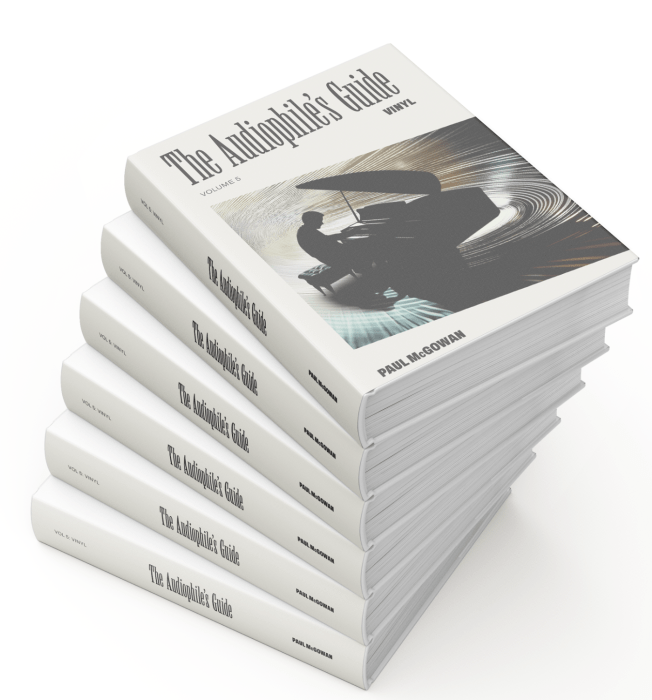
There are ten books. They cover, for example, The Stereo, The Loudspeaker, Analog Audio generally, Digital Audio generally, Vinyl, the all-important Listening Room, the Subwoofer, Headphones, Home Theater, and a distilled version of the series called The Collection.
The book about Vinyl is especially helpful. It begins at the beginning: the development and evolution of records, followed by a very clear explanation of “groove modulation” — the way record grooves interact with a phonograph stylus, which leads to a discussion of cutting masters, plating and pressing, and my favorite part, the debate about the quality of records vs. other recorded media. And so, the author eases into groove wall resistance, natural compression curves, and other particulars that make records sound so good — especially when the playback equipment is right.
The sound of vinyl is much affected by the operation of the turntable — the way the motor turns the circular table, for example — and the design of the tonearm. These concepts ride in the background of audiophile discussions, but here, author Paul McGowan shines — his articulate, direct, simple language makes the concepts compressible. The chapter called “Engineering Challenges of Tonearms” is not a lesson in technical engineering, but instead, a 2-page essay that pretty much tells the listener what they might want to know. Cartridges are also confusing and difficult to understand, but here, moving magnets, moving coils, cantilevers and other types of cartridge technology come to life, make sense, and provide the listening with a good basic understanding of what matters and why.
McGowan is equally good on the practice of buying just the right product for your individual purpose. And so: choosing a pre-amplifier, choosing a cartridge, and so on. There’s a turntable setup guide here, too, but I wish it included diagrams. If you’ve heard terms such as tracking force and azimuth, this book provides an easy way to learn the basics.
If you want to listen to music, but you feel as though you ought to know just enough about technology to advance your listening experience, this book series can be a very useful tool.



 Digital Insider