I’m investing $165K in the child who lives next door

In the U.S., 76 million students are currently enrolled in pre-K through graduate school. About 55 million students are in pre-K, elementary, junior high, or high school, and about 20 million more are enrolled in community colleges, four year colleges and universities, and graduate programs.

The cost of a pre-K through 12th grade education: $650 billion for 55 million people, or about $12,000 per student per year. Figure a total investment of $165,000 per student for the entire pre-K through high school run. In fact, nearly nine out of ten adults finish high school (most by 18, some later).

Add four years of college, and the total per-student investment exceeds $200,000. As it turns out, that’s the investment made by or for about one in three American adults.

Here’s another way to think about it. You’re in a room with ten people. One of those people never finished high school. Six finished high school, but not college. Three finished college. This is America:

“Between 2000 and 2010, the percentage of the adult population 25 years of age and over who had completed high school rose from 84 to 87%, and the percentage of adults with a bachelor’s degree increased from 26% to 30%.”

Researchers argue about whether the precise high school drop-out rate is closer to 12% or 33%–a very wide range–but 25% is comfortably in-between, hence the “one-in-four” assumption. For minority students, the drop-out rate is somewhere between 50% (yikes!) and 85%, so one-in-three seems to be a reasonable starting point for any discussion. This is an enormous problem. High school drop-outs earn far less than graduates, and often disrupt families and communities because their options are comparatively narrow.

Is there reason to be concerned about one in three Americans graduating from college?

As part of its College Completion agenda, The College Board reports the number of 25-34 year olds with an Associate Degree, or better, in various countries. The results are a bit surprising: there are four countries with over 50% rates, Korea, Canada, the Russian Federation (!), and Japan. There are eleven countries with rates higher than the U.S.; at about 41%, we’re comparable with Israel, France, and Sweden, and (again surprising), far ahead of Germany (24%). Expand the view from 25-35 to 25-64, and the results change a lot: the U.S. is fourth on the list with only Russia above the 50% mark–so it’s reasonable to assume that Korea, Canada and Japan have made great strides during the past few years, but the U.S. has not. Dig deeper and the reasons become clear: the white population seems to be twice as likely to hold a degree than the Latino population, which is growing quickly in the U.S.

Dig deeper and the situation becomes even more complicated.

So, what have I learned in my late night exploration of educational statistics?

1. Assuming our economy can provide the necessary jobs, we should probably set a 50% goal for college graduation. Assuming current trends continue, we will reach that figure within the next 10 or 20 years.

2. Unlike others, I don’t feel that the U.S. must lead in every category. We’re within a reasonable range among comparable nations, and that’s a good starting point.

3. The high school drop-out rate is alarming, both for the individuals involved and for the development of our society. The reasons why we don’t achieve a high school graduation rate are many: inadequate schools, old-fashioned ideas, insufficient budgets, inadequate family and community support for families, poor preparation in key skills necessary for high school success, peer pressure involving gangs, guns, violence, drugs, limited options, and so on.

No, this post does not end with a solid solution or even a rational recommendation. I’m just taking notes on stats that seem important, and devoting part of my day to understanding the bounds of the issue. I hope you will, too.

Notes:

High school rates: http://voxeu.org/index.php?q=node/930

History of pre-K through grade 12 enrollment, plus higher education: http://nces.ed.gov/programs/digest/d10/tables/dt10_003.asp?referrer=report

Lots more good stuff here (the source of the quote, too): http://nces.ed.gov/programs/digest/d10/

As always, Wikipedia offers abundant information, this time with lots of charts and graphs: http://en.wikipedia.org/wiki/Educational_attainment_in_the_United_States

College Board stats from: Organisation for Economic Co-operation and Development, 2010

I Want to Watch TV on My iPad (The Plot Thickens)

Here’s the original story published on March 6, 2012:

You’re looking at an array of television antennas. These antennas are used to capture local broadcast signals that you can watch, if you pay a monthly subscription fee, on your computer, tablet, or phone. Aereo (formerly Bamboom) is the company behind the scheme, and, as you might expect, they’ll be spending a lot of time in the legal system as they argue with broadcasters regarding the rights and wrongs of live retransmission (that is, if Aereo is to survive, the broadcast networks want to see monthly cash–just like they receive from the cable operators).

Ah, the free airwaves, the ones that broadcasters use for the public good. Ah, the intellectual property that broadcasters carry over those airwaves, the IP that cable service providers pay to carry. Ah, the unresolved legal gotcha!! Any company that attempts to make those signals available via a secondary distribution scheme must pay for the right, or so say the broadcast networks.

The price for the service? $12 per month. The debut date? March 12. The place: for now, the New York metropolitan area.

For cord cutters, this may be a terrific deal. But it’s unclear whether the courts will block Aereo’s progress, as they have with ivi.tv and others who attempted to climb the walls of the castle without paying the required tribute (or, as I’m adding in my updated version of this article… others who attempted to challenge the current system of copyright and payments for distribution rights to intellectual property).

Slingbox? That’s okay. Over-the-air mobile TV? That’s not ready yet, except in a few markets on a test basis. Watch over-the-air TV? Sure. Watch via cable or satellite? As long as you’re paying for the privilege. Watch on another device? Nope, not yet. Or, maybe the answer is yes. We’ll find out in a few weeks.

_____

Here’s the update that I wrote on March 12, 2012:

From Bloomberg: Predicting a “great fight” with traditional media companies, billionaire Barry Diller said he plans to expand his new Aereo Web-based television service to 75 to 100 cities within a year, reports Bloomberg.

Diller, speaking at the South by Southwest Interactive festival in Austin, Texas, noted that efforts by Walt Disney Co. and other media companies to cite copyright violations were “absolutely predictable,” since entrenched companies always protect their turf, the story says.

Want to know more? Here’s a bunch of links:

The tech explanation:

http://www.techspot.com/news/47467-aereo-offers-tv-over-internet-with-antennas-engineered-to-comply-with-law.html

The consumer angle:

http://www.forbes.com/sites/dorothypomerantz/2012/02/29/how-much-are-you-willing-to-pay-to-cut-the-cord/

The business story:

http://online.wsj.com/article/SB10001424052970204059804577229451364593094.html?mod=wsj_share_tweet#printMode

The investment story:

http://www.bizjournals.com/sanfrancisco/news/2012/02/14/iac-l20-million-aereo-barry-diller-vc.html?s=print

_____

Here’s the update as of July 17, 2012

Again from Bloomberg (July 13, 2012): “A U.S. district judge this week allowed Aereo to continue operating while television networks pursue a copyright lawsuit against the company. Aereo captures broadcast signals with small antennas and streams them to devices such as Apple Inc. (AAPL)’s iPad, without paying for the programming.” As a result of the ruling, Diller is now planning a nationwide rollout.

As I pondered what all of this might mean, I read an essay on TV NewsCheck’s website, written by television executive Lee Spieckerman. I contacted him, and we spoke for a while about the ruling and its implications. In short, he believes that Judge Nathan bungled the decision:

“We see loopy rulings from Federal judges all the time, and I think this fits into that category… She misread the governing law!”

Spieckerman’s argument is based in part upon law and in part upon common industry practice. His legal argument tracks back to a 1993 law which requires operators of paid television systems to secure the necessary rights from local broadcasters. The concept is called “retransmission consent” and that ruling has proven to be something of a windfall for local broadcasters as a result of the fees paid by cable operators in exchange for this consent. According to  Spieckerman, these fees are now worth about $2 billion to the commercial broadcast network, plus an additional several billion dollars to local stations. This, plus the additional revenues from political advertising resulting from the Citizens United decision, provide the advertising base necessary for local television news to survive. (Seems to me, we should all understand the economics and consequences of this new approach to journalism funding–a worthwhile topic for a future article). Back to his other argument: “there is no tradition in this country for renting antennas–nobody rents antennas!”

Digging deeper with Mr. Spieckerman, and the real argument emerges. This is all about copyright infringement, and protection of distribution rights associated with intellectual property. Judge Nathan’s ruling begins to disrupt a system by which cable operators compensate owners of cable networks and local stations. ESPN receives $4.69 per cable subscriber–do the math and that’s about $50 per year per subscriber multiplied by 100 million subscribers, and that’s $5 billion per year in subscription fees. Spieckerman believes local broadcast station fees to be 20-50 cents, but acknowledges that these deals are confidential. (Consider that Comcast, Time Warner, and other cable operators charge consumers charge those 100 million subscribers over $1,000 per year–1o0 million x $100 = $100,0o0,000,000, or $100 billion, also good raw material for another Digital Insider article.)

Of course, the local station operators are anxious to negotiate with Diller’s Aereo. And Diller is anxious to go with the Judge’s ruling because it requires no fees. For now, according to Bloomberg,

We’re going to really start marketing… Within a year and a half, certainly by ’13, we’ll be in most major markets.”

To which Mr. Spieckerman counters:

Who is going to be next? This is a pandora’s box, and when you start circumventing and tearing down the few elements there are in the industry and inviting the destruction of an important industry. If I have any intellectual property that I want to distribute, I do not want anybody able to steal my material.”

Going Postal in the Year 2022

As the U.S. Postal Service struggles to find its 21st century business model, it competes with FREE–that is, the 4.6 zillion emails we write, send and read every day, and with a fairly spiffy FedEx, and a reliably massive United Parcel Service. If I want to send somebody a message, I use email (or texting). If I want to send somebody a package, I use FedEx or UPS.

Today, I visited my neighborhood mailbox and learned about the 13-ounce rule. (Yes, it was new to me, too.) The sticker on the mailbox says, if the package weighs 13 ounces or more, you cannot drop it into the mail box. Instead, you must take the package to the “retail service counter at a Post Office.”

Yes, the USPS is behind the times. According to Wikipedia, the USPS is also:

(a) the second largest civilian employer in the United States (574,000 workers)

(b) the largest vehicle fleet operator in the world

(c) legally obligated to serve all Americans, regardless of geography, at uniform price and quality

(d) a protected monopoly in certain categories (non-package mail, use of mailboxes, etc.)

(e) operates 31,000 individual post offices

(f) delivers 600 million pieces of mail to more than 100 million delivery points — every day!

The knee-jerk reaction would be “well, let’s just modernize the whole darned system.” Or, let’s digitize it, or perform a magical internet transformation. The USPS and the K-12 school system have been mostly untouched by the digital revolution. The status quo is just too strong.

“To establish Post Offices” is among the powers assigned to Congress in the U.S. Constitution. One reason why we insisted upon Post Offices was to distribute newspapers in the 1700s. Within ten or twenty years, there may be no physical newspapers, and the future of print magazines, paper bills and invoices, legal notices, and other flat mail is equally dim. For the USPS, there are fewer letters to deliver, and fading enthusiasm for their once-vital services. To make things worse–as only a large government bureaucracy can do–the U.S. Postal Service is hobbled by a strange political situation that resulted in huge unfunded Federal mandate.

So as I find an alternate means to mail my 14-ounce package without using a 13-ounce-limit mailbox, here’s a thought experiment for a late winter’s day:

If you were in charge of a future version of a U.S. postal system–government operated or otherwise–how would you construct a 21st century system?

Did you hear what I said?

Here’s what I want from a Bluetooth headset: (a) you can hear me, (b) I can hear you, and (c) hassle-free phone pairing. For those of us who rely upon these devices, it’s tough to find happiness. And, it’s difficult to comprehend the experience of the other person on the line, the one who is supposedly listening to the conversation. It’s on item (a) that many headsets fall below expectations, but unless you ask, you have no way of knowing what the other person is (not) hearing.

I decided to experiment with two of the most highly-rated  Bluetooth devices.

Blue Ant's Q2 looks great in any color. It's small, well-designed, and sounded good to me.

Sure enough, I fell in love with its small size and wonderful incoming sound quality of the nifty Blue Ant Q2. Pairing with my iPhone: easy. Noise cancellation: in theory, great, in practice, not so great (even a gentle breeze was a problem). Fit and style: terrific; the device just hooks over the ear and looks sleek. Little button to press when making or receiving a call: sometimes, a bit hard to find, but okay with practice. Several voice control features added to a positive experience: terrific! I can ask the phone, “am I connected?” or to “redial” or to repeat all available menu commands. Finally, here’s a smart device that sounds good, looks good, and works properly. Or so  my great expectations imagined.

When I started asking people how I sounded, the comments were, at best, noncommittal and often, negative. Most often, I was told that the sound was “a little weak” and that they were hearing “some but not all of the words” and that they heard “a lot of background noise.” The more negative comments I heard, the more I experimented–trying different locations, different phones, interior, exterior, quiet, slightly breezy, in cars and trains, out walking the dog, etc. No change in the comments I received.

Since I could hear the other person so clearly, at first, I questioned the other person’s phone system, ears, sanity, whether they were using an inadequate phone or earpiece on their end, and so on. More than a month’s calls led me to the sad conclusion: although I could hear the other person, they could not hear me, not clearly, and, often, not completely.

So, I continued my Goldilocks routine by returning to an headset I had used before with some complaints. I liked the clunky big-battery-behind-the-ear, big-boom-microphone Plantronics PRO when I owned a previous model, but the incoming volume was unacceptably low. For most of February, I’ve been using the newer PRO HD, and found two improvements much to my liking. The first improvement is a better incoming sound system: every call is loud enough, and every call is clear. The second: I like the sensor that tells the headset when it is actually on my ear (if it’s not on my ear, it won’t take the call; if it is on my ear, it will answer calls automatically without requiring me to press a button).

Of course, the big test is not what I can hear, but what you can hear when you call me. I was really hoping for good results on that score–and sure enough, the PRO HD came through. Several people asked me whether I was actually on a headset because the sound was so clear. So far, not one person has complained about sound quality. For me, that’s extraordinary; I’ve been hearing complaints about my Bluetooth headsets for years.

Wind noise? Yeah, that’s still there. Better than the Blue Ant Q2, but a breezy day is a problem for an exposed microphone. On the Pro HD, the boom microphone is long and large enough to accept the equivalent of the wind muffle that location video shooters use–a soft furry condom to catch the wind–maybe that teeny accessory is on its way? And while we’re on the topic of accessories, even the PRO HD is really small, and really easy to lose. I sure wish Plantronics would develop some sort of carry-everywhere accessory to minimize the loss of its $100 device (so far, I’ve lost two of them).

This blog post is already on the long side. I’ll review Blue Ant’s Q4 speakerphone in a separate article.

Links:

Blue Ant Q2

Plantronics PRO HD

A clear explanation of the TV spectrum auction

http://a.tiles.mapbox.com/v3/fcc.Unavail_20111007_2/mm/legend,zoompan,tooltips,zoomwheel,zoombox,attribution,bwdetect,share.html#6/37/-96

Congress has approved a law that Obama will likely sign. That’s the first step in a long, complicated process. A national plan would be a good idea, but this adventure may take shape market-by-market, station-by-station instead.

What does this mean for the American people? Well, it’s probably the beginning of the end of broadcast television. If the FCC and lawmakers work together, they can probably construct a sensible transition to a robust IPTV-based system. Along the way, they must address the significant public interest concern of free access to information. The version of the future in which Comcast, Verizon and (probably) Google control all information is probably not in our best interests, but their investments are probably required to make ubiquitous broadband multimedia a reality. The alternative more closely resembles the information superhighway (remember the term?) version of the interstate highway system. This is not the way most people are thinking, but strong arguments will move in this direction, and soon.

Here’s the article as it appeared on February 17, 2012 in TVNewsCheck (link at end of article). It’s called Incentive Auction Headed for Obama’s Desk, and it was written by Kim McAvoy.

—–

After more than two years of political wrangling, Congress on Friday signed off on legislation authorizing the FCC to conduct an incentive auction of broadcast TV spectrum.

The measure is contained in a major legislative package that would extend payroll tax cuts and unemployment benefits.

Both the House and Senate approved the package, which now goes to President Obama, who is expected to quickly sign it into law.

The legislation permits the FCC to hold auctions and share the proceeds of them with broadcasters that voluntarily relinquish their spectrum.

However, for TV broadcasters who chose not to give up their spectrum, the measure contains safeguards against their suffering any loss of service.

Before the FCC conducts an auction, it has much to do. Implementing the law could take as many as three separate rulemakings. Some believe it could take five to 10 years to get to get to an auction.

A key element of the FCC’s March 2010 National Broadband Plan, the incentive auction is a mechanism by which the FCC hopes to reallocate up to 120 MHz of spectrum from TV to wireless broadband carriers.

The NBP believes the reallocation is necessary to meet what it believes will be a severe shortage of broadband spectrum as more and more Americans use smartphones, tablets and other mobile devices to access the Internet on the go.

The incentive auction language in the spending package is based on legislation authored by House Communications Subcommittee Chairman Greg Walden (R-Ore.) and has the backing of the National Association of Broadcasters.

NAB has been pushing hard for specific safeguards fearing that the FCC’s incentive auctions might damage the broadcasting business.

Among the key provisions is a requirement that the commission make “all reasonable efforts’’ to preserve … the  coverage area and “population served’’ of broadcasters who don’t participate in the incentive auction.

For local TV broadcasters, it is paramount that any legislation guarantee that their service areas will remain unaffected by the channel reassignments or “repacking” that will occur as a result of the auction.

Broadcasters are also pleased that the legislation would set aside $1.75 billion to compensate TV stations (and cable operators) for costs associated with repacking — the wholesale switching of channels that would occur after the FCC identifies the spectrum it will have to auction and consolidates it into large swatches that can be more easily auctioned.

Originally, Walden’s bill allocated $3 billion to a relocation fund, but House Democrats complained about the amount and argued that the fund should be only $1billion as recommended by the Congressional Budget Office.

The legislation also makes it easier for those broadcasters that are thinking about leasing excess spectrum to wireless carriers. According to the legislation, in lieu of reimbursing stations for the costs of repacking, the FCC may grant stations waivers to use some of their spectrum for services other than broadcasting. Such a waiver would remain in effect only while the licensee provides at least one free, over-the-air television program stream.

The measure also prevents the FCC from moving stations from a UHF channel to a VHF channel or from a high VHF channel to a low VHF channel.

And it makes clear that this is a one-time auction with a 10-year sunset on the FCC’s authority to repurpose broadcast spectrum.

Under the legislation, only full-power TV stations and Class A low-power stations can participate in the incentive auction.

It states that the FCC must use a “reverse auction system’’ as a means to establish a price at which TV stations would give up their license and then conduct a “forward auction’’ of the TV spectrum.

Most important, if the proceeds are insufficient to cover the incentive payments and relocation costs, the auction fails. And stations that participate in a channel-sharing arrangement retain must-carry rights.

NAB is also pleased about the provisions directing the FCC to address issues that could affect TV stations with service areas bordering Canada and Mexico before it relocates those broadcasters to another channel.

Those provisions were authored by Reps. John Dingell (D- Mich.) and Brian Bilbray (R- Calif.).

There is also language in the measure that allows an unhappy broadcaster that is being displaced by the incentive auction, or any interested party, with the right to go directly to court.

“The bottom line is, instead of protesting a license modification at the commission first, you could go to court,” says a source familiar with the legislation.

Although broadcasters would get a cut of the incentive auction proceeds, the bill intends for most of the revenue to go to the federal treasury and to help fund a nationwide communications network for first responders.

The CBO is estimating that $15.2 billion will be raised by the incentive auction.

House Republicans wanted to include the auction language in the payroll bill as way to help cover the costs associated with extending those tax breaks.

Overall, the measure was being hailed on and off Capitol Hill.

“We struck a fine balance to make more efficient use of the airwaves while also providing necessary protections for broadcasters,” said a statement released by Chairman Walden and House Commerce Committee Chairman Fred Upton (R-Mich.).

NAB President Gordon Smith said: “NAB salutes the tireless efforts of Congress to ensure that local broadcasters have a vibrant and robust future.’’

Smith applauded the efforts of  Chairmen Upton and Walden “for steering this bill to conclusion, and … Reps. Dingell and Bilbray for a critically important amendment guaranteeing continued viewer access to TV station signals along the Canadian and Mexican borders.’’

Over at the FCC, Chairman Julius Genachowski was also pleased with the news of impending congressional action on the incentive auction proposal. The FCC chairman has been a chief proponent of the incentive auctions, believing that TV spectrum is underutilized and would be put to better use for wireless broadband services.

“I’m pleased that Congress has recognized the vital importance of freeing up more spectrum for mobile broadband, both licensed and unlicensed, although the legislation could limit the FCC’s ability to maximize the amount and benefits of recovered spectrum,” Genachowski said.

The wireless industry, which has been leading the charge on Capitol Hill to get the incentive auction bill passed, called today’s vote “a resounding victory for consumers and the American economy,’’ in a statement from CTIA-The Wireless Association President Steve Largent.

“Making spectrum available will make it possible for America’s wireless carriers to offer consumers better, faster, more ubiquitous wireless broadband service,” Largent added. “The release of additional spectrum also will spur the investment and job creation that our economy needs.”

Vinyl for sale


As LPs continue to gain popularity, here’s a list of stores that sell used LPs. Fair prices (mostly, around $5, some as low as $1-2, as high as $7-8). Very good to excellent condition (free from noisy scratches, sometimes, a nice sheen). Jacket with significant rips, marks or other degradation. Check your local yellow pages–most urban areas support at least one good used record store. Please comment additions or corrections, and I will update the list from time to time.

Some favorites and recommendations I have not yet visited. Some of these stores stock only vinyl, and some mix it up with CDs:

Princeton Record Exchange – Princeton, NJ

The Bop Shop – Rochester, NY

Record Archive – Rochester, NY

Siren Records – Doylestown, PA (near Philadelphia)

Jerry’s Records Pittsburgh, PA

Stereo Jack’s – Cambridge, MA

Bull Moose Records – Portsmouth, NH

The Sound Garden – Baltimore, MD

Encore Recordings – Ann Arbor, MI

Grimey’s New and Preloved Music – Nashville, TN

Waterloo Records – Austin, TX

Dave’s Records – Chicago, IL

Twist & Shout – Denver, CO

Music Millennium – Portland, OR

Amoeba Music – Berkeley, CA, and both San Francisco and Los Angeles (I haven’t been there in a few years– are the prices still reasonable?)

Jive Time Records – Seattle, WA

One good web source for new vinyl:

Soundstage Direct

Not White

When Mike Nichols was directing the Broadway musical, Annie, one scene that was supposed to be funny was failing to get laughs. He tried everything. Nothing worked. The audience watched the scene, but didn’t laugh. So, Nichols asked a fellow director, Jerome Robbins, to take a look. Then, Nichols asked Robbins how to fix the scene. Robbins pointed to a white towel hanging on the back of the set.

“The towel should be yellow,” Robbins explained.

“That’s it? That will make the scene work?” Nichols thought, but did not say aloud.

Nichols changed the towel. From then on, the scene got laughs.

When it comes to creativity, everything is subjective. Except when it isn’t.

(From The Creative Habit by Twyla Tharp)

(Almost) Paperless Office

I’m not 100%, but I’m close. My working life is now mostly on-screen. And, as of yesterday, there’s no longer a five-inch stack of business cards on my desk.

Truly, I don’t use my full-sized color laser printer more than once a month. I carry around very few file folders, often, none at all. Just about everything is digital, easy to find, easy to search, Dropbox-able and email-able.

The biz cards presented a conundrum. This stack from a trade show, that one from four years of office meetings. My old systems–looseleaf notebooks with plastic insert pages, and a desktop filebox–were overwhelmed.

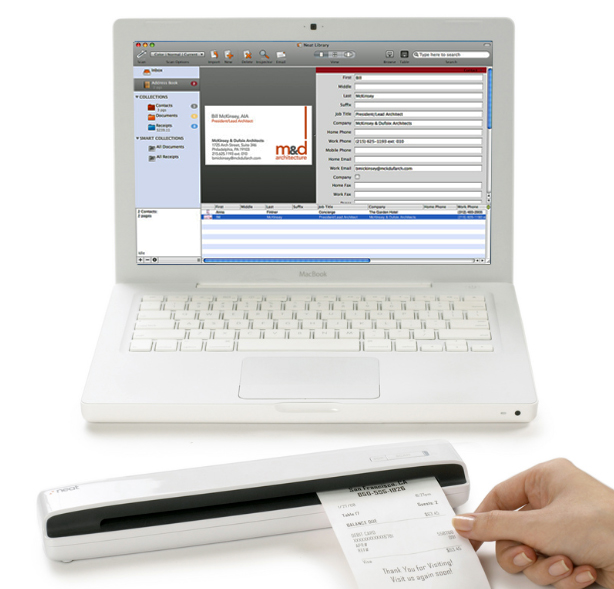
So I took the ultimate step: scanning business cards into some sort of database (in my case, Bento).

It worked. Not perfectly, but well enough to rate a good solid B-plus.

There are several available systems. I used the Neat Receipts Mobile Scanner for Mac. The scanner is about nine inches wide, maybe an inch high and two inches wide. There’s a large open slot that can be used to scan 8.5 x 11 pages (a nice convenience), receipts (hence the product name), and, for me, business cards. Each card is individually placed into the slot, and there’s a button marked “scan”–easy enough. I had some trouble because I connected the mini-USB cable to my Mac keyboard; the scanner requires more power than the keyboard can provide, so it must be plugged directly into the computer (an inconvenience).

The software grabs the image, quickly implements an OCR run (Optical Character Recognition), and places each bit of information in an appropriate field in its database. For some cards, the OCR does a perfect job. Usually, there are a few missteps, easily corrected because (a) the card is displayed alongside the database record, and (b) just about any item on the card can be manually dragged (and re-recognized) into your choice of database fields.

My several work sessions were amazingly productive–for three reasons. First, I was able to scan several inches of cards into the database in just a few hours (including my output from the Neat database to my Bento database). Second, the process itself required me to edit the batch of cards, to throw some of them away. Third, as soon as some cards were scanned, I copied the information and wrote a re-introduction email (“Hi, we met in 2008, thought I’d get back in touch…”)

And, perhaps best of all, I’m no longer accumulating random business cards in rubber-banded piles. Now, as soon as I collect a few cards, I scan them into the database.

Oh–one more note–if a business card presents a hyperactive multi-color design, don’t bother scanning because Neat will become completely flustered. Just type the information into the database.

Again, I’m not 100%, but the combination of hardware, software, and a new compulsion keep everything in order gets me closer to a 21st century workflow.

Corning’s Clear View of the Future

Interesting concept video by Corning Glass.

Boring? Yeah, that’s what I thought, too. I was wrong.

Turns out, screens are / will be everywhere. And, Corning knows that those screens will be made of… you guessed it.

Nielsen: TV isn’t changing so quickly, after all

Traditional television viewing completely dominates viewing habits. New behaviors are evident, but they are slowly shifting the landscape.

The latest from Nielsen’s periodic Cross Platform Report (formerly, the Three-Screen Report):

90% of US households subscribe to cable, satellite and similar television services. This number is NOT dropping. It is stable.

75% of US households pay for a broadband connection.

5% are “broadcast/broadband households” – that is, they do not subscribe to cable or satellite services, instead watching either broadcast channels and internet video (and, presumably, a lot of DVDs from Netflix). This group is growing. In comparison with Q3 2010, there are 23% more today. It’s still a very small portion of US households.

81 million US households pay for cable plus broadband.

22 million US households subscribe to cable or satellite, but not to broadband.

Looking at the total population, we’re still watching about 35 hours of television per week–still an astonishing 7 hours per day (do you actually know anybody who watches 7 hours of television a day–I know one person, but she’s pretty much housebound). About 2 of those hours are recorded on a DVR or VCR. Compare that with just 4 weekly hours of internet use (really? most people I know use the internet a whole lot more than 4 hours a week). How much internet TV viewing? About a half hour per week (seems about right to me).

Yes, there are generational differences, but the swings are not huge. Adults 18-24 watch 25 hours of television per week–over 3 hours a day. And they watch about 45 minutes of internet video. People 50+ watch about 45 hours per week, actually about twice as much TV as those 18-24. Teens 12-17 behave very much like the 18-24 crowd, but teens watch about a third less internet video than the college and post-college crowd.

Or, so Nielsen claims. Although Nielsen presents itself as the authority on television viewing, nowhere in the report is the survey base explained–no numbers of people or households surveyed, no demographic breakdown, no description of the sample used. Remember: Nielsen’s work is based upon surveys and samples–that is, Nielsen uses one household to represent perhaps 5,000 households. Of course, Nielsen claims that over time, the households come and go, but the survey results are very consistent. Look closer and examine Nielsen’s base–not all age groups, not all communities, not all zip codes, not all household incomes or ethnicities are measured.

Is something changing? Of course–everything is changing in every possible direction. Babies born in 2010 and baby boomers born in 1950 are watching “TV” on iPads and phones. Movies are available through so many sources, but these viewing habits aren’t really captured in Nielsen’s survey. Neither are videogames. So what we have here is a somewhat unreliable, but perhaps directional, study of a particular (though undefined) population of viewers who may or may not be evenly sampled or represented. A healthy skepticism of anything published by Nielsen should be part of any critical thinking exercise related to media and its transformation.

Nielsen-Cross-Platform-Report-Q3-2011