The Key to Fun and Learning

For many years, scholars have debated the aesthetics of film (or, with greater pretense, “cinema”) and the mass culture associated with television (or, with less pretense, “TV” or “the idiot box”). Videogames make for more interesting study because they combine the sound and images with the 21st century version of interactivity. Stories aren’t watched–they’re played. Characters aren’t observed–they’re enacted by the participant. It’s rich stuff.

So here’s my new hero, Constance Steinkuehler, a University of Wisconsin assistant professor who studies the intersection between videogames, science and cognition. Currently she’s on a leave of absence, working at the White House in the Office of Science and Technology Policy. I first encountered Ms. Steinkuehler while listening to NPR’s Tell Me More in April. Then, I found a video, and I realized how much I/we could learn from her.

So I took all of our plans and I threw them out the window. Structured stuff? Not going to work…If I talk at them, they are not going to listen to me. So, we’re just going to do this weird, radical thing. We’re just going to…play next to them. When an interest comes up, we’ll be like, well, you know, the place to read more about that would be “x”…Once we turned it around to a ‘follow their interests’ kind of a model, everything shifted. And it worked.

She’s talking about how learning works. And she’s using videogames as the basis for that learning. Among teen boys who were part of her project, chosen because they did not do well in school. She paid attention to the ways in which they preferred to learn, and here’s what happened:

So for example, we had a reader who was in tenth grade who read at the sixth grade level. [He was not] doing well in school. I handed him a fifteenth grade level text (from the game) and he was reading it with absolutely fine comprehension, 94, maybe 96% accuracy…”

Why?

When they choose the text, when they actually care about it, they actually fix their own comprehension problems…”

These quotes are lifts from the video below.

Steinkuehler is not the only academic who is thinking deeply about videogames and learning. This page does a good job in providing an overview of the videogame industry, and includes several videos that will stimulate your thinking about what games mean and why they are important. (The embedded TED talk is quite good because it covers bits about the industry and bits about game design.)

In this field, one original source of light is James Paul Gee, who explains, simply, that every videogame is a set of problems to be solved in order to win. His excellent book, What video games have to teach us about learning and literacy, is an excellent place to begin thinking seriously about videogames. So, too, is this introductory video:

Carnegie Mellon’s Jesse Schell will take your thinking further. He’s a game designer, an author, and someone who is thinking about games and learning in very exciting new ways. You may have seen Jesse’s TED talk, but you may not have seen his TEDx talk which is, ultimately, about how games (by design) encourage collaboration and shared learning styles, and how well-designed games respect the learner in ways that school often does not.

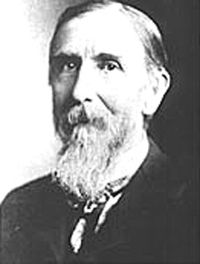
BTW: Score yourself 100 extra points if you recognized this article’s title, “The Key to Fun and Learning” as the tagline that appeared on most Milton Bradley board games. Double your score if you recognized the bearded man as Milton himself, a pioneer in games that were fun and also provided a learning experience. Triple your score if you knew that Mr. Bradley started out by making game and puzzle kits for Civil War soldiers to occupy their time in camp (remember, those guys were, mostly, teenagers.)

Good Old USA vs. the 21st Century

They are: Destination America, and Veria Living. They come to the screen with very different stories, and two very different world views. I’m finding myself watching both of these channels with interest.

I suppose I ought to start with Destination America, and, inevitably, a new series called United States of Food. I caught the episode called United States of Steak (don’t worry, more episodes are on the way: bacon, and burgers among them). The beefy Todd Fisher gets his Guy Fiere on, but focuses on the excellent prime rib served at Boston’s Durgin Park, the superior chicken-fried steak found in Texas, and a Brooklyn classic t-bone from Peter Luger.

You may recall the well-intentioned Planet Green from Discovery Networks. That’s gone now. Destination America is its replacement. So what else besides beef? A series called Super Duper Thrill Rides, another called Fast Food Mania, and a modern day gold rush called Ghost Town Gold. There are shows about crop circles and Vegas gambling, Area 51 and Sasquatch, UFOs and national parks. As easy rolling brainless television goes, it’s fun.

(Isn’t it weird that cable channels are replaced as if they were TV shows? I know it makes business sense, but everything seems so darned flimsy.)

The other new network (well, new to me, anyway) is called Veria Living. In sharp contrast with Destination America’s approach, this is a channel devoted to healthy living and wellness. It’s based in New York City, but the money and the distribution power are the result of a growing media industry in India. Zee Networks is one of India’s largest media brands; slowly but surely, Zee has been increasing its presence in the US, and elsewhere in the “Indian diaspora.”

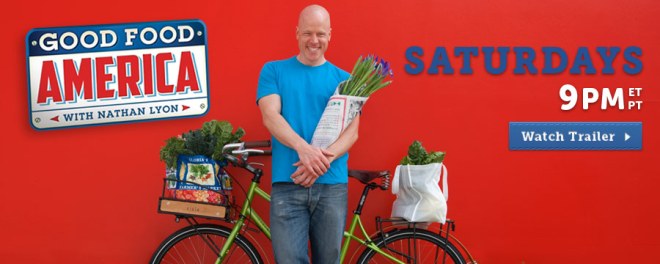
The first show I watched on Veria was Good Food America with Nathan Lyon. Other shows are about fitness, healing, yoga, and other good stuff. I especially enjoyed watching Nathan Leroy (yes, two different Nathans host different series) on Under the Sun, visiting Tuscany for an organic lunch (all local ingredients eaten on the patio of a rustic/elegant home that the local couple had built on their own). I’ve watched him, with some jealousy, enjoying organic strawberries in Finland… and you can, too. Veria’s viewers are enjoying a $200+ million investment in original programming, all of it celebrating a healthy, joy-filled lifestyle.

Does Discovery’s loss of interest in Planet Green and Discovery Health suggest likely failure for Veria Living? Is Veria Living’s internationalist approach likely to succeed and change people’s lives for the better, or will Veria Living learn the lesson that so many cable networks (A&E, History, Bravo, etc.) have learned, that downmarket is the only road to success? And, perhaps most important, after Todd Fisher travels on behalf of steak, burgers and bacon, where will he go next?

Guest Article: Legal Developments / Over-The-Top TV

Aereo’s marketing materials. The service is now launching in the New York City area.

With Aereo now in launch mode, this unconventional service (based upon thousands of tiny television antenna–each smaller than a dime), the television industry is facing some interesting questions about even its most basic operating assumptions.

As a result of reader interest in the blog post “I Want to Watch TV on My iPad,” here’s a legal view of the Aereo situation.This material is used with permission of the law firm Drinker, Biddle & Reath, and it originally appeared in the firm’s Antenna newsletter as “Legal Developments Affecting Over-the-Top TV.” The article was written by DBR communications attorney Howard Liberman and and his associate, Jennifer T. Criss.

—–

The past several weeks have seen important developments regarding “over-the-top” television. More and more consumers are moving away from traditional means of watching television and are embracing services that provide access to television programming directly on computers, tablets, and mobile devices. While some services such as Hulu distribute copyrighted content with permission of copyright owners, other over-the-top services are providing access to copyrighted content without obtaining copyright licenses or paying retransmission fees to TV stations.

One such over-the-top service, Aereo, provides the signals of local broadcast stations to subscribers who “rent” one of thousands of miniature antennas located in Aereo’s facility, for a monthly fee. In March, numerous television broadcasters, including ABC, CBS, NBC, Fox, and PBS. brought suit against Aereo for copyright infringement. While local stations would ordinarily be available for free to any household with an antenna, today most consumers receive access to local stations through subscriptions with cable or satellite providers. The broadcast companies argue that Aereo, which is backed by Barry Diller, is infringing copyrighted material by allowing its users to access live broadcasts over the Internet. Aereo asserts that it is simply providing access to programming that consumers are able to receive for free by allowing consumers to rent its miniature antennas either on a recurring or a per-program basis.

On July 11,2012, Judge Alison J. Nathan of the U.S. District Court for the Southern District ofNew York ruled that Aereo can continue providing services to its subscribers while the case moves through the courts. Judge Nathan concluded that Aereo does not retransmit broadcast channels to its customers because the company provides an individual miniature antenna for each customer rather than offering access to a single, large antenna that transmits signals to all Aereo subscribers. The court disagreed with the television broadcasters’ claim that they would be irreparably harmed and lose numerous customers should Aereo continue its activity until a final ruling in the case.

For now, Aereo operates only in New York City. But Aereo is planning to expand into additional U.S. markets. Thus, it is important for all TV broadcasters to be aware of developments in this litigation. In the meantime, the FCC is considering what constitutes a “channel” within its definition of “multichannel video programming distributor” (“MVPD”). The FCC is questioning whether Internet-based services such as Aereo and Hulu should be considered MVPDs if they distribute more than one broadcast or cable television channel. Including these services as MVPDs could mean that television stations could seek retransmission consent payments for the delivery of their signals by these systems.

As the Aereo case and the FCC proceeding move forward, it is clear that consumer access to television is rapidly changing. With companies such as Google, Apple and Sony considering offering video channels directly to subscribers via the Internet and going “over the top” of cable and satellite providers, defining what constitutes a “retransmission” and what service qualifies as an MVPD is critical to shaping the next decade of television viewing. Today’s viewers don’t just want their MTV; they want their MTV available inexpensively, 24-7, and on their computers, tablets and smartphones. These two proceedings – the Aereo litigation and the

FCC’s effort to re-define “MVPD” – will have a major impact on the future of over-the-air broadcast television.

This issue also has the attention of Congress. Hearings have been held in both the House and the Senate in recent weeks, as lobbyists and trade associations are gearing up for the introduction of legislation — perhaps this year – to make substantial revisions in U.S. communications laws for the first time since the passage of the landmark 1996 Act. We will monitor all these proceedings and provide updates in future issues.

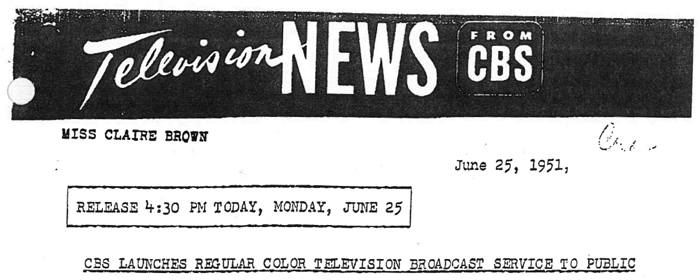
FROM: Miss Claire Brown, 6/25/1951……RE: Color TV

History marked time for one memorable hour today, and within its span, the promise of the greatest of all the miracles of mass communication became a reality.

At 4:30 PM, Eastern Daylight Time, color television’s triumphal entry into the public domain was emblazoned officiallyacross the log of man’s progress. In the 60 minutes that followed, this newest ,miracle among the electronic marvels was born.

Premiere, the Columbia Broadcasting System’s widely heralded full hour of star-studded entertainment, featuring Arthur Godfrey, Ed Sullivan, Faye Emerson, Garry Moore, Sam Levenson, Patty Painter, Robert Alda and Isabel Bigley, the New York City Ballet, the Bil Baird Marionettes, and Archie Bleyer’s Orchestra, took its place in history as the first commercial color television broadcast to the public. Brief addresses by Wayne Coy, Chairman of the Federal Communications Commission, William S. Paley, Board Chairman of the Columbia Broadcasting System; and CBS President Frank Stanton signalized, in a dedicatory vein, the start of regular color television broadcast service to the public by the CBS-TV Network.

The history-making broadcast was carried in New York by WCBS-TV, as well as by CBS-TV Network stations in Boston, Philadelphia, Baltimore and Washington, D.C., the color signals going out over the stations’ regular transmitters and on their regular channels.

Originating in CBS-TV’s Studio 57, at 109th Street and Fifth Avenue, New York, the color program was transmitted from Studio 57 by coaxial cable to CBS-TV’s Master Control in the Grand Central Building, New York, and carried from there by telephone cables to the WCBS-TV transmitter and by cable to the network. Thousands of the public, as wellas public and industry leaders and members of the press, saw the color inaugural in the five cities carrying Premiere. Many of the public who had completed home made conversions of their black-and-white sets also wereable to see the historic broadcast in color in their homes. Typical were the two junior high school youngsters in Newark who last week revealed they had been watching CBS color television transmissions for the past 18 months.

In New York, Mrs. Eleanor Roosevelt and Bernard Baruch were among the dignitaries and newspapermen who watched the inaugural on color receivers installed at CBS headquarters. There were also several showings in New York by dealers who are making color television eqUipment which they soon will have ready for the public. Among these were Colortone Inc., which had more than 400 dealers watching the inaugural on sets installed in its downtown headquarters, and Muntz-TV, which showed its new companion-piece in action to the public at its Queens headquarters.

In Boston, the public watched the program on a receiver set up in the Jordan Marsh Department Store, first store in the country to order color television equipment florstore use; Boston public leaders the press viewed the broadcast on CBS-Columbia sets installed in the Hotel Somerset’s Grand Ballroom.

The Philadelphia public saw the color show on a set installed in the lobby of WCAU, CBS affiliate, with clients, public leaders are press watching the program on another color set in the WCAU Auditorium. Baltimoreans viewed the show on sets installed by WMAR-TV in the lobbies of the new Sun Building and the old Sun Building. In Washington, D. C., WTOP-TV had sets in the Warner Building and at its transmitter at 40th and Brandwyne. In addition top government officials viewed the color inaugural on a set in the Hotel Carleton.

The Premiere broadcast was a breathtaking spectacle. His famous red hair and freckles lent an added brilliance to the wit and charm ofArthur Godfrey as he sang and quipped; a  bronzed Ed Sullivan greeted a new audience in a. setting vibrant with full, natural color; Faye Emerson was hostess. On still another stage that brought to viewers all the richness of paintings from the Metropolitan Museum of Art and ·the Museum of Modern Art; and members or the New York City Ballet “were ecstatically colorful in Maurice Ravel’s “La Valse,” staged by Sol Hurok with choreography especially for television by George Balanchine.

“Photo Credit: Ralph Morse / Time & Life Pictures / Getty Images”
“Licensed by Getty Images to Ed Reitan” – (photographed off the screen)
George Balanchine Ballet from “Premiere”
The first commercial CBS Color Television System Colorcast
June 25, 1951

Garry Moore and Sam Levenson added a note of comedy mixed with philosophy, against a setting as vivid as their artistry; Robert Alda and Isabel Bigley of the smash Broadway musical Guys and Dolls sang a duet; the Bil Baird Marionettes cavorted in a riot of hues; and “Miss Color Television” herself, Patty Painter, a. veteran of more than 1,000 CBS color demonstrations and transmissions, brought to life the full, rich, rich colors of the commercial products introduced by the new medium’s pioneer advertisers.

Sixteen national advertisers participated in the epoch-making inaugural, constituting what is believed to be the largest such group ever to sponsor collectively a single network broadcast. The pioneering advertisers were General Mills, Lincoln-Mercury Division of the Ford Motor Company, Longines-Wittnauer Watch Company Inc., Pabst Blue Ribbon Beer, William Wrigley Jr. Company, Revlon,Thomas J. Lipton Inc” National Biscuit Company, Toni Home Permanent, Monarch Finer Foods, Procter &Gamble Company, Standard Brands Inc., Quaker Oats Company, Best Foods Inc., Pepsi-Cola Company and Liggett & Myers Tobacco Company.

Fred Rickey, executive producer for color at CBS, produced Premiere and shared directorial duties with Frances Buss, under the over-all supervision of Jerry Danzig, CBS color program supervisor. Set designers were Paul Sylbert and Michael Baronoff.

The launching of CBS’ regular color television broadcast service to the public was accomplished merely by the addition of the three color cameras, plus monitors and associated control room equipment, to black-and-white studio facilities already existing before the inaugural program in Studio 57, which was chosen for the color broadcast simply because it had suitable time availabilities.

So effortless was the inauguration or regular color television service that the necessary technical work and installations in the studio were made in a 12hour period, between 10:00 PM last Wednesday, and 10:00 AM, the following morning, when rehearsals for the first commercial color telecast started.

A cue, thrown this afternoon from the control room of CBS·TV’s Studio 57 to technical personnel on the studio flooritself, opened the color Premiere. A still life picture of an orchid and a book was transmitted to waiting thousands, and the curtain was raised on history’s first commercial color television broadcast.

Today’s inaugural broadcast, establishing regular color television service to the public by CBS-TV, will be followed by daily morning and afternoon network-programs, commercial and sustaining, beginning tomorrow. A pattern of gradual expansion will be carried out, with a color schedule of approximately 20 hours a week expected by fall.

First of the regularly scheduled color programs, which will have its premiere tomorrow (Tuesday, June 26), is titled The World Is Yours! and features Ivan T. Sanderson, noted naturalist. The five-times-weekly show (CBS.Color TV, 4:30-5::OO PM, EDT. Mon. thru Fri.), “starring the earth’s natural treasures,” will be sponsored in its initial telecast by General Mills. Frances Buss will direct the CBS production, in cooperation with Ivan Sanderson Productions Inc. The World Is Yours! will present the wonders of the animal, vegetable and mineral worlds as “a sort of intellectual vaudeville show, informal in manner and functioning without benefit of script, featuring Ivan Sanderson and his “friends, II who comprise a bewildering array of nature’s creatures, including distinguished representatives of the human species. A frequent Visitor and featured participant will be Patty Painter, “Miss Color Television.”

Second or the regularly scheduled color programs, Modern Homemakers,” will make its bow before the color television audience, as a five-a-week series, on Wed., June 22 (CBS-Color.TV, 10:30-11 AM, EDT Mon. thru Fri,).

A cookery and homemaking program conducted by culinary expert Edalene Stohr, Modern Homemakers will specialize in menu-planning, food preparation, and demonstrating the eye-appeal of well-prepared foods, with emphasis on other facets of homemaking as well.

Opening of regular color broadcasting acted as an additional spur to the public to order color equipment from television dealers. Manufacturers or color TV adapters and converters reported they are receiving thousands of calls for such equipment. Typical was Arnold H. Klein, Vice President of Colortone Inc., who said his company was turning its full facilities over to the production of adapters, and that he expected to have 3,000 units in the hands of distributors by the weekend. He said he had received calls for more than 5,000 sample units from leading department stores and distributors from all over the country.

More info. A complete rundown on color TV’s early history. And, a review.

I Want to Watch TV on My iPad (The Plot Thickens)

Last week, a U.S. district judge provided Aereo with a go-ahead on TV that we’ll be able to watch on our mobile devices, but that oversimplifies an interesting story. Here’s the original article, plus an update that, I am certain, will be rewritten once again as the legal dust-up continues. Some of the issues are significant, and will resonate beyond this particular venture. Worth reading.
Here’s the original story published on March 6, 2012:

You’re looking at an array of television antennas. These antennas are used to capture local broadcast signals that you can watch, if you pay a monthly subscription fee, on your computer, tablet, or phone. Aereo (formerly Bamboom) is the company behind the scheme, and, as you might expect, they’ll be spending a lot of time in the legal system as they argue with broadcasters regarding the rights and wrongs of live retransmission (that is, if Aereo is to survive, the broadcast networks want to see monthly cash–just like they receive from the cable operators).

Ah, the free airwaves, the ones that broadcasters use for the public good. Ah, the intellectual property that broadcasters carry over those airwaves, the IP that cable service providers pay to carry. Ah, the unresolved legal gotcha!! Any company that attempts to make those signals available via a secondary distribution scheme must pay for the right, or so say the broadcast networks.

The price for the service? $12 per month. The debut date? March 12. The place: for now, the New York metropolitan area.

For cord cutters, this may be a terrific deal. But it’s unclear whether the courts will block Aereo’s progress, as they have with ivi.tv and others who attempted to climb the walls of the castle without paying the required tribute (or, as I’m adding in my updated version of this article… others who attempted to challenge the current system of copyright and payments for distribution rights to intellectual property).

Slingbox? That’s okay. Over-the-air mobile TV? That’s not ready yet, except in a few markets on a test basis. Watch over-the-air TV? Sure. Watch via cable or satellite? As long as you’re paying for the privilege. Watch on another device? Nope, not yet. Or, maybe the answer is yes. We’ll find out in a few weeks.

_____

Here’s the update that I wrote on March 12, 2012:

From Bloomberg: Predicting a “great fight” with traditional media companies, billionaire Barry Diller said he plans to expand his new Aereo Web-based television service to 75 to 100 cities within a year, reports Bloomberg.

Diller, speaking at the South by Southwest Interactive festival in Austin, Texas, noted that efforts by Walt Disney Co. and other media companies to cite copyright violations were “absolutely predictable,” since entrenched companies always protect their turf, the story says.

Want to know more? Here’s a bunch of links:

The tech explanation:

http://www.techspot.com/news/47467-aereo-offers-tv-over-internet-with-antennas-engineered-to-comply-with-law.html

The consumer angle:

http://www.forbes.com/sites/dorothypomerantz/2012/02/29/how-much-are-you-willing-to-pay-to-cut-the-cord/

The business story:

http://online.wsj.com/article/SB10001424052970204059804577229451364593094.html?mod=wsj_share_tweet#printMode

The investment story:

http://www.bizjournals.com/sanfrancisco/news/2012/02/14/iac-l20-million-aereo-barry-diller-vc.html?s=print

_____

Here’s the update as of July 17, 2012

Again from Bloomberg (July 13, 2012): “A U.S. district judge this week allowed Aereo to continue operating while television networks pursue a copyright lawsuit against the company. Aereo captures broadcast signals with small antennas and streams them to devices such as Apple Inc. (AAPL)’s iPad, without paying for the programming.” As a result of the ruling, Diller is now planning a nationwide rollout.

As I pondered what all of this might mean, I read an essay on TV NewsCheck’s website, written by television executive Lee Spieckerman. I contacted him, and we spoke for a while about the ruling and its implications. In short, he believes that Judge Nathan bungled the decision:

“We see loopy rulings from Federal judges all the time, and I think this fits into that category… She misread the governing law!”

Spieckerman’s argument is based in part upon law and in part upon common industry practice. His legal argument tracks back to a 1993 law which requires operators of paid television systems to secure the necessary rights from local broadcasters. The concept is called “retransmission consent” and that ruling has proven to be something of a windfall for local broadcasters as a result of the fees paid by cable operators in exchange for this consent. According to  Spieckerman, these fees are now worth about $2 billion to the commercial broadcast network, plus an additional several billion dollars to local stations. This, plus the additional revenues from political advertising resulting from the Citizens United decision, provide the advertising base necessary for local television news to survive. (Seems to me, we should all understand the economics and consequences of this new approach to journalism funding–a worthwhile topic for a future article). Back to his other argument: “there is no tradition in this country for renting antennas–nobody rents antennas!”

Digging deeper with Mr. Spieckerman, and the real argument emerges. This is all about copyright infringement, and protection of distribution rights associated with intellectual property. Judge Nathan’s ruling begins to disrupt a system by which cable operators compensate owners of cable networks and local stations. ESPN receives $4.69 per cable subscriber–do the math and that’s about $50 per year per subscriber multiplied by 100 million subscribers, and that’s $5 billion per year in subscription fees. Spieckerman believes local broadcast station fees to be 20-50 cents, but acknowledges that these deals are confidential. (Consider that Comcast, Time Warner, and other cable operators charge consumers charge those 100 million subscribers over $1,000 per year–1o0 million x $100 = $100,0o0,000,000, or $100 billion, also good raw material for another Digital Insider article.)

Of course, the local station operators are anxious to negotiate with Diller’s Aereo. And Diller is anxious to go with the Judge’s ruling because it requires no fees. For now, according to Bloomberg,

We’re going to really start marketing… Within a year and a half, certainly by ’13, we’ll be in most major markets.”

To which Mr. Spieckerman counters:

Who is going to be next? This is a pandora’s box, and when you start circumventing and tearing down the few elements there are in the industry and inviting the destruction of an important industry. If I have any intellectual property that I want to distribute, I do not want anybody able to steal my material.”

Brooke’s Illustrated Guide to Media Theory

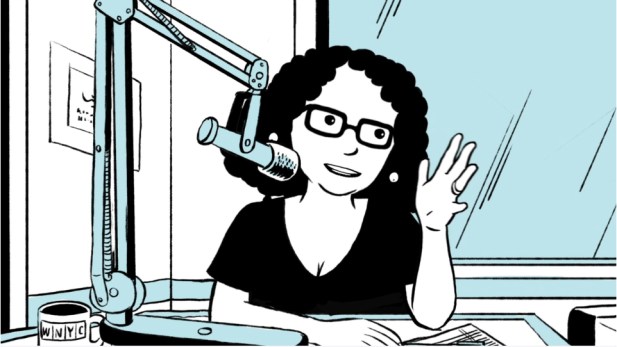
On the Media host Brooke Gladstone, in cartoon form, illustrated by Josh Neufeld for The Influencing Machine, “a media manifesto.”

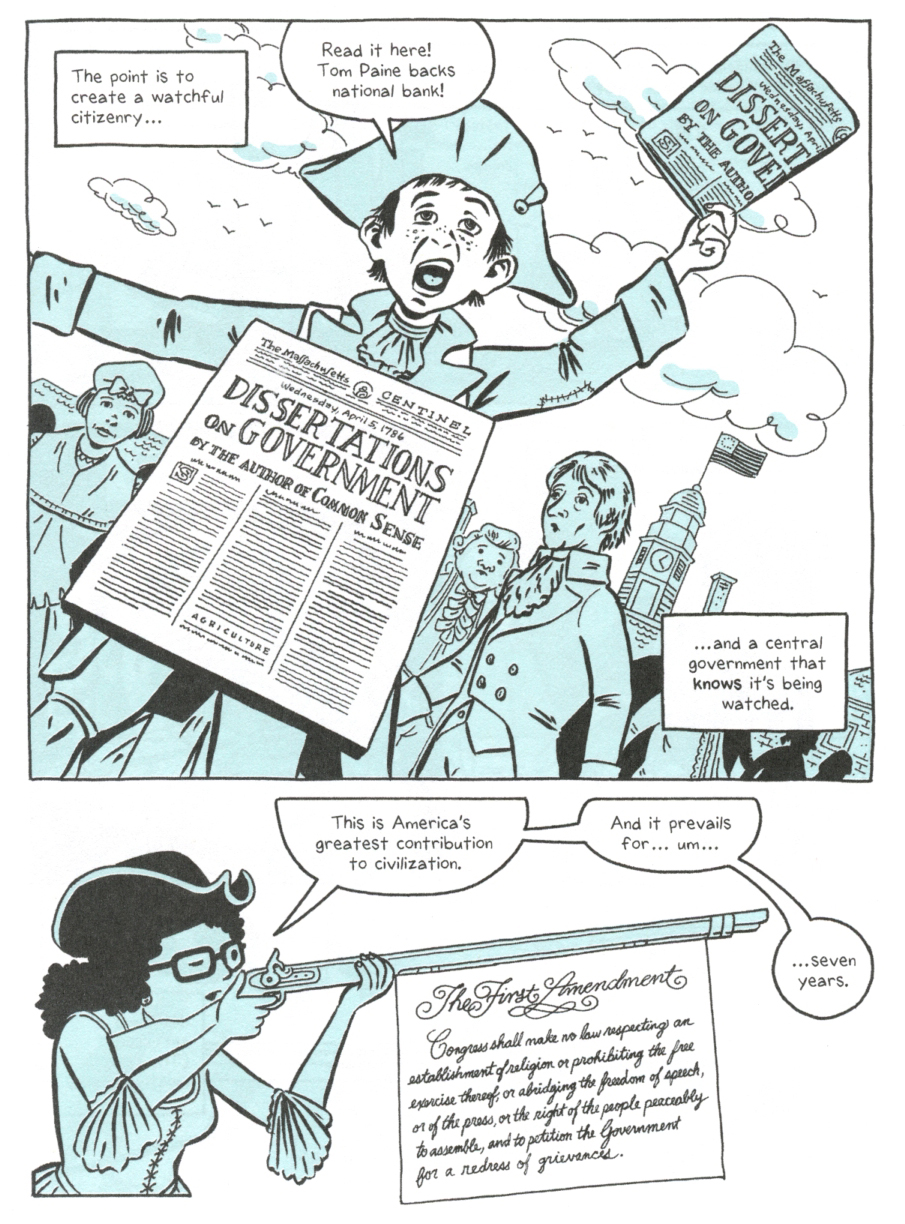
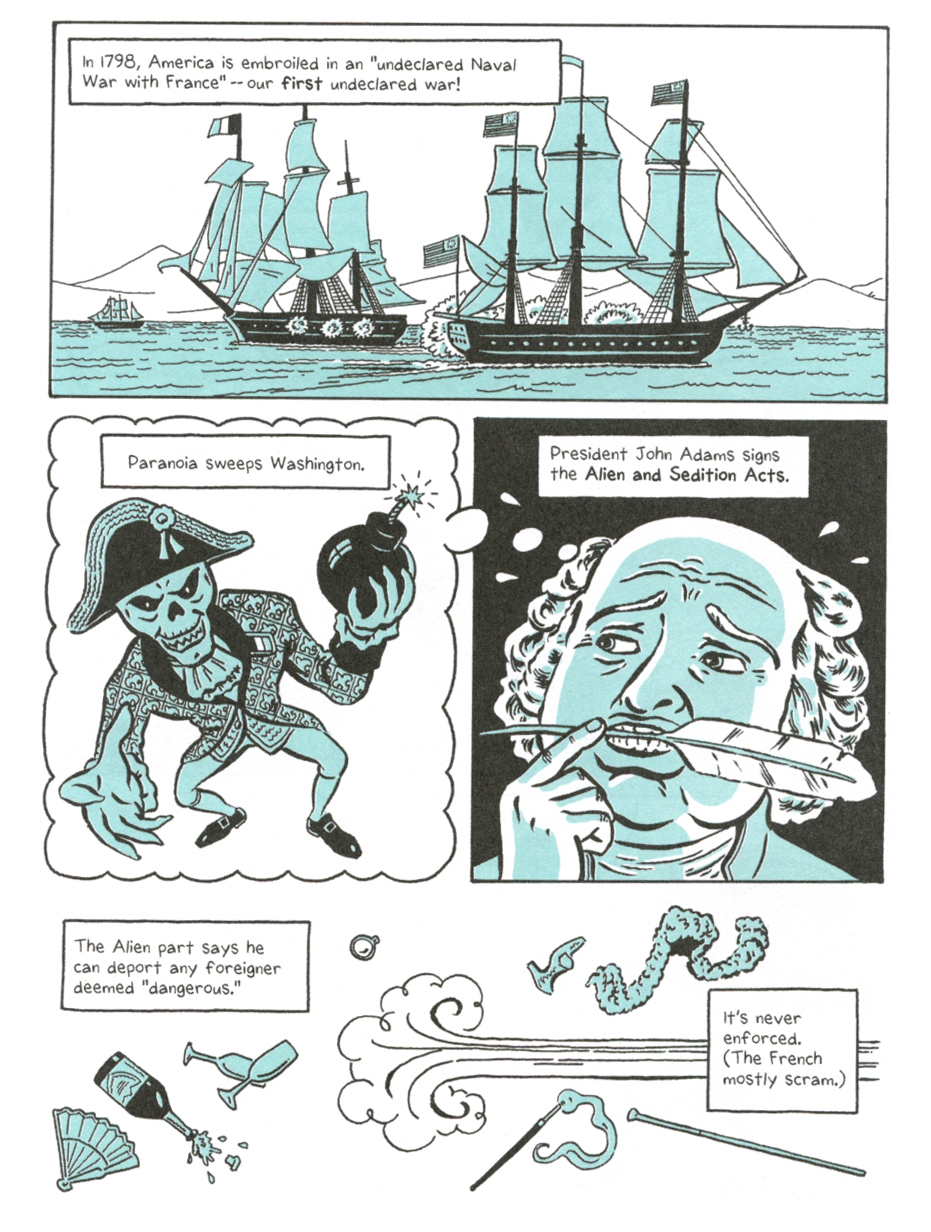
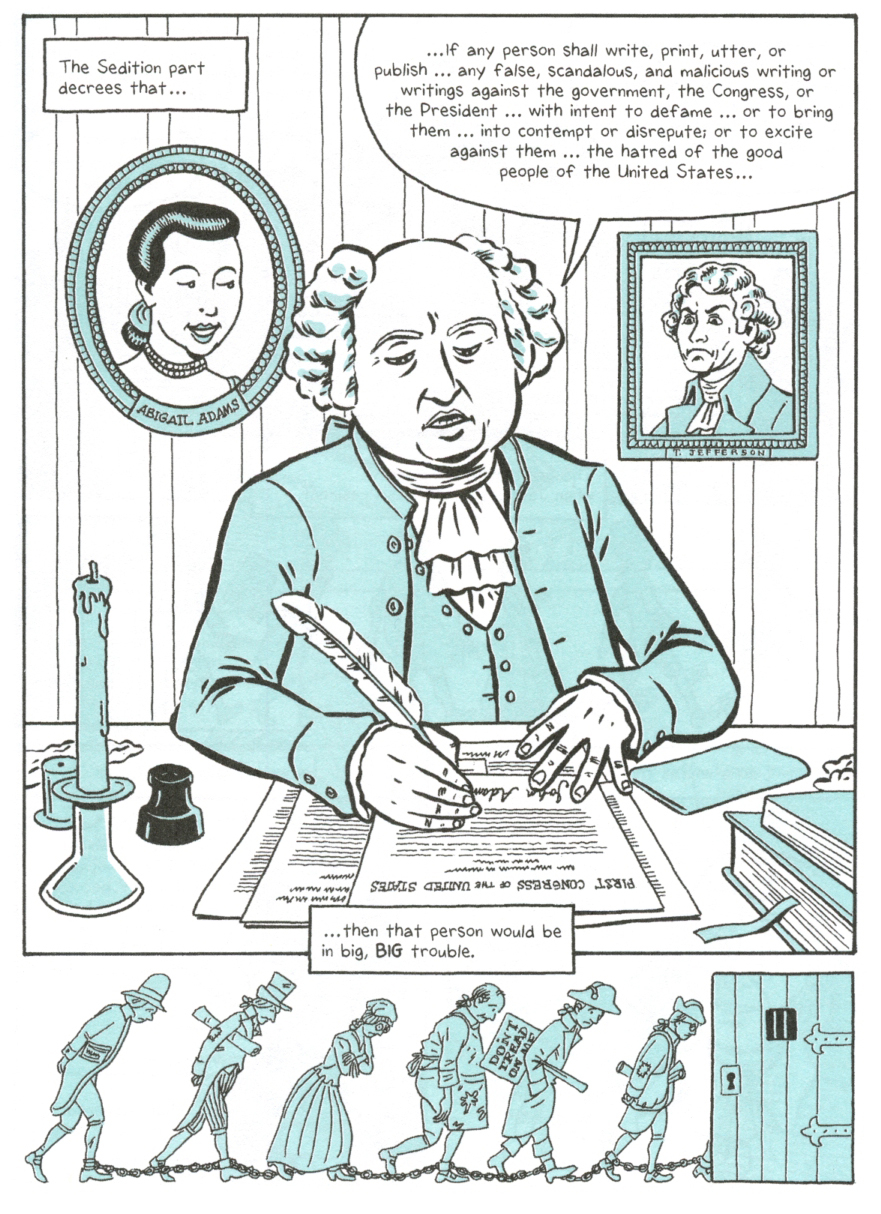
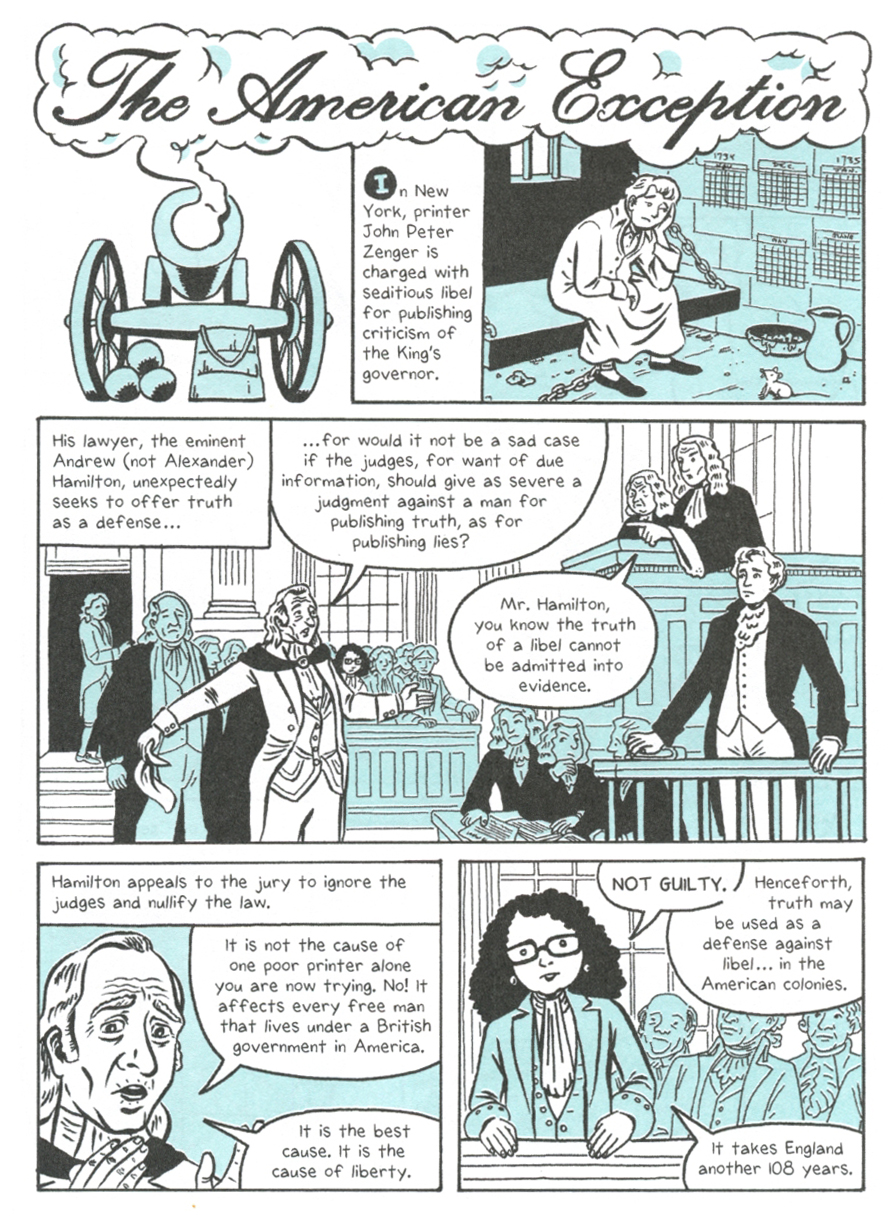
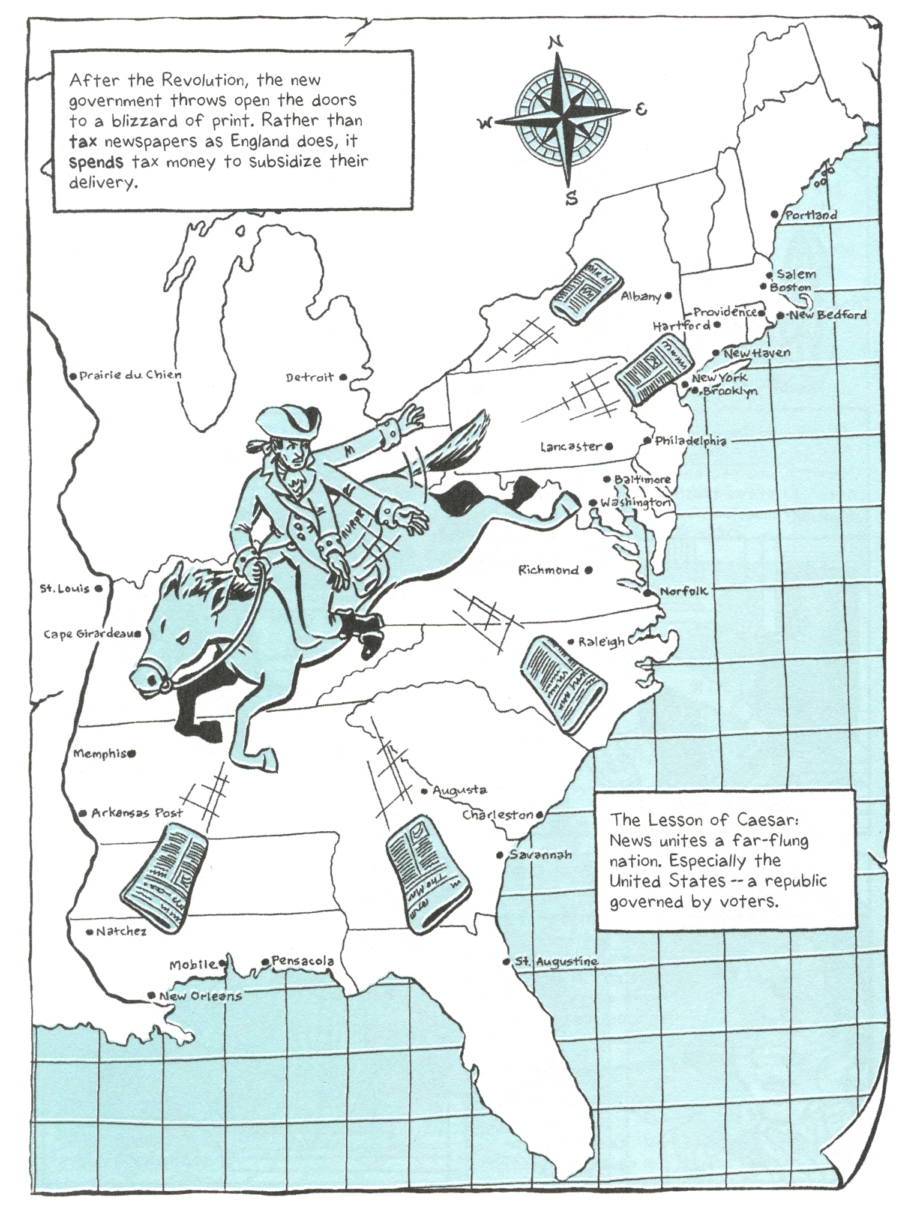
Brooke Gladstone is a brave woman. In the interest of explaining why media matters, she loses her head, plays the fool, embeds an Intel chip in her skull, becomes the robotic vitruvian woman, takes on the whole American political system (from its start in the 1700s), allows herself to be drawn in a hundred goofy ways by cartoonist Josh Neufeld, and…while on the high-wire, without a net…attempts to tell the truth about media and its influence on the ways that we think, believe, and act. In the early stages of this graphic non-novel’s development, it was “a media manifesto in comic book form.” Close enough. (If you’re interested, here’s how they did it.)

The Influencing Machine is now a paperback comic, the equivalent of a graphic novel, I guess, but it’s not easy reading. It’s a well-researched, deeply thoughtful examination of why media behaves as it does, how media interacts with law and government, and the interaction of history and philosophy. Pictures and the graphic novel style keep things light, and concise, but this is not a book to be read once, and it’s not a book to be read quickly. The starting point is news and public information, which may seem appropriate, but for most people, most media consumption is not news or information, it’s entertainment. And in that domain–which should include children’s programming, scripted comedy, scripted drama, and the variety shows that keep the masses satisfied (and have for centuries)–media’s influence is powerful, but rarely mentioned here.

She begins with a Victorian era story about machines that control people’s minds–or the fears that such a thing might someday exist.

Then, she explores the ideal of a perfect balance between effective governance and free flow of truthful information…only to find that such a balance is always outweighed by the government’s need for control.

Quoting German philosopher Arthur Schopenhauer (1788-1860):

Journalists are like dogs–whenever anything moves, they begin to bark.”

Most profound–and most evident in today’s journalism–is “The Great Refusal.” Simply stated, by Gladstone, “Few reporters proclaim their own convictions. Fewer still act on them to serve what they believe to be the greater good.” With pressure from government to suppress potentially important information (for example, think: embedded journalists and the trade-offs they must make), and lacking the necessary resources to provide information based upon research and time to consider the story so that it can be presented in context, most journalists simply parrot press releases or official statements. Along the way, they must steer clear of various biases, and play within what most people perceived as reasonable boundaries. This behavior gets everybody into trouble because the whole point of journalism should be uncovering stories that ask the difficult questions…but the system is not set up to encourage, fund, or accept that kind of journalism. Instead, posits Gladstone, we live within a comfortable doughnut. What’s more, any journalist who strays finds himself or herself either (a) famous, at least for a while, or (b) difficult to employ. The risk of the latter is very real, and so, the status quo rules.

And so it goes, as Gladstone attempts (and is drawn to be) a bird of a feather, flocking together in homophily while watching global warming destroy habitat–she calls the phenomenon of groupthink “incestuous amplification” and illustrates it with references to global warming and weapons of mass destruction. She considers reasons to be okay and reasons to panic. She wonders about dumbing down and frets about the half  of Americans who never read literature. She briefly touches on intellectual property laws, and G.K. Chesterton’s statement about journalism:

Journalism largely consists of saying ‘Lord Jones is dead’ to people who never knew Lord Jones was alive.”

And she wraps up with notions of globalism, and the ways that news is now a 24/7 global enterprise whose stories may affect us all.

There are few answers here, and the questions, well, they’re often difficult to shape and impossible to answer. At least she’s asking the questions, and placing herself in the middle of a digital storm. Thank you, Brooke, for steering clear of the obvious text presentation (mea culpa here, I’ll admit, as I write another few hundred words of text). The visual presentation, and the illustrations by Josh Neufeld, bring important ideas to life. And if there’s any interest in continuing the adventure to explore the many unexamined territories in the media landscape, count me among your first readers.

We need to talk about all of this stuff because the forces that demand silence are both powerful and ubiquitous. Even if it’s complex, even though it’s difficult to form into digestible bites, even if most people wonder why we’re obsessed with the way that media works, ought to work, and, sometimes, doesn’t work at all.

Below, some sample pages:

21st Century Debate

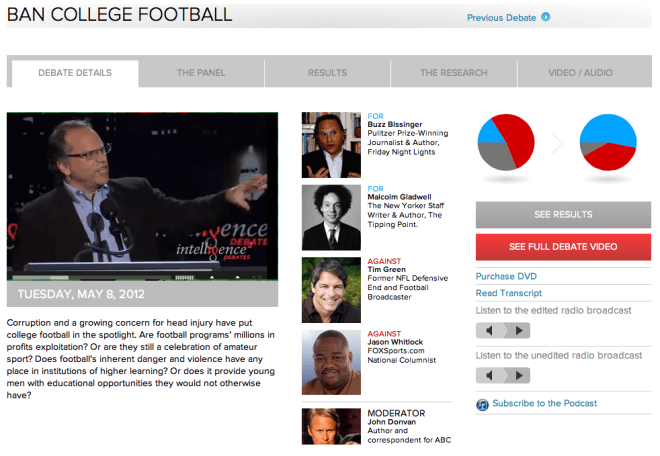
Although the series has been on the air for over five years, I discovered Intelligence ² within the past twelve months. Last night, I watched Malcolm Gladwell argue that college football was a bad idea because it involved the bashing of heads, and that, surely, there was some other game these people could play that would not, you know, involve bashing the heads of students (or anybody else, for that matter). On his team: Buzz Bissinger (he created Friday Night Lights, a popular TV series about football). Bissinger (see in the screen shot below) was strident, fierce and passionate in his well-researched beliefs: (a) colleges and universities should not be in the business of entertaining the masses, and (b) they should not be in the business of providing a farm system for professional football. On the other side, predictably, were two articulate football players who have moved on to bright careers (presumably, they, too have been beaten on the head several thousand times, but seemed to be okay with the way things turned out). Both were associated with FOX Sports: Tim Green and Jason Whitlock. In the advanced game of debate, their arguments proved to be less convincing.

Football is not high of my list of things I care about, but the debate was compelling (and, having now watched several episodes, it’s fair to say that some are very passionate and others are not as much fun to watch). The series is called Intelligence Squared. There are two teams and three rounds. First round: each team member presents his case, his ideas in detail. Second round, they mix it up by arguing with one another. Third round: closing arguments. What’s the point? At the start of each show, the audience at NYU’s Skirball Center votes on a straightforward question: “Should college football be banned?” (yes, the question is black-white and there are grey areas, discussed during debate, but not a part of the ultimate vote on the simple question). Panelists answer questions from members of the audience. End of show: now that they have been presented with convincing arguments, the audience votes again. One team wins (Gladwell-Bissinger), the audience applauds, and we’re done for the evening.

The influence of Stanford Professor James Fishkin is evident here. Deliberative Polling also involves a baseline vote, then immersion in fact-based information seasoned by strong opinion, with a re-vote after the information has been received and processed.

A look at the website suggests that this is modern media done properly. Of course, you can watch or listen to the whole debate (or an edited version, audio+video or audio only). You can listen on about 220 NPR radio stations, or watch on some public TV stations. Or, you can watch on fora.tv. For each episode, the site features a comprehensive biography on each of the four debaters, a complete transcript, and a rundown on the key points made by each debater, along with extensive links to relevant research. In short, you can watch an episode, then read a lot more from the debaters and from the thought leaders who influenced the debaters’ opinions. It’s presented in a  clean, easily accessible (non-academic) way. You can easily dive right in, learn a lot in a short time (if you wish), or spend a few hours to deeply consider what was said, why it was said, and why the voting audience did or did not change its collective mind.

The topics are provocative (and always simplified so they can be stated as a yes/no question for voting). Some examples:

BTW: If you like this sort of thing, you should spend some time at fora.tv, which features an abundance of intelligent, well-informed, well-researched lectures and discussions. Much of the material is free (advertiser and foundation supported). Fora.tv goes in directions that TED does not. And isn’t it interesting that there are now hundreds of these smart media outlets now available on the internet? In their way, they are taking the place of the 20st century dream of public television…with a broad range of ideas presented from every part of the world, abundant links to related ideas and research. Much of it is free, much of it is provocative, and very little of it is actually seen on television.

4K will be 4x better than HDTV

Even higher definition TV. Much higher. With 3D. Without glasses. We may never leave home again.

So says long-time consumer electronics public relations executive Lois Whitman in her blog, DigiDame. According to Lois: Current HD maxes out at 1080 lines or a 1080p picture. 4K HD is 4096 lines, or 4096p.

Ars Technica is a whole lot more critical.

IMHO, this is going to make spectrum reallocation more complicated. Right now, television stations and broadband operators are wrangling to use over-the-air spectrum for delivery of, well, television and broadband services. HDTV is a heavy user–and this new 4K technology will require a lot more bandwidth. Perhaps not over-the-air bandwidth, which might be put to better uses, but when we consider the available bandwidth built out by cable and satellite operators, well, 4K is likely to overwhelm their infrastucture, too. We’ll need new superDVDs or some other medium to carry the data associated with this new format… and I’m certain that will arrive soon enough.

As we Americans (and folks around the world) consider public telecommunications policy and the use of all sorts of bandwidth for television signal delivery, will 4K make the discussion, well, at least 4x more interesting? Will Snow White and the Huntsman be 4x more fun in 4KTV? Apparently, the answer is yes if (a) you sit really close to your new 4KTV, or (b) yes, if your screen exceeds 60 inches (not popular in most homes, just too darned big).

The question is: will viewers find 4x four times more interesting than HDTV? As Apple pushes its retina displays, and camera manufacturers begin to push the 20+ megapixel sensors for even-better-than-the-best imagery, when do we reach the point of diminishing returns? Does anybody need or want a 4K TV? And how might that answer change when 4K TVs are the only kind of TV that Best Buy (or whatever retailer manages to stay alive) sells in 2015?

Cool stuff, but I sure would like the manufacturers to focus on something more important than RHDTV*.

—–

* Ridiculously High Definition TV, a term I made up. You may also see the term QFHD (Quad Full High Definition), which somebody else made up.

This Just In… (from Aaron Sorkin)

I just watched The Newsroom on HBO. Aaron Sorkin in back on TV!

Probably fair to say that I was one of the dozen people who watched Studio 60 on the Sunset Strip with any regularity. Most people will recall Sorkin’s The West Wing with greater clarity.

Here’s the scoop. Jeff Daniels is a far better news anchor here than William Hurt was on Broadcast News, but the anchor is again struggling with a smartest-one-in-the-room brunette who is suddenly his Executive Producer. Once again, the anchor is a guy with issues, but in Sorkin’s hands, those issues drive the storyline. Daniels’ Will McAvoy has serious doubts about the news, his role in it, and whether journalism will ever matter more than ratings. Fortunately, there’s a moral compass, albeit one who drinks a lot. Sam Waterston is quickly mastering the craggy, seen-it-all puppeteer by way of Ben Bradlee.

Episode one contains the usual Sorkin hijinx: a bit of slapstick from the good-looking young man who doesn’t speak up until he saves the day (think Sam Seaborn, but see Jim Harper, above), the aforementioned brunette (MacKenzie McHale, who served embedded time) who takes control and out-maneuvers her mean spirited anchor (for whom she continues to carry the torch), insecure occupational glue (as the old newsroom crew is dismissed and the new one takes charge before job interviews are complete), backstories that just begin to reveal themselves, “let’s watch that again with closed captioning on” fast-talking during the key scenes, the busy workplace where important and loopy things happen simultaneously, the earnest speeches (one about Man of La Mancha) that deflate moments after their most dramatic deliveries, the open story lines that make me want to watch the next episode.

It’s all here. It’s good television. It moves, it winds, it surprises, it’s fun to watch, and it’s smart. And there’s sex, no violence.

It’s early yet, and Sorkin is still finding his footing. But it’s a real Sorkin show, and, well, it’s been a long time since The West Wing.

Now, if Stephen Sondheim would write a brilliant new musical for Broadway, everything will be back to normal.

Green, Blue, and Extremely Portable

One side is green and the other is blue. It stretches so your chroma-key productions have a lightweight, flat background. But it’s a good idea to stretch even more with clips.

Or: chroma-key, anywhere.

It’s amazing how easy portable video production has become. You can shoot high definition video with a smart phone, a tablet, a FlipCam (and similar products), an inexpensive video camcorder, a digital still picture camera… The list goes on.

Most of the time, the recorded video is real life… people in action, scenery, and so on. Sometimes, it’s interesting to explore new creative domains. Often, these explorations involve the placement of people or objects in imagined places, and this is often achieved through a technical miracle called chroma-key.

What can you (and some kids) do with chroma-key? Here’s a step-by-step example that’s fun to watch. (Click to watch the video.)

You know chroma-key: it’s the technology used to place your local meteorologist in front of a digital weather map. The subject performs in front of a green screen, and then, all of the green is (miraculously) dropped out of the image so that it can be replaced with your choice of alternative video. In fact, any color can be used as the chroma-key color, but most often, a deeply saturated green or blue is used because these colors are not (usually) seen in the colors of human skin or hair or eyes. The colored area is usually painted, or created with a cloth stretched very tightly and lit evenly. When using chroma-key, folds and shadows cause difficulty.

With these challenges in mind, I had very high hopes for the FlexDrop2 from Photoflex. The portable package is a big, lightweight fabric disc, not quite a yard in diameter. It sets up with not much more than the flick of a wrist, and opens to a taut five foot by seven foot panel. Very cool.

Mostly, the FlexDrop is flat, but the use of a small clamp here and there is necessary to eliminate all visible shadows and wrinkles. Unfortunately, it’s not a standalone device…it is designed to be attached to a lighting stand or other pipes or tubes (and these are rarely lightweight).

Hands on, FlexDrop2 really works. One person can stand in front of a field of nothing but blue (one side) or green (the other), and then, live or with a good edit application, the chroma-key process can be used to drop out the blue or green and drop in any video still, animation, graphic, or footage. Two people? Hang the FlexDrop2 horizontally. Another good use: as a background for stop-motion animation, but you will need to dress the tabletop surface with an additional green or blue cloth (exactly the same color as FlexDrop2).

At $165, the FlexDrop2 is a nice-to-have, a bit expensive unless you use it often. And, of course, there are less costly ways to make chroma-key happen: buy a cloth and stretch it yourself, paint a wall, etc. But this one is handy, portable, stretches nicely, stores without taking up much space, and does the job in a professional manner. One catch: it’s not so easy to collapse and pack away. This video shows you how to pack it up.

BTW: Thanks to Kristy and to Rebecca for their help with this article.