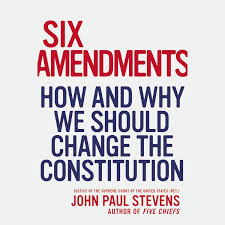
The book is entitled “Six Amendments: How and Why We Should Change the Constitution,” and it’s written by a justice who retired in 2010. While it’s difficult to read the book without wondering why Justice Stevens didn’t magically bring about change while in office, I suspect that the article that I found in The Atlantic is unreasonably harsh in its pursuit of this argument. As in:
The retired Supreme Court justice would like to add five words to the Eight Amendment and do away with capital punishment in America. It’s a shame he didn’t vote that way during his 35 years on the Supreme Court.
Those words would have abolished the death penalty by constitutional amendment. The new eighth amendment might include the italicized words:
Excessive bail shall not be required, nor excessive fines imposed, nor cruel and unusual punishments such as the death penalty inflicted.”
If you’re on death row, or if you care deeply about someone there, those five words make all the difference.
Similarly, Justice Stevens would add five words to the second amendment, forever clarifying the confusion about personal gun use as a constitutional right:
A well regulated Militia, being necessary to the security of a free State, the right of the people to keep and bear Arms when serving in the Militia shall not be infringed.”
So far, just ten words, and we end up with a vastly different free and criminal culture. And even if I am several months late in reviewing Stevens’ book and his ideas, I think every American citizen ought to be thinking about what we want from our amazingly effective governing document. Here’s another, this time about the practice of reorganizing election districts for political gain (“gerrymandering” dates back to 1812—it’s named for Massachusetts governor Elbridge Gerry). This is all new, and a bit dense:
Districts represented by members of Congress, or by members of any state legislative body, shall be compact and composed of contiguous territory. The state shall have the burden of justifying any departures from this requirement by reference to neutral criteria such as natural, political or demographic changes. The interest in enhancing or preserving the political power of the party in control of the state government is not such a neutral criterion.”
 After reading this suggestion carefully, I’m left wondering how it would be enforced, and whether politicians would pay it any mind. Maybe it’s the wording, maybe its the concept, maybe its a matter of “giving up” on the political system. That last statement, about giving up, is the whole point. We’re giving up on a system that doesn’t work as it should, perhaps because it has been gerrymandered beyond reason or recognition. Maybe Stevens has the right idea or the wrong words.
Moving on to campaign finance…
Neither the First Amendment nor any other provision of this Constitution shall be construed to prohibit the Congress or any state from imposing reasonable limits on the amount of money that candidates for public office, or their supporters, may spend in election campaigns.
New words, good idea, but we’re caught in the non-virtuous circle of politicians making rules for themselves and other politicians. Interesting article in The New York Times focuses on this issue, and on Justice Stevens’ book. (And yes, Stevens dissented on the Citizens United decision.)
One of the reasons I am writing this article is selfish. I want a good clean list of the former justice’s ideas, and I couldn’t find one on the internet, so I wrote it myself.
The last two are more complicated and require a deeper understanding of Constitutional law and government action. He would like to add “and other public officials” to
All debts contracted and engagements entered into, before the adoption of this Constitution, shall be as valid against the United States under this Constitution, as under the Confederation.
This Constitution, and the laws of the United States which shall be made in pursuance thereof; and all treaties made, or which shall be made, under the authority of the United States, shall be the supreme law of the land; and the judges in every state shall be bound thereby, anything in the Constitution or laws of any State to the contrary notwithstanding.
The Senators and Representatives before mentioned, and the members of the several state legislatures, and all executive and judicial officers, both of the United States and of the several states, and other public officials, shall be bound by oath or affirmation, to support this Constitution; but no religious test shall ever be required as a qualification to any office or public trust under the United States.
The final item is entitled Sovereign Immunity, and it’s more difficult to understand than the others. His suggested amendment:
Neither the Tenth Amendment, the Eleventh Amendment, nor any other provision of this Constitution, shall be construed to provide any state, state agency or state officer with an immunity from liability for violating any act of Congress, or any provision of this Constitution.”
O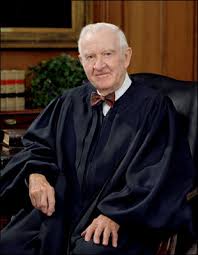 n the surface, this is clear, but it’s made more clear by the Justice’s twenty pages of commentary. In that endeavor, I’m sometimes a fan—his historical and contextual understanding is, well, supreme, but his ability to connect with a broad audience sometimes falters. The history becomes too complicated, the issues too tangled, nods to other justices sometimes adding complexity. On the other hand, we’re talking about a book that’s less than 150 pages and contains a whole lot of provocative, clearly presented material.
Wouldn’t it be interesting if every Supreme Court justice wrote a similar book?
 With digital publishing, the rules don’t apply—and for so many reasons. For example, publishers need not limit the number of titles they publish for any practical reason—there is no scarcity of shelf space. (They may limit releases due to marketing considerations, but that’s another story altogether.) Of course, bookstores are helpful parts of the marketing and distribution system, but they are no longer mandatory—Amazon ships just about any book, next day.
 Walter Isaacson is one of the smarter people in the media industry. As a keynote speaker for this past week’s Digital Book World conference, he talked about the limitations of his most recent book,
  For example, maybe a digital book is not a book at all, but a kind of game. Scholastic, a leader in a teen (YA, or Young Adult) fiction publishes a new book in each series at four-month intervals. The publisher wants to maintain a relationship with the reader, and the reader wants to continue to connect with the author and the characters. So what’s in-between, what happens during those (empty) months between reading one book and the publication of the next one in the series? And at what point does the experience (a game, a social community) overtake the book? NEVER! — or so says a Scholastic multimedia producer working in that interstitial space. The book is the thing; everything else is secondary. In fact, I don’t believe him—I think that may be true for some books, but the clever souls at Scholastic are very likely to come up with a compelling between-the-books experience that eventually overshadows the book itself.


 A monthly subscription fee buys access to a library of short- and long-form programs in four general categories: science, technology, civilization and the human spirit. Some programs are produced by Curiosity Studios—mostly, these are short-form interviews with scientists and other experts, often illustrated with animation. At the start, many of the long-form programs will come from TVO (that’s TVOntario, one of the best non-fiction producers in Canada), Japan’s NHK, France’s ZED, and of course, the BBC Worldwide. With two or three years, the service anticipates 2-3,000 titles; this year, subscribers will have access to about half that number of programs. Happily, John recognizes the challenges associated with VOD navigation, and I’m hoping to see Curiosity Stream reinvent the visual interface so that their programs are easy to find.
 The assortment of programs being assembled for the March 18, 2015 launch. Many are reminiscent of what The Discovery Channel used to be—before its prime time schedule began to resemble other cable channels (“Naked and Afraid,” etc.). Among the titles announced so far: “The Nano Revolution,” “Simon Schama: Shakespeare and Us,” “The Age of Robots,” “Destination Pluto,” and “Scotland: Rome’s Last Frontier.” There will be 4K programming, too—UltraHD for those who own the newer high-resolution TV sets—including a newly commissioned project called “Big Picture Earth” by the filmmaker responsible for “Sunrise Earth.”
 month, you can watch in standard resolution—a terrific on-ramp for viewers who are either new to SVOD or are more likely to be fairly light users, at least the start. At this price, it’s almost a trial subscription with an easy upsell to 720 HD resolution at $3.99 per month (which is all that most people probably need right now). For those with more extravagant viewing habits, 1080 HD resolution costs $5.99 per month; the 4K Ultra HD service costs $9.99 per month (but at the start, there won’t be a lot of 4K programming available—still, some is far more than most other services offer today).
 example, let’s assume that a high quality outdoor production costs about $750K to produce. If one company foots the bill, their programming budget only goes so far. But if Curiosity, for example, puts in $250K to control North American rights, and finds two partners, perhaps one in Asia and another in Europe, and each of them also puts in $250K for their respective territories, then nobody is out of pocket for more than $250K. Rights beyond North America, Europe and Asia provide additional revenue, which is typically shared by the funding producers. This “split exploitation” concept has been around since the 198os, and it works. In the SVOD marketplace, there will be many opportunities for future exploitation, which makes the venture progressively more profitable, and steadily increases the programming budgets, which generate more and better programming, and more subscribers… the circle continues to grow.
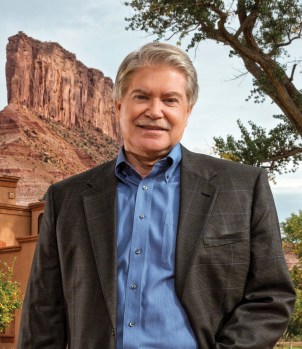 Unlike Ted Turner, whose approach to cable was mass market (TBS, TNT, and very broad-based news with CNN), Hendricks has always focused on nonfiction, documentaries, outdoors and reality (in the best sense, and also with many programming ventures way down market—Discovery owns TLC, so you can thank him for “Honey Boo Boo”). The point: he knows how to play the game, understands how to segment the market. His first pass: a three-bucket breakdown that includes (a) historically light TV viewers, the 1 in 8 of us, the 17 million U.S. households for whom TV is not a big part of daily life; (b) the connected world of perhaps 100 million cable and satellite homes, the ones that often complain that “there’s nothing good on TV” where he hopes to capture about 10 million households; and the rising 4K market, which he projects at 10 million households total and perhaps 5 million subscribers to Curiosity. By playing a more upmarket game from the start—he’s betting that there are enough documentary, adventure, curious viewers willing to pay at least a few dollars per month to see what Curiosity offers and to support what would seem to be a very promising future.
 Could he be defeated by Netflix hiring a former Discovery executive assigned to buying up lots of rights to Curiosity / Discovery -type programming from the short list of global suppliers? Sure, but it’s not likely that Netflix will zero-in on the nonfiction programs that Curiosity Stream plans to acquire. The nuanced understanding of programming for, and marketing to, this particular audience is not something that Netflix can easily replicate. Hulu probably won’t go there, and neither will Amazon. YouTube is interested in other aspects of the business, so it’s likely that John and his team will be able to build the same kind of success that they enjoyed with Discovery.
 was an extraordinarily clear thinker about things that matter. That clarity, and her passion, and her just-plain-good writing are the reasons why I will spend the winter reading every one of about fifty articles and essays in a book that her daughter Nona put together. It’s called “The Essential Ellen Willis.” I’m guessing you won’t find it in many bookstores despite the best efforts of the University of Minnesota Press, but it’s certainly available online. For someone who enjoys smart writing with more than a small dose of social conscience, it’s an ideal holiday choice.
 When I first saw Apple TV, I wondered what it was, and whether it was worth $100. By the time I saw Google’s Chromecast, I thought I understood what it was, and why it was worth $35. Neither device looks like much. Apple TV looks like a square hockey puck. Chrome cast looks like a thumb drive. Looks can be deceiving.
 ather Channel wasn’t at all concerned with weather forecasting. Instead, TWC was running an episode of “Fat Guys in the Woods” (in case there was any doubt that TV is in its pitiful final stages…). Nowadays, when I want a weather forecast, I no longer consult the TV; I find extremely local, extremely detailed, extremely up to date weather information on the internet.
 etflix, HBO GO, Showtime Anytime, YouTube, and a hundred other 21st century channels.
 Although many business leaders proceed with a comfortable pair of blinders that protect their minds from digital interference, every 21st century broadcaster, network, local TV channel must assume that the business of scheduled television is not a long-term proposition, and must also also assume that their job is to promote viewership of individual programs anytime anywhere via any device that the viewer wants to use. Apart from QVC, almost none of the original 24/7 cable experiences remains intact (MTV no longer shows music videos 24/7, CNN no longer shows news 24/7, The Weather Channel no longer shows weather 24/7, etc.) Still, the old TV channel brands face a bright future—on many platforms, not as TV channels.
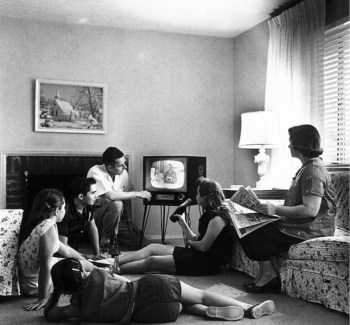 The broadcast spectrum is free, but we allowed, and encouraged, the likes of Comcast, to replace the use of free TV spectrum with a service that now costs more than a thousand dollars per year. Quite reasonably, the U.S. government figures, why reserve the spectrum for television broadcasters if so few people are watching those broadcasts over-the-air. In fact, why not sell off the spectrum for other purposes? That’s starting in 2016—probably about 10-15% of the TV spectrum will be sold by local TV stations to the government, which will flip the spectrum and resell it for wireless internet use.

 He’s a theater director and choreographer with a list of impressive, and recent,







 To begin, think not about the objects, but about our desires. We want to know it all—but not all of the time. Sometimes, we just want to know whether it’s cold outside, or whether the dog has been fed. We don’t know the details, don’t really need to know the precise temperature or the moment in time when the dog’s bowl was filled with food. So instead of a thermometer, or, more intensely, a digital thermometer that reports temperature to the tenth of a degree, how about a glowing orb? Or, as author-scientist-innovator-professor David Rose describes his invention, an Ambient Orb. He writes, in his new-ish book, Enchanted Objects, “They aren’t disruptive. They have a calm presence. They don’t require you to do anything…They are there, in every room of the house with the exact information you expect from them.” So he reimagined a crystal ball that contains LEDs that change color, and report the information you need by glowing in your choice of hues. “As the colors change, you glance and know if the pollen count in the air is higher than usual.”
 Why not a jacket that hugs the wearer every time she receives a “like” on her Facebook page? (This, from one of David’s students.) Or a toothbrush that knows it is being used (and being used properly), and recognizes your good work, rewarding you with a discount at the dentist? (Oy. The gamification of dentistry! Nah, not in David’s hands. He’s smarter than that—check this out.) One of his entrepreneurial firms was hired by a big pharmaceutical firm to bring some life to the little plastic pill containers. Hoping to change the behavior of the the many patients who do not take our prescribed meds, David’s company, Vitality, changed the cap. The cap glows when you’re supposed to take a pill. Even better, the GlowCap texts you when you’ve forgotten to take a pill, and automatically sends refill messages your local pharmacy. The “adherence rate” is up to 94 percent, far better than the 71 percent achieved by a standard (boring, non-glowing, non-internet connected) vial. It’s information at a glance, again non-disruptive.
 David’s vision of the future: whatever the device may do, it must be affordable, indestructible, easily used, and, when it makes sense, wearable. Lovable, too—his clever illustration of interactive medicine packaging are based upon faces that transform themselves. They’re happy when you’re doing the right thing, grumpy if you’re not.
 David dreams of on-demand objects, and objects that learn and respond to personal needs. Vending machines, for example, that customize their offerings based upon “a prediction of what the person will like.” He envisions “digital shadows” for objects—information associated with physical objects enhanced by digital projection.
 Digital Insider