A Re-Introduction to Two-Channel Stereo (Part 4: Pre-Amplifer)

Just to review: an integrated amplifier combines two functions, pre-amplification, and amplification. A pre-amp accepts  incoming signals of varying strength–from the CD player, FM tuner, and phono system–and makes the necessary adjustments on the way to the amplifier. Your volume adjustments are made on the pre-amp, too. In theory, a pre-amp should do little more than equalize the signals, and allow you to switch between the devices. In practice, your choice of pre-amplifier will greatly affect the way your system sounds, so it’s worth experimenting with several models before you make a decision.

A good pre-amplifier will cost over $500. You can spend a bit less, but you won’t get much for your money. You can spend many thousands of dollars on a pre-amplifier, and we will cover more expensive models later in this series of articles. For now, let’s have a look at what $1,000 will buy–and for that exploration, I often turn to a long-time favorite manufacturer in this price range, Rotel.

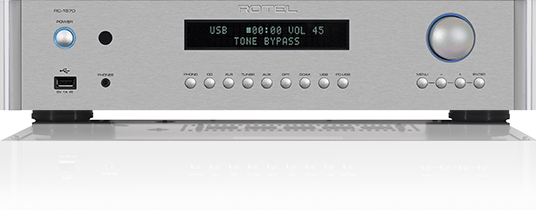
Specifically, let’s explore the Rotel RC-1570 ($999). And let’s have a look at the front and back panels of this pre-amp because we’ll be referring to the various features in a moment. (FYI, there’s a black and a silver model.)
rc1570_silver_0rc1570_back_0

As with any pre-amplifier, you’ll find a power button, a volume control, an input selector, and, on mid-priced models, a headphone jack. This particular pre-amp offers a whole lot more–a trend that is gaining favor. On the left, there’s a USB connector so you can attach a mobile device (an iPhone, etc.). There are a lot of other inputs, discussed below, and there is a visual display that provides a remarkable range of technical information. These features are uncommon, but all are welcome.

In fact, the back panel is the place to go for a clear understanding of capabilities. Let’s take a closer look.

rotel-pre-amp-diagram

On the left, there are two rows, one for the left and the other for the right channel. First up is the phono input–this pre-amp includes an equalizer for “Moving Magnet” or MM phono cartridges (some pre-amps do, others do not). You can also plug in a CD player, a tuner, and two other devices. All with RCA-type plugs. Then, there’s the output–both via RCA plugs and also via XLR connectors as “Balanced Output” (a different way to connect components that often reduces background noise and adds considerable clarity). There is one Balanced Input pair of jacks, too. There are some additional digital inputs useful for connection to a TV set top box, or a Blu-Ray CD player–in addition to the basic two-channel experience that is the principal purpose of a stereo preamplifier. And there’s more–but now we’re getting way beyond the typical operation of a pre-amplifier. (Perhaps that’s why Rotel refers to this model as a “Control Amplifier”–it does a lot!

It’s easy to get caught up in features, but before we move on, I’ll mention two ideas that aren’t typical of pre-amps, but make this device a pleasure to use. First, the volume control comes with a kind of memory–when you listen to a CD player, for example, it will remember the most recent volume setting, even if you turn the power off. It’s smart enough to recall the most recent setting for each of your devices, so the next time you play a record, it will remember the most recent volume setting for that device, too. Pretty cool! Second, you can attach a USB receiver so that anyone (with a password) can wirelessly connect and play music through your stereo system. Nice!

I am not an engineer, but friends who know audio engineering design are often impressed with the “build quality” of Rotel products. Often (but certainly not always), good design translates into a good listening experience. We can speak of particular transformer designs or the specific qualities of the Wolfson D-to-A converter, but that’s beyond me and most other people. And now is a good time to set expectations: this is not a high-end stereo pre-amplifier, but it is a very good mid-priced pre-amplifier. The difference is explained in a review of this device, and its paired amplifier, by The Absolute Sound, a leading audio journal:

The sonic question for components in this price range is not whether they can produce a fool-you facsimile of the real thing. Unfortunately, barring a technological revolution, they can’t. The more pertinent question, then, is whether they get enough sonic elements right—and whether those strengths are not overly compromised by the inevitable trade-offs—to convey music engagingly. “Engaging” is a word we high-enders use as shorthand for the cumulative effect of a multitude of sonic factors, but I believe that chief among these are the elements that most directly impact musical expressivity. Speci cally, I look for good timing, tonality, and dynamics.

As someone with a similar system in one room of my home, and a bona-fide high end system in another, I can attest to the difference. That said, listening to the RC-1570 is a pleasure, especially when paired with the RB-1552 Mk II Stereo Power Amplifier, and the sister CD player, the RCD-1570 CD Player. Each of these components costs $999–add a good turntable with an equally good cartridge for another $500 (the Rega RP1 with a Rega Bias 2 phono cartridge is on sale for $445 from Audio Advisor). And you’ll need loudspeakers. Total system price: about $5,000, but if you needed to come down a bit, I would probably cheat on the CD player (a $500 unit from Cambridge Audio or NAD would probably be fine.)

Gee, does that sound like a lot of money? We’ve only just begun. For most people, a $999 dedicated preamplifier is a major step forward, the beginning of a serious two-channel stereo system. And yet, $1,000 is considered a modest investment in high quality sound. As this series of articles continues, we’ll get into more costly gear. In fact, the next article, which is about power amplifiers (or, if you prefer, amplifiers) will begin to explain the virtues of a larger investment.

I should mention that Rotel makes an even more versatile pre-amplifier, the RC-1590. The step-up adds a lot of features and technology. See it here.


Be sure to explore more than one pre-amplifier. You’ll find different features and a different sound. One of the most popular is the Parasound Halo P7 7.1, which costs $1,699 and comes with a very wide assortment of RCA and XLR inputs and outputs. The phono input accommodates both a Moving Magnet and a Moving Coil cartridge. There are home theater capabilities, too.

If you’re seeking something simple–fewer features, more of a focus on sound–you’ll likely jump up into a somewhat higher price range, and you’ll be encouraged to explore the various advantages of tube vs. solid state pre-amps. Again, a topic for another day.

A Re-Introduction to Two-Channel Stereo (Part 3: Integrated Amplifiers)

The first two articles in this series covered the basics of tw0-channel stereo: a low-cost turntable, modest amplifier (built into the powered speakers), and the first steps toward a better system: the choice of loudspeakers that require a separate amplifier. For now, we’ll stay in the budget category, but this is the article where we’ll make a turn into the future of this series: equipment that offers a far more realistic, compelling, rich and entertaining presentation of recorded music. We’ll spend more money, and we’ll look at options for saving, or at least, investing with intelligence for the best long-term results.

A quick lesson before we get into specifics. You may recall that a receiver is a box that contains an AM/FM tuner, an amplifier called a phono stage that adds power to the tiny signal emanating from the phono cartridge on your turntable, a pre-amplifier to provide a similar function for the tuner and your CD player (or MP3 player, etc.), and a power amplifier (usually just called an amplifier) to provide enough energy to the loudspeakers. Each of these is available as a separate box, or component in audio lingo. The quality of each of these components affects the quality of the sound you hear through the loudspeakers. The quality of the cables that connect these devices matters, too–and you can spend tens, hundreds or thousands of dollars on these cables (again, a topic for a later article in the series).

Continuing for a moment with lingo: when purchasing amplifiers in the hundreds-of-dollars range, it’s  wise to consider an integrated amplifier. This device contains a pre-amplifier and a power amplifier, and often, a phono stage, too. Let’s start there, and consider completely separate components later on. Set aside $350 to $500 and you’ll be able to buy your first integrated amplifier–it won’t be a world beater but it will provide clearly delineated instruments and vocals, a bit cleaner bass and mid-range than you’d experience with a less costly setup, highs that don’t cause discomfort, and some presence or realism. You’ll be attaching this integrated amplifier to a pair of loudspeakers that cost about the same amount of money, and to a turntable and phono cartridge assembly that also costs a few hundred dollars. In total, your new stereo system will cost about $1,000. And we’ll step it up: if you purchase the right equipment, a greater investment should increase your listening pleasure. (Of course, it is possible to spend serious money and end up with lousy results. I’ll try to help you steer clear of this messy situation.)

rsz_205_smu_cambridge_3

The Cambridge Audio Topaz AM10 is a popular entry-level component for those interested in high-end audio. Be sure to read the review in The Absolute Sound (see link in text).

Crutchfield is one of several internet retailers who stock integrated amplifiers in this price range. Often, the discussion turns to the number of watts–in essence the power of the amplifier to drive loudspeakers. It may be tempting to focus on a 40 watt amp instead of a 25 watt amp. If you are driving large loudspeakers, extra power may be a consideration, but the difference between 40 and even 100 watts may be inconsequential because every loudspeaker and every room behaves differently. One good choice in this price range is NAD’s 40-watt model, a product from a respected low-cost manufacturer of long standing. Cambridge Audio Topaz AM10 also comes from a well-regarded maker (reviewed by top audio magazine The Absolute Sound here). Go up to the $500-600 range and the quality of the sound will increase, along with the number of available inputs (mostly not useful in today’s two-channel world), along with the the range of available features (most of which, you will never use). In this higher range, I would again look at NAD’s current offering (each manufacturer offers a product in this price level, but the model numbers and some features vary from one year to the next). This level also introduces components from Pro-Ject, a popular high-end maker with some lower cost products in their line: here, the MaiA for $500 with a convenient USB input (more and more popular among integrated amps). Find the NAD units in the extremely helpful, twice-annual Recommended Components edition published by Stereophile magazine.

In a larger room, you may want an integrated amp with more power or more refined electronics (resulting in more refined sound reproduction)–Cambridge, Pro-Ject, NAD, Marantz, and Yamaha are good manufacturers for those who wish to invest $1,000 or more. And now, we’re beginning to enter a more exotic realm, the world of high-end audio.

Why would you spend $2,000, or $4,000, or more on an integrated amplifier? There’s a simple answer. If you select the right integrated amplifier for your room, listening habits, and style of enjoyment, the music will simply sound better. At first, you may not buy into this way of thinking. You might even listen to one or two high end systems and proclaim that you do not hear a difference. While that may be true for you in a certain time and place, you will begin to discover differences as you take the time to quietly listen and compare one system to another. Why bother? Because we all spend a lot of our lives listening to music, and the experience can be extraordinary. Imagine enjoying an extraordinary experience every time you listen to music at home. That’s why you begin to invest in better audio equipment–and, inevitably, more recorded music, more LPs, and if you like, more CDs, too.

nait5si_1

The Naim NAIT 5si is an excellent choice for those who want to establish themselves in a high-end audio environment without spending a great deal of money. It comes with 60 watts per channel–sufficient for most mid-sized rooms and most listening levels–connections for a single pair of loudspeakers, a CD player, and your choice of other A/V equipment. There is no phono stage in this component–you will need to buy that component as a stand-alone. (See subsequent article about the phono portion of your new two-channel stereo system.)

In this category, one solid candidate for your long-term stereo system would be the Naim NAIT 5si, an update of a popular integrated amplifier first released in the early 1980s. The new model, released in 2015 for about $1,895, is typical of higher quality gear. And here, we dive into some tech talk. The quality of the transformer and the power supply matter a lot, and they are among numerous electrical and electronic parts that demonstrate the benefits of modern design and modern materials (capacitors, for example). In real terms, this means the newer product offers much improved sound: an open presentation that allows each instrument to be distinctly heard with nuance, even when the volume is turned down. The attack and decay of a snare drum sounds more realistic, more energetic, more captivating. The details become clear–listeners find themselves describing albums that they’ve heard a thousand times and are only now hearing the details. With speakers properly positioned, the Naim NAIT 5si and its kin generate a wonderfully wide and deep soundstage–close your eyes and you’ll imagine the musicians individually positioned, not only from side to side but also, remarkably (and magically) from back to front, and also from top to bottom. Some of this may seem like complete nonsense, but I have experienced the phenomenon time and again, and I have invited many other people, particularly the doubters, to engage in a similar experience. The Naim NAIT 5si has been well-reviewed, and it’s comforting to read a few positive reviews before you buy.

For about $400 less, you can make yourself happy with the Peachtree Audio nova150, pictured below. The earlier version of this product was nicely reviewed by one of my favorite (plain language!) reviewers at Stereophile magazine who goes by the pen name, Sam Tellig. Acknowledging that this is review of a somewhat different product, Tellig is wonderfully helpful in describing the characteristics of what remains a $1,500 integrated amplifier–one of the best you can buy in this price range. Just be sure to compare specs with the current model before you buy. And to keep you busy (and well-informed), here are some reviews of the newly designed 150.

peachtree

USEFUL ADDITION (November 30, 2016): The distinguished audiophile magazine, The Absolute Sound, just published its 2017 Buyer’s Guide to Integrated Amplifiers. If you’re considering the possibilities of a quality integrated amp, the guide is a superb reference.

Why buy an integrated amplifier when you could buy a separate power amplifier and pre-amplifier? That’s the next question we’ll tackle in this series.

A Re-Introduction to Two-Channel Stereo (Part 2: Basic Loudspeakers)

So we’ve begun. A brief explanation of older and modern two-channel stereo systems with a quick stop by two web sites, one to buy a pair of low-cost powered loudspeakers and the other to buy a turntable with a built-in phono amplifier to boost the strength of the signal coming out of the tiny phono cartridge. The system is adequate for a small room, and for very casual background music. The music sounds, well, just okay: clear enough, but not very lifelike. Certainly better than the sound you’ll hear from most of what’s available on streaming services, or from your iPhone, but quite low on the scale of what is achievable.

Throughout this series, we’ll seek out incremental steps as we improve various parts of the stereo system, sometimes taking big steps, sometimes modifying just one piece of equipment, sometimes several at a time. We’ll consider the various technologies and options now available–some offer substantial leaps in quality, and others offer more refinement and incremental joy.

For this step, let’s keep the turntable as-is: a $250 investment including the cartridge and some amplification of modest quality. But let’s separate the loudspeakers from their built-in amplification. This opens a wide gamut of opportunities to employ both new and used loudspeakers, each with its own particular personality, or acoustic characteristics. For example, some loudspeakers will offer improved bass but less clarity in the higher treble ranges, or greater detailing, or a more realistic sense of instrument placement in the panoramic sound field made possible by combining the sounds from the stereo system’s left and right channels (a bit of stereophonic magic that can be even more profound in surround sound systems involving five or more loudspeakers–an exploration for another day).

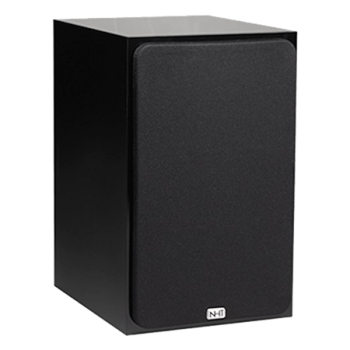
A very simple black box: the NHT Super Zero loudspeaker, a long-time favorite.

A very simple black box: the NHT Super Zero loudspeaker, a long-time favorite.

So, what we want is a pair of good-sounding, reasonably inexpensive loudspeakers offering just enough of each of those key ingredients. If you’re buying new loudspeakers, NHT offers a pair of their very popular Super Zero 2.1 loudspeakers for about $350. The company has been making reasonably priced, good-sounding loudspeakers since the 1990s. What I like about them: they’re clean, free from any obvious or annoying flaws, well-balanced in their bass, mid-section and high ranges and accurate. They are not $3,500 speakers, so don’t expect deep and clear bass, or silky strings, or extraordinary nuance in the vocals, but for most listening purposes, they are very satisfactory, and very enjoyable.

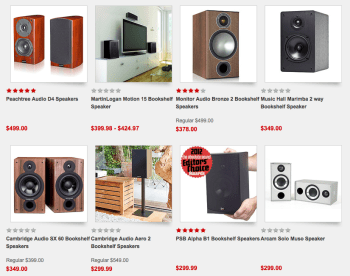
As a rule, loudspeaker manufacturers attempt to organize their product lines by price points. Many offer a “bookshelf” speaker for several hundred dollars to meet basic needs. PSB’s Alpha B1 costs $300 for the pair, and you’ll find a similar pair from Peachtree Audio, their SX60, for $350 to $400, and these compete with Monitor Audio’s Bronze 2, currently marked down from $500 to $378–all of these speakers are/were available from Audio Advisor, a leading web direct marketer, alongside speakers and other audio gear at prices from the hundreds to the thousands of dollars.

Here's an selection of bookshelf speakers offered by Audio Advisor. In the second row, note the speaker on a speaker stand. And on the top row, note the use of small speakers as part of a home theater setup.

Here’s an selection of bookshelf speakers offered by Audio Advisor. In the second row, note the speaker on a speaker stand. And on the top row, note the use of small speakers as part of a home theater setup.

I put “bookshelf” in quotation marks because you should NOT place these small speakers in a bookshelf because they will not very good. Instead–and here’s the first of many lessons learned from audiophiles–allow several feet of open space around the loudspeakers so that nearby surfaces do not reflect the sound. Initially, this may sound like complete nonsense, and admittedly, you may not hear any substantial degradation in a low-priced stereo system, but once you do notice, you’ll be redesigning your listening area until you eliminate the uncomfortable sound. Since loudspeakers cannot be suspended from mid-air, you will want to invest at least $100 in loudspeaker stands for your bookshelf loudspeakers. Or, you will want to invest in tower speakers–larger rectangles that are several feet high and often represent a step-up in sound quality (and price). More on that upgrade in an upcoming article.

One further note: the placement of loudspeakers matters. A lot. An expensive pair of speakers can sound just awful if they are not carefully placed. And an inexpensive pair of speakers can sound surprisingly good if they are in the optimum position within the listening area. To begin, nothing should be closer than a foot from any wall or large piece of furniture, and ideally, two or three feet. Then, imagine an equilateral triangle with you at one point, the left speaker at another, and the right speaker at another. Generally, the front panel of those speakers should face you very directly. (Avoid the temptation to angle the speakers.) Why bother? The stereo effect will be far stronger: instruments and vocalists will suddenly become clear and distinct images–the bassist over there, the piano over there, the singer center stage, etc. It’s an amazing thing–the way even modest loudspeakers can “image” when they are properly placed. And yes, you may need to do some rearranging of furniture for the optimum effect. If your loudspeakers sounded better in the store, placement is probably the secret sauce. Experimentation is part of the process because every room is different and because furniture, carpeting and other stuff affect the traveling sound waves as they move from the loudspeakers to your ears. Despite what others in the household may say, this process is always worth the time and trouble–and is often a good reason to find a room where you can be left alone to listen to your music.

Do you need new speakers? Your money may go further if you purchase a high quality pair of used speakers–but you must choose very carefully.

I found this pair of Thiel 2.2 loudspeaker on eBay for $490. You'll need a better amplification system to make the most of these speakers--we'll cover that in a future article--but these were considered very good in the 1990s (the larger 3.6 speakers were even better, but they require even more sophisticated equipment--also the topic of a future article). No surprise that these speakers require a local pickup in the SF Bay area where the seller is located.

I found this pair of Thiel 2.2 loudspeakers on eBay for $490. You’ll need a better amplification system to make the most of these speakers–we’ll cover that in a future article–but these were considered very good in the 1990s (the larger 3.6 speakers were even better, but they require even more sophisticated equipment–also the topic of a future article). No surprise that these speakers require a local pickup in the SF Bay area where the seller is located.

If $350 is within your budget, you might also consider a pair of used loudspeakers purchased from a very reliable local dealer. It is not unreasonable to search for a pair of twenty year old loudspeakers that may have cost up to $1,000–offering a great deal more quality–but the search may require several months of patient web searches and store visits, and some driving (figure a 100-300 mile radius, even if you live near several large cities). You’ll need to study to find the manufacturers whose products were reliable, high quality, and available in the used marketplace–and, unfortunately, information on the web is neither consistent nor abundant on these topics. If you have a friend who cared about loudspeakers in the 1990s or 2000s, a joint exploration is recommended. And I cannot emphasize the importance of a very reliable, trustworthy dealer quite enough. If you’re willing to take the time, you could certainly explore these and other quality brands: Thiel (for some ears), Magnepan (flat panel speakers employing a unique technology), Dynaudio (extremely accurate), KEF (good all-around), B&W (now marketing as Bowers & Wilkins), Celestial (good all around), and the list goes on (please add your favorites in the comments area below).

If you want to dig deeper, spend some time exploring this historical survey of superior audio equipment. It’s part of a massive website published by the longtime high-end (expensive, fine-sounding) stereo enthusiast magazine, Stereophile.

To some extent, the loudspeakers you find in the U.S. may be similar to those found in the U.K., France, Germany or Japan. Each region of the world has its own loudspeaker makers, and remember: the larger the speaker, the more costly the shipping. In the U.S., you will find a lot of European speakers and a lot of American-made speakers, but the selection is likely to be more local in other countries.

Now that we’ve got the loudspeakers, we’ll need to purchase an amplifier, perhaps an integrated amplifier to start. That’s coming up next.


A Re-Introduction to Two-Channel Stereo (Part 1)

Somehow, stereophonic sound has survived. The excitement began in the 1930s, but it wasn’t until the late 1950s when consumers could buy their own stereo record albums and their own stereo turntables. By the 1970s, many college students and music lovers owned their own stereo systems: a receiver, a turnable, and a pair of matching loudspeakers. We were quick to point out that a “turntable” was not a “record player”– a turntable contains a spinning platter, a tone arm, a phono cartridge, and within the cartridge, a tiny stylus (replacing what had previously been called a “needle”). A receiver, by the way, serves multiple purposes: it is an AM/FM radio tuner, a phono stage (to amplify the modest signal emanating from the phono cartridge), a pre-amplifier (to amplify the signal coming from the tuner, and later, from the add-on cassette or CD player), and an amplifier (a more powerful set of circuits to energize the loudspeakers). Early audiophiles incorporated a reel-to-reel audio tape recorder, which allowed recording of radio broadcasts and LPs, and live performances–the first time these capabilities were available to non-professionals. Some audiophiles purchased  headphones so they could listen without disturbing others, an old-school courtesy enabled by a technology that was considered somewhat exotic at the time. Nowadays, the tuner is hardly a necessity, the cassette or tape recorder has been bypassed by the digital revolution which eats its young (CDs and DVDs are enjoying their final productive years), but the turntable is in the midst of a resurgence, and headphones have never been more popular.

Here's a wonderful example of a 1970s stereo system (but few people owned two turntables). This image comes from a collector of 1970s stereo equipment (click on the link for more pictures and some stories). You are looking at: a Marantz 2330b receiver, a Thorens TD-165 turntable, a Thorens TD-126 turntable, JBL L96 speakers, and an Akai GX-266D reel to reel tape deck.

Here’s a wonderful example of a 1970s stereo system (but few people owned two turntables). This image comes from a collector of 1970s stereo equipment (click on the link for more pictures and some stories). You are looking at: a Marantz 2330b receiver, a Thorens TD-165 turntable, a Thorens TD-126 turntable, JBL L96 speakers, and an Akai GX-266D reel to reel tape deck.

By the 1980s, this system might have included an audiocassette deck in place of the reel-to-reel recorder, and a Graphic Equalizer–an elaborate set of tone controls that allowed listeners to emphasize or de-emphasize treble (high tones), mid-range, and bass. Generally, systems like the one above were intended for people who listened to rock music–electric guitars, deep bass, powerful drums. If the room was shaking but nothing was tumbling from the shelves, then the bass was not sufficiently powerful.

Today, two-channel stereo is simpler, more elegant, and sounds a whole lot better than it did in the 1970s. If you’re unearthing a system from somebody’s basement or attic, you might consider an upgrade, but most people will be happier with the sound that a new system can provide.

Basically, you need a pair of loudspeakers, an amplifier, and a turntable with a good new cartridge. And some cables (the quality of the cables affects the quality of the sound; more about that later). Some loudspeakers contain built-in amplifiers, allowing for a very simple setup. Most people do not buy a CD player–unless you’re sitting on a nice collection of discs. And most people don’t need an AM/FM tuner–but some people enjoy listening to a particular FM station. And so, most people do not require a stereo receiver–unless the system is intended to double as the center of a home theater (a role that can be performed, quite adequately, by a two-channel stereo). No need for a remote control either.

So let’s start simple. As this series of articles progresses, there will be ample opportunity to spend a thousand dollars, five thousand, ten thousand, and more. Let’s not get ahead of ourselves. Let’s start with a nice, new, modest system for $500. Visits to just two web sites take care of business:

at_lp120_usb_1_sqa2_plus_r-front_lbl3

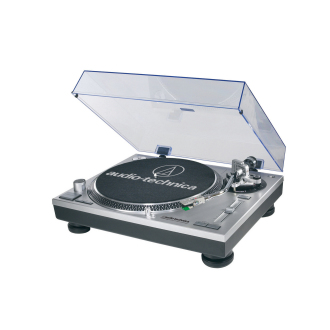
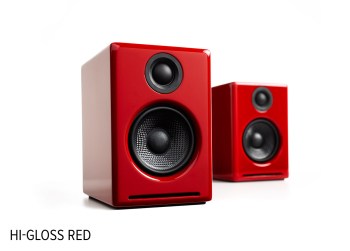
The first is Audio-Technica, a long-time maker of turntables, phono cartridges, headphones, microphones and other gear. Take a look at the AT-LP120-USB Direct Drive turntable. Buy it directly from the manufacturer for $249 (if you shop around, you won’t find it for much less). This particular turntable is unusual because it contains a small phono pre-amp (see above) so you won’t need an intermediate piece of equipment to plug it into a pair of powered loudspeakers. Which ones? Try the A2 Powered Desktop Speakers from AudioEngine— they also cost $249 direct from the manufacturer. If you want something that sounds better (more detail, more presence, clearer treble and bass, more punchy bass), move up to the A5+, found on the same website. The lower priced model is available in the nifty red color and black or white; the higher priced model is available with a wood veneer, or black or white.

So we’ve begun. And you can start listening to LPs with your new stereo system before the holiday. As we proceed, we’ll listen to a lot of music, spend a lot of money, and concentrate on the many reasons why investments in quality sound reproduction make so many people happy.

As a further inducement–you can buy LPs for just a few dollars. Sure, the ones in Barnes & Noble cost over $20, but that’s high-end, heavy duty vinyl, the latest in a long series of record industry schemes to collect more money from consumers. I ignore most of them. Instead, I seek out the best of dozens of old school record stores because many of them sell LPs, in very good condition, for five dollars or less. Classical albums are especially difficult for the stores to sell, so many of them cost even less. (Collectible rock and jazz albums cost more.) There is much to be said for used LPs from a reliable retailer–and much to be said for giving your used records a bath (being careful not to wet the paper label or to scrub too hard when drying them). As this series progresses, I promise to tell you where to find these stores, and the best online sources, too.

Much more to come. I hope this series turns out to be helpful to you.

The Vinyl Blip

Although streaming music is a wonderful convenience, I strongly prefer recorded music that I can hold in my hands. I enjoy listening to CDs, and I have never stopped enjoying LPs. Given the resurgence in the buzz around vinyl–it feels more authentic than a CD, and often sounds more authentic, too–I am now looking closely at my turntable, phono pre-amplifier, and cartridge. I am preparing for an upgrade, the first in two decades. This is proving to be a lot of work/fun, and I will be writing about what I have learned soon.

In the mean time, I wondered about the vinyl resurgence, and I happened to find a graph showing U.S. Recorded Music revenues, courtesy of the RIAA, a trade association. That mass of royal blue lines–those are CDs during the decades when they ruled the pre-recorded music kingdom. LPS, not so much. On the left, those are the light green lines– looks as though cassettes (a decidedly crappy format) had much more market impact. Those purple bars on the right, those are music downloads. And if you look really closely at the lower right, you may be able to spot a few tiny light green bars–that’s the vinyl resurgence we’ve heard so much about.

riaa-chart

Do I care? Nope. I can still buy used LPs on the cheap, and because the few record stores selling those LPs are now very selective, I can buy a very good recording for about $5, sometimes less (sometimes more).

What does this all mean? I believe the correct answer is “at this point, who cares?” The record industry has been decimated, very few people buy LPs or CDs anymore, and I’m having the time of my life. I can’t wait to complete my current research on high-class phono cartridges, to learn as much as I can about phono preamps and moving coil (and now, new for me, moving iron) cartridges, and all that stuff. Meantime, go, have yourself a wonderful time with the convenience of streaming. Me, I’m happily collecting the LPs that so many others have decided to discard. And I keep looking at those $25 180 gram vinyl discs–I can buy an stack used titles for that money–wondering about the magic that I have yet to experience.

This is fun. Join in any time.

President, Inc.

trump-chicago
So here’s something that hasn’t happened before, at least not at this scale. The new President is a businessman, and his personal name is one of his business’s most valuable assets. He lives in Trump Tower, alongside “public figures, athletes, celebrities and other affluent sophisticates” in “one of New York’s most visited attractions.” The organization’s website publicizes 24 domestic properties including a Trump Plaza, a Trump Palace, a Trump Parc, and so on. There are 9 more international properties, and 5 more commercial properties. That’s about 40 current properties, and 32 bear his name. These properties are gorgeous–the Trump portfolio includes some of the finest real estate properties on the planet. Taking a dark view, each of these could become a target because the wealthy capitalist U.S. President’s name is on so many of them, and Federal authorities began to address this issue by adding security to the Trump Tower on Manhattan’s Fifth Avenue today.

For this article, my concern is elsewhere.

On the one hand, we require public figures to cease involvement in private business activities, and with good reason: decisions should be made on behalf of the public good, not for private gain. This seems wise, but the bright line becomes very fuzzy because the name Trump will identify a very public asset on January 20: the President of the United States. If I want to name my company Jefferson Bank or John Kennedy Ford, could I name my new store Trump Fine Jewelry because the President’s name is now public property?

On the other hand, we’ve just elected a President whose personal name is also a very valuable brand name. If The Trump Organization is required to change its name, or, at least, remove the new President’s name from the company’s real estate properties, that would be unfair to the company’s employees, partners and shareholders. And under normal circumstances, the Trump Organization would probably prevent me from using Trump Fine Jewelry. Maybe now the rules are different.

Some of Trump’s properties are outside the U.S. What is our national comfort level with the name of our new President on a magnificent building in Panama or Turkey?

Okay, deep breath, this about to become more complicated.

How do we feel about the President’s name on more than a dozen fancy golf courses? Again, they are spectacular, and part of their alure is the Trump brand name. Remove that name and the business suffers. Keep the brand name and we’ve got a U.S. President endorsing private businesses–very upscale businesses that are inaccessible to most people because these golf courses charge high prices and serve privileged clientele. And yet, it’s not fair to penalize those businesses, those investors, those partners, those customers. Trump also manages “both of Central Park’s public skating rinks” which seems like less of a problem, and maybe the six luxurious restaurants are also of little concern (except when a tourist says, “I want to visit one of the President’s restaurants”).

President-Elect Trump has also been successful in the entertainment business. This, from his website: “Additionally, Donald J. Trump is the co-owner and Executive Producer of the “Miss Universe Pageant,” “Miss USA Pageant”, and “Miss Teen USA Pageant” in partnership with NBC.  Trump Productions recently Executive Produced the hit reality series “Pageant Place” on MTV.  Additionally, Trump Productions premiered a brand new series on MTV in 2009 based on the #1 hit UK show “Ladette to Lady.”

And there’s the President-Elect’s successful management company for fashion models: “Trump Model Management is an expression of exquisite beauty and contemporary style…With a name that symbolizes success, the agency has risen to the top of the fashion market, producing models that appear on the pages of magazines such as Vogue, on designer runways, in advertising campaigns and blockbuster movies. We take pride in scouting and developing our own talent in the stars of today and tomorrow, as well as maintaining outstanding client relations. With unsurpassed management and direction, our diverse group of managers and scouts continue to impress the world with their taste and style.”

For professors of brand marketing and Presidential law, all of this presents a fascinating puzzle. Do we just leave things alone, and allow the name of the U.S. President to become a marketing tool for Miss Universe or a few dozen real estate holdings? Do we demand that the President-elect remove his name from some or all of these properties for the run of his term, and potentially destroy businesses that employ (I’m guessing) thousands of workers? Do we make some exceptions? Or do we do as little as possible and just allow the marketplace to do as it will?

Will some of the people who now operate the Trump Organization operate the nation? Will they be allowed to continue to work with both the private company and the U.S. Government? Or must they decide, as public officials have decided for a century or more, to cease their involvement with private concerns while serving in public office? For most politicians, these questions require several meetings with lawyers and accountants. In this situation, maybe it’s that simple.

I don’t know the answers, but I hope somebody does. And if something needs to happen, I guess there’s a short deadline: ten weeks and two days from today, it’s the Trump White House.


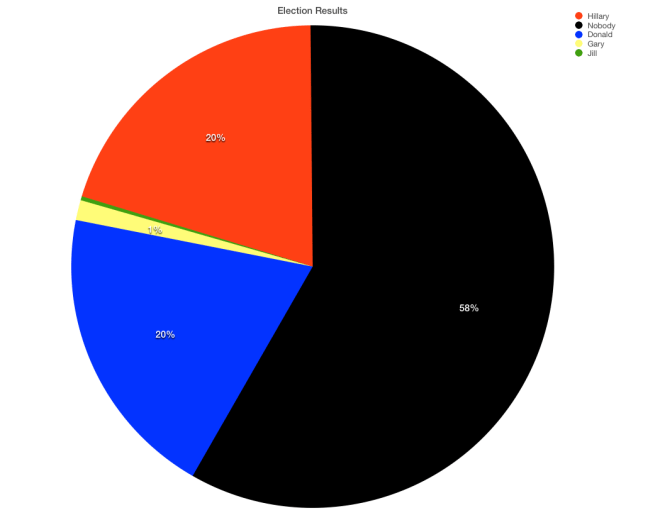
Trump 59M, Clinton 59M, Johnson 4M…Nobody 178M

In spite of the abundance of statistics delivered by the news media last night, this information didn’t get much attention.

  • About 325 million people live in the U.S., and about 25 million of us are under 18 years old, so 300 million people are old enough to vote.
  • Adding the Clinton (59 million) and Trump (59 million) totals, that’s 118 million.
  • So: less than 120 million people in the U.S. voted for the two mainstream candidates.
    • 60 percent of people 18+ DID NOT VOTE for either of these two candidates.
  • Add-in the not-much-mentioned Johnson (4 million) and Stein (1 million), and the total vote is up to 125 million.
  • So: the new President of the U.S. was voted into office by less than 20 percent of U.S. citizens 18+ years old.

According to The New York Times, 200 million U.S. citizens were registered to vote in the 2016 election (that is: 1 in 3 Americans are not registered). And, apparently, 75 million people who were registered decided not to vote. Hence, 178M U.S. adult citizens were the majority group in this Presidential election.

Sometimes, I wonder whether adults are more effective voters than children–most children spend their days learning, and some of what they learn is about choosing a leader. If we add 25 million children, then over 200 million U.S. citizens (out of 325 million U.S. citizens) did not vote in this election.

election-results

An Exuberant New Thing

Sly and Famly StoneA few months back, I found an old album by Sly and the Family Stone. They were a group I liked, but I never knew much about them. Next year marks fifty years (!) since Sly formed the multi-racial band, so now’s a good time to dig deeper.

By 1967, Sly (a boyhood friend misspelled Sylvester as Slyvester; the nickname stuck with him) was 26 years old, a San Francisco disc jockey on a soul station who played music from both Black and White artists. Sly had already produced several minor hit songs, formed and performed in several local band including the multi-ethnic Viscaynes. Times were changing very quickly—especially in the Bay Area—and Sly was well-connected because his influence via radio station KSOL was growing.

The first album by Sly and the Family Stone didn’t do much on the charts, but it’s clever, innovative, funky, and a whole lotta fun. The first single, “Underdog” starts out with a slow version of “Frere Jacques,” then rolls into a rap-like rhythm supported by power horns and a chanting chorus. There’s some gospel in there, too. Listen: this is fifty years old, but it sounds fresh, not at all dated. “I Cannot Make It” is the other popular track from 1967’s A Whole New Thing, and it opens with a vocal similar to “I am the Walrus” (same year). And then, the hits start coming—you probably know just about every one of them because they’ve never really left the world stage.

The fun begun with “Dance to the Music”—#8 on the Billboard Pop Chart and #9 on the Billboard R&B Chart—“listen to the voices!” with that screaming voice, the little bobbing a capella voices, the low down deep voice, the jumping back and forth between Stax, Motown, psychedelia, the big horn section, the get-up-and-dance, the complex jumping back and forth between musical ideas, in just three minutes. These guys are having such a great time making a new kind of music—and the public loves it! Black listeners (#9 on the Billboard R&B charts) and White listeners, too (#8 on the Billboard Pop Charts). The energy is so rich, so contagious—and still so free from the rigidity of corporate music production (that comes later). “Fun” from 1968 keeps the grove — “When I party, I party hearty, fun is on my mind, put a smile upon your face…there’s a sister there’s a brother having fun with each other”— driven by the kind of free-style audio production that looked beyond the traditional concepts of musical arrangements and formality. “ “M’Lady” sounds like a party going on. “Life” is a carnival that begins with a barker, then two, laughing at each other, big horns, a gigantic consciousness raising high—“Life – tell it like it is— you don’t have to die before you live!!”

Y4CDSS006The youthful exuberance is gone, the social awareness is increasing, the production is slicker by 1969’s “Stand” — “you’ve been sitting much too long—there’s a permanent crease in your right and wrong!” – “there’s a midget standing tall, and a giant beside him about to fall!” It feels a bit dated, a golden oldie, a solid memory but the controlled chaos and the crazy audio production is a thing of the past. From the same album (called Stand), there’s “Sing a Simple Song” and “Everyday People”— probably the group’s high water mark— and both of those songs bind the no-holds-barred past with the glossier, socially consciousness future. The same album’s “Don’t Call Me Nigger, Whitey” (same lyric, “Don’t call me whitey, nigger”) is a sincere push toward revolution.

And the hits just kept on coming: “You Can Make It If You Try”— the band’s optimism was always a joy— and “Hot Fun in the Summertime” are wonderful, timeless in their way. And now we’re having fun: “Thank You (Falettinme Be Mice Elf Agin)” and the anthem, “Everybody Is a Star.” That’s all pre-1970. A lot happened in just three years.

With the 1971 album, “There’s a Riot Goin’ On, The Family Stone reminds us of its roots with “Family Affair” — very AM-radio friendly, positive, bringing the community together in the best way: “One child grows up to be somebody who just loves to learn” “Newlywed a year ago, but you’re still checkin’ each other out” “Nobody wants to be left out” “You can’t leave ‘cause your heart is there” — a warm, cozy number that feels dated, but, it’s sincere. That song reached #1 on the Billboard Pop and R&B charts. There’s a similar song called “(You Caught Me) Smilin’” that’s more ambitious, kinda jazzy and bluesy, and although it charted, too, it’s not a song most people remember. In fact, I don’t remember any of the songs that followed on the charts from 1971 through 1975.

Those later songs are very good—some are vaguely familiar—but they lack the early energy. Instead, there’s a laid back funk, very appealing combinations of electric guitar and horns, a funky stoner groove that’s easy to enjoy time and again, decades after it was produced. It feels original, not at all derivative because the band always led, rarely followed. I was surprised how much I enjoyed the later material, and how nicely it has stood multiple plays while tooling down highways that did not exist when this music was made.

So what happened to Sly and the Family Stone? Trouble became evident as early as 1969 when a combination of influence from Black militants and the drug culture destroyed key creative relationships. By 1970, Epic Records gave up on the possibility of a promised (contracted) new album and released an early Greatest Hits album to keep the market alive. By 1975, the group’s fans had abandoned the possibility of Sly and his band actually showing up for concerts—a big show at NYC’s Radio City Music Hall left most tickets unsold. The downhill slide continued—the sad story is well-told in a Wikipedia article.

Certainly, music historians have written about the huge influence of Sly on several generations of artists, how rap and hip hop trace back to Sly and the Family Stone. That’s all fascinating, but the real story here is the freshness and magnetism of music produced fully a half century ago.

Can’t help but wonder. If it was 1967 today, and I was blogging, would I be writing about the amazing musicians of 1917? I’m guessing no. Sly was something special.


Backstage on Broadway

“No film has ever banked $1 billion at the box office, but three musicals–The Phantom of the Opera, The Lion King, and Wicked— have exceeded this benchmark on Broadway.” Globally, Phantom has earned twice as much as the most successful motion picture of all time, Avatar–$12 billion vs. $6 billion. The June 18 issue of The Economist goes on: “Hamilton may cement Broadways’s lead. For information about methodology–and this is fascinating–click on the chart below.

Well-tuned productions

These days, life on Broadway is sweet. Theaters are full. Shows are sold-out. Diversity is abundant. The situation is almost unimaginably different from the early 1970s, when a 60 Minutes report “showed a group of tourists from the South getting off their bus to see a Broadway show–and then getting right back on again because Times Square was so dangerous.” In 1972, Broadway’s largest producer was in a terrible way–J.P. Morgan turned down a $1 million loan, even thought all seventeen Schubert theaters were offered as collateral.

So what happened? It’s a story worthy of a Broadway musical. And it’s fun to read because author and theater columnist so relishes the opportunity to tell that story in his boffo book, Razzle Dazzle: The Battle for Broadway.

razzle-dazzle-9781451672169_hrThe turnaround story begins, as it ought to begin, with a pitch from a creative professional to a producer. The two remarkable people in this particular scene are Public Theater producer Joseph Papp and choreographer-director Michael Bennett. Reidel: “Bennett arrived at Papp’s office at the Public Theater carrying a bulky Sony reel-to-reel recorder and several reels of tape. He had nearly twenty-four hours of interviews with Broadway dancers. He thought there might be a show somewhere in those hours and hours of tape. He played some of them for Papp. After to listening to the recordings for forty-five minutes, Papp said, ‘OK, let’s do it.”

In fact, those tapes–the best of them recorded after midnight on January 18, 1974– are still around so we know what was said by Bennett to the other dancers: “I think we’re all pretty interesting, all of you are pretty interesting, and I think there is a show in there somewhere which would be called A Chorus Line.”

In April 16, 1975, the show played its first preview downtown at the Public Theater, a few miles from Broadway. “At the end of the opening number–“I Hope I Get It”–the audience of 299 stood and cheered and cried. In theater circles that night, phones rang off the hook with the news that the Public Theater had a massive hit. (BTW: Decades later, Hamilton was  developed at the same Public Theater.)

Since the Public Theater lacked the necessary funds to move the show to Broadway, they made a deal with the Schuberts. A Chorus Line opened at the 1,400 seat flagship Schubert Theater on July 25, 1975.

In 1974, Broadway theaters sold 6.6 million tickets. In 1976, the number was 8.8 million. Now, Broadway averages 12 million tickets per year–with annual box office receipts exceeding $1 billion. “The Times Square of Midnight Cowboy, of drugs, crime, and prostitution, of crumbling theaters and peep shows, is now one of the world’s leading tourist attractions.” The Times Square neighborhood contributed 11 percent of NYC’s economic output.

Michael Bennett and Joseph Papp are gone now–we lost Bennett to AIDS in 1987 and Papp four years later. Did they “save Broadway?” I like the version of the story where the answer is “yes”–a guy with an idea connected with guy who could raise money, and together, they saved Times Square and helped Broadway to find its heart and soul.

Last week, Broadway responded to the dreadful slaughter in Orlando, Florida by doing what it does best–performing like there’s no tomorrow. If you haven’t seen the video, now’s your chance:

“Confidence in Government Was Abysmally Low”

“The rump end of the Continental Congress still wobbled along in New York City, where it had met since 1785, but it hadn’t achieved a quorum since October. Its secretary, Charles Thompson, buttonholed members on the street, when he could find them, and dragged them into his office so that he could claim in his records that they had technically, “assembled.”

The people had elected a President, but nobody was sure what the man was supposed to do. People from Pennsylvania considered people from New England to be their enemies, and the feelings were mutual. Southerners trusted no one except themselves. The states didn’t want to work together, not that this seemed especially likely given the “the yawning listlessness” and “over-refining spirit in relation to trifles” exhibited by Congress’s first members. Apart from a few clerks, the Federal government had no employees. And almost no money. There was no Supreme Court, and there no lower courts. There were more than fifty different currencies in use, plus plenty of counterfeit currencies. There no political parties, but there were Federalists, who believed in the potential of a powerful central government, and Anti-Federalists, who did not. The Anti-Federalists were ready to take apart the new U.S. Constitution and start over, this time favoring these States, not a unified nation.

And we’re only a dozen pages into the book, “First Congress” by historian Fergus M. Bordewich. As a modern reader, the dysfunction is almost beyond comprehension. Not only was nothing much done in preparation for operating a nation, there were almost no likelihood that  the First Congress would accomplish anything in particular. And the only guy who could pull the whole country together—George Washington—expressed tremendous apprehension about becoming the President, or the King, or whatever the leadership role might be called. George had his doubts, but he really, really wanted the job and needed to be careful about seeming too anxious. (Ron Chernow, who wrote the biography “Hamilton” on which Broadway musical is based, also wrote a great bio book called “Washington: A Life” which is heavy on George’s constant internal conflicts. Bordowich does not as deeply here because he has other territory to cover.)

So it’s James Madison—whose story ought to follow “Hamilton” as a Broadway musical—who convinces George to man-up, and run the country. Hamilton is also in a leadership role, convincing Congress that the new country ought to set up a bank, assume the states’s debts, and establish a meaningful credit rating. But everything in those early days seems more like an informal startup company than the beginning of the richest nation on earth. “There was also John Jay who ran the Confederation’s Department of Foreign Affairs from his law office, and Henry Knox, who presided over the War Department from rented rooms at a Water Street tavern.”

Look into his eyes. This is James Madison, a politically savvy man who convinced George Washington to lead the new nation.

Look into his eyes. This is James Madison, a politically savvy man who convinced George Washington to lead the new nation.

Eventually, they got to work. Madison was the first congressman to propose a law so that the new country would have some revenue, and control its coastlines. And then, everybody argued, and protected their regional interests. And besides, nobody was clear on how these new rules could possibly be enforced.

With or without proper tariffs, Vice President John Adams “tirelessly repeated that Europeans would never take the United States seriously unless its chief executive was endowed with the trappings of sovereign grandeur…At minimum, he considered His Highness or His Most Benign Highness as the barest acceptable forms of address for its president. He…scathingly dismissed President as appropriate for ‘Fire Companies & of a Cricket Club.’ Any member of Congress willing to settle for less he considered a ‘driveling idiot.” Everything was new, nothing was settled, and everybody carried a strong opinion of how things must be done. Still, they were not without humor: Ben Franklin, who was always good for a laugh, called Vice President Adams “Your Superfluous Excellency,” while others looked at his widening girth and favored, “His Rotundity.” (I found Franklin’s comment on the web, not in the book).

Did the First Congress get anything done?

The surprising and overwhelming answer is “yes!” In surprising chapter by chapter, Bordowich leads us through one astonishing accomplishment after another. Congress establishes itself as a powerful legislative body. They manage to keep the government running at a time when it appears as though George Washington will not survive an illness. They worked out the Bill of Rights. They figured out where to place the new nation’s capital—a  major political accomplishment because of the many competing interests. While busy complaining about how little they understood about finance, they did not stop Alexander Hamilton from establishing the U.S. as a viable financial operation—a capitalist one at that. They worked on a reasonable solution for slavery—but failed in the attempt. They—and Adams gets much of the blame for this—managed to make the Vice President an ineffective leadership role. They invented the President’s Cabinet and its various departments—and convinced a very reluctant Thomas Jefferson to leave his lovely Paris mansion and lovelier lifestyle to return home and establish the State Department. They learned to deal with lobbyists (Quakers were the first lobbyists).

“Men who had seen themselves primarily as citizens of their individual states had now mostly come to see themselves as the common citizens of a nation and embraced their new government as their own in a way they had never done before.”

“Public opinion now mattered. Newly emboldened newspapers brought the doings of government to the door of every citizen, including the illiterate , who gathered in urban taverns and frontier hamlets to avidly hear reports read to them by their literate neighbors.”

A new nation had begun.
the-first-congress-9781451691931_lg