Your New Digicar Subscription

Ford Model T, circa 1910. Buy it for $850 or rent it for 10 cents a mile.

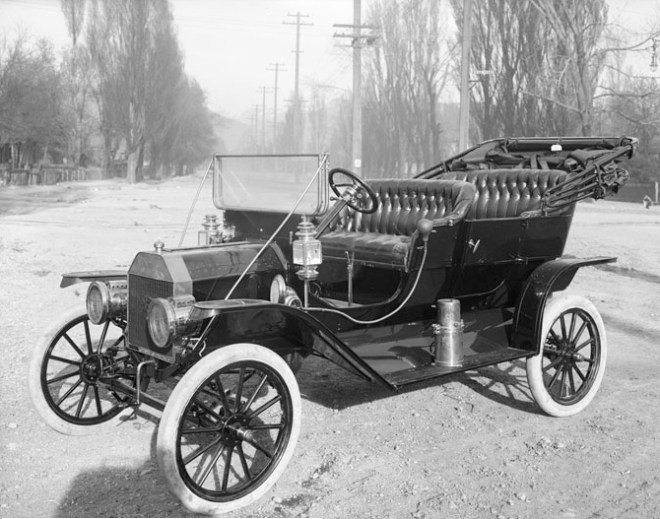
Ford Model T, circa 1910. By 1916, you could buy one for $850 or rent one for 10 cents a mile.

Robotic cars that drive themselves–that’s the comic book version of the future currently in advanced stages of development at Google, Mercedes-Benz, and, I would guess, just about every significant vehicle and technology maker on earth. Before the end of the 2020s, these cars will be as common as a Toyota Prius. In theory, cars that drive themselves will reinvigorate the automotive industry.

But that’s not the big story.

For a moment, think about your telephone(s). In your pocket or bag, you carry an expensive digital multi-purpose device that multitasks as a telephone, messaging center, emailer, web browser, camera, clock… so on. At home, you may still pay for a relatively stupid device that is little more than an old school telephone. Which one will go away? Easy answer.

Now, transpose that thinking to the car of the future. It’s foolish to impose old expectations on a new paradigm. A digital car will probably reinvent the whole idea of cars as well as our relationship with personal vehicles. We saw the start of this idea with rental cars. ZipCars showed up in the US around 2000, an idea borrowed from Europe. City dwellers and college students are Zip’s best customers because the opportunity to pay a membership fee for occasional use of a car is more sensible than owning, maintaining, parking, and otherwise caring for a physical product. In essence, ZipCar transfers the customer relationship from product purchase to service/subscription.

From last weekend’s Wall Street Journal:

Brace yourself. In a few years, your car will be able to drop you off at the door of a shopping center or airport terminal, go park itself, and return when summoned with a smartphone app.”

Presumably, the new cars won’t crash–saving enough lives to repopulate Newport, Rhode Island or Key West, Florida every year, and then some.

From the same WSJ article:

private vehicles spend 90% of their time parked and unoccupied

Let’s pull together several ideas. Texting while driving is just plain dumb. And yet, for most people, driving a car is less interesting than playing with an iPhone. If there was some way to move from place to place and allow texting (or emailing, playing a game, or learning), that might be preferable to our 2013 status quo. Me, I’m happier reading a book than doing daily battle with aggressive trucks exceeding the interstate’s speed limit. Let my digicar’s radar system, wide-baseline stereoscopic camera, massive processing power (think: computer chess applied to the calculus of high-speed traffic or crazy curvy country roads). Let vehicles talk to one another (“hey, I’m in the wrong lane–would you please slow down so that I can make that right hand turn coming 2.348 feet at longitude X and latitude Y?” “sure, anytime, have a nice day”)

How does EZ-Pass and privacy fit into all of this? For those who still honestly believe that their travels are not easily recorded, stored and compared with every shopping receipt, it’s both another loss of freedom and another realization that privacy is something that one cannot easily or simply protect in a digital age. Certainly, this information could become the property of bad people (or governments or large corporations, who may or may not define ‘reasonable’ as individuals do).

A digital car would certainly know where it is going, where it has been, and where it needs to go. And it would know, and record, passenger identities. When traveling, we’ve been balancing time, money and privacy for a long time. Here’s the current situation–consider how similar a digicar service and the “rental” of your airline seat can be:

If I want to travel from Times Square to Hollywood, I can drive for about 40 hours (more, if there’s traffic, but my digicar might know how to circumvent it). If I drive 8 hours/day, that’s 5 days of driving, 4 hotel nights (about $500), and 2,800 miles (100 gallons of gas, or about $400 worth), plus wear-and-tear of about $200 (if all goes well)–5 days of my life plus over a $1,000 of my money. I could take the train for 20 hours and spend about $450, but if I want to sleep on the train, it’s 43 hours and $1,200, plus the time and money required to get to and from the train stations. If I fly, my time expense is about 8 hours door-to-door and my dollar expense is $500 including ground transportation. Train and air travel requires me to surrender personal information about my identity and my precise travel plans; car travel does not (except when I use a credit card to fill the tank, which I will do about 8 times, pay a toll with EZ-Pass, or sleep in a hotel, or eat, making it easy to track my progress).

A long paragraph for a short idea: we routinely exchange privacy for time and money. Are we ready to surrender those expensive machines that sit idle all but 10% of their lives. Is the car of the future more likely to be a product (buy one at your local Ford dealer) or a service (lease one with an app, or sign up for a rental subscription service).

The answer is pretty clear to me. After the vehicle drops me off at the supermarket, I don’t much care what it does or where it goes, and, in most situations, I don’t  care whether it’s Holly, Dolly, Lolly, Molly or Folly The Digital Car that picks me up when I’m ready to go home. I just want to know that it will be there, on time, clean, reliable, capable, and right-sized for my needs (smaller if I have no bags). If I need the car for an extended period, I’m sure I could pay a higher subscription rate, perhaps by the month or year, perhaps by the trip. Will I be able to reserve? Will the vehicle show up? What if we get lost? What if there aren’t enough cars?

How many cars is enough cars? Right now, we’ve got about a billion cars for about seven billion people on planet earth–but that’s only because China’s ratio is about 7 people to one vehicle (in the US, it’s about 1.3 people per car).

More cars, more roads, more paved-over nature, more crowded national parks, more traffic jams, more stress on an interstate infrastructure that’s already stressed. Fewer cars? How about more efficient use of the whole idea of cars? Think about my imperfect math: if every car’s use was doubled in its efficiency, and was used 50% of the time, maybe we could reduce the number of cars on the planet by a third or more. If the cars were smart enough to avoid accidents, there would be no more time or energy spent on drinking and driving, or texting while driving, and no more arguments between teenagers who are probably too young to drive and parents who are terrified every time their child backs up out of the driveway.

For details about specific companies and their progress, click on the Wall Street Journal’s car below.


WSJ Car

Say It Ain’t So

The above image shows a practice with a few members of the 1886 White River Base Ball Club of Conner Prairie Living History Museum. Pictured are, from left to right: "Thunderbolt," "Digger" (hitting), "Hay Wagon" (pitching), "Scooter" (catching), and "Steamboat."

The above image shows a practice with a few members of the 1886 White River Base Ball Club of Conner Prairie Living History Museum. Pictured are, from left to right: “Thunderbolt,” “Digger” (hitting), “Hay Wagon” (pitching), “Scooter” (catching), and “Steamboat.”

From a recent Sunday edition of The New York Times, just before this year’s baseball playoffs began, a comment followed by a quote from forever sportscaster Bob Costas:

Think for a moment about the very phrase, ‘national pastime’ now, in 2013. What sorts of images does it conjure? ‘It sounds like a guy sitting on a rocking chair on his porch listening to a game on the radio and maybe he’s whittling.”

Another concerning quote from the same article, this one from Mark Twain during the game’s early days, preceded and followed by the newspaper’s comment:

Mark Twain called (baseball) a symbol of  ‘the drive and push and rush and stubble of the raging, tearing, booming 19th century!’ (From the Times:) ‘The 21st century, not so much.”

What happened? Pro football, mostly. Certainly, football more closely matches Mark Twain’s description of thrilling competition.

One more thought, first from the Times and then, from Mr. Costas:

When the post season rolls around and it’s time for baseball to take the national stage–well, it doesn’t unless the Yankees or the Red Sox are involved. (From Costas:) ‘If Tampa bay plays Cincinnati in the World Series, I don’t care if the series goes seven games and every game goes into extra innings, baseball is screwed. That’s not fair to the Rays or the Reds, but it’s true.”

It’s not easy to reinvent a sport, or a religion (where numbers are also down, except, as you may have read, among  Mormons and  Muslims). Their value is deeply rooted in belief systems, legacy and traditions. Clearly, building a new church or a new ball field suggests modernism and causes a bump, but neither solves the problem. Digital distribution of Rosh Hashanah services and every local baseball game will get you only so far. Eventually, the “what happened to us?” question must be answered.

Violence is the new American Way (as a rule,  prime time dramas feature at least one violent act, a corpse, and a conversation in a morgue).

Football benefits from simulated (and, on occasion, actual) violence. Baseball is  thoughtful, careful, complex, complicated, and not often violent game. Individual contributions and team competition elegantly balanced.

Unfortunately (for baseball, fortunately for many of us), baseball contains less action, fewer pile-ons. We like action. Maybe baseball players should run all of the time, and knock one another down? Maybe priests and school teachers should rap their lessons. Maybe every sport has its day.

Seems unlikely. But how do you reinvent a part of America? How do you reinvent schools, or church, or baseball, or cars, or suburbs? The 21st century is such a strange place, particularly in  “we used to be king of the world” America.

So where do we start? (How do we get to first base?) Long ago in the America of Mark Twain, we did things bottoms-up: town hall meetings, neighbors helping neighbors. Now, we do things top down (this being the basis of CBS’s “Undercover Boss,” where gap between boss and working stiff is vast). Traveling to and from the U.S. from other countries, it’s striking to see just how big the houses, the corporations, the school systems, the baseball leagues, the salaries have become. Big government, now shut down, in part, because of its own enormity. Big generates its own expectations and ecosystems. Big forces a universal top-down approach to problem-solving.

Small struggles to survive. We underfund small because big is more powerful. We underfund simple because the neighborhood playground lacks a business plan. We fix the interstate (because its traffic numbers are, you know, big), but the local street’s potholes remain, and there aren’t enough cops on the local beats. We ignore our local newspapers, and local news, because we’ve been led to believe that what happens in big Washington is more important than what happens in small Indianapolis. We don’t bother to vote, in part, because elections are, by and large, boring. Small, for the most part, and boring.

So? Baseball? Yeah, it’s a slower game than baseball, and no, it doesn’t attract the big celebrities like basketball or football does. Baseball competitive without the rough contact. It’s a game of numbers where a smart guy like Billy Beane can, in the words of Wikipedia, do well because of “the team’s analytical, evidence-based, sabermetric approach to assembling a competitive baseball team, despite Oakland’s disadvantaged revenue situation.” The joy of baseball is local, and small, even if the business of baseball is big. Perhaps the same could be said of high school football, where community is illuminated by the Friday night lights.

If the point of baseball is a pleasant sunny afternoon, not too far from home, scheduled so that I can grab a few games a year and, perhaps, revisit one of the 19th century’s better inventions, that’s going to be okay for a while, at least for me. Better, maybe, than calling a championship a “World Series” while failing to invite all but one other country to participate in the big competition.

Still, a pleasant afternoon in Status Quo Stadium won’t sustain baseball, not in the long-term. Maybe we’re willing to watch baseball go the way of Kodachrome, bookstores and schoolteachers (oh, sorry, that one doesn’t happen until 2027), that’s fine, I guess. But I sure want to see the game back up on its feet, not through easy gimmicks, but because it lives up to Yogi’s quote about being ninety percent mental and the other half physical.

What’s a MOOC Good For, Anyway?

This week, I’ve spent several hours with a friend whose intellect is recognized by a Ph.D. from an Ivy League university. We’re both deeply engaged at the intersection of media and learning, most often for some form of public good. Yesterday, we talked about why people go to school.  To be more specific, why people go to school beyond the point where law requires them (us) to do so.

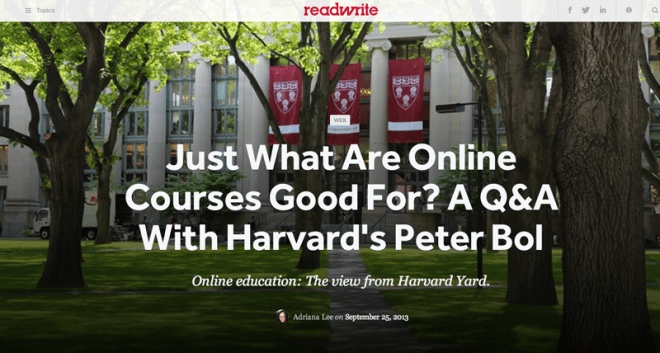
Harvard-MOOCWhen I read this readwrite article, an interview with Harvard’s new vice provost of advances in learning (excellent job title!), I started thinking about why anybody bothers with, say, TED Talks, or for that matter, why we read non-fiction books.

Just as we’ve managed to bottle up massive quantities of spirituality into the structures we call religions, we’ve managed to do the same with massive quantities of learning into the notion of school and organized education. MOOCs shake up that formula. A MOOC–a massively open online course–carries no price tag, and, although it may be offered by the likes of Harvard or Stanford or UPenn, it carries no credit, either. You take the course because, well, because you want to learn.

The distinction is a simple one, or so one might argue. There is learning, and there is education, and if they sometimes overlap (as they are intended to do), they might serve different purposes. Learning is all about personal development, and refinement of understanding. Education’s purpose is a degree, a formal recognition, typically for a price, that serves as an admission ticket into parts of the job marketplace that are otherwise inaccessible.

So what’s a MOOC good for? Same thing as a book, I think. It’s for learning. Turns out, millions of people simply want to learn, on line, for their own development and understanding.

Of course, that’s not the whole story. Do read the readwrite article (interesting phrase, that), and you’ll find that a bit more of the picture comes into focus.

Shooting with an iPhone

richardson-featured

So the new iPhone 5s includes an 8 megapixel camera. What can you do with a camera phone?

Turns out, quite a lot, especially if you happen to be an extremely skillful photographer whose credits include National Geographic.

Confirming the “it’s not the camera, it’s the photographer” theory, have a look at this work, read the article, and take the time to read the comments.

Here, then, is a sample image, a bit of the article in a Nat Geo blog, and a sampling of comments. Find it all here.

The photographer is Jim Richardson.

What surprised me most was that the pictures did not look like compromises. They didn’t look like I was having to settle for second best because it was a mobile phone. They just looked good. Nothing visually profound is being produced here, I would have to say. But it feels good, and I even noticed some of the folks on our tour putting big digital cameras aside once in a while and pulling out their cell phones when they just wanted to make a nice picture.

Alex of Virtual Wayfarer.com had this to say:

Not a fan of the either or approach that has been floating around, but definitely love the flexibility of using my phone as a camera. Scotland is incredibly difficult to photograph, so kudos for some wonderful shots. I actually find that with some vistas and views I have a much easier time capturing it accurately with my phone than my Canon. Interestingly, there were a number of shots I took on a recent Scottish roadtrip that were much better on the iphone (landscapes and Panoramas really are great on there if the light is right) than on my dSLR. Kudos!

Not quite convinced? Try the photographer’s Instagram exhibit, where you will find several dozen superb photographs. Among them, this image.

instagram

Never Thought About It That Way Before…

brochure1-mBirthday: August 4, 1961

Statehood: August 21, 1959

The first is the birthdate of the current President of the United States. The second is the date that Hawaii was transformed, by law, from a U.S. Territory to a U.S. State. The two dates are separated by two years, and just about two weeks. If Mr. Obama had been born on, say, August 20, 1959, he could not become  President.

On October 5, 2004, a Yale Law Professor named Akhil Reed Amar testified before the United States Senate. At the time, the Senate was exploring the reasons why, in today’s world, an immigrant was not allowed to become President. Professor Amar knows a great deal about the U.S. Constitution. He points out, “the Founders did exclude…immigrants from the Presidency. But they did so because some at the time feared that a scheming foreign earl or duke might cross the Atlantic with a huge retinue of loyalists and a boatload of European gold, and then try to bully or bribe his way into the Presidency…In a young America, when a fledgling New World democracy was struggling to establish itself alongside an Old World dominated by monarchy and aristocracy, this ban on foreign-born presidents made a lot more sense than it does in the twenty-first century.”

He goes on to explain that seven of the Constitution’s thirty-nine signers were immigrants; that three of the first ten Supreme Court justices were foreign-born; and that similar statistics applied to other key government figures. What’s more, the Constitution was approved by an enormous number of people who were not born here; the same is true of nearly all of the Constitution’s amendments. People who serve on juries, people who vote, people who want to run for Governor of any state…all of these people may be foreign-born. But not the U.S. President.

It took me a bit to get past my emotional responses to Amar’s arguments, but after reading nearly 1,000 pages of his analysis and provocative investigations, my mind is now becoming accustomed to the kind of workout that a law professor can provide.

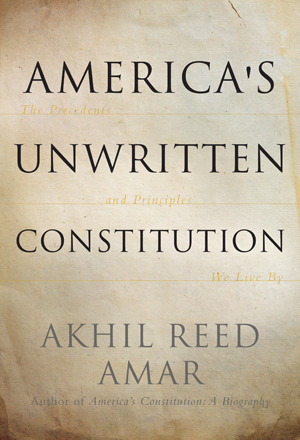
amar_akhilI started reading Amar’s book, American’s Unwritten Constitution: The Precedents and Principles We Live By last spring, but quickly realized that the book would make a lot more sense if I first read America’s Constitution: A Biography. The first book explains how the Constitution came together, and how its ideas have been interpreted, applied, shifted, calcified, de-calcified, respected, and transformed. The second book is more provocative; it requires the reader to consider his or her place, the decisions that we make within and beside the Constitution, the responsibilities that we accept as, for examples, voters and jurors.

The word juror, for example, is derived from the French and Latin words for “swear.” Not what I would have thought, but then, Amar shines the light on the concept of swearing an oath. What does the oath promise. In essence, we take an oath to use our conscience effectively. That is, we are swearing that we will, to the best of our ability, exercise a reasonable, moral, ethical judgment based upon the information provided to the jury. Which is to say, “when a juror is not told what punishments she is actually voting to inflict, and not told that she has a legal right to just say no and a legal duty to consult her conscience, then the moral foundations of the entire system begin to crumble.”

He goes on–these are long books, best appreciated over an entire summer of quiet nights–“Current practice…all too often instrumentalizes and infantalizes jurors by disrespecting or derailing their moral judgment. When a juror finds a man guilty of having shoplifted a baseball glove and only later finds out from a local newspaper or lawyerly acquaintance that what she really voted for was in the jury room was to send this poor soul to prison for life (and at taxpayer expense), she is apt to feel ill-used–as is the defendant, of course.

I think I’ve dog-eared the bottom corners of perhaps fifty pages–each containing a notable idea that I want to think about, learn more about.

Professor Amar, loose and having a good time as a guest on The Colbert Report last January.

Professor Amar, loose and having a good time as a guest on The Colbert Report last January.

In the second book, much is made about the Northwest Ordinance, a subject I vaguely remember from seventh grade, and perhaps, tenth grade in slightly greater detail. The key idea–and you’ll see why this phrase was so important in a moment–the key phrase in that document was “There shall be neither slavery nor involuntary servitude in the said territory, otherwise than in the punishment of crimes whereof the party shall have been duly convicted.” No slavery in what would become the states of Ohio, Michigan, Illinois, Wisconsin and Minnesota. Amar points out, “(these states) formed the backbone of the Republican Party. Men from these places filled the Union Army at every level, from Grant and Sherman on down. Without these northwesterners, there would have been no President Lincoln, no Civil War victory, and no Abolition Amendment… Residents of this region arrived there from many different places (especially from the free states, of course), and inclined toward a distinctly nationalist worldview. Whereas nineteenth-century Virginians like Robert E. Lee gave pride of place to their home state (which had pre-existed the Union by more than a century…), northwesterners tended to see themselves as Americans first and state residents second. America had chronologically preceded the states they now called home.”

I kept finding myself thinking, “gee, I never thought about it that way.” I suppose that’s why, through all of the details of Supreme Court cases, nuances of amendment wording, minute details about the judicial process, I stuck with it. I have fifteen pages remaining. I will finish my summer’s reading before I fall asleep tonight. This summer, Professor Amar taught me a lot. And based upon the dog-ears, I’m not going to finish with these ideas for a long while.

As it should be.

Amar-Americas_UnwrittenHORIZ

A Fight Over A Postage Stamp

Korean War Stamp_1On September 20, 2013, the U.S. Postal Service was ordered to pay well over a half-million dollars to Frank Gaylord. He is a sculptor, the artist responsible for the Korean War Veterans Memorial in Washington, D.C., which is managed by the National Park Service for the American People. (Let’s not forget: when the U.S. Postal Service writes the big check, they’re paying him with my money, and yours).

The U.S. Postal Service issued a stamp picturing the work,  based upon a photograph whose rights were cleared prior to the stamp’s publication.

For several years, the Postal Service and Mr. Gaylord have been caught in a legal tussle about copyright infringement. It’s interesting, confusing (as these cases tend to be), and provides a useful snapshot of U.S. Copyright Law, Fair Use, the rights of artists, questions about public property, and more.

Here’s a quick rundown on the story from Stanford University’s CIS (Center for Internet and Law):

One of the important questions the case presents is whether this stamp makes fair use of the statue that appears in it. The image you see is a photograph of a sculpture taken at dawn in a snowstorm. The sculpture itself is called The Column, and is part of the Korean War Veterans’ Memorial in Washington DC. It features nineteen larger-than-life soldiers arranged in two columns, representing a platoon of soldiers on patrol in the Korean War. The Postal Service got permission to use the photograph that appears on the stamp, but not the column depicted in it, so the sculptor sued the Postal Service for infringing his copyrights in the sculpture.

The ruling is here.

A detailed analysis prepared by Harvard University’s Berkman Center for Internet and Society is here, and well worth reading, especially if you’re (a) interested in the ways of copyright law, and/or (b) a creative professional whose understanding of fair use could be more complete.

The story about the ruling, and the reason why the case is suddenly in the news, is here on Digital Photography Review. DPReview does a fine job in explaining the story, so there’s no reason for me to repeat it here.

I will, however, offer a picture of the stamp. In fact, I could not find a US Postal Service image of the stamp, but I did find a picture of the stamp from the Stanford CIS site:

So here are questions in my mind at the moment:

1 – If I reprint Stanford’s picture of a U.S. stamp on this website, am I violating Stanford’s rights? Is such a clearance necessary?

2 – Did Stanford get permission from the U.S. Postal Service to show the picture of that stamp on its website? Was such a clearance necessary?

3 – If Stanford did not get permission, do I need to get permission?

4 – If you decide to forward this article, stamp included, do you need to get permission from me, or have I already granted that permission through some online agreement with WordPress that I’ve forgotten all about?

I am still wading through the articles myself. I can’t help but wonder whether the sculptor ought to  share compensation with general or specific Korean War Veterans whose images were depicted as statues or, at least, served as inspiration. And, like you, I am confused because I thought a Memorial was, somehow, public property.

Comments always welcome.

The Financial States of America

If you want to buy a house for cheap, buy one in Arkansas or Mississippi–those are among states in the center strip of the USA with the least costly houses. In fact, the swath extends from Nebraska to West Virginia–the flyover states. Houses in New York and California cost lots more. In fact, average home listings in the low-cost states are about four times lower than the averages in the highest states. That’s a large swing.

Here’s the map, a snapshot of a wonderful interactive map called The Financial States of America, published by moneychoice.org

Map1

Same website, same interactive map, but this time, I selected Well Being, and the results surprised me (of course, the site explains how they define and quantify well-being). No surprise that people in New Hampshire and Vermont are doing well. The surprise is that the every one of the “wellest” states is in the north–except Hawaii. The least well–the lowest ten states–are almost all connected in and beyond the Appalachians, with Oklahoma and Arizona in that group, too.  Here’s the snapshot (the interactive map would not translate to this blog, so I’m offering a few snapshots to encourage you to explore the map on your own).

Map2

The Minimum Wage map is fascinating because it shows how states that are near one another tend to make similar laws and accept similar rules. The states in the Deep South have no minimum wage. The states in the Pacific Northwest offer the highest minimum wage in the nation. Minnesota, Georgia and Wyoming offer the nation’s lowest minimum wage–an unjustifiable $5.15 to $6.20 per hour.

Map3

This is really interesting, to see American states behaving so differently from one another. One more, and then, you’re on your own. This one shows California with the nation’s highest GDP–the most productive economy, by far. Texas is second, and New York is third, and then, most other states don’t even come close. California’s GDP is now nearly $2 trillion dollars. If it was a country, it would compete with Italy and Spain, only about 10 percent smaller than the GDP of India. The state of New York competes, roughly, with South Korea. Texas’s economy is about the size of Mexico’s economy. By comparison, Michigan’s GDP is about the size of Denmark’s GDP–surprisingly small. Pakistan is slightly more productive than Connecticut. Tiny Delaware could fight it out with equally tiny Luxembourg. These match-ups are interesting enough to rate a Wikipedia article. Off the map, but NYC’s GDP is bigger than Spain’s. and Tokyo’s GDP is largely than Russia’s GDP (all GDPs are nominal). More GDP city data  here.

Map4

Enough of this. I could play with interactive maps all day long.

One more thing I found on the moneychoice site: an infographic about global money. This will keep me busy until bedtime…
The Future of Money: A Global Currency
Created by MoneyChoice.org

“The forced, bloated expanding bundle”

I like the phrase. It was used to describe the way Americans are forced to subscribe to cable television–if you want cable, you must pay for a tremendous number of unwanted channels. In the industry, the result of unbundling is called “a la carte” cable service because the operator allows you to select, and pay for, only the channels that you will actually watch. Bundled cable is, of course, the reason why Comcast accumulated enough money to buy NBC and Universal Pictures. It’s a sweet deal for cable operators, and for the cable industry, which is funded by selling products to people who don’t want them, but cannot do anything except, to use an example, buy everything in the store in order to make sure they have access to the loaf of bread and the jar of peanut butter. It’s a brilliant marketing scheme, and an utter failure of anything resembling consumer protection in the United States.

I could go on and on, and I could also make a case for why some aspects of the bundling business have utterly changed the television industry for the better. Mostly, though, I wanted to introduce you to an article about shifts in Canada’s cable television business that was published by Reuters last week. Here’s the start of it… to read the whole article, click here:

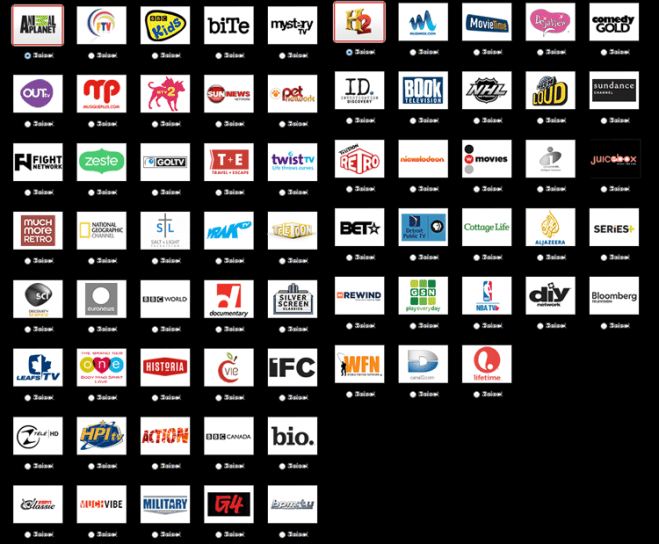
Subscribers to Rogers Cable in Canada can select from these a la carte channels. Most are not big name channels, but once the a la carte habits gains a foothold, the entire cable business may change.

Subscribers to Rogers Cable in Canada can select from these a la carte channels. Most are not big name channels, but once the a la carte habits gains a foothold, the entire cable business may change.

Analysis: Canadian Cable TV’s ‘a la carte’ menu begins to take hold

By Liana B. Baker and Alastair Sharp

NEW YORK/TORONTO | Thu Sep 19, 2013 12:49pm EDT

(Reuters) – A transformation in how some Canadian cable TV companies sell channels to consumers might be a sign of things to come in the much bigger U.S. market.

With “a la carte” pricing, cable companies are offering Canadians an alternative to “take-it-or-leave-it” bundles that effectively force viewers there – and in the United States – to pay for channels that they do not watch in order to get access to those they do.

(and so on)

AM, FM, UHF and the Future

Two weeks ago, The New York Times ran an article entitled “A Quest to Save AM Before It’s Lost in the Static.” The average listener to NPR is 56 years old, and new ones aren’t coming on board so quickly because of music services like Pandora. The big question that broadcast television executives are asking is whether there is a future for local television broadcast stations. In fact, the FCC is asking the same question, anxious to buy back a bunch of local television spectrum and sell it to the wireless operators because they say they represent the future. A century ago, we were trying to imagine a world where broadcast radio and television stations might someday exist. Now, we’re wondering whether we need them at all.

I really love this picture of a 1965 AM radio. It comes from a Ford Mustang. To see more, click on the radio.

I really love this picture of a 1965 AM radio. It comes from a Ford Mustang. To see more, click on the radio.

I suspect AM and FM radio are easier to defend because they provide news, sports, weather, emergency information, and entertainment for people on the road. Half of  radio listening happens either in a car or a truck (the rest happens at home, and to a  lesser extent, in workplaces). Once an also-ran, FM  is now the most popular part of the radio band. Music sounds much better on FM than AM radio, so AM is used, mostly, for talk, news, and religion (you knew that). Following the audience, many sports teams have moved to FM, leaving the AM landscape that much more barren. The New York Times article describes an effort to upgrade AM radio, an improvement requiring the replacement of every car and home radio. That seems as unlikely as the replacement of analog television seemed just a few years ago. But we did it.

The digital television transition moved some local broadcasters to other channels (“masked” with their old TV channel IDs so you never noticed), improved some signals for some households (worsened some signals for other households), and greatly increased the available television channels that could be transmitted by a single television station. Most network affiliates have made little meaningful use of  additional bandwidth, but MeTV, retroTV, and Antenna TV are among the entrepreneurial newcomers that make use of the additional bandwidth.  A handful of new non-commercial public networks have emerged, including several importing programs or full channels from other countries including Japan and France.

Jeannie_Bewitched_Website-960x445Where does  this lead? And how do we even begin to think about the future when so much television viewing is now on-demand and so much audio listening is via Pandora, podcasts, Sirius XM, and audible?
Let’s start with the audio side. Traditional radio listening is probably entering its final innings. The disruptive technology is mobile internet. It’s no longer a techno-stretch to include an internet device in an automobile or truck. Hundreds of channels are replaced by thousands. On-demand replaces scheduled programs.  ANy smart phone doubles as an audio file server, easily replenished via the cloud, and, with increasing reliability, the cloud itself becomes the server as the driver enjoys a live stream without considering its source. Program your vehicle with voice-activated instructions, and the car will know  you prefer Car Talk on Tuesday mornings during your commute. Brands matter, podcasts matter, but 24/7 feeds of country music and local news breaks don’t, or won’t. Press a button to see and hear local traffic conditions with appropriate automated warnings, and suggested re-routings. Sirius XM is trying to stay ahead of the curve by selling its own internet channel packages, and starting its own on-demand services. Good idea, but a half dozen companies will offer, more or less, similar subscription services, and, of course, everybody is competing with free (free has been the standard for AM and FM radio, and old habits are hard to change). Add audiobooks and podcasts to the mix, and the AM/FM prognosis becomes even more gloomy.

What about TV?With few exceptions, people watch programs, not networks. New matters less than buzz. If you haven’t seen it yet, last season’s Boardwalk Empire trumps  this season’s Girls. There is so much product,  so much fragmentation of viewing time, everyone plays catch-up almost all of the time. Catch-up has the potential to transform large numbers of viewers into video library consumers , not television viewers who know or care what’s on NBC on Wednesday nights at 9PM. In fact, if there was no broadcast television, viewers would quickly find alternatives on cable, on demand, and various internet services. Which is to say, 20th century television is probably enjoying its last laps. We just don’t need what we had before–there are better alternatives.

With broadcast radio and broadcast television, we established and continue to enjoy a public trust. As members of the public, we provide broadcast spectrum, at no charge, to the likes of CBS and its local affiliates, and they provide a mix of news, entertainment, and other useful or interesting stuff at no charge. The whole thing is monitored by an FCC that is not perfect, but generally watches out for abuses, and the public’s interests. That’s all good, and that’s in the process of going away.

In its place, there is no public trust, no assurance of an appropriate mix of news, entertainment and other useful or interesting stuff, and almost none of it will be provided at no charge. We are making a VERY POOR choice. We have missed a step. We are handing our mass communications to companies whose principal business is collecting monthly fees for services, not attending to the needs of the communities they serve, not attending to any national agenda or public interest. We have already seen bad behavior from operators who wish to constrain what is and is not made available through their commercially-controlled networks. We will see more control–all quite reasonable because these companies are not required, nor encouraged, to do good. They are required (by shareholders) and encouraged (by advertisers and subscribers) to keep the public interested, to capture our imagination and attention, but not for anything resembling good reason.

In short, we are missing a step. You and me, we have some interests to protect here. We should be unwilling to transfer control of all media to companies with no meaningful public interest requirement.

Let’s think about that. And let’s continue the conversation in the  near future.

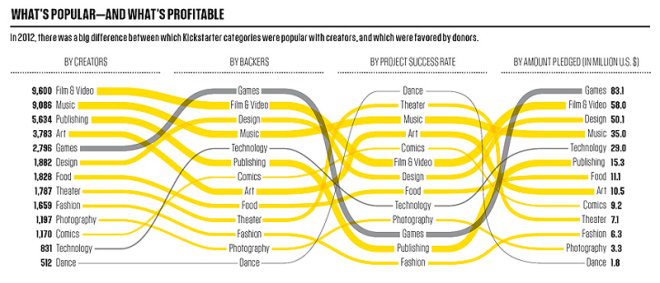
What Kickstarter Has Kickstarted

kickstarter

If the graphic appears a bit fuzzy, visit the Fast Company site for the article, scroll down, and click on the yellow-and-black infographic. You can magnify the infographic on their site, but nowhere else.

I missed this Fast Company article when it was published in April. Most useful was the infographic. In it, I learned:

  • Among creators, film and video is the most popular type of Kickstarter project, but this category ranks second among backers, and sixth in the list of successes.
  • The category most likely to be funded: projects related to dance (but there aren’t many of them, and there aren’t many people who back dance). Theater projects come in second,  music in third, and and art in fourth. Both music and art are strong in terms of number of projects, and also, in terms of their success rate, ranking fourth and fifth on the list.
  • There are lots of game projects, and lots of people who back game projects, but in terms of project success, odds are not so good. Still, games have generated more revenue than any other category.
  • Video matters. More than four out of five Kickstarter projects are pitched with a video.
  • For the past several years (that is, for as long as Kickstarter has been around), just over 2 in 5 projects are successfully funded.

There’s much more in the article.