Around the World with Joe Boyd

Every night, for the past two months, I have gone to bed with Joe Boyd. He wrote a book that’s more than 900 pages long — far too cumbersome to be read anyplace except on my pillow.

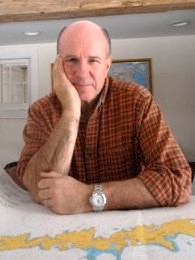
Here’s a photo of the author, the UK cover art, and the US cover art.

As it happens, it’s a terrific book, and I loved every minute of it. The title is: And the Roots of Rhythm Remain: A Journey Through Global Music. Basically, this is a social and political tour, a history of the cultures that produced music we’ve come to associate with Jamaica, D.R. Congo, Brazil, Mexico, and dozens of other places around the globe whose artists have defined the concept of “world music.” The terminology is cumbersome, but the storytelling is not. It’s clear, and as engaging as any good history book, but this particular book explains, for example, how and why the likes of reggae, flamenco (see below), and the cha-cha are all part of a hyperlocal and a wonderfully global story. Happily, the story goes back a ways — back to the fifteenth century in some cases.

For example, you’re probably familiar with flamenco music, from Spain. Well, not exactly from Spain. Flamenco is more like gypsy music than Spanish music, but where’s the gypsy connection? And what, exactly, is a gypsy? The word gypsy derives from Egyptian, because that’s where these people sometimes claimed they had originated. But they didn’t. They came from India, but they often played on the streets, and saying they were Egyptian caused the people who were listening to give them more money. So, sure, they’re from Egypt. Or maybe they’re from Hungary — part of their story takes shape, there, too, which leads to Béla Bartók, and later, to world music star Márta Sebestyén. So, back to India: there were about 10,000 musicians imported from India to what becomes Pakistan, then dismissed when they were no longer wanted in Pakistan due to change of regime. So they traveled toward Europe, scattered, stayed close to one another, and continued to perform music for themselves and to earn the money they needed to stay alive. Later, when the king of Spain forbade the use of the term gitano in the late 18th century — the gitanos were gypsies — he determined that they were from Flanders, hence the term, flamenco. But that’s such a small part of the story, and music is only one aspect of the gypsy culture — if there even is a single gypsy culture because the people scattered to so many different places in Europe (and often seeded what is perceived to be music of specific local cultures).

The reason I love this book is simple. It’s not a linear history. Instead, it’s the grand story of interwoven cultures, places, peoples, instruments, political pressures against certain kinds of music (in many places, at various times in history, rulers prohibited the use of drums, for example). And so, the Rastafarians connect Ethiopia to Jamaica, and Cuba is connected to the Congo, Senegal and Ghana to England, and England to what was the empire.

In one chapter, we’re on the dance floor in the Latin jazz clubs of New York City, or in Cuba when Cuba was still an exciting place to visit and do things that might not be okay at home. In another, jazz saxophone player Stan Getz is making a record with João Gilberto, building a foundation that would solve a problem for middle-of-the-road singers as they tried to make their way through the 1960s. Traditionally, these singers relied upon songwriters we now associate with the great American songbook — Gershwin, Rogers & Hart, Rogers & Hammerstein, Cole Porter — but those sources had aged out, and they were replaced by rock musicians who wrote and performed their own material. The older singers needed a new source of fresh material — and found it in, of all places, Brazil. When Brazilian musician Sergio Mendez recorded a song by Antonio Carlos Jobim, the likes of Tony Bennett and Frank Sinatra paid close attention. Jazz provided the bridge. And, of course, jazz was rooted in blues, and blues was rooted in music brought from Africa.

Joe Boyd is a wonderful storytelling, and a well-organized historian, but he is also a music producer who was often in the room where it happened — because he was the one who flew to Bulgaria or India, attended the performance of a magical artist with a spectacular local following, gained their trust, signed them, and got them into the studio to make records. Those backstage stories are fascinating because, more often than not, they take place in clubs and other venues in far away places with magic of their own.

You probably know at least some of the musicians in the book, but many others are likely to be new to you. Heck, I wrote a book (for Billboard Books) about world music CDs, and many of the names are now on my buy lists (yes, I still buy CDs). My sloppy list would certainly include Los Van Van, Ali Farka Touré (from Mali, in Africa, along with many other musicians from that vital country), Celia Cruz, Ravi Shankar, Nusrat Fateh Ali Khan, Fela Kuti, Tabu Ley Rochereau, Kanda Bongo Man — so many names, so much music that I want to hear again and again (much of my world music listening took place in the previous century!)

I should probably mention the many unlikely names in this book, too, because their stories provide a lot of valuable connective tissue, and lots of points of entry: Desi Arnaz, Igor Stravinsky, Dizzy Gillespie, Fidel Castro, Nikolai Rimsky-Korsakov…

This is not a book to read on a lazy weekend afternoon, but each (long) chapter is filled with a lovely combination of deep history and context. Taking it slow and easy is my recommendation. And, I would suggest you do something that I should have done — take notes. You will want to hear a lot of the music that the author discusses, but over nearly 1,000 pages, you will forget most of what you wanted to hear. Now, I find myself going page-by-page, constructing a proper list, finding some of the music on YouTube and some of it in my own collection, and, inevitably, buying more. It makes me very happy to buy a CD of ¡Cubanismo!, used, for $1.99, and to find out that there are concert videos on YouTube if I want to listen more, or listen for free.

That is: reading a very good book about music is not the end of the journey. It’s only the beginning.

A Forever Job

Tenure is a strange concept. Imagine — a job for life!

Not many professions support the idea of tenure. Outside of education, Federal judges work with a lifetime guarantee, as long as their behavior is “good” (a term that can be widely interpreted). Some clergy, and some research scientists may enjoy tenured positions, and some union workers, with especially strong contracts, may be assured lifetime employment, but the term tenure does not officially apply to them.

Mostly, tenure is used to describe the employment guarantee associated with teaching. K-12 teachers are afforded tenure, so even if their current compensation is lower than it might be in other professions, there is a assurance that it will go on for a very long time (and there is often an ample rest-of-life pension following that employment). Tenure is also associated with teaching at the college or university level, but the situation may not be simple, may be messy, and seems to be losing favor. This, according to Deepa Das Acevedo, a law associate professor at Emory University, and author of a new book entitled, The War on Tenure. It’s a world of work that’s largely unfamiliar to most people, except, perhaps when a professor’s private life is revealed in a movie or TV series.

Tenure applies to a very small portion of the overall population, but that doesn’t stop political campaigners from including the abolition or undermining of tenure in their speeches. When a scholar (assume all professors are scholars) works for a public university, they are, in fact, state employees. This may generate political conflicts — almost anything taught in a classroom these days may be deemed controversial and inappropriate by somebody — and that often affects stable employment.

Of course, it’s easy enough for any university to sweep away a current batch of pre-tenure or non-tenure employees with simple budget cuts, or in more difficult situations, through workplace pressure. This pressure can be strategically timed so that an individual scholar may believe they are on the path to tenure, only to find that state or board of governors or a third party has the power to erase the track completely. And then, of course, there is a question of academic integrity — at some point, many university scholars are required to make an ugly decision. Do they do what has been demanded and keep the pre-tenure or tenure job, or do they refuse, and place themselves on the job market with a vague black mark on their record?

There are lots of reasons why tenure may be denied, or pulled. These include academic misconduct (including plagiarism, which is now exceedingly difficult to sort out, given the growing role of AI), sexual misconduct (including, for example, well-founded or unfounded claims by students), or unprofessional conduct (such as bullying, which is often difficult to prove or disprove). When a university decides to shuffle departments, perhaps reorganize because their academic offerings require updating, tenure may disappear. Ditto for financial hard times for the institution.

So, tenure is not really a forever job. It may be better than most. Until it’s not. And when it’s not, a scholar with a fairly specific area of study may find themself difficult to place in another institution. That’s one reason why we have tenure in the first place — to support the many academic scholars whose fields of study are narrow but whose work is important. (But is all work important? How important?)

For the person seeking tenure, the path begins as an undergraduate. There is future value in selecting a program of study at a respected, sometimes specialized, institution. Often, this comes at a cost (and so, the debt begins to accumulate). Then, there’s graduate school, first for the master’s degree, then for the doctorate. Again, there is debt, and because these activities are so time-consuming, little opportunity to earn significant money in the process. So the debt becomes larger. There is a term for this situation: “PhD poverty.” Many institutions of higher learning operate food pantries. Hunger is a real issue. For those who come from low income poverty, “keeping mind and body together” is a real problem.

Then comes the post-doc phase: cheap labor for universities, and a necessary step if you want to become a professor. You may know post-docs by other names, such as fellows, lecturers, and visiting assistant professors.

The odds are lousy. Maybe 1 in 8 people make it to tenure track. As for the others — including the many who invest heavily, take on significant debt, and watch their dreams of an academic life go astray — there may be staff jobs at the university (that is, non-tenure track, and often, without the same prestige), or jobs in the larger marketplace (without tenure, and often not repaying the investment made by previously hopeful student).

Why should we care? Assume there are about 1.4 million college professors in the U.S., and about a third of them are tenured. Is that a lot? And why does this whole issue matter? Why write a book about tenure?

It matters because knowledge matters, because these people are the keepers of our knowledge, and they are the people who construct new knowledge, presumably with high standards in mind. Their work is different from other peoples’ work. They go deep. They think and construct models, then challenge one another’s models so everyone can think even more clearly. Their time horizons are different from other workers’ — they may take 10 or 20 years to work out what needs to be known, or done, and may work for lifetime, often with colleagues, to accomplish a very specific goal. Without institutional stability, and employment stability, this becomes very difficult to do. Why? In part because there aren’t many alternative ways to get this work done. Yes, it’s different. No, not every tenured scholar is producing essential knowledge. And no, it’s not a perfect system. But this is a situation where the perfect can easily become an enemy of the good. Although they are currently under attack, and always seem to be coping with the low hum of criticism, universities have a role, and scholars have a role, too. Which is why, in the end, we should be working to improve the system, and not tear it down.

We Have Some of the Answers

There’s a new book called Another World Is Possible: Lessons for America from Around the Globe, but I think the subtitle under-sells the book. The subtitle should probably be Lessons for Every Country from Around the Globe. The author is Natasha Hakimi Zapata, a journalist and university lecturer based in London.

Answers to big questions may not be so hard to find. Better public schools? Renewable energy? Health care? These problems are being solved all over the world, but most people don’t know much about what’s being done and why it might just work in our own countries.

She begins a book of nine solutions with health care, and describes “the United Kingdom’s groundbreaking universal health care system.” It’s not perfect, but Zapata believes, and offers convincing reasons, why this model could and should work in the U.S. (and elsewhere). As she outlines the history — “prior to the twentieth century, health care in the United Kingdom was provided by a disjoined mix of charity hospitals, the local welfare committees that ran so-called poor law workhouses, and private care.” The system was oriented toward low income communities, leaving those in the middle class with few good options, so they came to rely upon emergency care in emergency care facilities at local hospitals. In the U.S. today, we are trying to solve a similar problem, this time for our lower income residents. Government programs incrementally improved the situation, but did not solve it, but the situation changed with the end of the Second World War, when Britain was in dire straits. “The key principle enshrined in the 1946 Bill was that health was a right, not a community to be bought or sold, or subject to market forces.”

And there’s the pivot. The 1946 Act was an “extraordinary success” because it “incontrovertibly made people’s lives better.” Service began in 1948. In England and Wales, it now employs 68 thousand nurses, 12 thousand doctors, and 22 thousand midwives — and they are a small portion of a workforce of 1.4 million people. (And this does not include Scotland.) It’s funded by general taxation. The range of services is vast, including not only ambulance, maternity care, dental care, prescriptions, mental health, long-term care, and optical care. “Patients rare, if ever, pay out of pocket for anything.”

Yes, there has been enormous political capital poured into the service and its growth, and yes, there are special issues of all sorts — an “immigration health surcharge,” for example.” Overall, the system works, and because it is right and not a privilege, it is very much a part of British life.

The important idea here: it is possible for a large country to operate a national health service. There is a model. More people ought to know how it works, and the power of large numbers of people should make sure the success is widely known so it can become the basis for a new U.S. healthcare system. Certainly, there are reasons why this will never work, but that has been the rallying cry for the (hugely successful) opposition. Zapata provides a useful starting place for discussion, here and in other large area of life.

Estonia is a much smaller country, but it has pursued a very big idea. It’s a simple one: access to the internet is a human right (yes, human rights are a theme in this book). This is a country that was part of the Soviet world, with clunky technology, crumby infrastructure, not a lot of money, and political inflexibility. As the nation began to enjoy the new realities of independence, several organizations worked with government to make free internet connections possible. “In 1992, two of the biggest universities in the country [were] provided with free internet service. Soon enough, fiber optic cables were being laid throughout the country.” The pathways led through government, and a new concept of “e-government” was established as a means to operate the nation by, essentially, distributing power and responsibility to the people. This ignited a very different way of thinking about the relationship between a citizen and the government. “One of the main ideas behind Tiger Leap,” which placed education at the center of Estonia’s future, “was to raise a new generation of computer- and internet-savvy Estonians that could create innovations that could spur socioeconomic growth.” In time, Estonia’s Look@World Foundation helped Estonians of all ages to collaboration “in close cooperation,” and begin to see the importance of 100 percent internet access for all Estonians. And the story continues to unfold, with nearby Finland providing more examples and fueling a competitive spirit, too. Estonia is ahead of international curve on I-voting (via the internet, e-ID systems, and more. Estonia raises serious questions about private control of digital technology in the U.S. — they have certainly demonstrated the value of public-private partnerships, respect for the needs of individuals and the evolving role of government.

The author tells similar stories about Portugal and its drug policy; Norway and its family-friendly laws; Uruguay’s approach to renewable energy, and Aotearoa New Zealand’s approach to universal pensions.

Indeed, another world is not only possible, it has taken shape, but the future is not evenly distributed. In many ways, the U.S. seems to be far behind, a remnant of old thinking about power and the unproductive alliances between government, big money and big companies. There are other ways to think about running countries on behalf of their people, and Zapata’s book is enormously useful in imagining what could and should be.


LAND, from the prolific Simon Winchester

Simon Winchester has taught me a great deal. Including: in any given used bookshop, there will always be at least one nonfiction book by Simon Winchester that I have not read before. Past encounters, each one a pleasure, include: Outposts: Journeys to the Surviving Relics of the British Empire; Hong Kong: Here Be Dragons; Korea: A Walk Through the Land of Miracles; Pacific Rising; The Map that Changed the World, or was it A Crack at the Edge of the World; Atlantic (or, maybe, Pacific); Oxford; and probably several more. I believe The Map That Changed the World and The Professor and the Madman are patiently waiting for my attention.

So why another? And why this book? Mostly, because he’s interested, and, as a rule, if Simon Winchester is interested, then I am, too. The new book is called LAND: How the Hunger for Ownership Shaped the Modern World. If my count is correct, this is his 33rd book, but even the publisher is reluctant to name a number (“the acclaimed author of many books).

His fascination begins with his own land, formerly owned by “a plumber named Ceasare,” a “second-generation Sicilian-American.” The tract is “123 1/4 acres of forested and rocky mountainside, located in the hamlet of Wassaic, in the village of Amenia, the town of Dover, the County of Duchess, in the state of New York.” That’s quite a lot to unpack, a string of political decisions organized, in part, to claim title to land that once belonged to nobody, but was certainly taken, in a series of shameful acts, from the natives who once relied upon the area for sustenance. Before British royalty determined that their might gave them the right, long before, there was a long history, dating back over hundreds of millions of years–“geological turmoil executed on a titanic scale…a tortured and spectacular history that begins with volcanic land formation, and is given over to eons of sudden fracturing, splitting, compressing, heating, pummeling, twisting, folding, and breaking, followed by millions more years of inundations by tropical seas…” (you get the idea).

The author is British but based in the United States, and so, there is a lengthy discussion about North American natives and how they were stripped of their land. Happily, Winchester’s view is global. And one of the most important questions about global land use is just how much of it exists–and how it might be measured. And mapped. The mapping of the earth is a very complicated project, a crazy idea promoted by glacier expert Professor Albrecht Penck, who nearly succeeded in mapping the entire planet at a scale of one to one million. Penck’s design would have resulted in a scale model about the size of a house. And it would have disallowed the likes of Terra Incognito, or Here Be Dragons. But there were fierce arguments between governments that would need to cooperate–the French, for example, insisted upon the Metric System, and the English refused to go in that direction. Remarkably, the project moved ahead, albeit nearly two decades later than planned. Remnants remain, including the use of Greenwich (Prime) Meridian), and an abundance of really good maps–“France mapped much of francophone Africa. Germany made maps of all German-speaking countries in Europe. The entirety of the Roman Empire was mapped.” There was a fifty-sheet series on Brazil, and 107 sheets on Hispanic America, and more. It took eight years of trekking and wandering to map Mongolia and Chinese Turkestan; it was done by forty scientists from six countries protected by thirty infantrymen and more than three hundred camels, plus a large number of local helpers. Mapping 37 billion acres of land, without much technology, was an amazing accomplishment, but the job was completed. Still, the project remained alive, if on life support, until December, 1986. By that time, airline maps (which were simpler, easier to produce and update) served global needs.

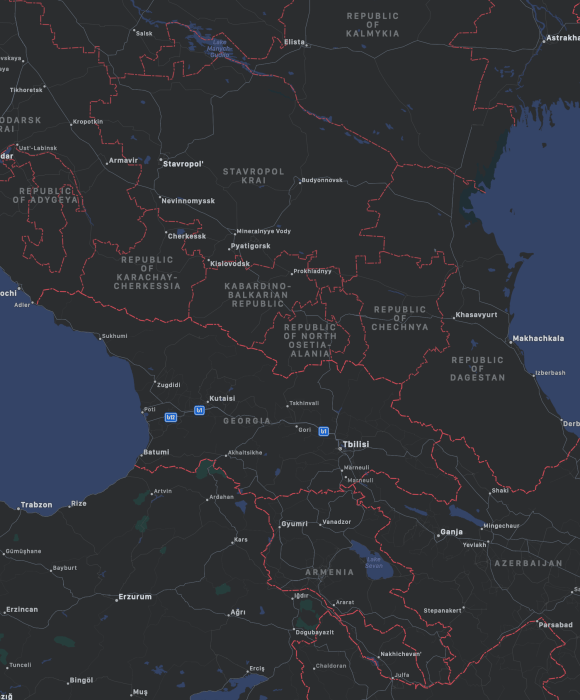
As I learned this morning, there is still quite a bit that I don’t know about the distinction between, say, a republic and a nation, or a nation and a country. All the same thing? Although the author does not address the question directly, he did cause me to look more closely at Apple’s Maps application when I was speaking with a colleague in Armenia. Yes, Armenia is a country, because it is a nation with its own government which occupies a particular territory. The part about a nation is related to people with common interests, and this is certainly true of Armenia. It’s a republic. It’s located west of Azerbaijan, which is also a republic–but part of Azerbaijan is separated by the rest. That is, Armenia is both east and west of Azerbaijan. Armenia also borders Iran, Georgia, and Turkey. But if you look just a bit further north, you’ll find a bunch of republics with unfamiliar names: the Kabardino-Balkarian Republic; the Republic of Karachi-Cherkessia, The Republic, of Adygeya, The Republic of North Osetia-Alania, and the Republic of Dagestan. There’s also the Republic of Chechnya, which is familiar. CIA Factbook to the rescue: “46 provinces (oblasti, singular – oblast), 21 republics (respubliki, singular – respublika), 4 autonomous okrugs (avtonomnyye okrugi, singular – avtonomnyy okrug), 9 krays (kraya, singular – kray), 2 federal cities (goroda, singular – gorod), and 1 autonomous oblast (avtonomnaya oblast’) Ah, but just what is a republic? Wikipedia’s definition: “Kabardino-Balkariya is a ‘Federal subject’ of Russia.” As Winchester points out, there are often stories that explain what happened and how we found ourselves in the present situation, but there are so many conceptions of land, ownership, colonization, nations, and so on, with such a long and twisted history, not much of it is guided by reason or consistent practice. This is unfortunate for social studies teachers who are already overburdened, and fortunate for those of who live in 2021 because there are online resources that can, at least, clarify these stunningly complicated ways to say, “this is my land” or, perhaps as often, “this is not your land.”

If you begin with the assumption that nothing makes sense except power, it’s easier to navigate the strange story of Japanese farmers in California who made unproductive land productive, but were then chased from their land because of World War II paranoia, never to return. Or the complexities associated with Scotland’s potential as a new country, independent from the British Empire after all of these years. Or, perhaps this book provides the framework to comprehend the ways in which colonists redesigned Africa’s borders to form countries whose borders still exist, but rarely make sense. And then, there’s climate change and the potential for natural borders to wash away, for productive land to become useless, for icebound land to become productive.

The book is filled with stories, some familiar, some astonishing, all useful in gaining a contextual understanding of how humans interact with land. The book is, in essence, a really good course in global social studies, written for adults who really ought to know enough about the subject to teach our children. Most of us cannot do that. I know a lot about geography and I cannot do that. Simon Winchester can, did, and I hope he’ll do it again. I want to read Land: The Saga Continues or whatever he decides to call his second book on the subject. If he’s not working on this book just yet, perhaps we can encourage him to do so.

A Surprising Solution to a Deeply Disturbing Problem of Our Own Making

Let’s begin with Heather McGhee. She’s the right kind of troublemaker. I heard her interviewed on NPR, got her book, read it carefully, and determined, as she did, that we’ve been wrong-headed about a whole lot of important stuff. She’s the former president of a think tank that focuses on inequality called Demos, and now, she’s both an important spokesperson for clear thinking, and the chair of the world’s largest online racial justice organization, Color of Change.

She’s making trouble because she requires readers to see everyday life from a radically different perspective. Not radical in the political sense, though she does that, too, but radical in the sense of eradication of old perspectives.

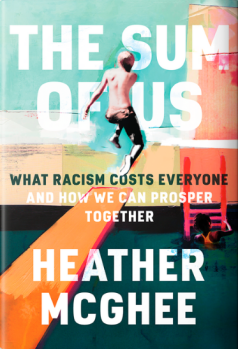
On the cover of her new book, The Sum of Us: What Racism Costs Everyone and How We Can Proper Together, there is an abstract paining of a white boy jumping off a diving board into a swimming pool. Ah, but the swimming pool is a mirage. It was there, at one time, but it’s been filled with cement. Why was it filled with cement? Because, in 1971, Jackson, Mississippi’s city council decided to fill swimming pools with cement so they could not be used by both Black and White swimmers. It was a way to avoid integration. The decision deprived the Black kids from swimming during the ridiculously hot Mississippi summer, but it also deprived the White kids from the doing the same thing. Better that nobody benefit!

If this thinking–roughly, the opposite of public good, so perhaps it’s public bad–was unusual, there would be no book and no reason for Heather McGhee to focus here. Instead, public bad (my term) is the basis for a great deal of public policy in the United States–and not only on hot summer days, not only in Mississippi, and not only in swimming pools. We use this theory of good decision making to work through where people live, how much money they earn, how their kids are educated, how we tax, where we place our roads and highways, and how we make a surprising number of important decisions. Roughly, the theory plays out as follows:

If a policy is a good idea, we should go ahead, but if it benefits Black folks, or equalizes the situation, then we should not go ahead. (Same, roughly, for other minorities.) And if not going ahead harms White folks along the way, that’s just too bad because that’s the decision we’re going to make.

Sounds like something from the 1950s in the American South, or maybe the 1910s. Then, McGhee explains how much of this thinking provides a framework for everyday life for everyone–especially people in lower income areas. The term “shooting yourself in the foot” comes to mind quite often. This is a completely crazy way to govern, to set policy, to run a county or a country. And yet, that’s what we do everyday. And it doesn’t seem to change. That is: the news coverage on George Floyd is extensive, and Black Lives Matter, but the hardcore reality of daily life in the U.S. receives very little coverage. Hence, this book.

She sets the stage with considerable skill. Then, she surprises by telling one story after another, each illustrating the impact of racism in ways that aren’t often considered. For example, “Many of the nation’s biggest and most respected public colleges were tuition free, from the City University of New York to the University of California system. The massive public investment wasn’t considered charity; an individual state saw a return of three to four dollars back for every dollar it invested in public colleges. When the public means ‘white,’ public colleges thrived.”

And then… “That’s no longer the case. Students of color comprised just one in six college students in 1980, but now they make up over four in ten. Over this period of growth among students of color, ensuring college affordability fell out of favor with lawmakers. State legislatures began to dramatically cut what they spent per student on their public colleges, even as the taxable income base in the state grew….By 2017, the majority of state colleges were relying upon student tuition dollars for the majority of their expenses…”

Or, to put this another way, the reason why so many public college students now carry so much college debt is connected to racism. Yes, it’s a bit of a leap, but more examples from other sectors add credibility to this line of thinking. The ripple effect is powerful, and not just on minority populations:” In 2018, the Federal Reserve reported on what most of my generation knows: student debt payments are stopping us from buying our first home, the irreplaceable wealth-building asset.” A rather complicating story of sub-prime mortgages, mostly rooted in racist practices, is the next story she tells, and certainly that has affected, and continues to affect, much of the U.S. population. Weakening of labor unions? Another example of similar practices, similar thinking, similar destruction of the American dream for the majority, not the minorities.

The mythology of democracy is an easy target: from the Founding Fathers through the present, unequal representation, loopholes, workarounds, and other means have been used to elevate a relatively small upscale male white population and to keep everyone else in their place. We’re breaking through, but only a bit, because the status quo is immovable. It’s woven throughout our laws, our political boundaries, our voting districts, our school districts, our tax system, and so much more.

No surprise to find a chapter about redlining–the practice of geographic segregation. No surprise to find the ugly practices of destroying neighborhoods by making decisions about the location of public roads, either. “The economic imperative (of the first half of the 1800s)…set the terms of racial understanding: in the South, Blacks were seen as inferior and servile but needed to be close. In the North, Black people were job competition, therefore seen as dangerous, stricken with a poverty that could be infectious.” Beginning in the later 1880s, and “for the next eight years, segregation dispossessed Native Americans, Latinos, Asian Americans, and Black Americans of land and often, life. No governments in modern history, save Apartheid South Africa and Nazi Germany, have segregated as well as the United States, with precision and under the color of law. These truths are self-evident, but easily overlooked when viewed through the nonsense of “justice for all” and “the land of the free.” Time after time, McGhee hits hard, almost always with evidence and legal history that is difficult to dispute. She is a very convincing advocate of the big picture.

Is K-12 school inequitable. You bet. Here’s a theory on why that’s true, and what might be done about it. “Today, the majority of public school students in the United States are children of color. Why? Because of disproportionate number of white students are enrolled in private schools, comprising 69 percent of K-12 private school enrollment…The pricing up and privatization of public goods has a cost for us all–white families included. A house in a neighborhood unencumbered by systemic racism found in public schools will cost significantly more.” Summarizing a complicated idea, white households pay a 77 percent premium on housing in areas where public schools are “excellent.” (This was written before the housing boom of 2020-2021, so we’re probably looking at 110% today.) On the plus side, when the home is sold, there’s a premium, but there’s also an issue in choosing a home in one of these places. “In order to chase these so-called good schools, white families must be able and willing to stretch their budgets to live in increasingly expensive, and segregated, communities… To be clear, “These white parents are paying for their fear because they’re assuming that white-dominant schools are worth the cost to their white children.” And (yikes!) they are essentially reinforcing the worst possible decisions: that segregated schools are best.

It’s now 2021, so it’s nearly impossible to write a book about any subject without at least one chapter about climate change. And so, we learn about the impact of poor pollution management, how the minority neighborhoods suffer most, and how the pollution spreads to other neighborhoods, too. As with, “The United States is…the biggest carbon polluter in history, but we have one of the strongest and most politically powerful factions opposed to taking action to prevent catastrophic climate change…the key players waging war against environmental protection were reliable white men, from industry executives to the politicians to the media commentators.” She theorizes that our society has taught a lesson: there are winners and losers, and the losers will be the ones who most suffer from climate change. The winners believe they will be fine. Of course, this is faulty thinking, wholly unreasonable and illogical, as evidenced by the frequent droughts that threaten our agribusiness, or the floods that disabled New York City’s subways, or the scary rise on the coastlines that will somebody make beachfront property worthless (regardless of how much wealth is poured into temporary solutions). Basically, the climate change opposition works this way: “we won’t risk the economy for this dubious idea.” And so, we believe, or lead ourselves to believe, that climate change is somebody else’s problem, and that it can be managed in the same ways that we manage school or neighborhood segregation.

Then, McGhee tells the story of Lewiston, Maine. The whole story begins to change. There is hope, and it’s real. Lewiston lots its manufacturing jobs, then its economy, then spiraled into almost no economy at all. There were few jobs, little opportunity, and on Lisbon Street, once Maine’s second largest commercial district, half the stores were vacant. So what happened? Refugees from the Somali Civil War led immigrants first to Atlanta, then to the less expensive Portland, Maine, then to Lewiston where “quiet streets offered more peace and the low rents offered more security. Other African refugees followed”–from the Congo, Chad, Djibouti, and Sudan. They rented the vacant storefronts, and started new businesses. They built a new economy. In the whitest state in the country. They paid nearly $200 million in local state and local taxes in 2018–and I’m guessing the number continues to grow. This story is found in other places–Kennett Square, Pennsylvania (outside Philadelphia) “is now 50% Latinx, mostly from Mexico and it’s a community given new life by the families of migrant workers at the mushroom farms.” McGhee tells similar stories about Storm Lake, Iowa, and towns in the Texas Panhandle once considered hopeless, now beginning to thrive.

“Even in the face of anti-immigrant policies and the absence of vehicles for mobility such as unions and housing subsidies, today’s immigrants of color are revitalizing rural America.” In the first decade of the 21st century, nearly 83% of the growth of rural America is people of color. America is changing, but many us are missing the big story.

I’m grateful to Heather McGhee for opening my eyes. So far, The Sum of Us is the book I have most recommended to friends and colleagues in 2021. I’m feeling as though this might be essential reading for the early 21st century.

The Self-Important Year of 1974

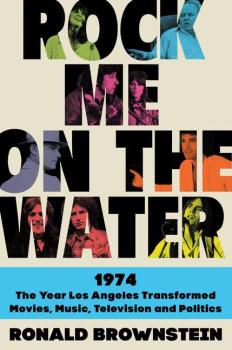
A good friend told me about a new book called Rock Me on the Water: 1974, The Year Los Angeles Transformed Movies, Music, Television and Politics. He was excited because we experienced some of the adventures that author Ronald Brownstein described, at least tangentially. It’s interesting to write about this particular book and this particular era because I happened to rewatch Almost Famous, Cameron Crowe’s film about his adventures on the road with The Allman Brothers Band (as a sixteen year old journalist for Rolling Stone, late 1973).

The book tells the story–a very good story at the start–about Linda Ronstadt and the way she built her career. This leads to background about David Geffen and the evolution of community of musicians in and around Laurel Canyon in the Los Angeles area. In short, they shared just about everything–life, love, shelter, food, drugs, music, songs, recording sessions, and a gigantic creative heart. In time, this culture evolves into a big-money enterprise, as evidenced by, for example, The Eagles, and the played-out sensibility so effectively described in their song, “Hotel California.” Indeed, this is music journalism at quite a high level, pleasant to read, deeply connected with outside events, evocative of time and place, and, viewed from the distance of time, something quite important. At the time, or shortly afterwards, I happened to be working (at a very junior level) at Warner Bros. Records in New York City. It was clear that everything had shifted west, but when the opportunity to move to Los Angeles came up, I turned it down. But I could sense that 1974 was right around the time when New York City lost a lot of ground as the center of the entertainment universe, and Los Angeles had gained what NYC had lost.

I come from a television background, but I had never thought much about how the development of Norman Lear’s sitcoms and Mary Tyler Moore’s small empire were related to this shift. I suppose I figured that sitcoms had always come from Los Angeles–for a long time, anyway–but I did not connect the creative energy in music to the creative energy in television. But there it is, and again, author Ronald Brownstein lays it all out in ways that suggest a much larger story.

And yes, there was a lot happening in the movie business at that time, too. All in Los Angeles. There was the old guard and the remains of the studio system, and Warren Beatty who seemed to be able to play both in the old ways and in the new. And there was Jack Nicholson, who was a somewhat awkward fit (mostly as a writer) but a far better fit for the independent orientation of the new. This, too, takes shape at around this time (1974 is a loose peg, but a good one). And much of what Brownstein describes is deeply connected to the larger shift in creative power.

But then, we meander into the “I wish I cared” world of Jane Fonda, Tom Hayden, and the very specific strange politics of the Vietnam era. The national material is good, if well-known, but the California politics is slow-going, and although the author tries very hard to connect the dots, that felt like a struggle. The politics of this era were all about the Vietnam War, but Los Angeles was tangential to the story. Unfortunately, the long story of Jerry Brown extends the book’s dull middle section before we see the light at the end of the tunnel–which turns out to be yet another motion picture screen, this time featuring the work of young Steven Spielberg and George Lucas. The story of the younger directors–Brian de Palma and Martin Scorsese among them–lifts the story back to a higher level, but now, the connections between their efforts, Los Angeles and the year become more diffuse.

The first half of the book is great fun, and somewhat provocative reading (as provocative as pop culture goes, I suppose). The second half contains interesting stories, but I lose the point of the book. Yes, I enjoyed reading about the development and success of M*A*S*H*, and the struggles between Carrol O’Connor (Archie Bunker) and Norman Lear, but neither really illuminates how and why Los Angeles and 1974 changed the world. We begin to see female directors, but that happens, mostly, later on. Here and there, we see some non-white faces and some non-white directors, and we do see “two hundred movies centers on Black characters” from 1971 until 1975, but the shift in Hollywood takes shape, in a meaningful and sustainable way, much later. Similarly, there are non-white recording artists and the beginning of a new segment in the industry, but the action here is in Memphis, Philadelphia, and soon after, in disco capitals throughout the U.S. It’s not really an L.A. thing, not that L.A. isn’t part of the story, it’s just that the book promises a deeper and more long-lasting connection.

The book regains some strength when it returns to Linda Ronstadt, whose story about career development is also not an L.A. thing. Her work with Peter Asher is more about her own independence and versatility as an artist (one who made a lot of money, who started her career in Los Angeles but then became full-scale U.S. star). Again, worth reading if you’re curious about Ronstadt and because she happens to be a very smart, wise, and talented artist–and in part, because she comes up as several other smart, wise and talented women are blazing their own paths. This, too, is partly tied to Los Angeles (Sherry Lansing becomes the first head of a major studio), but it’s also happening throughout the world at that time–and quite slowly, everywhere.

By “December” (each chapter is titled with the name of a month, but the months have nothing to do with the order or organization of the storytelling), everything is falling apart. ABC has out-maneuvered CBS, so the Norman Lear shows are losing ground to the likes of the fluffy-but-fun Happy Days on a newly competitive network. JAWS introduces the blockbuster film, leaving the rich potential of independent film in an early 1970s bucket that would take a long time to find its footing, and shifting priority of studio executives to a much better money-making proposition. Stadium shows took the place of small rock club performances–shifting the creative power back to NYC as punk and other alternative forms suddenly seemed a whole lot more interesting than anything that was going on in L.A. Fleetwood Mac, once an interesting band with blues roots and a critically acclaimed take on progressive rock, added Stevie Nicks, and became wildly popular among the stadium concert goers, and simply irritating for those who reveled in the early 1970s creative culture that was once, for a brief period, the center of the universe.

We Were Not Alone

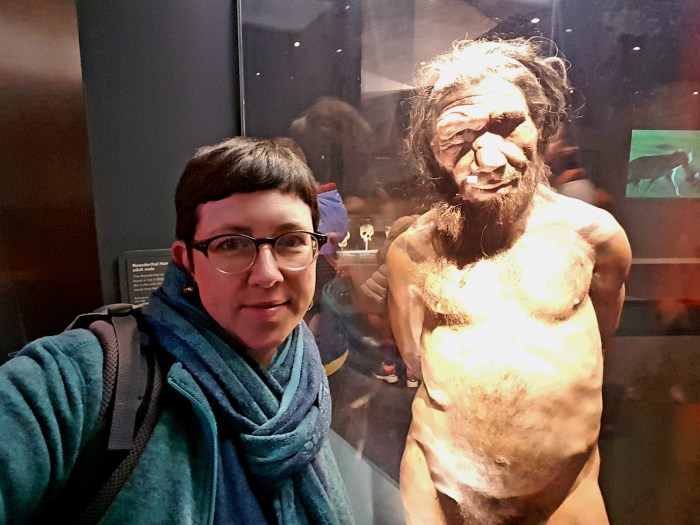
Seems like science fiction, but for a long time, Homo sapiens were not the only human beings on earth. And there were a lot of them. And they lived in a very large area that included most of Europe, much of Asia, and probably, in many other places, too (but we haven’t yet found the evidence). They were far more sophisticated than you might imagine, very similar to our own kind as we evolved, in parallel, from about 350,000 years ago until (fairly recently?) until about 40,000 years ago. If we extended our individual family trees back to that time, most or many of us would find parents, aunts, and uncles, and plenty of cousins who were Neanderthal or mixed with our own kind, and quite likely, mixed with other early humans, too (and, probably, other species). This is not some exotic scientific story. This is the story of our own lives. And no less messy.

This morning, I happened to see a cartoon drawing of two large bears inspecting a minivan. On the back window of the vehicle were stick figures of a human family. One bear remarks, “Look! A menu!” It’s not easy to study the Neanderthals, or other early hominids, because they were eaten, destroyed in battle and accidents, burned, and buried. In fact, buried is good–if you know where to look. So far, we’ve been lucky enough to find bones, tools, settlements, but not many of them. Still, it’s a start, and we’ll no doubt find a lot more throughout the 21st century as we improve our satellite imaging (for example). In the meantime, scientists and historians have figured out some parts of the puzzle. Bear in mind that humans have been pursuing archeology for just over 150 years–and for the first 50-100 years, there were a lot of questions about validity, integrity, and there was astonished disbelief because humans (and their religions) didn’t want to consider the possibility that we were not alone as a human race. Getting past the idea of a “missing link” between humans and apes was, and perhaps remains, a problem, too. And this is made more complicated because Neanderthals are “extremely similar creatures to us” but “many simultaneous pathways existed, some finishing in dead ends, others like Neanderthals developing their own unique bodies and minds that were a match from our own.”

I’m quoting Rebecca Wragg Sykes, a remarkably talented storytelling and scientific historian whose book, KINDRED: Neanderthal Life, Love, Death and Art is an absolute delight. She keeps the story interesting (fascinating would be a better word), piling on the historical details, open questions, likely facts, and the vast vastness of things we don’t know. I love that.

So far, we’ve found about 250 Neanderthal bodies, or enough parts and pieces of bodies to develop some ideas about their lives. We will certainly find a lot more. Their brains and our brains–about the same size (“just as big and deliberating as your own”) Their brow–more expansive than ours. Their babies’ chins–less prominent, so our babies are, or were, probably cuter than their babies. Their eyes–bigger than ours, noting that “people from higher latitudes have eyeballs up to 20 percent bigger than those from near the equator.” Their ears–very similar to our own, inside and out. Their noses–certainly larger, so they could “snort in the air at almost twice the rate we do.” But why? Here’s the speculative layer that’s found throughout the book–questions about whether the larger nose provided greater airflow, more air filtering and conditioning, or a more powerful or refined sense of smell. “…in some ways, Neanderthals’ large internal structures resemble reindeer and saga antelope, which have extensive mucous membranes to reduce dehydration and heat loss…[but] the internal structures in Neanderthals appears to be worse at air conditioning than our own.”

There’s a strangeness about discovering Neanderthal life expressed in time and distance. They lived for several hundred years in an expanse from Spain to Siberia. When something is discovered about a particular body or settlement, one must consider not only where it was found but also when. That’s because cultures and communities are always in motion–so a place-based assumption may, in fact, be more of a time-based assumption. Think in terms of discovering a human body from the Middle Ages in France and another from two years ago in Vancouver, British Columbia, and making statements about their dental care, or their diet. Assumptions must be carefully considered. Now, expand the time scale from a thousand years to twenty thousand years–the assumptions become that much flakier.

Tools: “More artisans than klutzes, [Neanderthals] appreciated the right tools for the job. Selecting hammers…was crucial. Small cobbles have the necessary mass to hit hard for big flakes, but for more delicate work, pebbles are better. And using soft rather than hard hammers produces different effects. Elastic organic materials like antler and bone or even dense rock like limestone spread out the kinetic energy and produce thinner, longer flakes…Tools were often retouched, sometimes to give a particular edge, but often to resharpen them–flakes dull very fast even when cutting meat.” So: yes, Neanderthals made and used a variety of tools for a variety of purposes, just as we did, and do today. This suggests the range of activities they pursued–hardly anything as simple as hitting a bear with a wooden club, though they may have done that, too. They used wood to make spears: “far from pointed sticks…finely crafted from thin spruce and a single Scots pine, their tips are all at the stump end: the hardest part. The shafts were systematically carved off-center for increased strength…Experiments show that the shorter-throwing spears easily range to 30 meters (30 yards).”

Their diet was varied. “Beavers’ fatty tails would have been succulent treats…they certainly gorged on tortoises…dolphins, seal and large fish…ticks and lice might have been nibbled while grooming hair…Neanderthals hunted [bears] more than other predators…burning hints at cooking right there in the den.” They ate plants, too–pine, mushrooms, moss. They cooked stews. They soaked acorns, then boiled them, a far more sophisticated conception than eating only raw meat. They fermented food, one of many examples of planning and preparation.

I could go on through where they lived, how they raised their children and families, the art they made, their customs and care for the dead, and more. There is so much in KINDRED, and so much of it is captivating. And I am so looking forward to the next book from Ms. Sykes. I have found a new favorite author.

Happy 60th Anniversary, Arhoolie!

In this season of abundant music, I wanted to draw your attention toward something quite special and quite unique. Sixty years ago, Chris Strachwitz founded a record label to celebrate authentic folk music and blues. The label’s first release remains a personal favorite: Mance Lipscomb: Texas Sharecropper and Songster, recorded in rural Texas and released in 1961.

It’s wonderful that the story continues to this day. Even better that there is a free (please donate) documentary featuring the history and lots and lots of really terrific performances by and in memory of Arhoolie Records artists. Right now, I am thoroughly enjoying “Morning Train” by The Campbell Brothers band–so much fun to see this spectacular rendition recorded simply and so effectively. (It begins at 1:28:40 on the YouTube video.)

Man, this is great stuff! Taj Mahal opens with a Mance Lipscomb tune, and that’s followed by a rocking Ry Cooder version of a track from Big Joe Williams Tough Times, an album he remembers buying (his father hated it). The song is “Sloppy Drunk.”

Some of the best music here comes from the label’s dedication to Mexican music. Arhoolie released several albums by Lydia Mendoza, remembered here with a fresh and impassioned La Marisoul, backed up by Max Baca, whose own band, Los Texmaniacs updates a song recorded by Flaco Jimenez, who recorded for Arhoolie. (Jimenez “was introduced to the outside world by Ry Cooder–everything is connected!) “Un Mojado Sin Licencia (A Wetbaack Without a License)” is sung first by Jimenez, then by Los Texmaniacs, and both are terrific.

What am I missing? There’s Cajun music with BeauSoleil, several members of the Treme, and the Preservation Hall Jazz Band, Z.Z. Top’s Billy Gibbons (singing a Lightnin’ Hopkins song), a story by the Hungarian Csôkolom, blues star Charlie Musselwhite (who used to earn money on the side by delivering records for Chris). You might know Sugar Pie DeSanto, Ruthie Foster, or Barbie Dane, but you’ll know them after you watch this documentary–and you’ll not soon forget them.

And then, and at last in the documentary, there’s Mississippi Fred MacDowell, celebrated by Bonnie Raitt. She offers a big hug and thank you to Chris, then sings and plays a lovely version of MacDowell’s “Write Me a Few Lines” and “Kokomo Blues.” Gorgeous. So great!

Hosted by American Routes radio host Nick Spitzer, the documentary was released on Thursday, December 10. It’s nearly two hours long. I loved every minute of it. UPDATE: Unfortunately, it’s no longer available online.

Akin to the Internet, circa 1920

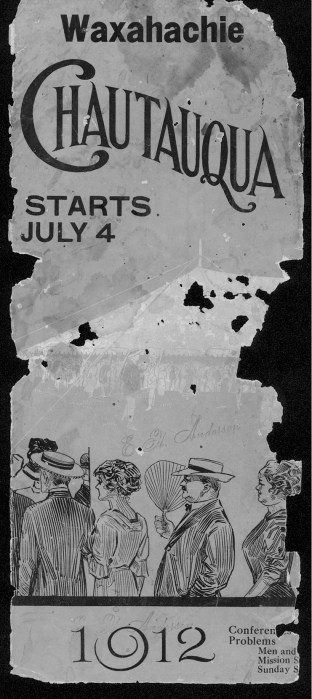
One version of our story begins in 1874, midway between Cleveland and Buffalo, about 20 miles inland from Lake Erie, on the shore of Lake Chautauqua. Another version begins a half-century earlier, in 1826, in a town called Millbury, just south of Worcester, Massachusetts. The third takes shape in 1904 in Iowa and Nebraska, in part because small towns could now be reached by the railroads out of Chicago.

Here’s what happened.

“In an age when most Americans had acquired only a grade school education,” two educators who were involved with Sunday schools “recognized the power of education to elevate, enlarge and enrich lives.” They were Reverend John Heyl Vincent, a Methodist minister who had become Secretary of the Sunday School Union, and Lewis Miller, a former teacher who became a businessman (farm machinery) who served as the Superintendent of Sunday School and at his church and President of the Board of Education in his hometown of Akron, Ohio. Together, on the pretty shore of Lake Chautauqua, they put together a conference for 2,500 Sunday school teachers for two weeks during the summer of 1874, mostly to listen to lectures and seminars about religion. When they did it again the following year, they added music from the Tennesseans, who sang plantation songs from the American South, and non-religious lecturers, notably President Ulysses S. Grant (he had been a former parishioner at Miller’s church in Illinois). A year later, there were lectures about chemistry, geology, and astronomy.

When I visited Chautauqua in 2014, I wrote about the experience. If I had stayed the full nine-week season in 2019, I would have attended lectures by public radio’s Krista Tippett and Ira Glass; Middlebury College President Laurie L. Patton; comedians David Steinberg and Lewis Black; author and activist Bill McKibben; writer and author James Fallows; author of The Death and Life of the Great Lakes Dan Egan. I would have gone to concerts featuring Judy Collins, Madeleine Peyroux, Bela Fleck and Abigail Washburn, Diana Ross, the Lincoln Center Jazz Orchestra with Wynton Marsalis; and a lot of vocal and chamber groups whose names are unfamiliar. I would sit in on each morning’s lecture/sermon by a notable Chaplain, watched performances of several operas (The Barber of Seville, and Figaro), and just walked along the beautiful shore. If you’d like to imagine what you would have done, every season since 2007, follow this link and enjoy. They are now planning their 2021 summer season. And they’ve introduced an online version that I’ll write about in the future; it’s called Chautauqua Assembly.

Yes, it’s amazing that this bit of 1870s culture remains vibrant and remarkably successful 150 years after it began, but that’s only part of our story.

Now, let’s jump back to the late 1820s and 1830s–where the roots of today’s public radio reside (GBH began just ten years later). Somewhat similar to today’s TEDTalks, the Lyceum circuit provided lecturers to more than 3,000 theaters and public spaces all over the country. There were big stars on the circuit: Mark Twain, P.T. Barnum, Susan B. Anthony, Frederick Douglass, Abraham Lincoln, and other U.S. Presidents, and lots of lesser-knowns. But there was a problem. No air conditioning. No climate control for hot indoor spaces during the summer–so the Lyceum circuit was, mostly, a wintertime activity. Until one day…

Keith Vauter, who managed western states and territories for a booking agency that supplied the Lyceum Circuit with talent, decided to try a new approach. The Chautauqua concept in upstate New York had inspired summer chautauquas in other places. He figured he could book his talent during the summer, and expand his business. His first attempt–in 1904–failed because the logistics of moving so many performers to so many locations was just too expensive. As Vauter improved the logistics and came up with a way for local communities to guarantee the cost of their own chautauqua, the concept took off. Borrowing ideas from traveling circuses, vaudeville, and theater troupes, they devised what became a very popular idea: the traveling chautauqua. At least until 1929, when a combination of talking motion pictures and the Depression more-or-less ended the fun. For about 25 years, traveling Chautauqua “served to provide small towns with a deeper sense of self, community, nation, the world, and God. They spanned the silent movie era, the Progressive Age, and the transportation shift from horse-and-buggy to automobile.”

There is great wisdom in the chautauqua movement, and in the Lyceum movement, and in their intermingled roots of what has since become radio, television, some of the Internet, some of the entertainment industry, and more. When I started to become curious, I found two extraordinary experts who knew the culture and the whole story. The first was Harry P. Harrison, who was among the first “platform superintendents” for the new Chautauqua circuit way back in 1903. He wrote, or dictated, a book to co-author Karl Detzer, a professional writer; it’s called Culture Under Canvas: The Story of Tent Chautauqua (published in 1958; I found an autographed copy for $3 in a used bookstore). The second is newer, written by a college professor who worked with music students in summer Chautauqua for many years. It’s called The Traveling Chautauqua, and the author is Roger E. Barrows. The material quoted in this article comes from that book.

So: what was it like, going to a tent chautauqua for a week in the 1920s?

From Missouri’s Joplin Globe: The most famous Chautauqua speaker was the founder of Temple University, Russell Conwell. Conwell is said to have given his “Acres of Diamonds” speech 6,150 times between 1882 and 1925. Much in the spirit of self-improvement found in chautauquas, Conwell emphasized that developing his talents and skills is what made a man successful — or diamonds could be found in one’s own backyard. He and perennial presidential candidate William Jennings Bryan were two of the most sought-after speakers.”

Harrison tells stories about the many performers who helped make his career. Barrows breaks it down by type of performer, provides many more pictures, and also includes excerpts from their scripts.

“Madame Ernestine Schumann-Heink sweeps onto the stage. She is a large woman whose presence dominates the platform. Her rich voice, with its wide range…begins with the spring aria from the Saint-Saens opera, Samson and Delilah.” (“When the movement began in 1874, all music was live.”) “To the perpetual spinning sounds of the piano, Madame Schumann-Heink becomes Gretchen at the spinning wheel, expressing her mounting heartache as she comes to realize the emptiness of Faust’s promises…Schubert’s art song travels from the Austrian metropolis of Vienna to the small towns of Texas and Ohio…The artist would later recount how, in the midst of her signing, she could hear the mooing of cows…”

Bohumir Kyrl, who had played with Sousa, conducted his own popular band and became a star performing on cornet. College girls, on an adventure for the summer, would sing classical, art, and popular songs. The Jubilee Singers (the Fisk University group was one of several) would “harmonize a cappella;” “they had heard tales of slavery from their parents’ laps, and…had personal experiences with racism, (as they expressed) the “anguish and sorrow of the original singers.” There were authentic Indian princesses who performed on piano, sang songs, and shared legends of their people. The Raweis were Native New Zealanders on tour through the American hinterlands. At a time when actors were not welcome in God-fearing small towns, Lucille Adams was an “interpreter,” also called a “reader,” who read and spoke expressively, but didn’t quite “act.” In time, the circuit tried a Shakespearean acting troupe led by Ben Greet, a legitimate Shakespearean actor, and they became popular, famous, and well-traveled, introducing Shakespeare’s work to audiences who had never seen anything quite like it. Eugene Laurent was a popular magician on the circuit.

There were cooking lessons, many lecturers who specialized in a loving life at home, and plenty of preachers. Billy Sunday was a former professional baseball player who converted to evangelical Christianity and became one of its most famous spokespeople. Lots of souls were saved in the chautauqua tents, of lives transformed. Many religions were represented; Rabbi Emil Hirsch of Chicago’s Sinai Congregation helped non-Jews understand his religion.

One of the most famous speakers relied upon religion with a more old-time flavor, not only for his tremendous success on the circuit but also as the basis for three runs for U.S. President–William Jennings Bryan, at the time, one of the best-known American citizens. (You’ll recall his name and presence from the Scopes Trial and the play, Inherit the Wind). Reformer Jane Addams was on the circuit in 1909 and 1919. Women’s suffrage was a hot topic on the circuit, too. Jeanette Rankin often spoke about that–she being the first woman elected to the U.S. Congress.

From 1909 to 1912, Peter MacQueen talked about his adventures hunting for big game with Teddy Roosevelt in Africa. Around the same time, Frederick A. Cook spoke–more than 350 times–and claimed to be the first man to reach the North Pole (Peary was second). Booker T. Washington spoke about progress through education at chautauquas around 1914, and a few years earlier, Florence Mayrick talked about her life in an English prison. When the chautauaqua was in town, everyone was elevated, educated, and thrilled. Truly, this was something special in towns where not much special happened very often.

And then, it was over. This huge chunk of American education for adults, and for the entire family, just went away. Radio took its place with an even wider variety of education, religion, entertainment and more. And then, television, and then, the internet.

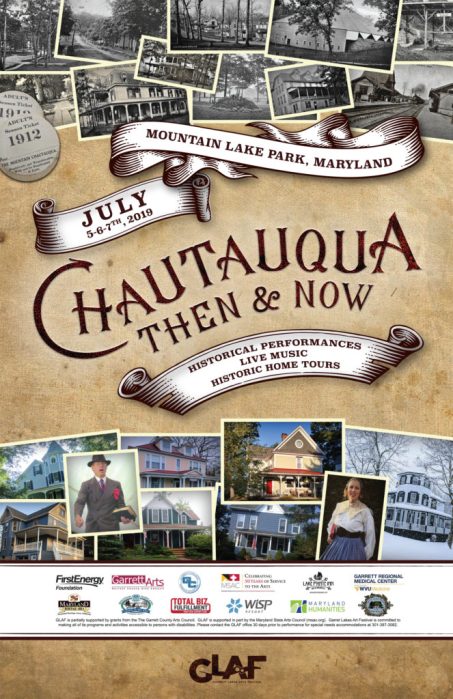
The best way to experience a chautauqua is to buy a ticket for several days, or longer, for the original that still runs in New York State. The second best, which may be pretty darned good, is to find yourself a local chautauqua like the one that the Wythe Arts Council runs in Wytheville, Virginia, or the weekend festival in Madison, Indiana, or the one that feels intentionally old-fashioned in Mountain Lake Park, Maryland, an old B&O Railroad town and former resort that was, in the day, home to an original Chautauqua traveling show. As soon as things open up again, they’re on my list–and if you know of any others, please add them to the comments below.

AND–for even more fun–check this out! It’s an industry trade magazine from June 1922–and it’s chock full of advertisements, news stories, photographs, listings of booking agents, and so much more. The magazine is called Lyceum Magazine: For the Lyceum and the Chautauqua.

Seeing 10 Years into the Future

Somehow, even in the shadow of the virus, we can see 2030 with surprising clarity. We know a lot, and we can make good guesses about much of what we don’t know. In fact, I’ve been doing this for several years, traveling the world, speaking to university audiences, explaining how and why Southern Asia and Sub-Saharan Africa are the places that today’s students must study because of their enormous population increases and their associated growth as consumer markets. I’ve been focused on the lives and futures of young people growing up in the 21st century, much of it connection with Kids on Earth, a global interview project, and my work as a Senior Scholar at The University of Pennsylvania.

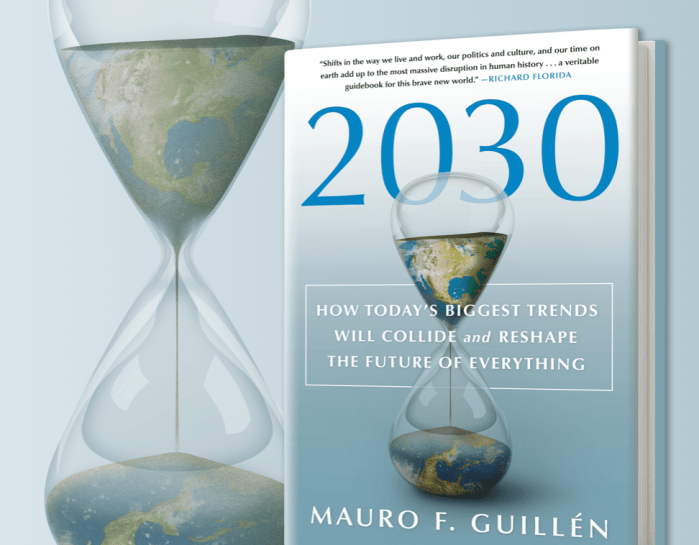
In fact, it was a browse through a UPenn newsletter that led me to Professor Mauro F. Guillén, a colleague at UPenn’s Wharton School. About two months ago, Guillén published a book entitled 2020: How Today’s Biggest Trends Will Collide and Reshape the Future of Everything. My interest in children, teenagers, parents, and schools; his is business, economics and government, but our circles overlap with plenty of shared space.

For both of us, the key to the secrets of the 21st century is the number of babies being born, where they are being born, the number of people who are living long lives, and where they are living those lives. He sets the stage with the rapid growth of the world’s population: 3 billion by 1960, 4 billion by 1975, 5 billion by 1987, 6 billion by 2000, and 7 billion by 2010.

And then: “The reality is that by 2030 we will be facing a baby drought.”

Take a closer look: “for every baby born in the United States, 4.4 are being born in China, 6.5 in India, and 10.2 in Africa” and “improvements in nutrition and disease prevention in the poorest parts of the world have made it possible for an increasing number of babies to reach adulthood and become parents themselves.” And so, by 2030: “South Asia (including India) will consolidate its position as the number-one region in terms of population size. Africa will become the second-largest region, while East Asia (including China) will be relegated to third place. Europe, which in 1950 was the second largest, will fall to sixth place, behind Southeast Asia…and Latin America.”

If 21st-century governments were more open to immigrants, the trends could equalize, but they’re going in the opposite direction–limiting incoming populations from countries whose people they need in order to maintain not only sufficiently large populations but also sufficiently young ones. That is, Europe and The United States will become increasingly old–which is terrible for the economy (the success of Social Security in the U.S., for example, relies upon income from the younger population, which disappears if there aren’t enough babies and aren’t enough immigrants). As we make these (okay, the correct word really is “stupid”) decisions, we are making an economic and social mess for ourselves.

It’s always instructive to study maps. One of my current favorites compares the size of the African continent with various countries. If you move the countries around like jigsaw puzzle pieces, you can fit all of China into the part of Africa that’s south of the equator, with all of India and all of the United States, and Eastern Europe, and France, Germany, and Spain, and still find enough space on the continent for The U.K., Japan, Italy, Switzerland, and a bunch of other countries. It’s not easy to think clearly about Africa, or any other place unless you understand its size, its history, and its potential for the future. Incredibly, people in the countries listed above know very little about Africa (challenge yourself: how many African countries can you name? how many cities?)

Perhaps women will think more clearly than men have done. This is the other huge trend: women graduating from higher education, with more advanced degrees than men, and gradually gaining power in both industry and government. They marry later–average age of first time mothers is now 28 years old. For example, “in the 1950s, about 7 percent of women between the ages of 25 and 29 had a college degree, half the rate of men. Nowadays, the proportion of women with a college degree is 40 percent, while the figure for men is only 32 percent.”

Now, let’s think about old age. People really are living longer–science, medicine, biotech, nutrition, hygiene, education, social programs–everything contributes to longevity. “By 2030, the average 70 year old will live like today’s average 50 year old.” We’ll be aided by robotics, and devices that make it easier to climb stairs, maintain balance, diagnose disease more quickly, and more–all of this takes shape during the current decade. In many ways, this is driven by necessity. For example, “by 2025, Japan will need 1 million nurses the country currently doesn’t have.” In the U.S., as in most countries, “about 90 percent of paid senior care is done by immigrants”–but our present-day policies are limiting the number of available workers. If Japan solves the problem with robots–a significant current effort–perhaps the U.S. will benefit.

Forget about “keeping up with the Joneses.” Now, we’re “keeping up with the Singhs and the Wangs.” Forget about your current notions of cities as a great place to live and work. (We’re seeing this in the real estate market as many people leave the crowded cities for locations with fewer people, less crowding, and increasingly excellent services.) Many cities exist near bodies of water, and with climate change, water levels are rising, and storms are causing chaos. Also on the subject of water, several cities in India are illustrating a nasty future in which water supply is insufficient for population needs. (“A majority will face formidable challenges related to pollution, congestion, and security. The cities most exposed to climate change will suffer from a shortage of freshwater and an excess of saltwater.”) Less so, perhaps, for food needs as vertical farming is becoming to take hold. And yet, some cities are flourishing–even during the pandemic, and hopefully, afterwards–because of creative class and knowledge workers–but these are precisely the folks who can work just about anywhere.

Present-day assumptions about ownership may be giving way to newer assumptions about sharing (a phenomenon slowed by the pandemic). Assumptions about the ways money and banking work are also taking shape in new ways–look at the progress made by PayPal, Venmo, and credit cards in a marketplace where so many people are now reluctant to handle paper currency and coins. We may be seeing the end of non-digital money by 2030.

I like the quote from William Faulkner that begins the end of the book: “You cannot swim for new horizons until you have courage to lose sight of the shore.” So here we are, stuck in the pandemic, questioning whether we all ever return to the old normal, strikingly unaware of so many of the realities already in the “high likelihood” category for 2030. We’ve already lost sight of the shore; we just haven’t accepted that reality.

The author’s suggestion that we “approach uncertainty with optimism” may be the only approach that makes sense in what is now a fairly crazy world of the future.