Stinking Bishop, or Why British Food Rules

The cheese is named for the Stinking Bishop pear, which is used to make the perry used to rinse the cheese at it ages. The cheese is soft, produced in limited quantities from the milk of once-nearly-extinct Gloucestershire cows. The great care associated with this special cheese is not unusual. In fact, special attention to local foods was a hallmark of my recent journey through the Cotswolds, the English countryside just east of Oxford. Never have I taken a trip where fresh food was so abundant, so front-and-center. If you’re still caught up in the mythology about lousy British food, reality has passed you by.

While we’re on the subject of cheese, I should note two very special cheese shops, one in the Cotswolds railroad village of Moreton-on-the-marsh (beautiful old main street, endless shops and old inns, railroad just a few blocks away). The Moreton shop is called Cotswolds Cheese Company; the one on swanky Jermyn Street in London is Paxton & Whitfield. In  Moreton, I tasted my first Single Gloucester (mild, classy and grassy, but nothing to get me excited about), and my first Double Gloucester (lots of fresh character, earthy, stronger and richer flavor), and also, a Burford (a simple, smooth cheddar). I bought a small hunk of each, a baguette and a blackcurrant-apple juice, and ate lunch on the short train trip to Oxford. In the second, I tasted Stinking Bishop and then benefitted from a very friendly cheesemonger who introduced me to several British cheeses, including an ale-washed Caerphilly that I happily munched whilst window shopping along Jermyn Street (where their London store is located). Great cheeses, all local to Britain, most produced within a two hour drive.

When I visited the Cotswolds, it was asparagus season, and, seemingly everywhere I went, delicate smoked salmon was available. I combined the two, as an appetizer, at Bourton-on-the-water’s Rose Tree Restaurant, and learned something about the taste of fresh English asparagus. It’s sweet. The taste resembles American asparagus–even my local variety here at home–but only somewhat. The flavor is delicate, and welcoming. And, apparently, May is its favorite time of year. I followed by Beef Wellington with local mushrooms and local beef. This was in keeping with another modern, organic restaurant in the same village, The Croft, where I enjoyed one of the beefiest, freshest tasting hamburgers I’ve ever eaten, and also, a tasty Steak and Ale Pie, the latter being a house speciality also available with chicken or fish. Of course, the ale was local.

If there was any lingering doubt about the quality of British country food, a visit to Daylesford Organic presented an extraordinary argument in favor of the flavor and beauty of fresh food. (To learn more, here’s a whole page filled with videos.) I wanted to try every gorgeous fruit and vegetable, then sit down for a proper dinner to enjoy the local, organic fresh meats, and then, dessert. But it was just 10 in the morning, and all I could fit into my post-breakfast appetite was a delicious little scone. Next time, I will build at least one day’s meals around a visit to Daylesford.

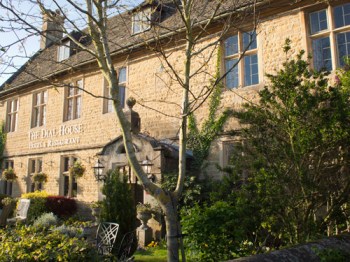
Back to Bourton. Here’s dinner at the Dial House, known for its local cuisine and extremely creative dishes (a completely delicious meal, worth the drive to Bourton the very next time you visit Britain):
  • Canapes – Ballantine Ham hock with cornichon (French gherkin) gel on top, smoked butter foam with poached mussels
  • Cauliflower with white truffle oil
  • Homemade – carmelized shallots with garlic and cumin
  • Salmon with lemon air with fromage blanc, keta (caviar), crispy salmon skin, panacotta and cucumber
  • Cornish Brill with cep purée (mushroom), sea aster (flower resembling a daisy)
  • Yuzu (Japanese lime/lemon) with coconut sorbet and chocolate strands
In fact, you should stay over (I did, at the Halford House, a B&B owned by the Dial and just blocks away), if for no other reason than to head for nearby Bibury and the fresh smoked trout (from the trout farm just down the road), and the excellent smoked salmon, both served at a fancy local establishment called The Swan.
Bourton-on-the-water and other Cotswolds villages are not very far from London, just about a 90 minute train ride to another world, a place largely untouched by the industrial revolution, a place whose focus is now shifting toward serious local food. One chef behind this trend is Rob Rees, a visionary I met over tea at Sudeley Castle in Wynchcombe; his unabashed promotion of the region and its stunning food is something you ought to know more about. Rob speaks eloquently about the importance of farm foods, and a local food economy, and more broadly, about the importance of proper food for growing children. He brings industry, government, and family kitchens together in ways that are altogether unique, as explained on his web site.
Oh, I nearly forgot about the side trip to Canterbury, which is on the eastern side of London (Cotswolds are on the west). Take the train to Canterbury West (there are two train stations), and when you walk out of the station, look immediately to the left. You will see an old train shed turned (six days a week) into a local farmer’s market called The Goods Shed. Sample the smoked haddock, made just outside of town, and note the smooth, non-fishy, salty-sweet flavor. Try the fruit-enhanced Florentine cookies. Taste the apple cider, also from nearby. Then, do the cathedral and your shopping, and return for dinner (here’s the spring 2012 menu). Mine included perfect scallops. The restaurant menu is built from produce available at the market.
——
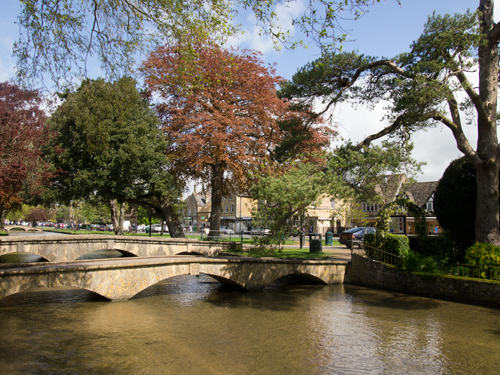
Me, I’m just back, ready to write some more about British food (a topic I never thought I would ever write about), this time from Cardiff and Pembrokeshire. More later. Meantime, enjoy Bourton-on-the-water in the photo below.

Food: The Meta-layer

Past few months, everybody’s talking about the meta-layer. We don’t just watch TV. We add a meta-layer, tweeting about the Academy Awards, commenting on comments–ideas piled on ideas. We’re learning to comment on everything, with or without the requisite knowledge of the facts involved, rarely with the research needed to form a coherent opinion.

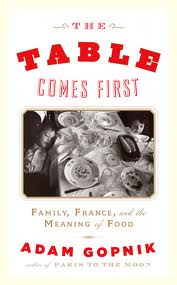
Not so with Mr. Gopnik, whose past stories about his young family’s life in Paris (Paris to the Moon) and their return to Manhattan (Through the Children’s Gate) are among my most-recommended books, and whose 2011 book, The Table Comes First: Family, France, and the Meaning of Food has provided several months of nourishing food for thought, or thoughts about food, probably some of each.

Where did restaurants come from? Who came up with the idea of not just eating outside the home, but dining there? (Long answer, begins around the French revolution). Quite rightly, he compares the restaurant customer to an aristocrat, accustomed to being served (and served beautifully). Gopnik delights in grazing through the thoughts of Brillat-Savarin and Grimod–two early, influential writers about food and dining–but I like the bit that he found in Robert Frost best:

“Home is a place where, when you have to go there, they have to take you in. A restaurant is a place where, when you go there, they not only have to take you in but act as though they were glad to see you. In cities of strangers, this pretense can be very dear.”

This is a book in which New Yorker writer Adam Gopnik thinks about food, and thinks about how others think, and have thought, about food. He goes deep, with some chapters so mired in philosophy or history that they eventually become indigestible. Fortunately, these are exceptions. And when the going becomes thick, he pauses for to write an email to Elizabeth Pennell, who wrote with intelligence and wisdom about food about a century ago; these chatty emails cover the true benefits of cinnamon, the best ways to cook lamb, the extraordinary use of hot air in the hard-to-find and hard-to-cook pommel soufflés, his dog Butterscotch’s love for steak, and other lighthearted stuff.

Adam Gopnik is a regular contributor to The New Yorker.

This is not a book to read over a single meal. It is, instead, book to be savored, bit by bit, over several months. There is simply too much information, too many glimpses and meta ideas, too much richness and provocation and serious research, to be enjoyed quickly. It is slow food for the brain–imagine that, in an era of emails and tweets–much of it about topics I’ve never really thought much about.

For example, Gopnik compares “cook it at home” recipe books that restaurants sell with the home game version of, say, Hollywood Squares. Certainly, there is a resemblance, but the resources and the spicing are entirely different, and so is the experience. He tells a long and funny/odd story about his search for a live chicken that can be purchased, cooked, and eaten within the bounds of New York City, and another about the cleverness of farming tilapia to feed large urban populations, then adds the zesty meta-layer, invoking Adam Smith and the total cost associated with what he believes to be a current fad for localism. And so:

“If Kenyan greens take less total energy than Plattsburgh tomatoes, then we should revel in them no matter how far they have to travel.”

And so it goes, through questions about whether we really can taste the differences between wines (or whether the situation and the artifice overpower the actual human capacity for taste), the imperfection of memory as it applies to the fancy French restaurants of 20th century Manhattan, why sugar was used mostly to flavor tea in England but became the impetus for the pasty industry in France, the various ethical arguments for and against the slaughter of animals for human consumption, and so much more.

As with his own food choices–today, spicy beans and rice, tomorrow, a complicated and challenging attempt at a classic French dish from a century ago–some sections are rich with friendly storytelling and some are thick with pretense, serious thinking, and historical reconsiderations. Unlike Twitter, you need not absorb every idea in an instant. There is time enough to consider the meta-layer, to appreciate the fine writing that has long been Gopnik’s strong suit, time enough to think about what Gopnik has said about what others have said and done, and perchance, to learn something about their ideas by reading Brillat-Savarin in the original (on my list, but not for this year).

The Ultimate Road Trip

It’s the biggest thing we’ve ever built–bigger than the pyramids of Egypt, about a hundred times as long as the Panama Canal, easily eight times the length of The Great Wall of China. It’s newer, too. And, soon, we’ll probably build it all over again.

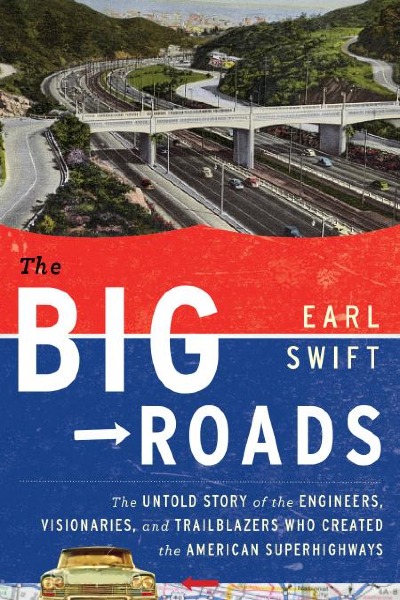
As Earl Swift explains in The Big Roads: The Untold Stories of the Engineers, Visionaries and Trailblazers Who Created the American Superhighways, the U.S. interstate highway system is forty-seven thousand miles long, and it is the “greatest public works project in history.”

Messy as our current dilemma about infrastructure may seem, life was worse before the interstates, before modern roads. In the good old days, New York City’s horses output 2.5 million pounds of manure every day, plus 60 thousand pounds of urine. In 1893, the agriculture department got things rolling with a new Office of Road Inquiry, whose boss, a Civil War veteran, declared Americans “have the worst roads in the civilized world.” Still, intrepid automobiling pioneers attempted a cross-country race in 1903 (one car included a dog, Bud, who wore goggles and “became a hit in every town they visited.”) This was the beginning of an industry, complete with sales stunts on a grand scale: Carl Fisher, whose early days were consistently colorful (and completely crazy), “rigged a Stoddard-Dayton roadster to a massive balloon and flew it over Indianapolis, vowing to drive it back into town from wherever he landed.” (Actually, Fisher stripped the floating car and drove home in a look-a-like spare). Not long after, Fisher partnered with two other car crazy businessmen  and built the Indianapolis Speedway. Fisher was among the first to campaign for a big interstate highway system.

A half-century later, in 1956, “nearly $2.6 billion had been committed to the work… contracts had been awarded on more than a thousand bridges… construction was under way or about to begin on nearly two thousand miles of highway.” Half the book is about the wrangling, the engineering and politics, the slowdowns due to the Great Depression and World War II, and all sorts of rational and irrational arguments about the nature of the undertaking, the roles of the states versus the Federal government, the best ways to pay (tolls? gas tax? Federal funds? State funds?), and much more. In fact, the weakest part of the book attempts to describe this wrangling–Swift (great name for the author of a book about fast highways, BTW) does his to craft a story from his astonishing collection of arcane research. With Detroit pumping out over 5 million cars per year (1 in 3.5 citizens owned a car), America had a mess on its hands. Far too many cars driving on roads that were designed decades earlier. Trucks made the situation worse, both by contributing to congestion and also by damaging roads never built for a big truck’s combination of weight and speed. “Snarls at New York’s George Washington Bridge were traced back eighty-four miles–seriously, eight-four miles–to Monticello, New York.”

Even in these early stages, Swift explains that the highway system had its critics: Lewis Mumford published articles and books about the loss of city neighborhoods, and the economic destruction of towns and villages across the nation. By the 1960s, the environment movement gradually imposed restrictions on engineers who were once able to construct interstate highways pretty much anywhere, regardless of impact on animals, ecosystems, even city parks. Several Baltimore neighborhoods fought tremendous battles, and today, there is no interstate highway system cutting across Baltimore–the local activists won their battle. Visitors to Baltimore’s lovely old Fell’s Point neighborhood can thank those activists–if the interstate was built as planned, that neighborhood would be gone.

Swift goes on the record to give credit where it’s due, often to government functionaries who exceeded the call of duty, but his writing is far more interesting when he’s on the road himself, or when he’s telling the (too-brief) stories of how Howard Johnson’s or other roadside co-conspirators grew to be a part of American life on the road.

What’s more, I wish he had told us more about the next fifty years, or perhaps, the next twenty. Apparently, the interstate highway system was built for about a half century’s useful life. It has not been properly maintained. As the most dedicated of the government figures, Frank Turner, pointed out, “Highways grow old and wear out at a fairly predictable ages and lifespans, and therefore must be replaced or restored.”

Swift explains, “One federal study suggested that all levels of government should spend a combined $225 billion a year for the next fifty years to rehabilitate surface transportation…they’re currently spending just 40 percent of that, in a country that does 96 percent of its traveling by car and truck.”

So begins a brief discussion about dedicated truck lanes, alternative fuels and other incremental improvements. The bigger question is potentially world-changing and certainly mind-bending, so I offer it as the basis for Swift’s next book. A century ago, visionaries came up with the idea of cars (and trucks), and then, a connected interstate highway system to move people and goods in a safe, reliable, cost-effective way. By the time the interstate highway system was completed in the late 1960s, most of those people were either gone or too old to drive. Given the astonishing public good, the modernization of America, and the tremendous downside associated with our current system, I wish Swift would encourage a discussion so we can decide whether to, and how to:

(a) spend another $11 trillion ($225 x 50 years) to fix and upgrade a highway system conceived before television, McDonalds, cell phones, FedEx or the internet, or

(b) come up with an equally bold conception of transportation that could sustain us until, say, 2112?

Here’s the photo of author Earl Swift as published on the literary festival’s website.

Looks like a strange, unimaginable number, that 2112, but in 1912, when Fisher and his friends were tooling around Indianapolis in their early model cars, 2012 must have seemed as far away, and as impossible, as a 47,000 mile highway system connecting every city and town in what is now called the lower 48 states.

BTW: In researching the author, I found this impressive bit about his interests: “An avid outdoorsman, Swift has through-hiked the Appalachian Trail, circumnavigated the Chesapeake Bay by sea kayak, and traveled the 435-mile length of the James River by foot, canoe, and kayak.” I found it here.

The Big Roads was published in 2011 by Houghton Mifflin Harcourt.

Buy it from Powell’s Books.