 Maybe twenty years ago, I remember my friend Harry, who knows a lot about cars, telling me about a magical idea called a “heads up display.” Harry explained that data and images would be projected on every car windshield, and if I understood him correctly, instrumentation would move from the dashboard to an ultra-simple visual presentation directly in the driver’s field of view. No more looking down, no more looking away from the road. I became vaguely aware that some truck drivers were using this technology, but I wondered whatever happened to the consumer side of the idea.
Next year, we can all buy a dashboard mounted video projector called a Navdy. It costs less than $30o, and it does what Harry promised, and more. Navdy projects very simple graphics and just a few words directly on the windshield, directly above the steering wheel. The projector is set up so that your point of focus on the data is also your point of focus while driving, so the information is always easy to see (I’m curious how those with bi- or trifocals will respond).
We all know that picking up a phone while driving (or stopped at a light) to read a text message is a bad idea, and that sending a text is an even worse idea. So now, the text shows up immediately in front of you, perhaps with a little iconic picture of your texting buddy (who is, hopefully, on a coach, not driving a big rig while texting). To reply, you either speak (Navdy will recognize what you have to say) or gesture (a favorite but simple way to interact with Navdy).
You can use your existing cell phone (Android or iPhone). There is no monthly service fee. You only need to buy the device.
So what else does Navdy do? It can display your fuel level, speed, and other information about your car. It allows you to make phone calls and to respond to them without touching a telephone. Ditto for text messages. If your phone is playing music, you can stop and start the stream. It responds to voice control, just as Siri does (hopefully, it’s better than Siri).
New idea? As an add-on, sure. But those who follow the car industry report several million HUDs (Heads-Up Displays) already in cars that are on the road, and have been for several years.
Although there are lots of questions about what we should and should not be doing while driving, whether Navdy is a help or a hindrance or something else entirely, whether this sort of thing will become standard in every vehicle, and, of course, whether most of us will actually be driving a car in a future where cars are probably going to be driving themselves. In the mean time—there’s at least a ten year gap between today and the future—this is a device that will become a buzz item in 2015.
Do watch the video. It’s irreverent and fun.
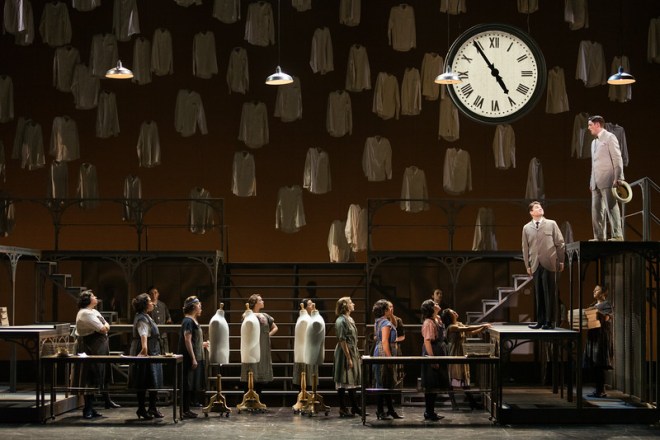 The next character in what turned out to a fascinating Saturday night at the Glimmerglass Festival just north of Cooperstown NY is Tobias Picker. If you don’t know the name, you should. “An American Tragedy” is his fourth opera (and one of several he has written with Gene Scheer’s libretto—you may know


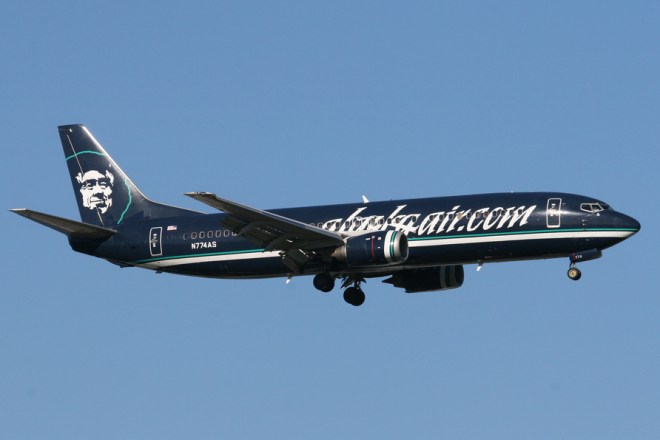 Three across, seats A, B, and C in a exit row. All three of us reading a book. The ten year old girl who happened to sit in the window seat: a fat novel by Rick Riordan. My wife: The One Hundred Mile Walk, now being released as a Helen Mirren motion picture. Me, a terrific long novel by New York City newspaper legend Pete Hamill, who writes about his city with street smarts and an appealing sense of mysticism.
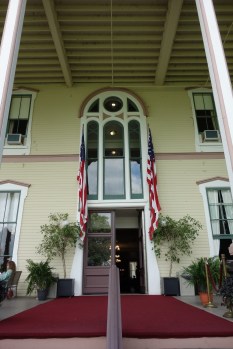 Yesterday afternoon was busy with reading on the Hotel Atheneum’s wraparound porch, studying the lake, selecting the perfect rocking chair, becoming distracted by what sounded like a full orchestra nearby. Wandering is what folks do on a summer’s day at Chautauqua, so I followed the music to the amphitheater where a rehearsal of Madame Butterfly kept me and perhaps two hundred other people busy for an hour. On Saturday night, the theater will be filled with nearly four thousand people, mostly residents who either spend their summers here, or, at least, several weeks each year. I was reluctant to linger: I wanted dinner before heading to the theater. Back at the
 Me? I’m off to Sol Messinger’s “Yiddish Language Conversation” back up near the main road at the relatively new (few Chautauqua structures are new) Emerson Jewish Life Center, built in 2009. Sol is sitting at a conference table with four or five people, interviewing each of them, each of us, about our family history. He is speaking in Yiddish. I understand only a bissel—the tiniest portion—but just the act of listening is joyful. Here and there, one of the people at the table translates key ideas for me. The conversation drifts in and out of English. The people are not young. I wonder what will happen to Yiddish, but only for a moment. My head is filled with ideas, but the yellow broadsheet—the detailed schedule for this Chautauqua week, contains far too many things for me to do, so I keep moving, grab a quick quiche at the informal lunch place above the bookstore (not wonderful: Chautauqua’s food for short-term visitors is a weak link), and manage to get to Philosopher’s Hall in time to get a seat just on the perimeter. It has been raining, so some seats are wet. I sit on my Daily, my bun is a little wet for a while, but I quickly forget my personal issue when the speaker begins. He’s compelling—
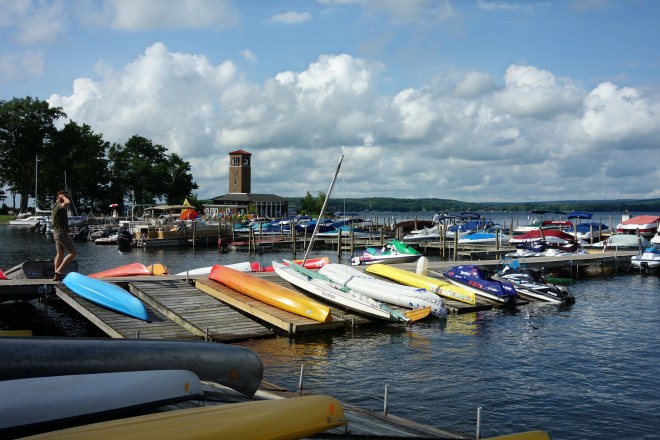 No time to linger. A Chautauquan keeps busy, does not lollygag (except when the day is beautiful and there is a book to be read under a century-old tree while children are racing around on bicycles and otherwise living a perfect small town American life). That glimpse of what America might have been is just that—a glimpse—for there is music to be enjoyed in one of the old churches. An hour of art songs performed by students from Chautauqua’s music school on the north side of town (no time to visit, but I understand practice sessions and rehearsals are open, and a bit like Tanglewood). Then, at 5:00PM, I wander back to the hotel for a daily wine tasting. I was invited by my new friends at last night’s Community Table. Mostly, my contribution to the table of six chatty people was recommendations of novels by Reynolds Price because one of the women was interested. Then, we headed down to dinner in the hotel’s main dining room. Steak dinner. Fresh cut.
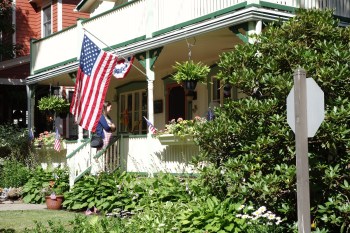 Next morning, it’s up at 7:00 am for the Farmer’s Market, then a spiritual bit, then a visit to the Methodist House (many religions, many houses, used for residents and for small events) for a July 4 lecture about the specific wording of the Declaration of Independence. I intended to stay for just a few minutes, but stayed for an hour and learned a lot about what Thomas Jefferson wrote and what Richard Henry Lee wrote. Half of the people in the audience seemed to know the speaker as a friend. I suspect he was a long-time Chautauqua resident or visitor, and that revealed one more piece of this fascinating puzzle: the people who attend Chautauqua are not just visiting because the lake is pretty in July. They attend because the combination of leisure and learning, family and fellowship, curiosity and creativity is, for nine special weeks every summer, available here and almost nowhere else.


 Digital Insider