Fellini on the bed

The room is almost completely dark. There is a single light source on this night of the October power outtage. It is Fellini’s 8 1/2 on an iPad screen. The images are sharp, contrasty, perfectly photographed in wonderful black-and-white. And, it sounds pretty good, too.

I love my iPad, but the sound is just awful. A dozen manufacturers now sell portable Bluetooth speakers. Some of these speakers are reasonably priced and sound good, too–but most are either over $100 or not worth the cost because they lack clarity, bass, punch, whatever. Forget about the Bluetooth part–it doesn’t work properly, it’s a technology that is far inferior to something much simpler: a $10 cable with one end that plugs into the speakers and the other end into the iPad. That combination is reliable enough to watch Fellini’s 8 1/2 with no interruption, and no Rice Krispies crinkling that is common among Bluetooth devices of all sorts, my little phone earpiece among them.

I’d love to tell you that I have secret source for the best sound at the best price. In fact, I found my speaker by making a friend of a salesperson at a local Best Buy store. As some of the salespeople are wont to do–provided there is no manager nearby–my guy opened several packages and allowed me to listen to several devices.

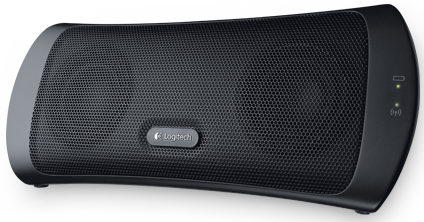
My favorite–still a favorite several months later, in fact–was the Logitech Wireless USB Speaker, which I use as neither a wireless device nor a USB device.  It costs about $70, and comes with a carrying case. I leave it in my car’s trunk so that anywhere I go, it’s available. I’ve used it to entertain a group of people watching video from a computer screen (the computer’s speakers were crappy), and another group of people attempting to watch a projected image during an office presentation (the projector’s speakers were inadequate). During the summer, when I write on my porch on warm days, the speaker provides the background music. And on a dark and stormy night, it provides a clear, crisp, well-articulated soundtrack with a reasonable amount of bass.

I was less enthusiastic about the more expensive Jawbone Jambox, which costs twice as much and tends toward the boomy approach to bass. When I was shopping earlier this summer, there were few choices. Now, there are more. But I think I’ve found a good one, and I recommend it wholeheartedly.

Paco de Lucia – One Summer Night…

Paco de Lucia was born Francisco Sánchez Gómez in 1947 in Algeciras, a southern port city in Spain. He learned the guitar from his father, his brother, and family friend Niño de Ricardo, a virtuoso. By age 7, de Lucia was playing flamenco guitar; by 12, he was recording. Before his teen years, he had won several guitar competitions. By 13, de Lucia was touring internationally with José Greco’s flamenco show. He started composing and playing backup for various Spanish singers, notably the great Gypsy singer (or cantador) Camarón de la Isla, with whom de Lucia worked from the late 1960s until the early 1990s. In addition to leading his own group, de Lucia has collaborated on projects with John McLaughlin, Chick Corea, Al di Meola, and even Placido Domingo. De Lucia is widely regarded as the finest living flamenco guitarist—and one of several musicians who has modernized the classic Spanish form.

Here’s the thrilling, no-holds-barred, blazing-guitar, high-energy concert recording that caused many rock fans to pay attention to a flamenco guitar player. Recorded by de Lucía’s Sextet in 1983, it’s terrific ensemble work with de Algeciras, a flutist named Jorge Pardo, and an equally facile percussionist, Rubem Dantas. John McLaughlin composed a pretty intro to “Alta Mar,” and “Chiquito” is dedicated to Chick Corea; listen for strong 1980s jazz/fusion influences in de Lucía’s interplay with electric bassist Carlos Benavent, and the flute and guitar arrangement that begins “Gitanos Andaluces.” But it all comes back to de Lucía’s straight flamenco.

http://www.amazon.com/Live-Summer-Night-Paco-Lucia/dp/B0000046UR

Maria Bethânia – As Cancões Que Você Fez Pra Mim

Maria Bethânia is the sister of top Brazilian singer-songwriter Caetano Veloso. Born in 1946 in the interior region of Bahia, Brazil’s northeastern state, she’d planned to become an actress. In 1963, Bethânia and her brother moved to the nearby state capital city of Salvador, where she impressed audiences singing in a musical (written by her brother). Bethânia has been a professional singer ever since. While in Salvador, she and her brother became friendly with Gilberto Gil and Gal Costa, and the four led a significant cultural movement called Tropicálismo that changed Brazilian music and art. It was so radical that Veloso and Gil were exiled, but Bethânia and Costa kept the movement alive in Brazil. Bethânia is a dramatic singer whose versatility is matched by her desire to experiment with a wide variety of songs and genres, and a willingness to introduce works by up-and-coming songwriters.

This 1993 album was recorded twice. One version was recorded with Portugese lyrics (as above). The other, called Las Canciones Que Hiciste Para Mi (Philips 518-787), is in Spanish. Both are majestic. Each is a collection of 11 songs written by Roberto and Erasmo Carlos and sung with a small combo backed by an enormous string section (magnificently arranged by Graham Preskett). Bethânia’s powerful, dramatic interpretations are affecting on both the Portuguese and Spanish versions, but her passion breathes life into the Portuguese versions of “Fera Ferida,” “Palavras,” and “Eu Preciso de Você.” Analog recording, but sounds better than most digital discs.

Philips 518-214

Available only as an import, but worth the price: http://www.amazon.com/Cancoes-Que-Voce-Fez-Pra/dp/B0000015TF