“How wonderful that we have met with a paradox. Now we have some hope of making progress.”– Niels Bohr
“How is it that you are raising your children to be very loyal/attached to the family and very independent individuals simultaneously?” That’s a wicked problem. A paradox worthy of debate. I found it on a enlightened website called Liberating Structures. Most wicked problems are not so easily contained. They’re sloppy, messy, extremely difficult to frame without all sorts of potential appendages and disruptions. There are likely to be a lot of stakeholders, and they are likely to perceive and deal with the problem with a wide variety of opinions and belief systems. As the problem is being analyzed, and perhaps mitigated on its way to a solution, the wicked problem changes–almost as if it has a life of its own. In other words, a wicked problem is not just a conundrum or a paradox, but a massively frustrating problem, often high on the list of nasties that keep us up all night.
A clear explanation of a wicked problem was nicely articulated in the Harvard Business Review, mostly as a framework for business strategy discussions about difficult problems that, IMHO, rarely rise to the level of a bona-fide wicked problem.

Image of Horst Rittel from Swedish Morphological Society, 2005

Melvin Webber, an urban planner, in a UC Berkeley portrait.
“Wickedness isn’t a degree of difficulty. Wicked issues are different because traditional processes can’t resolve them, according to Horst W.J. Rittel and Melvin M. Webber, professors of design and urban planning at the University of California at Berkeley, who described them in a 1973 article in Policy Sciences magazine (part of it appears below). A wicked problem has innumerable causes, is tough to describe, and doesn’t have a right answer, as we will see in the next section. Environmental degradation, terrorism, and poverty—these are classic examples of wicked problems. They’re the opposite of hard but ordinary problems, which people can solve in a finite time period by applying standard techniques. Not only do conventional processes fail to tackle wicked problems, but they may exacerbate situations by generating undesirable consequences.”
Curious, I tried to learn more, and found this handy list, also part of the HBR article.
The 10 Properties of Wicked Problems
If I made a list of, say, my top three, four or five wicked problems, I wonder which problems I would choose. Here’s my very preliminary pass (sloppy questions, in part because I’m new at this.)
- There are far more similarities among humans than there are differences. The problem is: we have always focused on the differences, resulting in slave trade, wide disparity of income and education, and all sorts of ethnic conflict. Is equality achievable on a massive scale? If so, how, and can it be sustained?
- War and fighting are very harmful to individuals, families, cultures, property (and animals, BTW). And yet, partly as a subset of my first question, we persist in all sorts of dangerous conflict, and we perpetuate these behaviors, perhaps because we have no better way of dealing with our differences. Can we evolve past fighting, or does this way of thinking and behaving run deep in every human?
- There are always people in need, people who are sick, poor, unfortunate in other ways. It’s clear that the only way these people will flourish is if others help them. On the one hand, we build massive medical structures people thrive. On the other, we deprive more than half of the people on earth of even the most fundamental resources to be healthy, not poor, and wise.
- Most of us acknowledge that children are our future, and that each child’s future success relies upon his or her education. And yet, we refuse to provide an adequate learning environment for all but the most fortunate children. Can we massively change the way we think about the future of children? If we can, will we?
I am certain that these are interesting ideas for discussion, but I am uncertain whether I have conceived or written these questions in anything resembling proper wicked question form, if such a thing exists. Help?
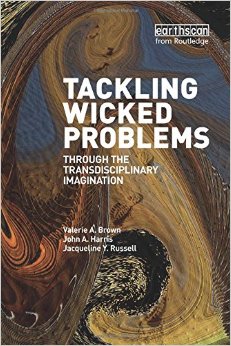
Maybe I’ll find help here: a book with a very promising subtitle. It’s called Tackling Wicked Problems through Transdisciplinary Imagination (I love that final phrase–it moves the problem from the logical left brain to the more visionary right). Or, from the free PDF published by the Australian government as a public policy entry point. Fascinating. But I’m a novice. And I look forward to learning more.




 In book, lecture and conversation, Scott McCloud has taught me a lot. But it’s one thing to be a teacher and another to be the creator of the material. The expectations become unreasonably high. The student wants to see every lesson incorporated in exquisite elegant prose and picture. The story must be perfect. The storytelling, better than perfect.
 As David tells his story, the evidence of Scott’s visual storytelling skill propels the sense of reality. There are extreme close-ups and wide streetscapes, frames without dialog that communicate more than those with words, and an interesting isolation technique in which David is fully inked against a world that is rendered only in sketch form. There’s a girl, of course, an angel of sorts, and as in the second act of Stephen Sondheim’s Sunday in the Park with George, a difficult-to-fathom big city art scene (Scott and Stephen wrestle with some similar themes.) Main character David tells us that he hates parties and by extension, the whole scene, but those pages are among Scott’s very finest: a crowded multi-page sequence where you can feel the energy of a noisy large-scale party and the frustration in coping with the idiots who won’t leave you alone while you’re trying to keep some girl within your visual range, while you’re trying to chase her before she’s gone forever. (Gee, he does this well!)
 For me, that’s the treat, same as reading Understanding Comics, same as watching Scott lecture, same as spending time with him. We’re living in a world filled with stories and ideas, and clever ways of communicating. If it’s all as simple as A-B-C, then the magic isn’t so magical. Life’s more complicated than a straight series of logical events—and that’s the beauty of a well0-crafted graphic novel. No shopping mall cinema audiences to satisfy with a clearly articulated happy ending. No need for extreme helicopter crashes or uncomfortable explosions punctuated with graphic violence. The story can be personal, it can be told by a single storyteller (provided the storyteller is willing and able to spend several years writing and drawing his epic), and it can be somewhat nonlinear. With that, a reader’s note: do it in one day. That is, find yourself a good stormy day, turn off the cell phone, and just lose yourself. Don’t think too much—just allow the storyteller control your mind for a few hours. We do this for movies all the time—with this book, you don’t want to disengage. You want to pay attention, and grab the ideas as they’re unfolding, then return to study the craft. Last weekend, I read the book. Today, a Saturday, I returned to study the construction of the visual sequences, the use of characters, my favorite scenes and how they were put together.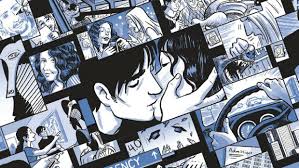

 For example, maybe a digital book is not a book at all, but a kind of game. Scholastic, a leader in a teen (YA, or Young Adult) fiction publishes a new book in each series at four-month intervals. The publisher wants to maintain a relationship with the reader, and the reader wants to continue to connect with the author and the characters. So what’s in-between, what happens during those (empty) months between reading one book and the publication of the next one in the series? And at what point does the experience (a game, a social community) overtake the book? NEVER! — or so says a Scholastic multimedia producer working in that interstitial space. The book is the thing; everything else is secondary. In fact, I don’t believe him—I think that may be true for some books, but the clever souls at Scholastic are very likely to come up with a compelling between-the-books experience that eventually overshadows the book itself.



 Digital Insider