 A few months back, I found an old album by Sly and the Family Stone. They were a group I liked, but I never knew much about them. Next year marks fifty years (!) since Sly formed the multi-racial band, so now’s a good time to dig deeper.
By 1967, Sly (a boyhood friend misspelled Sylvester as Slyvester; the nickname stuck with him) was 26 years old, a San Francisco disc jockey on a soul station who played music from both Black and White artists. Sly had already produced several minor hit songs, formed and performed in several local band including the multi-ethnic Viscaynes. Times were changing very quickly—especially in the Bay Area—and Sly was well-connected because his influence via radio station KSOL was growing.
The first album by Sly and the Family Stone didn’t do much on the charts, but it’s clever, innovative, funky, and a whole lotta fun. The first single, “Underdog” starts out with a slow version of “Frere Jacques,” then rolls into a rap-like rhythm supported by power horns and a chanting chorus. There’s some gospel in there, too. Listen: this is fifty years old, but it sounds fresh, not at all dated. “I Cannot Make It” is the other popular track from 1967’s A Whole New Thing, and it opens with a vocal similar to “I am the Walrus” (same year). And then, the hits start coming—you probably know just about every one of them because they’ve never really left the world stage.
The fun begun with “Dance to the Music”—#8 on the Billboard Pop Chart and #9 on the Billboard R&B Chart—“listen to the voices!” with that screaming voice, the little bobbing a capella voices, the low down deep voice, the jumping back and forth between Stax, Motown, psychedelia, the big horn section, the get-up-and-dance, the complex jumping back and forth between musical ideas, in just three minutes. These guys are having such a great time making a new kind of music—and the public loves it! Black listeners (#9 on the Billboard R&B charts) and White listeners, too (#8 on the Billboard Pop Charts). The energy is so rich, so contagious—and still so free from the rigidity of corporate music production (that comes later). “Fun” from 1968 keeps the grove — “When I party, I party hearty, fun is on my mind, put a smile upon your face…there’s a sister there’s a brother having fun with each other”— driven by the kind of free-style audio production that looked beyond the traditional concepts of musical arrangements and formality. “ “M’Lady” sounds like a party going on. “Life” is a carnival that begins with a barker, then two, laughing at each other, big horns, a gigantic consciousness raising high—“Life – tell it like it is— you don’t have to die before you live!!”
 The youthful exuberance is gone, the social awareness is increasing, the production is slicker by 1969’s “Stand” — “you’ve been sitting much too long—there’s a permanent crease in your right and wrong!” – “there’s a midget standing tall, and a giant beside him about to fall!” It feels a bit dated, a golden oldie, a solid memory but the controlled chaos and the crazy audio production is a thing of the past. From the same album (called Stand), there’s “Sing a Simple Song” and “Everyday People”— probably the group’s high water mark— and both of those songs bind the no-holds-barred past with the glossier, socially consciousness future. The same album’s “Don’t Call Me Nigger, Whitey” (same lyric, “Don’t call me whitey, nigger”) is a sincere push toward revolution.
And the hits just kept on coming: “You Can Make It If You Try”— the band’s optimism was always a joy— and “Hot Fun in the Summertime” are wonderful, timeless in their way. And now we’re having fun: “Thank You (Falettinme Be Mice Elf Agin)” and the anthem, “Everybody Is a Star.” That’s all pre-1970. A lot happened in just three years.
With the 1971 album, “There’s a Riot Goin’ On, The Family Stone reminds us of its roots with “Family Affair” — very AM-radio friendly, positive, bringing the community together in the best way: “One child grows up to be somebody who just loves to learn” “Newlywed a year ago, but you’re still checkin’ each other out” “Nobody wants to be left out” “You can’t leave ‘cause your heart is there” — a warm, cozy number that feels dated, but, it’s sincere. That song reached #1 on the Billboard Pop and R&B charts. There’s a similar song called “(You Caught Me) Smilin’” that’s more ambitious, kinda jazzy and bluesy, and although it charted, too, it’s not a song most people remember. In fact, I don’t remember any of the songs that followed on the charts from 1971 through 1975.
Those later songs are very good—some are vaguely familiar—but they lack the early energy. Instead, there’s a laid back funk, very appealing combinations of electric guitar and horns, a funky stoner groove that’s easy to enjoy time and again, decades after it was produced. It feels original, not at all derivative because the band always led, rarely followed. I was surprised how much I enjoyed the later material, and how nicely it has stood multiple plays while tooling down highways that did not exist when this music was made.
So what happened to Sly and the Family Stone? Trouble became evident as early as 1969 when a combination of influence from Black militants and the drug culture destroyed key creative relationships. By 1970, Epic Records gave up on the possibility of a promised (contracted) new album and released an early Greatest Hits album to keep the market alive. By 1975, the group’s fans had abandoned the possibility of Sly and his band actually showing up for concerts—a big show at NYC’s Radio City Music Hall left most tickets unsold. The downhill slide continued—the sad story is well-told in a Wikipedia article.
Certainly, music historians have written about the huge influence of Sly on several generations of artists, how rap and hip hop trace back to Sly and the Family Stone. That’s all fascinating, but the real story here is the freshness and magnetism of music produced fully a half century ago.
Can’t help but wonder. If it was 1967 today, and I was blogging, would I be writing about the amazing musicians of 1917? I’m guessing no. Sly was something special.
 Enter the
  In 1969, most people, even those who were following the progression from jazz to fusion, hadn’t yet heard the work of a British guitar player named John McLaughlin. That was the year that he recorded his first album, “Extrapolation.” At the time, it was wildly experimental, but as I listen to it in the background while writing this article, it’s really delightful, gentle, meditative, not at all explosive. McLaughlin is a gifted guitar player and composer. He shares the stage with an another young British musician, a man who plays the somewhat unusual combination of soprano and baritone sax. His name is John Surman. At the time, Surman was already recording on his own for the
  Traces, there is a deep female voice whose sound more closely resembles an instrument than an upfront vocalist—and she’s singing phrases that feel more like poetry than lyrics. She was not credited as a singer, but instead, as “voice.” Her name is Karin Krog.
 Earlier this year, late at night, I decided to do a Google Search on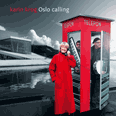
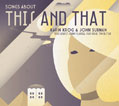
 Of the three CDs, the most interesting is also the most experimental, a cycle of songs originally composed for a 2010 jazz festival. It’s called “Songs About This and That,” and I like it because it recalls my earlier interest in their exuberant experimental side, but places it in a more artful, more carefully arranged setting. There is a sense of open time and space to explore, to allow for long lines, an ease with the maturation of Karin’s voice. On this CD, I think my favorite track may be “Cherry Tree Song” because the poetic lyrics wind so gracefully around John’s baritone sax and bass clarinet, a warm combination of electric guitar, vibraphone, and John’s bass recorder. In fact, I jotted down some other favorite tracks, and found the list was too long to manage, but I will mention the vibe solo that begins “Moonlight Song” and Karin’s waking-up voice, looking backward on memory. Wrapping up an article I’ve so enjoyed writing, I happened to notice that Karin’s credit on this CD is what it was so many years before, not “vocals” but simply, “voice.”


 The most ambitious track is Secrets of the Sun (Son) featuring wonderful vocal work by formidable performer, vocal arranger and composer

 Where does this lead? And how do we even begin to think about the future when so much television viewing is now on-demand and so much audio listening is via Pandora, podcasts,



 Digital Insider