 There is no DVD sewn into the back of “Blended: Using Disruptive Innovation to Improve Schools,” a new book by Clayton Christensen’s acolytes, Michael B. Horn and Heather Staker. Instead, there are QR codes and URLS. If I’m reading with an iPhone or an iPad nearby, and I happen to have a QR reader installed, I can watch Clip #15, which shows how the Quakertown Community School District produces A La Carte courses to provide students with flexibility.” Sometimes, the QR code reader doesn’t do it’s job effectively, so it’s helpful to have the URL printed below the bar code. In fact, I am writing about “Blended” on an iMac, which does a lousy job reading QR codes with its built-in camera (too hard to bring the book up to the camera, then focus, etc.) So: what we have here is a blended solution, a book that relies upon videos to tell its story in an era when books lack any means to display a video except via an external device. And a free chapter to read.
Add a whole lot of scale, and many more people, and the problem of blended schools begins to take shape. We still have school buildings and classrooms, and millions of students making their way through a traditional curriculum, but many of those students now use digital devices to pursue their own interests, and most of these pursuits are individual activities, not collective learning experiences. So we do the best we can with a hybrid situation that will probably last a long while. The authors attempt to classify, codify and otherwise organize what we know and what it means, but they’re fully cognizant of the strange situation they are describing. And they are trying to make the best of it.
Quite reasonably, they begin with the now-commonplace thoughts on “Why Factory-Model Schools Fall Short Today,” and “Why Schools are Reaching a Tipping Point,” the latter detailing desire for personalization, desire for access and desire to control costs as three significant discussion points. They describe four common K-12 blended learning models: Rotation, Flex, A La Carte, and Enriched Virtual, then drill down on several Rotation models: Station Rotation, Lab Rotation, Flipped Classroom, and Individual Rotation. Huh? To explain this not-so-helpful taxonomy, they break a rule of book publishing. They follow each chapter with its own appendix! Brilliant! I flip the page at the end of the chapter, and there are more pages to explain the concepts in more detail.
After reading the definitions, I was unimpressed with the current state of the taxonomy. Pretty much, some work is done online, some is done in the classroom, some involves more teacher interaction and some involves less. Lots of diagrams attempt to explain these very basic ideas—which aren’t all that different from learning during the 20th century, as some students were allowed more or less freedom based upon their own initiative and the teacher or school’s flexibility. (Important not to overthink these ideas, and also, not to rely too heavily on what seems to be impressive technology circa 2015).
The authors are Christensen people, so they tell the best stories about innovation and obsolescence. My favorite one—clearly told to agitate the laggards—goes like this:
…seeing steam’s potential, the old sailing-ship companies that specialized in wind-powered transoceanic travel did not completely ignore the new technology. The only place they could even think about using steam power, however, was their mainstream market—to help them build ships that would cross entire oceans even more efficiently. They had little motivation to refocus on inland waterway customers, given that they had the opportunity to build even bigger, more profitable ships to cross the oceans. Not wanting to dismiss steam power entirely, however, sailing-ship companies searched for the middle-ground. They ultimately pioneered a hybrid solution, one that combined steam and sails. In 1819, the hybrid vessel Savannah made the first Atlantic crossing powered by a combination approach; in truth only 80 hours of the 633-hour voyage were by steam rather than sail… The wind-powered ship companies never made a true attempt at entering the pure disruptive steamship market—and ultimately they paid the price. By the early 19o0s, the steam-powered ships, which started in those inland waterways that looked so unattractive to the wind-powered ship companies, became good enough for transoceanic travel. Customers migrated from sailing ships to steam-powered ships, and every single wind-powered ship company went out of business.”
And so, the authors ponder, “What will become of schools?,” how to design teams to innovate, “The Cost of Getting It Wrong,” and so on. This is a practical book, a companion or “field guide” to a previous book called “Disrupting Class” that is filled with the theory that makes these practical approaches work. Both are worth reading, both for educators and parents, and for those in businesses or other situations that are not yet equipped with the large-scale change that the 21st century seems destined to spread to so many of aspects of daily life.

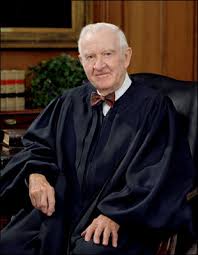 n the surface, this is clear, but it’s made more clear by the Justice’s twenty pages of commentary. In that endeavor, I’m sometimes a fan—his historical and contextual understanding is, well, supreme, but his ability to connect with a broad audience sometimes falters. The history becomes too complicated, the issues too tangled, nods to other justices sometimes adding complexity. On the other hand, we’re talking about a book that’s less than 150 pages and contains a whole lot of provocative, clearly presented material.

 With digital publishing, the rules don’t apply—and for so many reasons. For example, publishers need not limit the number of titles they publish for any practical reason—there is no scarcity of shelf space. (They may limit releases due to marketing considerations, but that’s another story altogether.) Of course, bookstores are helpful parts of the marketing and distribution system, but they are no longer mandatory—Amazon ships just about any book, next day.
 Walter Isaacson is one of the smarter people in the media industry. As a keynote speaker for this past week’s Digital Book World conference, he talked about the limitations of his most recent book,
  For example, maybe a digital book is not a book at all, but a kind of game. Scholastic, a leader in a teen (YA, or Young Adult) fiction publishes a new book in each series at four-month intervals. The publisher wants to maintain a relationship with the reader, and the reader wants to continue to connect with the author and the characters. So what’s in-between, what happens during those (empty) months between reading one book and the publication of the next one in the series? And at what point does the experience (a game, a social community) overtake the book? NEVER! — or so says a Scholastic multimedia producer working in that interstitial space. The book is the thing; everything else is secondary. In fact, I don’t believe him—I think that may be true for some books, but the clever souls at Scholastic are very likely to come up with a compelling between-the-books experience that eventually overshadows the book itself.


 A monthly subscription fee buys access to a library of short- and long-form programs in four general categories: science, technology, civilization and the human spirit. Some programs are produced by Curiosity Studios—mostly, these are short-form interviews with scientists and other experts, often illustrated with animation. At the start, many of the long-form programs will come from TVO (that’s TVOntario, one of the best non-fiction producers in Canada), Japan’s NHK, France’s ZED, and of course, the BBC Worldwide. With two or three years, the service anticipates 2-3,000 titles; this year, subscribers will have access to about half that number of programs. Happily, John recognizes the challenges associated with VOD navigation, and I’m hoping to see Curiosity Stream reinvent the visual interface so that their programs are easy to find.
 The assortment of programs being assembled for the March 18, 2015 launch. Many are reminiscent of what The Discovery Channel used to be—before its prime time schedule began to resemble other cable channels (“Naked and Afraid,” etc.). Among the titles announced so far: “The Nano Revolution,” “Simon Schama: Shakespeare and Us,” “The Age of Robots,” “Destination Pluto,” and “Scotland: Rome’s Last Frontier.” There will be 4K programming, too—UltraHD for those who own the newer high-resolution TV sets—including a newly commissioned project called “Big Picture Earth” by the filmmaker responsible for “Sunrise Earth.”
 month, you can watch in standard resolution—a terrific on-ramp for viewers who are either new to SVOD or are more likely to be fairly light users, at least the start. At this price, it’s almost a trial subscription with an easy upsell to 720 HD resolution at $3.99 per month (which is all that most people probably need right now). For those with more extravagant viewing habits, 1080 HD resolution costs $5.99 per month; the 4K Ultra HD service costs $9.99 per month (but at the start, there won’t be a lot of 4K programming available—still, some is far more than most other services offer today).
 example, let’s assume that a high quality outdoor production costs about $750K to produce. If one company foots the bill, their programming budget only goes so far. But if Curiosity, for example, puts in $250K to control North American rights, and finds two partners, perhaps one in Asia and another in Europe, and each of them also puts in $250K for their respective territories, then nobody is out of pocket for more than $250K. Rights beyond North America, Europe and Asia provide additional revenue, which is typically shared by the funding producers. This “split exploitation” concept has been around since the 198os, and it works. In the SVOD marketplace, there will be many opportunities for future exploitation, which makes the venture progressively more profitable, and steadily increases the programming budgets, which generate more and better programming, and more subscribers… the circle continues to grow.
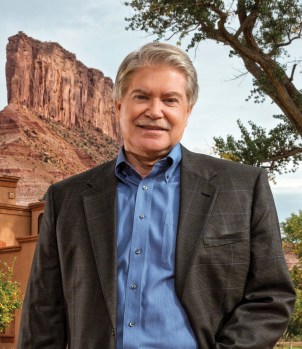 Unlike Ted Turner, whose approach to cable was mass market (TBS, TNT, and very broad-based news with CNN), Hendricks has always focused on nonfiction, documentaries, outdoors and reality (in the best sense, and also with many programming ventures way down market—Discovery owns TLC, so you can thank him for “Honey Boo Boo”). The point: he knows how to play the game, understands how to segment the market. His first pass: a three-bucket breakdown that includes (a) historically light TV viewers, the 1 in 8 of us, the 17 million U.S. households for whom TV is not a big part of daily life; (b) the connected world of perhaps 100 million cable and satellite homes, the ones that often complain that “there’s nothing good on TV” where he hopes to capture about 10 million households; and the rising 4K market, which he projects at 10 million households total and perhaps 5 million subscribers to Curiosity. By playing a more upmarket game from the start—he’s betting that there are enough documentary, adventure, curious viewers willing to pay at least a few dollars per month to see what Curiosity offers and to support what would seem to be a very promising future.
 Could he be defeated by Netflix hiring a former Discovery executive assigned to buying up lots of rights to Curiosity / Discovery -type programming from the short list of global suppliers? Sure, but it’s not likely that Netflix will zero-in on the nonfiction programs that Curiosity Stream plans to acquire. The nuanced understanding of programming for, and marketing to, this particular audience is not something that Netflix can easily replicate. Hulu probably won’t go there, and neither will Amazon. YouTube is interested in other aspects of the business, so it’s likely that John and his team will be able to build the same kind of success that they enjoyed with Discovery.
 It’s a salad with the obvious fresh greens and toasted scallops, smaller than the ones we find in the U.S., and a bit saltier, too. There are bits of a local bacon, too, which enhances the salty favor. The sauce is a red pepper puree, which adds the necessary sweetness to balance the salty flavor. Bit of polenta toast complete the dish.





 Just keep walking. Morning tea at the Florian, an old and not especially crowded coffee house (the first two weeks of December, nobody is in town, so I had the place to myself). It’s a landmark on the Piazza San Marco, and has been since the 1720s, when the Turkish invaders introduced coffee to the city. Casanova, Proust and Dickens hung out there, and now, so have I. The place is gorgeous, inside and out. I enjoy my $15 tea—it’s served in a clear teapot with a blooming cluster of leaves that open up as the tea brews. I contemplate the pigeons on the far side of the square—and the San Marco Basilica which seems to need a good cleaning. The treasured mosaics do not sparkle in the sunny day. They are obscured, in part, by inevitable scaffolding. The place is surrounded by expensive Fifth Avenue fashion shops, and Italian brands (Loriblu, for example, with splendidly silly crystalline boots in the window). Time to move on to more interesting surroundings. I keep walking. Time for lunch. Closed on Sundays (today is Thursday), the place to go is
 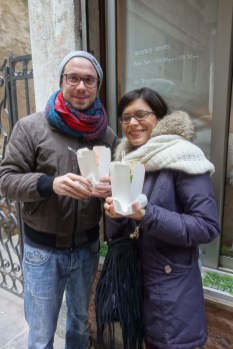 We chat for a bit, then I move on to a favorite campo in the Santa Croce area of town. It’s square dominated by a very old church called San Giacomo dell’Orio, and it dates back to 1225 (“Tradition says that the church


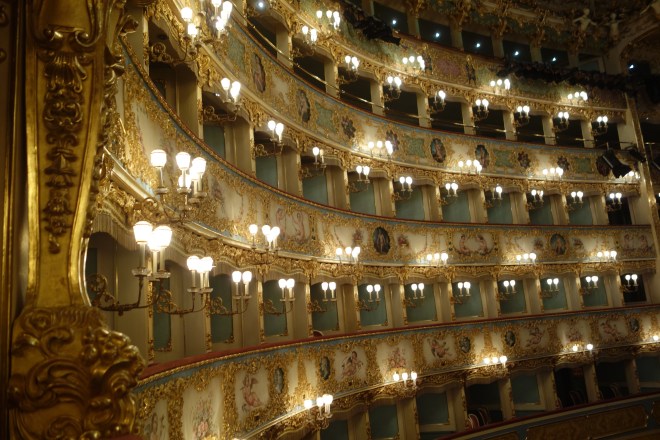
 Why did I care about this particular theater? The history, mostly. And the way it looks on the inside. Just being there, even if there isn’t the same there that was there before. This is the opera house where Verdi’s “La Traviata” made its debut. Same for “Simon Boccanegra,” where Maria Callas became a star. It is, or was, a remarkable place in the history of music. Why the dancing verbs? Because the place has a history that’s as crazy as any opera plot. Originally built as the San Benedetto Theatre in the 1730s, it burned down in 1774, and was rebuilt as Teatro La Fenice (“Fenice” translates as “phoenix”) to begin anew in 1792. Immediately, there was squabbles, the theater survived and by early 1800s, it was a world-class venue, mounting operas by Rossini, Bellini and Donizetti, the big names in Italy at that time. In 1836, it burned down again, and was quickly rebuilt a year or so later. That’s when Verdi started writing operas for La Fenice, including “Rigoletto” and “La Traviata,” which debuted there. So began a century and a half of magic—until 1996, when two electricians burned it to the ground. Remarkably, engineers had measured the theater’s acoustics only two months before, so the theater was rebuilt sounding much the same as its predecessor.
 That’s the theater that I visited, the 1,000 seat theater that hosted the premiere of “La grande guerra (vista con gli occhi di un bambino)” – a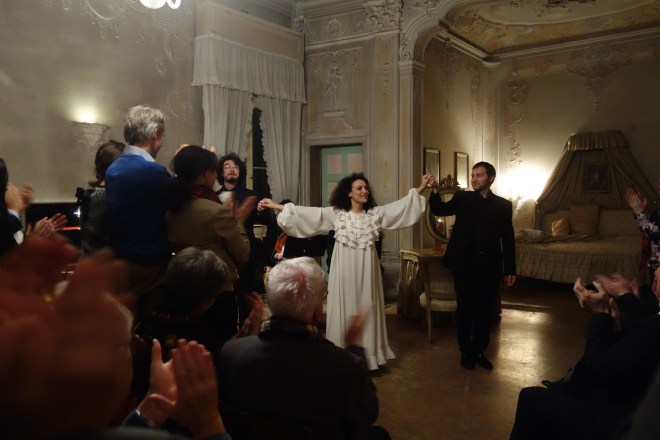
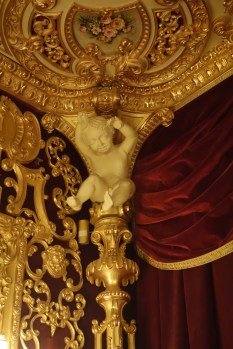 The contrast was fun to contemplate. On the one hand, a classic old opera house rebuilt from its own ashes less than twenty years ago presenting material from World War I in a 21st century setting. On the other, an old mansion dating back two centuries— Ca’Barbagio presenting an opera that debuted at La Fenice in 1853 for 21st century tourists visiting an old city of just 50,000 permanent residents whose long decline probably began more than 500 years ago. Today, the city exists mostly for its history and tourism—more than 20 million people visit Venice every year. I was lucky enough to spend my time at La Fenice sitting next to a local woman, Mirella, whose love for La Fenice has less to do with classic old operas and more to do with the many contemporary works, like those by Ambrosini, for this is, after all, her neighborhood music house.
 Digital Insider