LAND, from the prolific Simon Winchester

Simon Winchester has taught me a great deal. Including: in any given used bookshop, there will always be at least one nonfiction book by Simon Winchester that I have not read before. Past encounters, each one a pleasure, include: Outposts: Journeys to the Surviving Relics of the British Empire; Hong Kong: Here Be Dragons; Korea: A Walk Through the Land of Miracles; Pacific Rising; The Map that Changed the World, or was it A Crack at the Edge of the World; Atlantic (or, maybe, Pacific); Oxford; and probably several more. I believe The Map That Changed the World and The Professor and the Madman are patiently waiting for my attention.

So why another? And why this book? Mostly, because he’s interested, and, as a rule, if Simon Winchester is interested, then I am, too. The new book is called LAND: How the Hunger for Ownership Shaped the Modern World. If my count is correct, this is his 33rd book, but even the publisher is reluctant to name a number (“the acclaimed author of many books).

His fascination begins with his own land, formerly owned by “a plumber named Ceasare,” a “second-generation Sicilian-American.” The tract is “123 1/4 acres of forested and rocky mountainside, located in the hamlet of Wassaic, in the village of Amenia, the town of Dover, the County of Duchess, in the state of New York.” That’s quite a lot to unpack, a string of political decisions organized, in part, to claim title to land that once belonged to nobody, but was certainly taken, in a series of shameful acts, from the natives who once relied upon the area for sustenance. Before British royalty determined that their might gave them the right, long before, there was a long history, dating back over hundreds of millions of years–“geological turmoil executed on a titanic scale…a tortured and spectacular history that begins with volcanic land formation, and is given over to eons of sudden fracturing, splitting, compressing, heating, pummeling, twisting, folding, and breaking, followed by millions more years of inundations by tropical seas…” (you get the idea).

The author is British but based in the United States, and so, there is a lengthy discussion about North American natives and how they were stripped of their land. Happily, Winchester’s view is global. And one of the most important questions about global land use is just how much of it exists–and how it might be measured. And mapped. The mapping of the earth is a very complicated project, a crazy idea promoted by glacier expert Professor Albrecht Penck, who nearly succeeded in mapping the entire planet at a scale of one to one million. Penck’s design would have resulted in a scale model about the size of a house. And it would have disallowed the likes of Terra Incognito, or Here Be Dragons. But there were fierce arguments between governments that would need to cooperate–the French, for example, insisted upon the Metric System, and the English refused to go in that direction. Remarkably, the project moved ahead, albeit nearly two decades later than planned. Remnants remain, including the use of Greenwich (Prime) Meridian), and an abundance of really good maps–“France mapped much of francophone Africa. Germany made maps of all German-speaking countries in Europe. The entirety of the Roman Empire was mapped.” There was a fifty-sheet series on Brazil, and 107 sheets on Hispanic America, and more. It took eight years of trekking and wandering to map Mongolia and Chinese Turkestan; it was done by forty scientists from six countries protected by thirty infantrymen and more than three hundred camels, plus a large number of local helpers. Mapping 37 billion acres of land, without much technology, was an amazing accomplishment, but the job was completed. Still, the project remained alive, if on life support, until December, 1986. By that time, airline maps (which were simpler, easier to produce and update) served global needs.

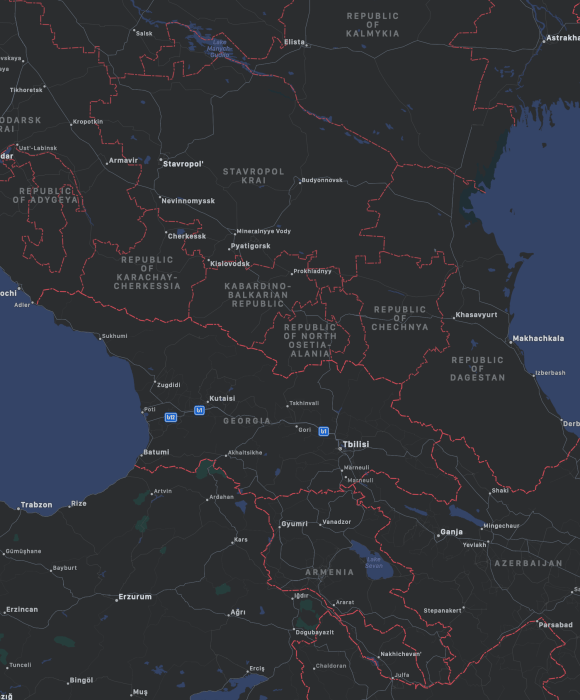
As I learned this morning, there is still quite a bit that I don’t know about the distinction between, say, a republic and a nation, or a nation and a country. All the same thing? Although the author does not address the question directly, he did cause me to look more closely at Apple’s Maps application when I was speaking with a colleague in Armenia. Yes, Armenia is a country, because it is a nation with its own government which occupies a particular territory. The part about a nation is related to people with common interests, and this is certainly true of Armenia. It’s a republic. It’s located west of Azerbaijan, which is also a republic–but part of Azerbaijan is separated by the rest. That is, Armenia is both east and west of Azerbaijan. Armenia also borders Iran, Georgia, and Turkey. But if you look just a bit further north, you’ll find a bunch of republics with unfamiliar names: the Kabardino-Balkarian Republic; the Republic of Karachi-Cherkessia, The Republic, of Adygeya, The Republic of North Osetia-Alania, and the Republic of Dagestan. There’s also the Republic of Chechnya, which is familiar. CIA Factbook to the rescue: “46 provinces (oblasti, singular – oblast), 21 republics (respubliki, singular – respublika), 4 autonomous okrugs (avtonomnyye okrugi, singular – avtonomnyy okrug), 9 krays (kraya, singular – kray), 2 federal cities (goroda, singular – gorod), and 1 autonomous oblast (avtonomnaya oblast’) Ah, but just what is a republic? Wikipedia’s definition: “Kabardino-Balkariya is a ‘Federal subject’ of Russia.” As Winchester points out, there are often stories that explain what happened and how we found ourselves in the present situation, but there are so many conceptions of land, ownership, colonization, nations, and so on, with such a long and twisted history, not much of it is guided by reason or consistent practice. This is unfortunate for social studies teachers who are already overburdened, and fortunate for those of who live in 2021 because there are online resources that can, at least, clarify these stunningly complicated ways to say, “this is my land” or, perhaps as often, “this is not your land.”

If you begin with the assumption that nothing makes sense except power, it’s easier to navigate the strange story of Japanese farmers in California who made unproductive land productive, but were then chased from their land because of World War II paranoia, never to return. Or the complexities associated with Scotland’s potential as a new country, independent from the British Empire after all of these years. Or, perhaps this book provides the framework to comprehend the ways in which colonists redesigned Africa’s borders to form countries whose borders still exist, but rarely make sense. And then, there’s climate change and the potential for natural borders to wash away, for productive land to become useless, for icebound land to become productive.

The book is filled with stories, some familiar, some astonishing, all useful in gaining a contextual understanding of how humans interact with land. The book is, in essence, a really good course in global social studies, written for adults who really ought to know enough about the subject to teach our children. Most of us cannot do that. I know a lot about geography and I cannot do that. Simon Winchester can, did, and I hope he’ll do it again. I want to read Land: The Saga Continues or whatever he decides to call his second book on the subject. If he’s not working on this book just yet, perhaps we can encourage him to do so.

A Surprising Solution to a Deeply Disturbing Problem of Our Own Making

Let’s begin with Heather McGhee. She’s the right kind of troublemaker. I heard her interviewed on NPR, got her book, read it carefully, and determined, as she did, that we’ve been wrong-headed about a whole lot of important stuff. She’s the former president of a think tank that focuses on inequality called Demos, and now, she’s both an important spokesperson for clear thinking, and the chair of the world’s largest online racial justice organization, Color of Change.

She’s making trouble because she requires readers to see everyday life from a radically different perspective. Not radical in the political sense, though she does that, too, but radical in the sense of eradication of old perspectives.

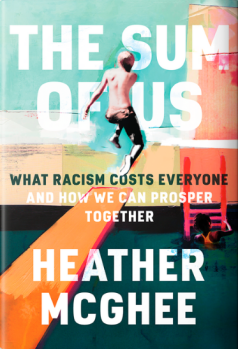
On the cover of her new book, The Sum of Us: What Racism Costs Everyone and How We Can Proper Together, there is an abstract paining of a white boy jumping off a diving board into a swimming pool. Ah, but the swimming pool is a mirage. It was there, at one time, but it’s been filled with cement. Why was it filled with cement? Because, in 1971, Jackson, Mississippi’s city council decided to fill swimming pools with cement so they could not be used by both Black and White swimmers. It was a way to avoid integration. The decision deprived the Black kids from swimming during the ridiculously hot Mississippi summer, but it also deprived the White kids from the doing the same thing. Better that nobody benefit!

If this thinking–roughly, the opposite of public good, so perhaps it’s public bad–was unusual, there would be no book and no reason for Heather McGhee to focus here. Instead, public bad (my term) is the basis for a great deal of public policy in the United States–and not only on hot summer days, not only in Mississippi, and not only in swimming pools. We use this theory of good decision making to work through where people live, how much money they earn, how their kids are educated, how we tax, where we place our roads and highways, and how we make a surprising number of important decisions. Roughly, the theory plays out as follows:

If a policy is a good idea, we should go ahead, but if it benefits Black folks, or equalizes the situation, then we should not go ahead. (Same, roughly, for other minorities.) And if not going ahead harms White folks along the way, that’s just too bad because that’s the decision we’re going to make.

Sounds like something from the 1950s in the American South, or maybe the 1910s. Then, McGhee explains how much of this thinking provides a framework for everyday life for everyone–especially people in lower income areas. The term “shooting yourself in the foot” comes to mind quite often. This is a completely crazy way to govern, to set policy, to run a county or a country. And yet, that’s what we do everyday. And it doesn’t seem to change. That is: the news coverage on George Floyd is extensive, and Black Lives Matter, but the hardcore reality of daily life in the U.S. receives very little coverage. Hence, this book.

She sets the stage with considerable skill. Then, she surprises by telling one story after another, each illustrating the impact of racism in ways that aren’t often considered. For example, “Many of the nation’s biggest and most respected public colleges were tuition free, from the City University of New York to the University of California system. The massive public investment wasn’t considered charity; an individual state saw a return of three to four dollars back for every dollar it invested in public colleges. When the public means ‘white,’ public colleges thrived.”

And then… “That’s no longer the case. Students of color comprised just one in six college students in 1980, but now they make up over four in ten. Over this period of growth among students of color, ensuring college affordability fell out of favor with lawmakers. State legislatures began to dramatically cut what they spent per student on their public colleges, even as the taxable income base in the state grew….By 2017, the majority of state colleges were relying upon student tuition dollars for the majority of their expenses…”

Or, to put this another way, the reason why so many public college students now carry so much college debt is connected to racism. Yes, it’s a bit of a leap, but more examples from other sectors add credibility to this line of thinking. The ripple effect is powerful, and not just on minority populations:” In 2018, the Federal Reserve reported on what most of my generation knows: student debt payments are stopping us from buying our first home, the irreplaceable wealth-building asset.” A rather complicating story of sub-prime mortgages, mostly rooted in racist practices, is the next story she tells, and certainly that has affected, and continues to affect, much of the U.S. population. Weakening of labor unions? Another example of similar practices, similar thinking, similar destruction of the American dream for the majority, not the minorities.

The mythology of democracy is an easy target: from the Founding Fathers through the present, unequal representation, loopholes, workarounds, and other means have been used to elevate a relatively small upscale male white population and to keep everyone else in their place. We’re breaking through, but only a bit, because the status quo is immovable. It’s woven throughout our laws, our political boundaries, our voting districts, our school districts, our tax system, and so much more.

No surprise to find a chapter about redlining–the practice of geographic segregation. No surprise to find the ugly practices of destroying neighborhoods by making decisions about the location of public roads, either. “The economic imperative (of the first half of the 1800s)…set the terms of racial understanding: in the South, Blacks were seen as inferior and servile but needed to be close. In the North, Black people were job competition, therefore seen as dangerous, stricken with a poverty that could be infectious.” Beginning in the later 1880s, and “for the next eight years, segregation dispossessed Native Americans, Latinos, Asian Americans, and Black Americans of land and often, life. No governments in modern history, save Apartheid South Africa and Nazi Germany, have segregated as well as the United States, with precision and under the color of law. These truths are self-evident, but easily overlooked when viewed through the nonsense of “justice for all” and “the land of the free.” Time after time, McGhee hits hard, almost always with evidence and legal history that is difficult to dispute. She is a very convincing advocate of the big picture.

Is K-12 school inequitable. You bet. Here’s a theory on why that’s true, and what might be done about it. “Today, the majority of public school students in the United States are children of color. Why? Because of disproportionate number of white students are enrolled in private schools, comprising 69 percent of K-12 private school enrollment…The pricing up and privatization of public goods has a cost for us all–white families included. A house in a neighborhood unencumbered by systemic racism found in public schools will cost significantly more.” Summarizing a complicated idea, white households pay a 77 percent premium on housing in areas where public schools are “excellent.” (This was written before the housing boom of 2020-2021, so we’re probably looking at 110% today.) On the plus side, when the home is sold, there’s a premium, but there’s also an issue in choosing a home in one of these places. “In order to chase these so-called good schools, white families must be able and willing to stretch their budgets to live in increasingly expensive, and segregated, communities… To be clear, “These white parents are paying for their fear because they’re assuming that white-dominant schools are worth the cost to their white children.” And (yikes!) they are essentially reinforcing the worst possible decisions: that segregated schools are best.

It’s now 2021, so it’s nearly impossible to write a book about any subject without at least one chapter about climate change. And so, we learn about the impact of poor pollution management, how the minority neighborhoods suffer most, and how the pollution spreads to other neighborhoods, too. As with, “The United States is…the biggest carbon polluter in history, but we have one of the strongest and most politically powerful factions opposed to taking action to prevent catastrophic climate change…the key players waging war against environmental protection were reliable white men, from industry executives to the politicians to the media commentators.” She theorizes that our society has taught a lesson: there are winners and losers, and the losers will be the ones who most suffer from climate change. The winners believe they will be fine. Of course, this is faulty thinking, wholly unreasonable and illogical, as evidenced by the frequent droughts that threaten our agribusiness, or the floods that disabled New York City’s subways, or the scary rise on the coastlines that will somebody make beachfront property worthless (regardless of how much wealth is poured into temporary solutions). Basically, the climate change opposition works this way: “we won’t risk the economy for this dubious idea.” And so, we believe, or lead ourselves to believe, that climate change is somebody else’s problem, and that it can be managed in the same ways that we manage school or neighborhood segregation.

Then, McGhee tells the story of Lewiston, Maine. The whole story begins to change. There is hope, and it’s real. Lewiston lots its manufacturing jobs, then its economy, then spiraled into almost no economy at all. There were few jobs, little opportunity, and on Lisbon Street, once Maine’s second largest commercial district, half the stores were vacant. So what happened? Refugees from the Somali Civil War led immigrants first to Atlanta, then to the less expensive Portland, Maine, then to Lewiston where “quiet streets offered more peace and the low rents offered more security. Other African refugees followed”–from the Congo, Chad, Djibouti, and Sudan. They rented the vacant storefronts, and started new businesses. They built a new economy. In the whitest state in the country. They paid nearly $200 million in local state and local taxes in 2018–and I’m guessing the number continues to grow. This story is found in other places–Kennett Square, Pennsylvania (outside Philadelphia) “is now 50% Latinx, mostly from Mexico and it’s a community given new life by the families of migrant workers at the mushroom farms.” McGhee tells similar stories about Storm Lake, Iowa, and towns in the Texas Panhandle once considered hopeless, now beginning to thrive.

“Even in the face of anti-immigrant policies and the absence of vehicles for mobility such as unions and housing subsidies, today’s immigrants of color are revitalizing rural America.” In the first decade of the 21st century, nearly 83% of the growth of rural America is people of color. America is changing, but many us are missing the big story.

I’m grateful to Heather McGhee for opening my eyes. So far, The Sum of Us is the book I have most recommended to friends and colleagues in 2021. I’m feeling as though this might be essential reading for the early 21st century.

Indonesian Food!

Now is not the very best time to try new restaurants, but it is a very good time to try new cookbooks, and perhaps, new cuisines as well.

Let’s begin with Eleanor Ford’s Fire Islands: Recipes from Indonesia. Like many of today’s cookbooks, this one is visually beautiful, with photographs for each of the dishes and locales. Indonesia is one of the world’s largest nations–it’s just behind the U.S. with 270 million people, making it the world’s fourth-largest country. We don’t see a lot of Indonesian restaurants, but the numbers seem to be growing: according to Yelp, there are 4 in the Boston area, 10 in the Philadelphia region, a half dozen in and near Seattle (some are food trucks, others are mixed with Malaysian). Indonesia is an archipelago, and it emerged as a unified nation coming out of World War II, but the islands were previously unified as the Dutch East Indies, a colony in 1800. Indonesia is a very large country–with more than 17,000 islands.

Start in the west (above left) with Sumatra. Aceh, on its northern tip, was “capitol of a spice empire”–if you remember your world history, Columbus and others were in search of spice islands, and Sumatra was one of the largest, a source for cinnamon, nutmeg, clove, fennel, star anise. “The Minangkabau people…have developed a sophisticated cuisine that has traveled to become Indonesia’s most popular. No town in the archipelago is without a Padang restaurant, named for the region’s largest city. They serve delectable dishes, rich with coconut and scented with kaffir lime. The crowning glory is rending, beef or buffalo that is slow-cooked until caramelized and infused with chili, lemongrass, turmeric, and ginger.”

Next, on to Java, “the center of Indonesian politics, economy and culture.” Here, you’ll find the mega-city of Jakarta. Try “asinan, a…pickled vegetable salad swathed in peanut sauce.” Or, fish in a banana leaf with the scent of basil and lemongrass.

The island of Bali is a tourist center, where you might try Babi Guling, which is a suckling pig steam with hot stones in an earthen oven. Order it with lawar, a green bean dish with coconut dressing.

And we’ve begun. Let’s cook something.

“It starts with bumbu — “the bass note to almost every Indonesian recipe is a spice paste called bumbu. This gives depth and resonance with a combination of heat, sharpness, and space. Candlenuts are often added, which give body.”

Easy enough to begin by cooking up some street food. Begin with Peanut & Lime Leaf Crackers. These are super-crispy, and it takes some practice to ladle the batter so it slides into the hot oil and finds its way to the hot center of the pan for “final crisping.” What’s inside? Skin-on peanuts, garlic, candlenut (or almonds), coriander seeds, salt, rice flour, some black peppercorns, and two lime leaves. Nothing that’s difficult to find.

Still on the streets, IFC (Indonesian Fried Chicken) is very popular, and there are lots of different recipes, but the author strongly favors a Yogyakarta version (see map) with spice-scented coconut water. Other ingredients: Asian shallots, garlic, coriander, salt, flour. We’re seeing a pattern here. You know Chicken Sate from other Asian restaurants–this is a good introduction for the reluctant-to-try, and always a favorite with children because it’s fun to eat off a skewer.

Indonesia is influenced by many different cultures, including India, which is not very far away. No surprise to find a Lamb Korma recipe here–and a suggested recipe for golden lace pancakes as a suitable side dish.

Indonesia is an island nation–lots of fresh fish. Scallops gulai introduces gulai sauce, which is “spicy, sunny colored, and coconutty.” It’s quick to prepare (it uses bumbu spice paste, prepared in advance), and ridiculously tasty.

Clearly, one of the author’s favorites in Ayam tailiwang, which she describes as “truly everything you could hope for in a grilled chicken. The skin is burnished and glazed, contrasting with the succulent meat inside. There is a fiery smack of charred chili and deeply smoky savoriness from the garlic.” Her recipe comes from a local chef in Lombok, who got it from his mother.

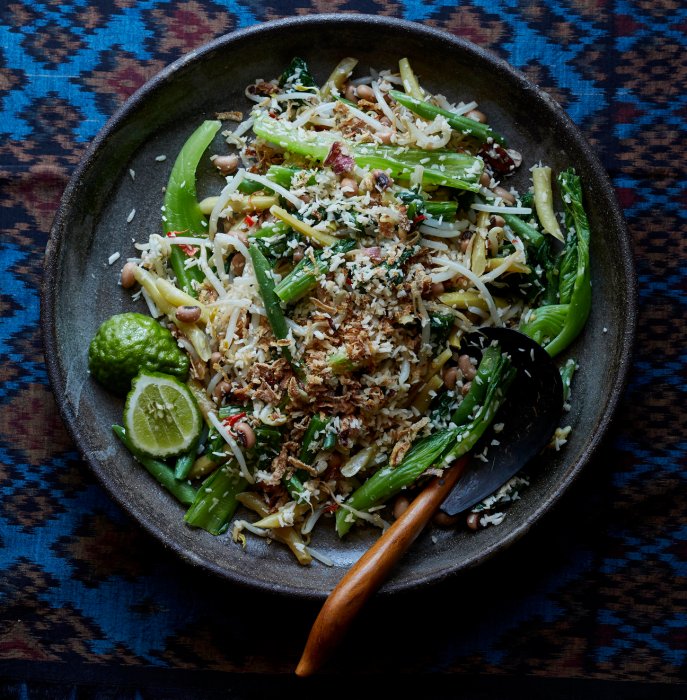
Vegetable urap

Vegetable urap with fresh spiced coconut has its roots in Bali. It’s a salad with green beans, beansprouts, coconut oil, shallots, garlic, chili, black-eyed peas, and lime. She recommends pakis, which are fern fronds, but if you catch the time of year just right, you could probably pop a few fiddlehead ferns into the salad in addition or instead. For a variation, try Sweet Coconut & Basil Salad, which features kencur (it’s fun to experiment with unfamiliar ingredients; it’s are aromatic gingers).

“There’s not a tourist restaurant in Indonesia that doesn’t serve Nasi goreng, which is a “Unami-packed fried rice.” You’ll want to get to know your rices, too: there’s red rice, which is nutty and a bit chewy; black rice, also sometimes purple rice, high in antioxidants (the color comes from the same pigment as blueberries), often served in a pudding with salted coconut cream; white rice, which is brown when the bran layer is intact), best if you buy the long-grained Jasmine which carries a delicate perfume.

You’ll want to know about sambal, too: it’s a “spicy crescendo” and often a complement to bumbu. Sambal is a relish, not cooked into the dish but dropped onto the top. There are lots of variations from Padang Red Chili Sambal to Sweet Tomato Sambal to Strawberry Sambal.

For dessert, you could go for the Coconut Custard Pie, leftover from the colonial era, but ambitious bakers will give Terang bulan a try. It’s a street food sandwich “rather like a giant crumpet” and you choose your own filling. “A rubble of roasted peanuts and sesame seeds, frosted with lots of sugar and a little salt is good.” She also recommends a surprising combination of chocolate and cheese as a homemade filling. If you’re a fan of peanut brittle, give coconut brittle a try.

Magical World: Nom Wah!

If you happen to wander through Chinatown, in New York City or in Philadelphia, the name Nom Wah may mean something to you. Sure, it’s a Chinese restaurant, but not many Chinese restaurants date back to 1920–a hundred years ago! Nom Wah Tea Parlor has roots in the Chinese Exclusion Act, which restricted immigration to the U.S. from China. Mostly, the now-restaurant began as a bakery serving tea, moon cakes filled with red bean paste (a particular delicacy, made very well by Nom Wah), and as a pre-lunch meal, Dim Sum. In time, in accordance with the market needs of its times, Nom Wah was a popular supplier of Chinese baked goods to other restaurants, and eventually, the Dim Sum business became the center of it all. Not many U.S. restaurants do Dim Sum better. And now, there’s a Nom Wah cookbook (now begins a relative term, as explained below).

In a world without COVID-19, Nom Wah would be a place I would visit several times each year. A great place to bring a small crowd of co-workers, family, friends. For the best Dim Sum in town. Ordered off a menu, so everything is freshly made (most Dim Sum palaces serve off rolling carts, which is fine if the place is big and busy, but Nom Wah is neither big nor busy). And so, it’s a place where Dim Sum can be ordered on demand, not based upon what happens to roll by. And I wanted to eat some of that food, in situ, prior to writing about this cookbook.

Begin with the hardware. You’ll need a proper wok, a wok lid, a wok ring, and a wok chuan (a spatula with a curved end to make its way around the wok), and also a spider (a long-handled mesh spoon to fetch the dim sum from a hot liquid). Also, a bamboo steamer and a Chinese cleaver. In the pantry, your checklist includes dark and light soy sauce, toasted sesame oil, chicken powder, fermented black beans (which smells in a distinctive way), two kinds of rice wine, rice vinegar, rice flour, cornstarch, potato starch, and several other items. You can find everything online, or from a good Asian supermarket or grocery store. Much of it can be stored for later use.

Now, think in terms of two types parts of Dim Sum: the fillings and the wrappers. And begin to practice three techniques, all essential: steaming, pan-frying and stir-frying in a wok. Next, before you attempt to cook anything, just sit down and read about the history, ingredients, and processes associated with Bao, and the Bao dough that you’ll use to make, for example, Char Siu Bao, or House Special Roast Pork Buns–in your own home. To me, this seems like magic, but when I review the ingredients and try it myself, it’s not as impossible as it seems: oil, white onion, sugar, light soy sauce, oyster sauce, sesame oil, dark soy sauce, chopped pork, cornstarch, water and the basic ingredients of the Bao dough: yeast, water, flour, sugar, oil, baking powder. It’s all in the instructions–but it is neither easy nor simple to get everything right without a lot of practice and a fair number of mistakes.

Ah, but when you do get something right, and it either looks or smells or tastes as it does in the restaurant, there’s good reason to grin. And to practice by making even more buns, and more mistakes. Stay focused. Get the buns right, and the dumplings become that much easier, too.

That’s the next step: the master fillings associated with dumplings: pork, shrimp, and “no pork no shrimp,” a vegetable filling. There are a lot of different types of fillings here, distinguished not only by their preparation (fried, for example), but their shape and their color. Then, there are Har Gow, the dumplings made in a bamboo steamer. and the Shanghai Soup Dumplings (Hiro Long Bao), which contain liquid and just be managed just-so, lest you make a gloppy mess.

Everyone is familiar with fried rolls–egg rolls and spring rolls, for example, but the floppy and slippery version, sometimes called a rice roll, is far more difficult to control.

And then, there are the cakes. You probably know Scallion Pancakes, but there are other kinds, too, perhaps more familiar in Asian than other households. And, rice and noodle dishes–but you won’t be making your own noodles this time around.

We’re about 2/3 done. There are feasts and various chef’s specialities, all wonderful, but I think of Dim Sum when I think about Nom Wah, I decided to concentrate my efforts on those dishes.

Perhaps I’ve given the impression that The Nom Wah Cookbook is a book filled with recipes from one of my favorite Chinese restaurants. Yes, it’s all that, but I’ve omitted the sub-title: “Recipes and Stories from 100 Years at New York City’s Iconic Dim Sum Restaurant.” Of course, the food is terrific, but the stories and the people and the places are so much a part of this book. There’s “The Man: Uncle Wally Tang,” a sixty-year employee who worked his way up from dishwasher to Dim Sum master. We learn about tea from “The Tea Guru: Timothy Hsu,” shopping in Chinatown from “The Queen of Pearl River: Joanne Kwong of Pearl River Mart,” and “The Grocery Store Goddess: Sophia Ng Tsao of Po Wing Hong.” And related: “The Tofu Kid: Paul Eng of Fong On.” All of this is a bit like traveling to a place that you’ve seen but never entered to explore. People who live and work in the community, who eat together, and share their food because that’s what friends and family do.

Many cookbooks attempt to combine technique, recipes and a sense of people and place in a single volume. It’s not easy to do, or to do well. Here, Wilson Tang and Joshua David Stein make it all work–and Alex Lau’s photographs make it all seem possible. For me, I love the book, but it draws me more toward the restaurant than to endless practice with results that will never be as good as the food I buy and eat at Nom Wah Tea Parlor. But that’s not exactly the point. For me, the point is owning, touching and feeling a part of Nom Wah, and, from time to time, attempting to conjure some of its magic in my own kitchen.

The Self-Important Year of 1974

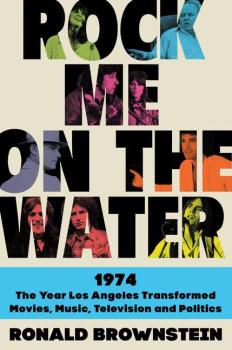
A good friend told me about a new book called Rock Me on the Water: 1974, The Year Los Angeles Transformed Movies, Music, Television and Politics. He was excited because we experienced some of the adventures that author Ronald Brownstein described, at least tangentially. It’s interesting to write about this particular book and this particular era because I happened to rewatch Almost Famous, Cameron Crowe’s film about his adventures on the road with The Allman Brothers Band (as a sixteen year old journalist for Rolling Stone, late 1973).

The book tells the story–a very good story at the start–about Linda Ronstadt and the way she built her career. This leads to background about David Geffen and the evolution of community of musicians in and around Laurel Canyon in the Los Angeles area. In short, they shared just about everything–life, love, shelter, food, drugs, music, songs, recording sessions, and a gigantic creative heart. In time, this culture evolves into a big-money enterprise, as evidenced by, for example, The Eagles, and the played-out sensibility so effectively described in their song, “Hotel California.” Indeed, this is music journalism at quite a high level, pleasant to read, deeply connected with outside events, evocative of time and place, and, viewed from the distance of time, something quite important. At the time, or shortly afterwards, I happened to be working (at a very junior level) at Warner Bros. Records in New York City. It was clear that everything had shifted west, but when the opportunity to move to Los Angeles came up, I turned it down. But I could sense that 1974 was right around the time when New York City lost a lot of ground as the center of the entertainment universe, and Los Angeles had gained what NYC had lost.

I come from a television background, but I had never thought much about how the development of Norman Lear’s sitcoms and Mary Tyler Moore’s small empire were related to this shift. I suppose I figured that sitcoms had always come from Los Angeles–for a long time, anyway–but I did not connect the creative energy in music to the creative energy in television. But there it is, and again, author Ronald Brownstein lays it all out in ways that suggest a much larger story.

And yes, there was a lot happening in the movie business at that time, too. All in Los Angeles. There was the old guard and the remains of the studio system, and Warren Beatty who seemed to be able to play both in the old ways and in the new. And there was Jack Nicholson, who was a somewhat awkward fit (mostly as a writer) but a far better fit for the independent orientation of the new. This, too, takes shape at around this time (1974 is a loose peg, but a good one). And much of what Brownstein describes is deeply connected to the larger shift in creative power.

But then, we meander into the “I wish I cared” world of Jane Fonda, Tom Hayden, and the very specific strange politics of the Vietnam era. The national material is good, if well-known, but the California politics is slow-going, and although the author tries very hard to connect the dots, that felt like a struggle. The politics of this era were all about the Vietnam War, but Los Angeles was tangential to the story. Unfortunately, the long story of Jerry Brown extends the book’s dull middle section before we see the light at the end of the tunnel–which turns out to be yet another motion picture screen, this time featuring the work of young Steven Spielberg and George Lucas. The story of the younger directors–Brian de Palma and Martin Scorsese among them–lifts the story back to a higher level, but now, the connections between their efforts, Los Angeles and the year become more diffuse.

The first half of the book is great fun, and somewhat provocative reading (as provocative as pop culture goes, I suppose). The second half contains interesting stories, but I lose the point of the book. Yes, I enjoyed reading about the development and success of M*A*S*H*, and the struggles between Carrol O’Connor (Archie Bunker) and Norman Lear, but neither really illuminates how and why Los Angeles and 1974 changed the world. We begin to see female directors, but that happens, mostly, later on. Here and there, we see some non-white faces and some non-white directors, and we do see “two hundred movies centers on Black characters” from 1971 until 1975, but the shift in Hollywood takes shape, in a meaningful and sustainable way, much later. Similarly, there are non-white recording artists and the beginning of a new segment in the industry, but the action here is in Memphis, Philadelphia, and soon after, in disco capitals throughout the U.S. It’s not really an L.A. thing, not that L.A. isn’t part of the story, it’s just that the book promises a deeper and more long-lasting connection.

The book regains some strength when it returns to Linda Ronstadt, whose story about career development is also not an L.A. thing. Her work with Peter Asher is more about her own independence and versatility as an artist (one who made a lot of money, who started her career in Los Angeles but then became full-scale U.S. star). Again, worth reading if you’re curious about Ronstadt and because she happens to be a very smart, wise, and talented artist–and in part, because she comes up as several other smart, wise and talented women are blazing their own paths. This, too, is partly tied to Los Angeles (Sherry Lansing becomes the first head of a major studio), but it’s also happening throughout the world at that time–and quite slowly, everywhere.

By “December” (each chapter is titled with the name of a month, but the months have nothing to do with the order or organization of the storytelling), everything is falling apart. ABC has out-maneuvered CBS, so the Norman Lear shows are losing ground to the likes of the fluffy-but-fun Happy Days on a newly competitive network. JAWS introduces the blockbuster film, leaving the rich potential of independent film in an early 1970s bucket that would take a long time to find its footing, and shifting priority of studio executives to a much better money-making proposition. Stadium shows took the place of small rock club performances–shifting the creative power back to NYC as punk and other alternative forms suddenly seemed a whole lot more interesting than anything that was going on in L.A. Fleetwood Mac, once an interesting band with blues roots and a critically acclaimed take on progressive rock, added Stevie Nicks, and became wildly popular among the stadium concert goers, and simply irritating for those who reveled in the early 1970s creative culture that was once, for a brief period, the center of the universe.

CDs, LPs and the Future of a Record Label

The problem is, we’re easily convinced to do foolish things. We started with a few very good ideas, but then, we followed the crowd.

The first of the good ideas goes back to Edison in the late 1880s: record about two minutes of sound on a rotating tube coated with wax. Technology improved: two minutes became three and four minutes; microphones were invented and allowed far greater fidelity by the 1920s, and, of course, the world adopted the 78rpm disc as the industry standard that became known as a “record.” By the late 1950s, the long-playing (“LP”) increased running time so that a full symphony or a Broadway cast recording could be presented on a single disc. By the 1950s, the 33 1/3 rpm disc became the industry standard as a record “album” (replacing the old album filled with several 78 rpm discs). The 45 rpm single came along at about the same time. With proper care, these plastic (vinyl) discs could last a very long time, but the combination of scratches (even with the best of care), and dust (few people washed their LPs, but today, many people do) gave the record industry good reason to pivot to a new format: CDs. And so, many of us re-bought the same titles we owned on LP and enjoyed what we had been led to believe was a more durable, better-sounding format. Smaller and portable, too. Then, we were convinced to re-buy our music track-by-track for inclusion on even smaller, more versatile listening devices, including iPods and later, our phones and iPads. And then, we were convinced that there was no need to own music, that subscribing to music was a much better idea. And for casual listening to popular music, it is, indeed, a better idea.

However. Only about half of recorded music is popular music. The other half is less popular, but often, more interesting. While everyone else seemed to be spending money on subscription services, I frequented record stores that sold large quantities of classical, opera, choral, jazz, Broadway, blues, folk, country, classic rock, and other forms of music for remarkably low prices. Nearly all in superb condition. Along the way, I became more enamored of music from the 1950s through the 1980s than contemporary work. Then, I started to think about that. What was I missing? What happened to the record label? Were there labels that were continuing to release interesting work that, somehow, I was not seeing online, not reading about in newspapers, not showing up on the counter of my local record store?

Yup! Pi Recordings is a very good example. There are others, and I will write about them as I continue to listen to the good work they’ve released, and continue to release, most often on–gasp!–CD.

If we go back a bit, record labels were associated with distinctive personalities. For example, Stax Records, in Memphis, released a particular type of soul music. Blue Note Records, in NYC, focused on small group jazz, then modern jazz. Chess Records, in Chicago, concentrated on blues and some R&B. Later, and ongoing, ECM Records, in Munich, Germany, developed a unique brand with a combination of avant-garde jazz and classical music with a modernist sensibility. Most former labels are now reduced to imprints, sub-brands within far larger companies, notably Concord and Universal. ECM Records remains independent, but it relies upon larger companies for marketing and distribution throughout the world. Larger companies may or may not respect the unique brand identity of the original label.

And so, back to Pi. Here is a modern label with a distinct personality, a reliably avant-garde profile with a consistent run of superb, modern, interesting, 21st century music. It is a delight to listen to each of the CDs, and to learn about a distinctive group of rather special artists.

This morning, I’ve been listening to one of Pi’s most consistent sellers, Verisimilitude by drummer/percussionist Tyshawn Sorey. It was recorded about five years ago, but no matter. It is fresh, filled with original ideas and a flow that makes for casual listening, background, or sit-up-and-pay-attention listening. It is abstract, it floats along, and I find myself writing for a while, then stopping to listen more carefully and playing a particular passage two or three times to get a better listen. It’s trio music. Chris Tordini is the bassist, and Corey Smythe plays piano, toy piano and electronic instruments. But…if you asked me to identify the instruments, or count them, I would find it difficult to answer because the sounds themselves are distinct, different from the usual concept of instrumental songs. Instead, it’s a soundscape, sometimes musical, sometimes something else that is provocative, intelligent and enjoyable, but does not require academic study for comprehension. It just feels modern, and it feels good. In fact, Sorey is both the modern musician and the academic–he is now on the faculty of The University of Pennsylvania, teaching composition. He is often offered as an exemplar of modern abstract music, the subject of magazine articles about contemporary music. And yet, his work is entirely accessible, and I’m thrilled to tell you that each of his Pi Recordings are worth owning. Uncertain? Watch the videos, but allow yourself the time and space to pay attention.

And yes, I wrote “owning” this music. Sure, that may be a divergent idea for 2021, but listening to this music with a good CD player and a good pair of headphones is a delightful way to spend a summer day. If you have the option don’t listen to this music on an inferior sound system. It’s all about the subtlety of sound, the feeling brought on by particular instruments and sound patterns. Pi Recordings are prepared, and produced, with such care, you’ll miss a lot if you’re not listening in the best possible way (not to say that the recordings are inferior on lesser systems, but there is so much here, and I want you to enjoy all of it). If I were to recommend a second purchase, I suppose it would be The Inner Spectrum of Variables, but there’s ample opportunity to sample a lot of his work online, so please, go explore.

I like the idea of “label-mates,” a term not so often heard these days. With Chess Records, I enjoyed listening to, say, Muddy Waters, and I trusted Chess to offer more good records by more good artists, so it was an easy jump to Willie Dixon or Howlin’ Wolf. I found Arvo Pärt because I trusted ECM’s musical judgement with regard to Keith Jarrett. With streaming services, we do have recommendation engines–if you liked this artist, then you’d like this one, too–but this is algorithmic, so it’s not based upon the creative instincts of label executives dedicated to the music. And there is a difference.

I trust Pi Recordings, so I’m more likely to open, say, a more ambitious release by, say, the Steve Lehman Trio. And when I hear Lehman’s alto sax meander through “Prelude,” which opens a 2019 recording called The People I Love, I’m primed to pay attention and enjoy. And suddenly, I’m following a line of musical thinking that leads me into “Ih Calam & Ynnus,” which begins calmly with Craig Taborn’s piano and quickly jumps into a far more abstract improvisation (sounds like an improvisation, anyway) with Damion Reed rolling through drums. Long lines, complex stuff, but Pi has built the necessary scaffolding. Things calm down with “Curse Fraction,” and if you’re getting the impression that is is, somehow, smart music, or music for smart people, maybe that’s part of the brand. Again, accessible and welcome, but the music does provide a bit of a ride. As it should. I feel as though I am listening to something new, extraordinary well-done, and crafted with the greatest of care. The sound mix on this track, for example, seems especially well-balanced–again, providing good reason for fully-engaged listening, again, preferably on a sound system that allows you to hear the artists’ work as it was played and recorded.

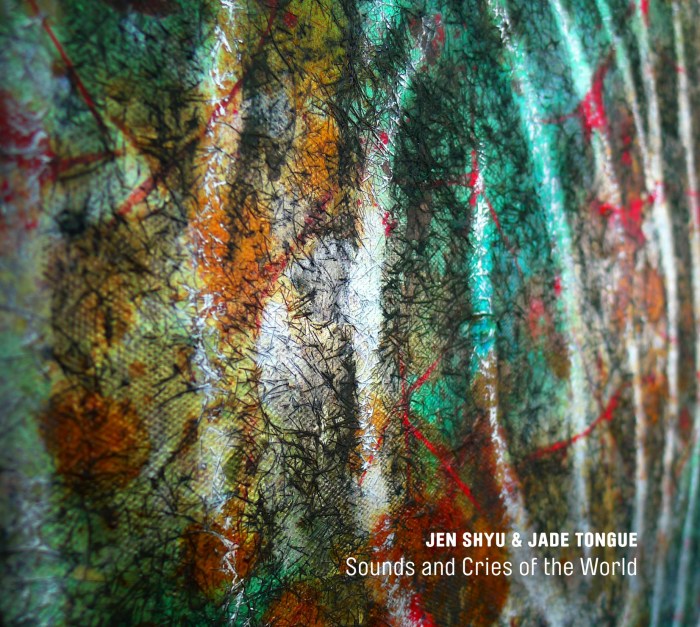
Trust matters. I like what I hear, so I trust the label and allow myself to listen to an artist whose name, instrument choice, style and sensibility is unfamiliar, even strange to me. So here’s Jen Shyu, who plays the 2-stringed Taiwanese Moon Lute, the 12-stringed Korean zither, the Korean gong, and the Javanese gamelan idiophone (that is, the gat kim, gayaguem, ggwaenggwari and kemanak), and sings in a combination of traditional and new ways. Accompanied by trumpet, viola, bass and drums, Sounds and Cries of the World is a multi-cultural musical enterprise. And it works. Like other titles in the growing Pi Recordings catalog, this one comes from an academic arts tradition, growing from the artist’s cultural studies with The Asia Society and the Asian Cultural Council. Given the wonderful popularity of Rhiannon Giddens, on Nonesuch, whose work (post Carolina Chocolate Drops) has been concerned with historical and cultural aspects of music from her heritage, music that grows from musicology doesn’t seem as strange or foreign as it did in the past century. And the combination of those sounds with more modern arrangements and practices makes the music even more interesting.

And the label continues to grow. There’s a new Jen Shyu album, just released, entitled Zero Grasses: Ritual for the Losses, and “devoted to the marginalized voices of women around the world.” Happily, this album follows Song of Silver Geese, which The New York Times recognized as one of the year’s best several years ago. Even more happily, you can listen to, and watch, the work of Jen Shyu by visiting Pi’s website.

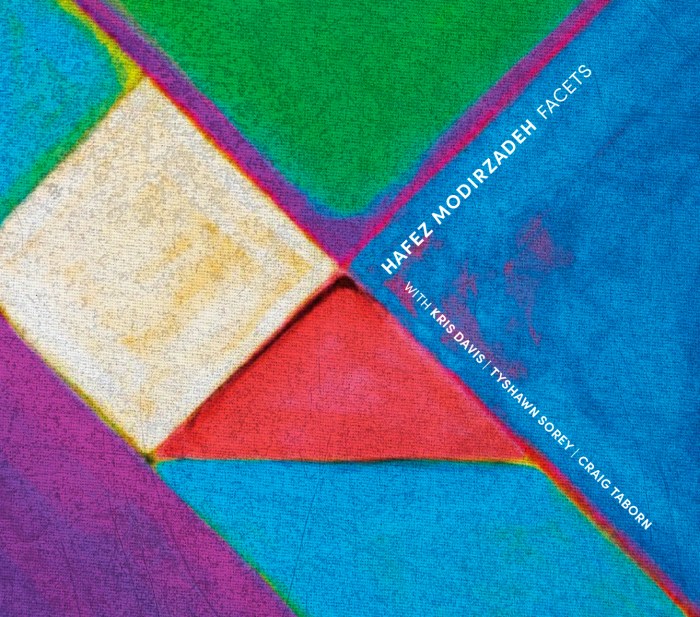
This is no minor effort, this notion of a 21st century record label. There are now about 100 CDs in the Pi Recordings catalog. Included are several by long-time jazz leader Henry Threadgill–the label’s first artist, and Hafez Modirzadeh, a Professor of Creative/World Music at San Francisco State University, whose recent release, Facets, also features Craig Taborn and Tyshawn Sorey (when musicians play together in different combinations for the same label, sometimes, good things happen). That one’s on my list for future listening, as are the two albums by Miles Okazaki, the newer one, The Sky Below, and a very well-reviewed and well-regarded 2017 release called Trickster.

I could easily lose myself in a full summer’s exploration of the Pi Recordings catalog, catching up with what is likely to be even more new releases to accompany our post-pandemic world. Thing is, I find myself stopping everything else I’m doing in order to listen more carefully. To listen more carefully–isn’t that the reason for all of this? Streaming seems to me another way to say, listen less carefully. I prefer the Pi formula. Music is worth the time, and I am extremely appreciative of the effort, care, love, and intelligence that this (now 20-year-old) label has brought to the marketplace and the cultural landscape. Please listen. And buy yourself a CD today. (Or, listen via Bandcamp–these guys are living in the 21st century, and doing the best they can to keep a lot of plates spinning.)

Not incidentally, those guys do have names, an office and a website. They are Seth Rosner and Yulun Wang, their office is in Brooklyn, and you can learn more about them by visiting their About page, which leads to 2011 New York Times article about their story.