“Confidence in Government Was Abysmally Low”

“The rump end of the Continental Congress still wobbled along in New York City, where it had met since 1785, but it hadn’t achieved a quorum since October. Its secretary, Charles Thompson, buttonholed members on the street, when he could find them, and dragged them into his office so that he could claim in his records that they had technically, “assembled.”

The people had elected a President, but nobody was sure what the man was supposed to do. People from Pennsylvania considered people from New England to be their enemies, and the feelings were mutual. Southerners trusted no one except themselves. The states didn’t want to work together, not that this seemed especially likely given the “the yawning listlessness” and “over-refining spirit in relation to trifles” exhibited by Congress’s first members. Apart from a few clerks, the Federal government had no employees. And almost no money. There was no Supreme Court, and there no lower courts. There were more than fifty different currencies in use, plus plenty of counterfeit currencies. There no political parties, but there were Federalists, who believed in the potential of a powerful central government, and Anti-Federalists, who did not. The Anti-Federalists were ready to take apart the new U.S. Constitution and start over, this time favoring these States, not a unified nation.

And we’re only a dozen pages into the book, “First Congress” by historian Fergus M. Bordewich. As a modern reader, the dysfunction is almost beyond comprehension. Not only was nothing much done in preparation for operating a nation, there were almost no likelihood that  the First Congress would accomplish anything in particular. And the only guy who could pull the whole country together—George Washington—expressed tremendous apprehension about becoming the President, or the King, or whatever the leadership role might be called. George had his doubts, but he really, really wanted the job and needed to be careful about seeming too anxious. (Ron Chernow, who wrote the biography “Hamilton” on which Broadway musical is based, also wrote a great bio book called “Washington: A Life” which is heavy on George’s constant internal conflicts. Bordowich does not as deeply here because he has other territory to cover.)

So it’s James Madison—whose story ought to follow “Hamilton” as a Broadway musical—who convinces George to man-up, and run the country. Hamilton is also in a leadership role, convincing Congress that the new country ought to set up a bank, assume the states’s debts, and establish a meaningful credit rating. But everything in those early days seems more like an informal startup company than the beginning of the richest nation on earth. “There was also John Jay who ran the Confederation’s Department of Foreign Affairs from his law office, and Henry Knox, who presided over the War Department from rented rooms at a Water Street tavern.”

Look into his eyes. This is James Madison, a politically savvy man who convinced George Washington to lead the new nation.

Look into his eyes. This is James Madison, a politically savvy man who convinced George Washington to lead the new nation.

Eventually, they got to work. Madison was the first congressman to propose a law so that the new country would have some revenue, and control its coastlines. And then, everybody argued, and protected their regional interests. And besides, nobody was clear on how these new rules could possibly be enforced.

With or without proper tariffs, Vice President John Adams “tirelessly repeated that Europeans would never take the United States seriously unless its chief executive was endowed with the trappings of sovereign grandeur…At minimum, he considered His Highness or His Most Benign Highness as the barest acceptable forms of address for its president. He…scathingly dismissed President as appropriate for ‘Fire Companies & of a Cricket Club.’ Any member of Congress willing to settle for less he considered a ‘driveling idiot.” Everything was new, nothing was settled, and everybody carried a strong opinion of how things must be done. Still, they were not without humor: Ben Franklin, who was always good for a laugh, called Vice President Adams “Your Superfluous Excellency,” while others looked at his widening girth and favored, “His Rotundity.” (I found Franklin’s comment on the web, not in the book).

Did the First Congress get anything done?

The surprising and overwhelming answer is “yes!” In surprising chapter by chapter, Bordowich leads us through one astonishing accomplishment after another. Congress establishes itself as a powerful legislative body. They manage to keep the government running at a time when it appears as though George Washington will not survive an illness. They worked out the Bill of Rights. They figured out where to place the new nation’s capital—a  major political accomplishment because of the many competing interests. While busy complaining about how little they understood about finance, they did not stop Alexander Hamilton from establishing the U.S. as a viable financial operation—a capitalist one at that. They worked on a reasonable solution for slavery—but failed in the attempt. They—and Adams gets much of the blame for this—managed to make the Vice President an ineffective leadership role. They invented the President’s Cabinet and its various departments—and convinced a very reluctant Thomas Jefferson to leave his lovely Paris mansion and lovelier lifestyle to return home and establish the State Department. They learned to deal with lobbyists (Quakers were the first lobbyists).

“Men who had seen themselves primarily as citizens of their individual states had now mostly come to see themselves as the common citizens of a nation and embraced their new government as their own in a way they had never done before.”

“Public opinion now mattered. Newly emboldened newspapers brought the doings of government to the door of every citizen, including the illiterate , who gathered in urban taverns and frontier hamlets to avidly hear reports read to them by their literate neighbors.”

A new nation had begun.
the-first-congress-9781451691931_lg

Stick It in Your Ear

This is guest review by Stephen Blumenthal.

After breaking my third pair of wired earbuds in the one year, I began to look into alternatives. I have a bit of a reputation for pushing the durability of my gear over time. My dad puts it as “you really use your stuff, don’t you?” I can’t say he’s wrong. Any technology that I invest in, I use often and thoroughly. After some light research, it became clear that it was time to bring myself into the 21st century: wireless Bluetooth headphones. Here’s what I wanted from a new pair of wireless headphones…

1. Stable fit in my ear.
2. Good audio quality. I am a composer and audio engineer, I usually manage my expectations of earbuds because they are consumer products, not professional gear. These aren’t headphones that I’m using for input monitoring in the studio; they are earbuds that I wear while talking on the phone or listening to music while running.
3. A reliable microphone for lengthy phone conversations with my family and friends. Same managed expectations as my previous point; this isn’t for a professional quality recording, this is so people can hear me clearly.
4. Since we’re dealing with Bluetooth here, expenditure of energy of both my phone and the wireless earbuds is something to consider. Also, a reliable connection to whatever device it is interacting with.
5. Bonus points for a streamlined, modest looking design.
JabraEnter the Jabra Pulse.
It came in the mail this weekend. I was so excited! I was watching for the mailman from my apartment window. It finally arrived in some beautiful, well-designed packaging. A box with a smooth texture, and a panel that folds out and is held in its place by a well-concealed magnet. I get the box opened up and lay all of the gear out on my coffee table. In addition to the earbuds themselves, there’s a short micro-USB cable for charging, a brief instruction manual, a couple pairs of soft rubber “wings,” which come in different sizes and interesting shapes, for fitting into the ridges of your ear and small soft rubber cups (I believe the call them ‘EarGels’) of varying sizes to ensure a secure fit in your ear. Getting the right fit was a little confusing at first, but once I wrapped my head around how they worked, I had no problems.They all come in a nifty little carrying case, it’s obvious that a lot of thought and care went into customer experience and product design.
For a $199 pair of earbuds, my expectations have been met – definitely worth the price.
Not wanting to wait even a second more to bother with charging them, I immediately fired  up the Bluetooth on my iPhone and paired the devices. I skimmed the Jabra instruction manual. Hold down the center button on the control piece on the earbuds with your phone’s Bluetooth turned on, you’re greeted by a pleasant, modern sound to confirm the ‘buds are awake, and then a nice, female voice confirms your connectivity. It feels like something out of the future, something like Cortana from Microsoft’s Halo video game series.
First things first, let’s play some tunes. I start Spotify, and my expectations of audio quality are exceeded. I didn’t quite know what to expect, but I’m smiling ear to ear with how great this sounds. I start with playing some Daft Punk, a favorite, and something that I expect to sound good on a product like this. These earbuds seem to be marketed towards people with an active lifestyle, so I expect music that falls into genres like EDM, Rock, R&B etc. to sound great on these. Something to run to, something to lift to, etc.
But what about something quiet and orchestral?
I pop on Nuages from Claude Debussy’s Nocturnes. The beginning of this piece is quiet, very quiet. Granted, I’m in my room in my apartment, a very quiet space. My first observation is that I do not have to crank the volume to hear the soft beginning. The quality is impressive, I can hear the instruments and subtle orchestration clearly. Expectations are exceeded here. For a small set of in-ear speakers, I’m hearing a lot more detail than I expected. I’ve studied this work thoroughly, so I have a pretty clear idea of how it’s supposed to sound. There weren’t a lot of missing frequencies here, and that impressed me. While I’m happy to know that the quality is high here, orchestral music is still better on a big pair of loudspeakers, or better, in a live venue.
The range of connectivity isn’t half bad, either. I left my phone in my bedroom and walked to the other side of my two bedroom apartment to the kitchen. The signal didn’t start to break up until I got to my front door, the furthest point from my room.
Phone call test was next, I called my brother. He’s at noisy restaurant waiting in line to order a bagel. He picks up, I can hear him clearly, he can hear me clearly. Very different from my past experiences. I’ve had long conversations using these little ‘buds already, and I’ve had little to no issue with them.
This morning, I took them out for a run. This time, I used Jabra’s complimentary fitness tracking app. It has some pre-loaded workouts, you can make your own workout routine within their app, or you can have it just track your speed, heart rate and distance. I’ve only used this app once so far, but the whole experience is pretty seamless.
I’m very happy with my Jabra Pulse, my expectations were exceeded. Definitely worth the investment.

Far from Here

With dreams of barbecue and blues, I visited Memphis for the first time. Instead of Graceland, my rented car took me to the Stax Museum of American Soul Music. Second only to Motown, Stax Records was home to Carla Thomas, Booker T. and the MGs, Rufus Thomas, William Bell, Wilson Pickett, and other ground-breaking artists, the label folded in 1975. Now, it’s old headquarters is a museum. Arounfourway-logod the corner from the museum is The Four Way Restaurant, where Stax musicians, producers and engineers used to eat, and where I shared a table with a preacher who was touring the South, speaking about how Wal-Mart was destroying the local economy. Fried chicken, fried fish, side dishes of greens and yams. Preacher told me he would be heading next to Clarksdale, then on to Cleveland (Mississippi) and Indianola, just a few hours south. Next morning, I decided to skip a few speeches at a trade show and head for Clarksdale, figuring I’d be back just after lunch. I guess I didn’t anticipate driving down Highway 61, or waiting on Aunt Sarah to do her daily deliveries before serving lunch in what turned out to be one of the few places to buy lunch in the once-vibrant small city of Clarksdale. And if it wasn’t for my visit with Roger Stolle in the Cat Head Store in Clarksdale, I wouldn’t have known about Miss Sarah in the first place—Sarah Moore passed in 2009, and I sure wish I had time to stay around for a nighttime performance because Sarah’s Kitchen was a popular juke joint before the place closed down in 2010. Driving back to Memphis, I kept staring out at what had been plantations—these massive open fields with tiny shacks in the distance, and nothing to protect a runaway from the advancing dogs except the cypress trees with their submerged swampy roots and cottonmouth snakes. I drove away, first to Helena, Arkanas where a deranged woman attempted to enter my moving vehicle with a straight-edged razor in her hand, then to Oxford, Mississippi to stand between the columns where James Meredith claimed his college education, then passed more than a few gas stations whose second business was cooking up and selling ribs.
Unknown
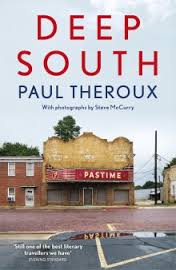
I live a thousand miles away, not two days’ drive, but no place in my country has ever felt more foreign. Never articulated that before, but then, I hadn’t read Paul Theroux, either. Some months ago, I got my hands on “Deep South,” written by an extremely well-traveled author who had “driven from my home in New England, a three-day road trip to another world, the warm green states of the Deep South I had longed to visit, where the past is ‘never dead.’

Summer is the time for travel, but if you’re feeling as though the road might be too rough, or too hot, or just too darned far, “Deep South” is the book you’ll want for armchair traveling. There is no single narrative. It’s just a series of four road trips with notes that became essays, profiles, musings, and the chatter of a good traveling companion (photographer Steve McCurry—you know him from the famous photo of the Afghan girl with those amazing blue eyes) went along for some of it, and contributed some photos to the book.

A few samples:

“There was hardly any work. There were no visitors, as in years past. Once there had been textile factories in Allendale, making cloth and carpets. They’d closed, the manufacturing outsourced to China, thought a new textile factory was set to open in a year or so, he said…I was to hear this story all over the rural South, in the ruined towns that had been manufacturing centers, sustained by the making of furniture, or appliances, or roofing materials, or plastic products, the labor-intensive jobs that kept a town ticking over. Companies had come to the South because the labor force was available and willing, wages were low, land was inexpensive, and unions were nonexistent. And a measure of progress held out the promise of better things, perhaps prosperity. Nowhere in the United States could manufacturing be carried on so cheaply…Even the catfish farms—an important income-producing industry all over the rural South—have been put out of business by the exports of fish farmers in Vietnam.”

and

“You take the cane and strip it. Then you take it out to the syrup mill, where you had a thing like a crusher. You put the cane up there and hook your  mule to it. And you had a pan, called a syrup pan, about four feet wide, and the syrup run up into that pan, and up the front, that’s where the heat stays. Like a skillet. You boils it and throws the top away with a ladle. That molasses was prime.”

“It seems you could feed yourselves.”

“We was poor, so we made our own food,” he said. “Gutting and smoking hogs. Bleeding them, cutting them up, smoking them for about two-three days. We done everything ourselves.”

“How much land did you have?”

“Forty or fifty acres, we rented it from a white man who had a lot of land. I have nothing bad to say about that white man. He had a tractor, though, and we had nothing but two mules.”

“Mules instead of a tractor”

“Sure enough. Hook ‘em up to the plow, but they only plowed one furrow at a time, not like a tractor that could do two or more.”

We went on talking about the old-fashioned farm, cotton picking, foraging, hunting.

“My father went out hunting almost every day,” Floyd said. “He shot rabbits and squirrels and deer, and we ‘et ‘em.” He smiled, perhaps thinking of those meals. Then he said, “Not like today. People are hungry today but all they do is sit around.”

and forty-two year old Dolores Walker Robinson:

“I wanted something I could own,” she said. She’d been raised on a farm near here. “I wanted to get my sons involved in the life I knew.”

Apart from the herd of cows and goats, she had sheep, geese, and chickens. She encouraged the chickens to sit on nests of eggs, sold some of the fowl, sold and ate some of the eggs. She grew corn to feed the cows. Because the cash flow from the animals was still at the break-even point, she worked six days a week at the East Arkansas Area Agency on Aging as a caregiver…Money was always a problem.

Easy going, uncomplaining, yet tenacious, Dolores Walker Anderson had all the qualities that make a successful farmer: a great work ethic, a strong will, a love of the land, a way with animals, a fearlessness at the bank, a gift for taking the long view, a desire for self-sufficiency.

“I’m looking ten years down the road, she said as we tramped the sloping lane. “I want to build up the herd and do this full-time.”


Photo by Steve McCurry, appears on the cover of Deep South. Here are the details: DSC_4192, Deep South, Warren, Arkansas, USA, 09/2013, USA-10914. Pastime theatre.  Final Deep South selection for Smithsonian. retouched_Sonny Fabbri 11/25/2014

Photo by Steve McCurry, appears on the cover of Deep South. Here are the details: DSC_4192, Deep South, Warren, Arkansas, USA, 09/2013, USA-10914. Pastime theatre.
Final Deep South selection for Smithsonian.
retouched_Sonny Fabbri 11/25/2014


A Fresh Look at the Cable TV Business

LeVarBack in the 1970s, most Americans thought television would be free forever. There weren’t many channels—just CBS, NBC, ABC, PBS, and a few independents—but that seemed sufficient—so the audience looked forward to the addition of even one additional channel to watch reruns, baseball games, or old black-and-white movies. At that time, cable television was a sluggish industry for four reasons: (1) there was no wired infrastructure, no way to connect most households  to a local cable television system; (2) the principal value of cable was improved broadcast reception, which was an issue for a relatively small number of viewers; (3) cable systems mostly served small cities and towns, so the economics of scale were absent; (4) apart from the few low-budget, hyper-local cable channels (“local origination”), there were almost no cable-only television channels, and no economic model to support the idea; and (5) almost nobody was willing to pay to watch television.

It took about twenty years, but by 1998, there were 171 cable networks, and today, there are nearly 1,000. In 1998, there were nearly 70 million households paying a monthly fee to a cable television system operator. How much? Nowadays, that’s not a figure to calculate because internet services and cable subscriptions are bundled, but if that number is $500 per year x even 50 million households (assume severe cord-cutting), that’s $25,000,000,000 per year—$25 billion, plus advertising and other services that brings the industry closer to the $40-50 billion mark. That’s several times larger than our U.S. automobile industry, several times the size of our retail industry, and about the size of our energy industry.

This will not last forever. In fact, it’s changing very quickly because cable can no longer protect the near-monopoly that it constructed for itself in the 20th century. The problem is Google, the problem is Apple, the problem is the cable industry itself that has grown fat and happy by collecting those monthly fees. The cable industry did not, could not, or didn’t bother to protect its essential territory: the TV screen. Sure, it controls the DVR, but that’s not enough. With every HBO Now, every YouTube video watched on an iPhone, the traditional cable industry is cut out of the equation.

At the recent INTX conference (no longer called “The Cable Show” or the “NCTA” for National Cable Television Association) earlier this month, the emphasis was not on program services (though there were small booths from large cable network operations like NBC Universal and Disney), but on hardware that combines the cable and internet viewing experience into a single set-top box. If you want to watch HBO, or ESPN, or YouTube, it’s all in one place. And often, that box is made by TiVO (which still sells DVRs, but was aced out of that sector by the cable operators).

If you’ve been waiting for a decent YouTube search interface on your TV set, it’s coming, thanks to cable. And if you’re liking the idea of TV Anywhere—watch the program on your TV, then switch to your tablet—that’s the new iteration of cable, too.

Mostly, cable has successfully pivoted. On the surface, we think of the cable industry as the provider of television channels, and now, some VOD services, and we pay a monthly fee for those services. But that’s not the way cable operators see the future. In order to survive, they must control your screen, and that means, they must control your internet service because internet services are becoming wireless, and that will, in time, eliminate the need for the physical cables that defined the industry a half-century ago.

When all of this got started, the cable operators walked a path laden with gold. They would enter a small city, perhaps Fort Wayne, Indiana, and make all sorts of ridiculous promises to local government officials (building schools, swimming pools, new government buildings, senior centers, and so on), and sometimes ease the way with skanky business practices and celebrity appearances (famous Warner Bros. movie stars visit the city, kiss the Mayor, and dazzle the locals so that its cable division could sweep up the local rights—the franchise—to build the local cable television system). Now, things are different. It’s not the people of River City who must be won over. It’s the blaze of battle against some of the world’s wealthiest companies, and they possess a technology advantage far beyond the reach of most cable operators. So: if they cannot compete against Google or Apple, they do the next best things: they buy their competitors (Time-Warner Cable was just sold), and they attempt to control the content (Comcast owns not only NBC Universal but now Dreamworks Animation, too).

We’ve seen this play before. Gigantic companies buy the entertainment companies, and then, those companies fall into the hands of the finance people who make decisions that drive the creative community to smaller, more entrepreneurial companies.

So where does that leave you and me? Paying $1,ooo-2,ooo per year for combined cable and internet services, with a voice-controlled remote control and some artificial intelligence to recommend programs we might enjoy. We’ll watch John Oliver tell us everything that’s wrong, and we’ll do our best to forget that he’s employed by a $30 billion company, one of the few that controls what we watch, what we see and what we know.

And so, we complete the circle. There are far better toys in our house than there were in the 1970s, but our viewing choices are still controlled by a small number of big companies. The only real difference: those big companies are much, much richer than they were fifty years ago. Meanwhile, we’re still kicking back for 30 or 40 hours a week devoting our free time to the less-than-satisfying hobby of watching television programs and commercials.

BTW: The man in the picture is LeVar Burton who starred in ABC’s original version of ROOTS in 1977, and is now co-executive producer of a new version which debts on several cable networks in this month, around the world.


Chilling with the Fridge

I keep hoping my refrigerator would smarten up, but there it sits just keeping things well-organized and cold. For $600 or so, that’s what the biggest box in my house does all day long.

Ah, but what might $6,000 buy? (Ten refrigerators?) Okay, just one, but it’s pretty amazing.

Click on Flex Zone and you can turn the bottom drawer into either a fridge bin or a freezer bin, and adjust the temperature so it’s ideal for beer, veggies, fish or snowballs.

Adjust the humidity so that the cooling system doesn’t zap the life out of cheese, lettuce, radish greens and the like.

Watch TV. Yup, anything that you’re watching on a smart TV system in your house, you can now watch on the front door of your fridge. Not a big priority for me, but maybe for some people who spend a whole lot of time in the kitchen.

Check the weather. Again, doesn’t come up too often, but sometimes, when I’m scooping ice cream or cutting some bread, I think to myself, gee, I wonder what the weather is like, but my phone and my three computers are too far away, so thank goodness the info is on my fridge!

Listen to the radio, or to any music stream. Yes, this is a nice thing. I can do it with a $200 tablet, but if I’m spending $6,000 on a fridge, sure, why not? Pandora is a standard feature. So are built-in speakers, and if you’d like to spend a bit more money, you can opt for both a sub-woofer and surround sound (wireless surround speakers are best placed above the sink).

Control your automobile until self-driving cars come along. Just tell the fridge where you want to go, and it takes over your car’s computer system to assure a safe journey. Since the fridge is doing the driving, you can sit back and enjoy a cold drink which the fridge places in the accessory cooling chamber in any recent-model automobile.

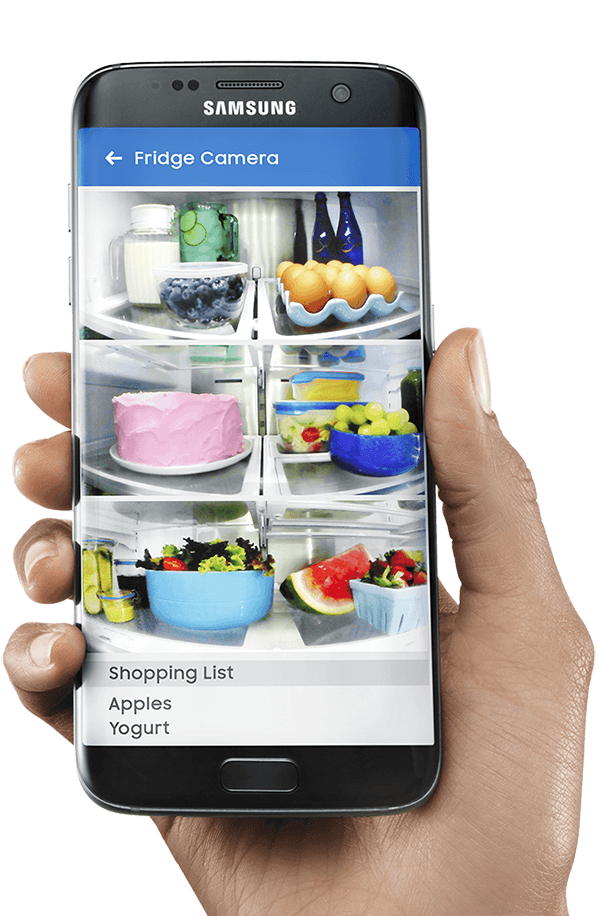
There are refrigerator apps, too. One is called View Inside, and it allows you to peek inside the fridge using three video cameras. Another allows you or anyone in your family to post digital messages on the refrigerator door, or to add to a family calendar. You can turn the fridge’s panel into a family whiteboard, too. There’s a group shopping list, and a few other apps, too.

And, you can turn the whole thing into a picture frame for family memories.

Your new fridge comes in choice of color (stainless steel silver, or stainless steel black), and in two sizes, one for about 22 cubic feet and the other for about 27 cubic feet (the smaller one fits nicely into an upscale kitchen with counters).

Can all of this be true? Absolutely! I’m writing about Samsung’s just-announced Family Hub [TM].

Also true: I made up the part about the car. And the subwoofers and surround sound, but you probably knew that.

And I do wonder: this box seems pretty cool for 2016, but what the heck are you going to say in 2020 when everyone has something even cooler in their kitchen and you have to explain why you spent $6,000 for a device with features that are now widely available on a $1,200 fridge? Heck, that’s easy! You just buy a new model and ask the robot inside to take good care of the kids while you vacation for a few weeks on Mars.

See more!

fridge-mobile.png


In Praise of Sarah Cooper

I don’t usually post funny little graphics (okay, sometimes I do), but as a CEO of a nonprofit, I certainly recognized the truth in this graphic. It comes from a clever website called The Cooper Review.

I don’t usually repost cute little graphics, but this one deserved special treatment.

I became curious about what The Cooper Review was all about, so I found the source of this graphic and learned about Sarah Cooper. Here’s the start of her bio: “I was born a small blackish child in Jamaica. My mother is half German and my father is half Chinese, which is why I look Colombian. My family moved to Washington, DC when I was three. As soon as I learned to talk I was correcting my parents’ accents and grammar.”

No need to go on and on Sarah’s stuff when it’s only a click away. I did some exploring, and if every item from this former Google designer’s site doesn’t hit the mark, her batting average is really impressive. I especially liked her analysis of nodding behavior at meetings, a good place to begin.

Ms. Cooper’s first book will be published in October. I’m guessing it will become quite popular.


Being There

While I admit to not being here for about a year—apologies, but I’ve been having fun doing cool stuff—I tend to enjoy knowing precisely where I am at any given moment.

For example, about two weeks ago, I visited Bohemian National Hall on Manhattan’s Upper East Side. It’s an impressive old building, one of the few surviving ethnic community halls that provided comfort and culture to ethnic communities on the island. BNH has become the New York home of the Digital Hollywood conferences. This time, the focus was Virtual Reality, and its kin, Artificial Reality.

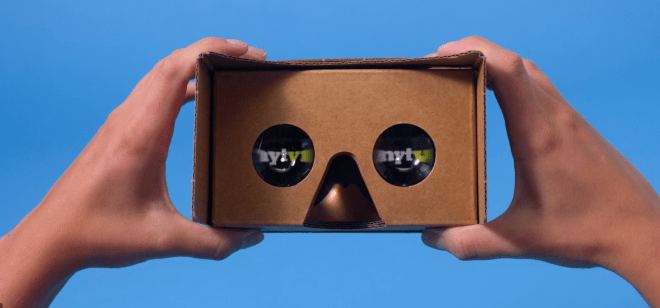
NYT VRThe New York Times now employs a Virtual Reality Editorial Team. They have completed about five projects, each involving high technology and a cardboard box. For the uninitiated, the cardboard box is used to house a smart phone, which, in turn, displays oddly distorted images that can be seen through a pair of inexpensive stereoscopic lenses. To hear the soundtrack, ear plugs are required.

VR is not 3DTV, but it shares some characteristics with that dubious invention. You are a camera with perhaps sixteen lenses. As you turn your head, the stitched-together video imagery simulates reality: you can turn from side to side, up to down, all around, and gain a sense of what’s all around you. (One of the new VR production companies showed off a home-brewed VR camera setup: 16 GoPro cameras set in a circle the size of a frisbee, with several more pointing up and down, all recording in synchronization, collectively requiring an enormous amount of video storage.)

VR provides is a wonderful sense of immersion, and a not-so-good sense of disorientation.

When there is something to explore, immersion is a spectacular invention. For example, diving in deep water and seeing all sorts of aquatic life. Or, walking in a forest. Or being in just the right place at the right time at a sporting event or political convention—you know, being there.

But where, exactly, is “there?” And precisely when should do you want to be there? I never thought about it much before, but the television or film or stage director makes that decision for you—“look here now!” And after that, “look here.” With VR, you can explore whatever you want to explore, but you are likely to miss out on what someone else believes to be important. There is freedom in that, but there is also tremendous boredom—that’s the point of employing a director, a guide, a writer, a performer—to compress the experience so that it is memorable, informative, and perhaps, entertaining.

Tidbits from the NY Times panel: “VR film is not a shared experience—each audience member brings his or her own perspective”…”the filmmaker must let go of quick cuts, depth of field, and cannot control what the viewer may see”…”how do we tell a story that may be experienced in different ways by different people?”…”there is far less distortion imposed by the storyteller”…”much of what would normally be left out is actually seen and heard in VR.”

In some ways, letting the viewer roam around and reach his or her own conclusions is both the opposite of journalism and, perhaps, its future. In an ideal sense, journalism brings the viewer to the place, but that never really happens. Is it useful to place the viewer in the observational role of a journalism, or does the journalist provide some essential editorial purpose that helps the viewer through the experience in an effective, efficient, compelling way?

Is all of this a new visual language and the first step toward a new way of using media, or a solution in search of a problem?

After a very solid day of listening to panelists whose expertise in VR is without equal, I left with a powerful response to that question: “who knows?”

Jenny Lynn Hogg, who is studying these and related phenomena, might know. “Imagine if the Vietnam War Memorial could speak.” Take a picture of any name on the wall, and your smart phone app will retrieve a life story in text, images, video and other media. Is this VR, AR, or something else? Probably not VR, not in the sense of the upcoming Oculus Rift VR headset, but probably AR, or Augmented Reality. What’s that? In essence, turning just about everything we see into a kind of QR Code that links real world objects with digital editorial content. Quicker, more efficient, and more of a burst of information that a typical web link might provide, AR is often linked to VR because, in theory, they ought to be great friends. As you’re passing through a VR environment, AR bits of information appear in front of your eyes.

Although AR was less of a buzz than VR, I think I could fall in love with AR—provided that I could control the messages coming into my field of view, I really like the idea of pointing my smart phone at something, or someone, and getting more information about it, or him or her.

VR, not so much, at least not yet. I’m not enthralled with wearing the headgear—even if it reduces itself from the size of a quart of milk to the design of Google Glass—but that’s not the issue. VR is disorienting, a problem now being deeply researched because the whole concept requires that your perceptive systems work differently. I certainly believe VR is worthy of experimentation to determine VR’s role in storytelling, journalism, gaming, training, medical education, filmmaking, but mostly, to discover what it’s like to be there without being there. We’ll get there (which there? oh, sorry, a different there) by playing with the new thing, trying it out, screwing up, finding surprising successes, and spending a ton of investment money that may, in the end, lead to a completely unexpected result.

Through it all, sitting in that beautiful building, I couldn’t help but wonder what its original inhabitants would have made of our discussion—people who were already gone by the time we invented digital, Hollywood, radio, television, the movies, the internet, videogames and, now, virtual reality. Wouldn’t it be fun to bring them back, to recreate their world, to allow me to walk down Third Avenue in 1900 and just explore? Yup. Fun. And in today’s terms, phenomenally expensive. Tomorrow, maybe, not so much.