With dreams of barbecue and blues, I visited Memphis for the first time. Instead of Graceland, my rented car took me to the Stax Museum of American Soul Music. Second only to Motown, Stax Records was home to Carla Thomas, Booker T. and the MGs, Rufus Thomas, William Bell, Wilson Pickett, and other ground-breaking artists, the label folded in 1975. Now, it’s old headquarters is a museum. Aroun d the corner from the museum is The Four Way Restaurant, where Stax musicians, producers and engineers used to eat, and where I shared a table with a preacher who was touring the South, speaking about how Wal-Mart was destroying the local economy. Fried chicken, fried fish, side dishes of greens and yams. Preacher told me he would be heading next to Clarksdale, then on to Cleveland (Mississippi) and Indianola, just a few hours south. Next morning, I decided to skip a few speeches at a trade show and head for Clarksdale, figuring I’d be back just after lunch. I guess I didn’t anticipate driving down Highway 61, or waiting on Aunt Sarah to do her daily deliveries before serving lunch in what turned out to be one of the few places to buy lunch in the once-vibrant small city of Clarksdale. And if it wasn’t for my visit with Roger Stolle in the Cat Head Store in Clarksdale, I wouldn’t have known about Miss Sarah in the first place—Sarah Moore passed in 2009, and I sure wish I had time to stay around for a nighttime performance because Sarah’s Kitchen was a popular juke joint before the place closed down in 2010. Driving back to Memphis, I kept staring out at what had been plantations—these massive open fields with tiny shacks in the distance, and nothing to protect a runaway from the advancing dogs except the cypress trees with their submerged swampy roots and cottonmouth snakes. I drove away, first to Helena, Arkanas where a deranged woman attempted to enter my moving vehicle with a straight-edged razor in her hand, then to Oxford, Mississippi to stand between the columns where James Meredith claimed his college education, then passed more than a few gas stations whose second business was cooking up and selling ribs.
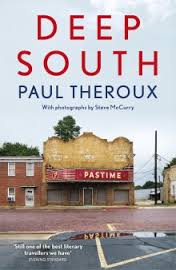
I live a thousand miles away, not two days’ drive, but no place in my country has ever felt more foreign. Never articulated that before, but then, I hadn’t read Paul Theroux, either. Some months ago, I got my hands on “Deep South,” written by an extremely well-traveled author who had “driven from my home in New England, a three-day road trip to another world, the warm green states of the Deep South I had longed to visit, where the past is ‘never dead.’
Summer is the time for travel, but if you’re feeling as though the road might be too rough, or too hot, or just too darned far, “Deep South” is the book you’ll want for armchair traveling. There is no single narrative. It’s just a series of four road trips with notes that became essays, profiles, musings, and the chatter of a good traveling companion (photographer Steve McCurry—you know him from the famous photo of the Afghan girl with those amazing blue eyes) went along for some of it, and contributed some photos to the book.
A few samples:
“There was hardly any work. There were no visitors, as in years past. Once there had been textile factories in Allendale, making cloth and carpets. They’d closed, the manufacturing outsourced to China, thought a new textile factory was set to open in a year or so, he said…I was to hear this story all over the rural South, in the ruined towns that had been manufacturing centers, sustained by the making of furniture, or appliances, or roofing materials, or plastic products, the labor-intensive jobs that kept a town ticking over. Companies had come to the South because the labor force was available and willing, wages were low, land was inexpensive, and unions were nonexistent. And a measure of progress held out the promise of better things, perhaps prosperity. Nowhere in the United States could manufacturing be carried on so cheaply…Even the catfish farms—an important income-producing industry all over the rural South—have been put out of business by the exports of fish farmers in Vietnam.”
and
“You take the cane and strip it. Then you take it out to the syrup mill, where you had a thing like a crusher. You put the cane up there and hook your mule to it. And you had a pan, called a syrup pan, about four feet wide, and the syrup run up into that pan, and up the front, that’s where the heat stays. Like a skillet. You boils it and throws the top away with a ladle. That molasses was prime.”
“It seems you could feed yourselves.”
“We was poor, so we made our own food,” he said. “Gutting and smoking hogs. Bleeding them, cutting them up, smoking them for about two-three days. We done everything ourselves.”
“How much land did you have?”
“Forty or fifty acres, we rented it from a white man who had a lot of land. I have nothing bad to say about that white man. He had a tractor, though, and we had nothing but two mules.”
“Mules instead of a tractor”
“Sure enough. Hook ‘em up to the plow, but they only plowed one furrow at a time, not like a tractor that could do two or more.”
We went on talking about the old-fashioned farm, cotton picking, foraging, hunting.
“My father went out hunting almost every day,” Floyd said. “He shot rabbits and squirrels and deer, and we ‘et ‘em.” He smiled, perhaps thinking of those meals. Then he said, “Not like today. People are hungry today but all they do is sit around.”
and forty-two year old Dolores Walker Robinson:
“I wanted something I could own,” she said. She’d been raised on a farm near here. “I wanted to get my sons involved in the life I knew.”
Apart from the herd of cows and goats, she had sheep, geese, and chickens. She encouraged the chickens to sit on nests of eggs, sold some of the fowl, sold and ate some of the eggs. She grew corn to feed the cows. Because the cash flow from the animals was still at the break-even point, she worked six days a week at the East Arkansas Area Agency on Aging as a caregiver…Money was always a problem.
Easy going, uncomplaining, yet tenacious, Dolores Walker Anderson had all the qualities that make a successful farmer: a great work ethic, a strong will, a love of the land, a way with animals, a fearlessness at the bank, a gift for taking the long view, a desire for self-sufficiency.
“I’m looking ten years down the road, she said as we tramped the sloping lane. “I want to build up the herd and do this full-time.”

Photo by Steve McCurry, appears on the cover of Deep South. Here are the details: DSC_4192, Deep South, Warren, Arkansas, USA, 09/2013, USA-10914. Pastime theatre.
Final Deep South selection for Smithsonian.
retouched_Sonny Fabbri 11/25/2014



 Digital Insider