I want to go to Provence. In 1970.

There was a secret shared, and in time, the secret was widely shared. It was beautiful. Tasty and life-affirming, too. And many of us benefit from it every day of our lives.

Before 1970–give or take a few years either way–we ate frozen and canned foods, modern conveniences for the busy family. Fresh food wasn’t on the radar (and certainly not on the Radarange). Restaurants weren’t modern, not yet focused on locavores, or for that matter, shared cuisines beyond, say, a local pizza or Chinese restaurant.

What changed? Lots of cultural norms–greater awareness, shifted sensibilities, a focus on nutrition and fresh foods. This didn’t happen magically. It may have begun, in earnest, in 1970, when several iconoclasts gathered in nearby homes in the south of France. They changed the way we think about food, and if food is life, they changed the way we think about life, too.

They were Julia and Paul Child, whose rough contours were sketched in the film Julie & Julia. And, to a lesser degree, Simone Beck, who co-wrote “Mastering the Art of French Cooking” with Julia, and whose insistence upon classic French tradition emboldened Julia to think more clearly about the real world of American moms (few American dads cooked–except outdoors). There was the travel / food / free spirited writer M.F.K. Fisher and the American food expert  James Beard, struggling through an extensive survey of our unique and sometimes inexplicable cuisine. And several others who cooked together, argued, and savory the good life that was making its way to Sonoma and Napa.

Their story is told by Ms. Fisher’s nephew, Luke Barr in a book that’s becoming quite popular. It’s called Provence, 1970, and it provided a  winter weekend’s entertainment. There are menus, and they lead into wonderful stories of friends building meals together– serious cooks experimenting and showing off for their foodie friends. It’s loose and informal, and I kept fantasizing about what it might have been like to join them, if just for a night. Few nonfiction books draw me into the story in quite this way, and it was fun to be a part of it, if only as an observer nearly fifty years later.

It’s now available in paperback, but there’s something about the hardbound edition that’s even more appealing.

Enjoy!

BTW: The complete title is “Provence, 1970: M. F. K. Fisher, Julia Child, James Beard, and the Reinvention of American Taste.” Here’s an excerpt, courtesy of NPR.

M.F.K. Fisher, clearly enjoying life.P.S.: I think I need to read more by M.F.K. Fisher. One intriguing title is a 1942 book called “How to Cook a Wolf.” I found a review of the book when it was new in the digital catacombs of The New York Times. They wrote:

Mrs. Fisher writes about food with such relish and enthusiasm that the mere reading of her books creates a clamorous appetite. She also writes with a robust sense of humor and a nice capacity for a neatly turned phrase.”
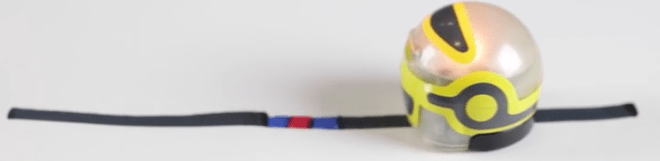
Meet the Ozobots

I first met the Ozobots last year, right around this time, at Toy Fair. I thought they were the coolest thing at the show.

What’s an Ozobot? It’s a tiny robot, about the size of a ping-pong ball. You can dress an Ozobot in one of several rubber helmets, and that allows you to tell them apart. (Once you own an Ozobot or two, you will almost certainly want more.)

An Ozobot gets its power through a mini-USB that plugs into its back. Where its left ear might be, there’s a power-on/off button. On the base are two tiny wheels and the most important Ozobot feature: the color sensors.

Ozobot sensors read four colors: black, blue, red and green. Ozobot rides along a color path, sensing the colors below by scanning them. You can draw the path yourself, and Ozobot will respond to your commands.

Ozobot Path

If you click on the above, you’ll see Ozobot first moving forward, then encountering the blue-red-blue pattern, which is a coded command that instructs Ozobot to flash color blue, then flash color red, then turn 180 degrees.

Ozobot knows lots of commands. Here’s the chart (click to enlarge).

Ozobot-OzoCodes-Reference

With these commands, you can do all sorts of fun things with Ozobot. Most people probably start, as I did, by drawing lines on papers with the four broad-tipped colored markers, and simply enjoying the ways in which Ozobots follow them. The experience is not unlike watching electric trains in motion (it’s definitely more fun with at least two Ozobots, and even more fun with a whole bunch of the little guys). Of course, electric trains can’t spin around or pretend to be a tornado—so when you add the color signals, as above, Ozobotting becomes a lot more fun than model railroading.

There are plenty of pre-designed Ozobot paths and games now available on the Ozobot website, but that’s just the beginning. For curious kids, Ozobot is a hands-on introduction to computer programming. By employing a limited toolset (four colors in lines and patterns), children quickly come to understand that they can cause Ozobots to obey their commands—and that programming can be a lot of fun.

And then, we move to the tablet. There are several iPad apps — remember that Ozobot reads colors, and there’s no reason why it wouldn’t be able to read them from an iPad screen instead of paper. This makes the Ozobot so much cooler! There are several starter paths that allow you to see how Ozobot responds—and these come with color tools and pre-defined spot combinations that you can place anywhere so that Ozobot moves very slowly, very quickly, and makes other moves. A second app, called Ozogroove, includes digital dance floors, allowing Ozobot to really show off. (What fun!)

Back to the website, there are paths ready for download (to a flat horizontal screen) or paper (which always lies flat). For example, here’s a game called Mazerunner.

mazerunner


Intrigued? Here’s a closer look at an Ozobot:

ozobot-work1


An Ozobot costs about $50, but I would suggest that you buy a duo set because it’s way more fun to play with two Ozobots than just one. You can buy them directly from the website or from various toy stores listed on the site. I kinda wish they were selling them in sets of three or four, and I hope the prices will go down. Watching a dozen or more of these guys racing around a hand-drawn track, spinning around, speeding up, slowing down, blinking their little colored lights was so much fun at Toy Fair last year, the onesy-twosy experience pales a bit by comparison. But that the for the future. For now, get started with one or two, have fun, and let me know what you think.


Watch, Smile, Watch, Read

Brawley GirlfriendThis is going to take about fifteen minutes, but I think it’s worth the time.
First, you’re going to watch a very nice music video that was shot with Olympus’s just-announced OM-D E-M5 Mark II (several of them, in fact). It’s a fine piece of work by DP John Brawley. It’s here.

Second, you’re going to watch a making-of video.  It’s a behind-the-scenes video with a music track, so you can see what he did without getting lost in the details. It’s fun to watch, and it’s here.

Finally, read the detailed article about Mr. Brawley’s impressions of a camera that he likes very much. If you’re intrigued by the video potential of the still cameras, this essay will help to clarify your understanding of the state of the art.

It isn’t often that a creative professional reveals his process so completely—and so joyfully! It’s a fun read—and don’t be surprised if you go camera shopping immediately afterward.

Enjoy!

A Blended Book about Blended Learning

bookThere is no DVD sewn into the back of “Blended: Using Disruptive Innovation to Improve Schools,” a new book by Clayton Christensen’s acolytes, Michael B. Horn and Heather Staker. Instead, there are QR codes and URLS. If I’m reading with an iPhone or an iPad nearby, and I happen to have a QR reader installed, I can watch Clip #15, which shows how the Quakertown Community School District produces A La Carte courses to provide students with flexibility.” Sometimes, the QR code reader doesn’t do it’s job effectively, so it’s helpful to have the URL printed below the bar code. In fact, I am writing about “Blended” on an iMac, which does a lousy job reading QR codes with its built-in camera (too hard to bring the book up to the camera, then focus, etc.) So: what we have here is a blended solution, a book that relies upon videos to tell its story in an era when books lack any means to display a video except via an external device. And a free chapter to read.

Add a whole lot of scale, and many more people, and the problem of blended schools begins to take shape. We still have school buildings and classrooms, and millions of students making their way through a traditional curriculum, but many of those students now use digital devices to pursue their own interests, and most of these pursuits are individual activities, not collective learning experiences. So we do the best we can with a hybrid situation that will probably last a long while. The authors attempt to classify, codify and otherwise organize what we know and what it means, but they’re fully cognizant of the strange situation they are describing. And they are trying to make the best of it.

Quite reasonably, they begin with the now-commonplace thoughts on “Why Factory-Model Schools Fall Short Today,” and “Why Schools are Reaching a Tipping Point,” the latter detailing desire for personalization, desire for access and desire to control costs as three significant discussion points. They describe four common K-12 blended learning models: Rotation, Flex, A La Carte, and Enriched Virtual, then drill down on several Rotation models: Station Rotation, Lab Rotation, Flipped Classroom, and Individual Rotation. Huh? To explain this not-so-helpful taxonomy, they break a rule of book publishing. They follow each chapter with its own appendix! Brilliant! I flip the page at the end of the chapter, and there are more pages to explain the concepts in more detail.

After reading the definitions, I was unimpressed with the current state of the taxonomy. Pretty much, some work is done online, some is done in the classroom, some involves more teacher interaction and some involves less. Lots of diagrams attempt to explain these very basic ideas—which aren’t all that different from learning during the 20th century, as some students were allowed more or less freedom based upon their own initiative and the teacher or school’s flexibility. (Important not to overthink these ideas, and also, not to rely too heavily on what seems to be impressive technology circa 2015).

The authors are Christensen people, so they tell the best stories about innovation and obsolescence. My favorite one—clearly told to agitate the laggards—goes like this:

…seeing steam’s potential, the old sailing-ship companies that specialized in wind-powered transoceanic travel did not completely ignore the new technology. The only place they could even think about using steam power, however, was their mainstream market—to help them build ships that would cross entire oceans even more efficiently. They had little motivation to refocus on inland waterway customers, given that they had the opportunity to build even bigger, more profitable ships to cross the oceans. Not wanting to dismiss steam power entirely, however, sailing-ship companies searched for the middle-ground. They ultimately pioneered a hybrid solution, one that combined steam and sails. In 1819, the hybrid vessel Savannah made the first Atlantic crossing powered by a combination approach; in truth only 80 hours of the 633-hour voyage were by steam rather than sail… The wind-powered ship companies never made a true attempt at entering the pure disruptive steamship market—and ultimately they paid the price. By the early 19o0s, the steam-powered ships, which started in those inland waterways that looked so unattractive to the wind-powered ship companies, became good enough for transoceanic travel. Customers migrated from sailing ships to steam-powered ships, and every single wind-powered ship company went out of business.”

And so, the authors ponder, “What will become of schools?,” how to design teams to innovate, “The Cost of Getting It Wrong,” and so on. This is a practical book, a companion or “field guide” to a previous book called “Disrupting Class” that is filled with the theory that makes these practical approaches work. Both are worth reading, both for educators and parents, and for those in businesses or other situations that are not yet equipped with the large-scale change that the 21st century seems destined to spread to so many of aspects of daily life.

Six Good Ideas from a Former Supreme Court Justice


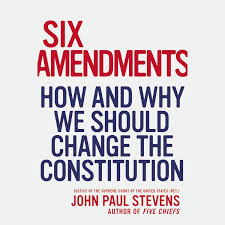
The book is entitled “Six Amendments: How and Why We Should Change the Constitution,” and it’s written by a justice who retired in 2010. While it’s difficult to read the book without wondering why Justice Stevens didn’t magically bring about change while in office, I suspect that the article that I found in The Atlantic is unreasonably harsh in its pursuit of this argument. As in:

The retired Supreme Court justice would like to add five words to the Eight Amendment and do away with capital punishment in America. It’s a shame he didn’t vote that way during his 35 years on the Supreme Court.

Those words would have abolished the death penalty by constitutional amendment. The new eighth amendment might include the italicized words:

Excessive bail shall not be required, nor excessive fines imposed, nor cruel and unusual punishments such as the death penalty inflicted.”

If you’re on death row, or if you care deeply about someone there, those five words make all the difference.

Similarly, Justice Stevens would add five words to the second amendment, forever clarifying the confusion about personal gun use as a constitutional right:

A well regulated Militia, being necessary to the security of a free State, the right of the people to keep and bear Arms when serving in the Militia shall not be infringed.”

So far, just ten words, and we end up with a vastly different free and criminal culture. And even if I am several months late in reviewing Stevens’ book and his ideas, I think every American citizen ought to be thinking about what we want from our amazingly effective governing document. Here’s another, this time about the practice of reorganizing election districts for political gain (“gerrymandering” dates back to 1812—it’s named for Massachusetts governor Elbridge Gerry). This is all new, and a bit dense:

Districts represented by members of Congress, or by members of any state legislative body, shall be compact and composed of contiguous territory. The state shall have the burden of justifying any departures from this requirement by reference to neutral criteria such as natural, political or demographic changes. The interest in enhancing or preserving the political power of the party in control of the state government is not such a neutral criterion.”

UnknownAfter reading this suggestion carefully, I’m left wondering how it would be enforced, and whether politicians would pay it any mind. Maybe it’s the wording, maybe its the concept, maybe its a matter of “giving up” on the political system. That last statement, about giving up, is the whole point. We’re giving up on a system that doesn’t work as it should, perhaps because it has been gerrymandered beyond reason or recognition. Maybe Stevens has the right idea or the wrong words.

Moving on to campaign finance…

Neither the First Amendment nor any other provision of this Constitution shall be construed to prohibit the Congress or any state from imposing reasonable limits on the amount of money that candidates for public office, or their supporters, may spend in election campaigns.

New words, good idea, but we’re caught in the non-virtuous circle of politicians making rules for themselves and other politicians. Interesting article in The New York Times focuses on this issue, and on Justice Stevens’ book. (And yes, Stevens dissented on the Citizens United decision.)

One of the reasons I am writing this article is selfish. I want a good clean list of the former justice’s ideas, and I couldn’t find one on the internet, so I wrote it myself.

The last two are more complicated and require a deeper understanding of Constitutional law and government action. He would like to add “and other public officials” to

All debts contracted and engagements entered into, before the adoption of this Constitution, shall be as valid against the United States under this Constitution, as under the Confederation.

This Constitution, and the laws of the United States which shall be made in pursuance thereof; and all treaties made, or which shall be made, under the authority of the United States, shall be the supreme law of the land; and the judges in every state shall be bound thereby, anything in the Constitution or laws of any State to the contrary notwithstanding.

The Senators and Representatives before mentioned, and the members of the several state legislatures, and all executive and judicial officers, both of the United States and of the several states, and other public officials, shall be bound by oath or affirmation, to support this Constitution; but no religious test shall ever be required as a qualification to any office or public trust under the United States.

The final item is entitled Sovereign Immunity, and it’s more difficult to understand than the others. His suggested amendment:

Neither the Tenth Amendment, the Eleventh Amendment, nor any other provision of this Constitution, shall be construed to provide any state, state agency or state officer with an immunity from liability for violating any act of Congress, or any provision of this Constitution.”

OUnknownn the surface, this is clear, but it’s made more clear by the Justice’s twenty pages of commentary. In that endeavor, I’m sometimes a fan—his historical and contextual understanding is, well, supreme, but his ability to connect with a broad audience sometimes falters. The history becomes too complicated, the issues too tangled, nods to other justices sometimes adding complexity. On the other hand, we’re talking about a book that’s less than 150 pages and contains a whole lot of provocative, clearly presented material.

Wouldn’t it be interesting if every Supreme Court justice wrote a similar book?