 Henri Cartier-Bresson was one of the great photographers of the 20th century. Best known as a prolific street photographer (for whom color was a commercial concession, not an aesthetic option), HCB’s life story is no less compelling than his lifetime of images. His career and personal commitments were well-described last year at an extensive exhibition at the Centre Pompidou in Paris. Happily, the exhibition has been packaged as a coffee table book by Clément Chéroux and published by Thames & Hudson. It’s expensive ($75) and it’s worth the money, in part because Mr. Chéroux curated the 2014 exhibition.
Students of photography associated HCB with “the decisive moment. Just as Martin Luther King (okay, “MLK”)’s life work far exceeds the brief period of his “I Have a Dream” speech, Cartier-Bresson’s infatuation with the precise instant when a photograph ought to be made is only part of an expansive range of artistic and journalist expression.
Born in 1908, Cartier-Bresson grew up in a comfortable Parisian household; the family owned a large cotton and thread manufacturing company. 1908 was also the year that, in England, Robert Baden-Powell published “Scouting for Boys” to support his new progressive approach to education known as the Boy Scouts. The organization’s combination of an active life for boys, with ample freedom and discipline, was a good match. At age 14, as a Scout, Henri began to experiment with photography, but only as hobby. The family’s plan for Henri was all business—he was sent to the best schools so he could, sometime, lead the large family business. Of course, things didn’t work out as planned. Instead, with the blessings of his family, he studied art. Mostly cubism. Which he found “boring” because it was “too systematic.” He preferred the more expansive world view offered by surrealism. In October, 1930, by now free from both his formal education and military service, Cartier-Bresson followed Europeans curious about “the Dark Continent.” He spent nearly a year in Cote D’Ivoire, Cameroon, the French Sudan, Togo, and along the Niger River, he photographed children on the streets and people at work—avoiding the exotic and tribal imagery, just focusing on the day-to-day. Over the next few years, his casual interest in travel photography became a passion, then, a career. He traveled to, and photographed street activities in, Paris, Marseilles, Milan, Florence, Sienna, Trieste, Madrid, various parts of Mexico, and more.
Along the way, he learned by copying the styles of Eugene Atget (streets of Paris, store windows); European photographers intrigued by the geometry of city life (mostly); the golden section that is key to classic composition; various less-than-compressible surrealistic sketches and distortions. In time, he worked out his own style. Before he turned 30, he had created enough distinctive images to display his work in a successful exhibition.
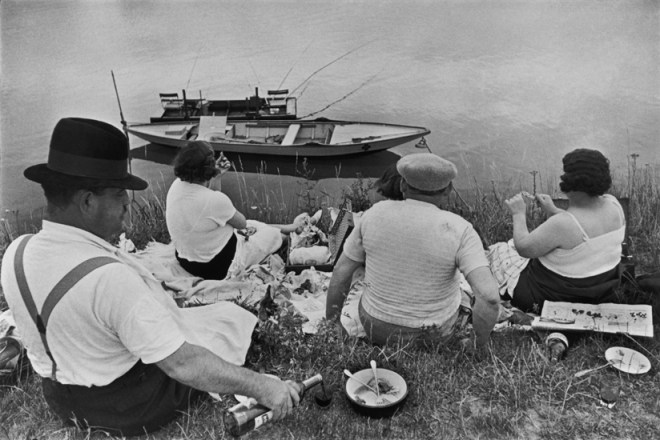
The story becomes more interesting as HCB moves from travel photography and street work (often one and the same) to work with a more specific purpose: often, related to his attachment to the ideals of Communism. Stories of the Spanish Civil War, Mussolini, and the utter transformation of Europe are among the best stories—supported by some of the best images—in this book. He becomes concerned about poverty and tells his visual stories so they will provoke attention. He attends to the facial expression and behavior of crowds, often ignoring (and needing to caption) just what they are looking at. He documents free time—a relatively new idea in 1938 France, at least for the working class—and this is probably my favorite selection of his work. For example, a Sunday on the banks of the Seine from that year:
In truth, what I love about this book is the arc of the creative story. It begins with a smart teenager who decides he likes art and photography better than college and business, who grows up quickly as he travels and makes stunning pictures. Then, he finds his political and social conscience, and plays a very active role, using his photography as a very effective tool. Then, he realizes that his political affiliations will become a career problem, so he co-founds Magnum, a journalistic photo agency with Robert Capa and several other extraordinary photojournalists, and becomes one of LIFE magazine’s active contributors. Then, he explores topics that interest him: the growing connection between people and machines (a project for the IBM of the 1960s, for example), icons of power (very powerful—and decidedly odd—image of a giant Lenin in front of the Winter Palace in Leningrad as a man and his small child stroll in the foreground), and the ways that crowds behave. And then, in this 60s, he begins to slow down, to take images that are more focused on the feeling than the moment. And he begins to draw, picking up on something he loved to do as a child. He visits art museums, and spends hours sketching great works. He takes pictures of the family with his legendary Leicas. It’s a lovely life story, wonderfully punctuated by his pencil on paper self portraits from 1987 and 1992. One of the better free bios on the web is here. And there are a lot of smaller books filled with specific HCB projects that you can find on Goodreads, along with the compendium Henri Cartier-Bresson: The Man, The Image and His World, also from Thames & Hudson.
Henri-Cartier Bresson was born in August, 1908 and died in August, 2004—he lived, and documented, the better part of a century. And nobody did it better.
On the left, a picture of an American woman in 1947. On the right, “Giant Effigy of Lenin” from 1973.

 With digital publishing, the rules don’t apply—and for so many reasons. For example, publishers need not limit the number of titles they publish for any practical reason—there is no scarcity of shelf space. (They may limit releases due to marketing considerations, but that’s another story altogether.) Of course, bookstores are helpful parts of the marketing and distribution system, but they are no longer mandatory—Amazon ships just about any book, next day.
 Walter Isaacson is one of the smarter people in the media industry. As a keynote speaker for this past week’s Digital Book World conference, he talked about the limitations of his most recent book,
  For example, maybe a digital book is not a book at all, but a kind of game. Scholastic, a leader in a teen (YA, or Young Adult) fiction publishes a new book in each series at four-month intervals. The publisher wants to maintain a relationship with the reader, and the reader wants to continue to connect with the author and the characters. So what’s in-between, what happens during those (empty) months between reading one book and the publication of the next one in the series? And at what point does the experience (a game, a social community) overtake the book? NEVER! — or so says a Scholastic multimedia producer working in that interstitial space. The book is the thing; everything else is secondary. In fact, I don’t believe him—I think that may be true for some books, but the clever souls at Scholastic are very likely to come up with a compelling between-the-books experience that eventually overshadows the book itself.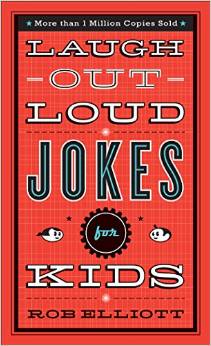


 A monthly subscription fee buys access to a library of short- and long-form programs in four general categories: science, technology, civilization and the human spirit. Some programs are produced by Curiosity Studios—mostly, these are short-form interviews with scientists and other experts, often illustrated with animation. At the start, many of the long-form programs will come from TVO (that’s TVOntario, one of the best non-fiction producers in Canada), Japan’s NHK, France’s ZED, and of course, the BBC Worldwide. With two or three years, the service anticipates 2-3,000 titles; this year, subscribers will have access to about half that number of programs. Happily, John recognizes the challenges associated with VOD navigation, and I’m hoping to see Curiosity Stream reinvent the visual interface so that their programs are easy to find.
 The assortment of programs being assembled for the March 18, 2015 launch. Many are reminiscent of what The Discovery Channel used to be—before its prime time schedule began to resemble other cable channels (“Naked and Afraid,” etc.). Among the titles announced so far: “The Nano Revolution,” “Simon Schama: Shakespeare and Us,” “The Age of Robots,” “Destination Pluto,” and “Scotland: Rome’s Last Frontier.” There will be 4K programming, too—UltraHD for those who own the newer high-resolution TV sets—including a newly commissioned project called “Big Picture Earth” by the filmmaker responsible for “Sunrise Earth.”
 month, you can watch in standard resolution—a terrific on-ramp for viewers who are either new to SVOD or are more likely to be fairly light users, at least the start. At this price, it’s almost a trial subscription with an easy upsell to 720 HD resolution at $3.99 per month (which is all that most people probably need right now). For those with more extravagant viewing habits, 1080 HD resolution costs $5.99 per month; the 4K Ultra HD service costs $9.99 per month (but at the start, there won’t be a lot of 4K programming available—still, some is far more than most other services offer today).
 example, let’s assume that a high quality outdoor production costs about $750K to produce. If one company foots the bill, their programming budget only goes so far. But if Curiosity, for example, puts in $250K to control North American rights, and finds two partners, perhaps one in Asia and another in Europe, and each of them also puts in $250K for their respective territories, then nobody is out of pocket for more than $250K. Rights beyond North America, Europe and Asia provide additional revenue, which is typically shared by the funding producers. This “split exploitation” concept has been around since the 198os, and it works. In the SVOD marketplace, there will be many opportunities for future exploitation, which makes the venture progressively more profitable, and steadily increases the programming budgets, which generate more and better programming, and more subscribers… the circle continues to grow.
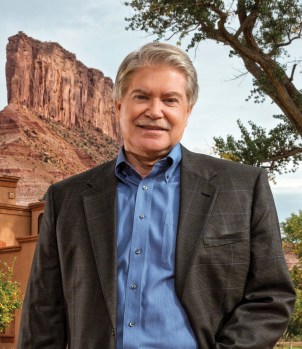 Unlike Ted Turner, whose approach to cable was mass market (TBS, TNT, and very broad-based news with CNN), Hendricks has always focused on nonfiction, documentaries, outdoors and reality (in the best sense, and also with many programming ventures way down market—Discovery owns TLC, so you can thank him for “Honey Boo Boo”). The point: he knows how to play the game, understands how to segment the market. His first pass: a three-bucket breakdown that includes (a) historically light TV viewers, the 1 in 8 of us, the 17 million U.S. households for whom TV is not a big part of daily life; (b) the connected world of perhaps 100 million cable and satellite homes, the ones that often complain that “there’s nothing good on TV” where he hopes to capture about 10 million households; and the rising 4K market, which he projects at 10 million households total and perhaps 5 million subscribers to Curiosity. By playing a more upmarket game from the start—he’s betting that there are enough documentary, adventure, curious viewers willing to pay at least a few dollars per month to see what Curiosity offers and to support what would seem to be a very promising future.
 Could he be defeated by Netflix hiring a former Discovery executive assigned to buying up lots of rights to Curiosity / Discovery -type programming from the short list of global suppliers? Sure, but it’s not likely that Netflix will zero-in on the nonfiction programs that Curiosity Stream plans to acquire. The nuanced understanding of programming for, and marketing to, this particular audience is not something that Netflix can easily replicate. Hulu probably won’t go there, and neither will Amazon. YouTube is interested in other aspects of the business, so it’s likely that John and his team will be able to build the same kind of success that they enjoyed with Discovery.
 Digital Insider