Touched by an Eagle

I was quite taken with Ellen Eagle’s new book, Pastel Painting Atelier.  It’s a classy book, hardcover and quite beautiful, as this atelier series tends to be. Unlike most books about art, unlike most books written for creative people, this one provides several hours of quiet time with the artist at work in her studio, in her mind, with her eyes, with her hands.  She sees beauty in the tiniest of details: the curve of the silhouette of a woman’s face, the arrangement of the old pipes beneath the even older sink in the corner of a Manhattan studio, the private thoughts that take shape in a best friend’s eyes.

Here and there, the book is an instructional work for artists who wish to perfect their pastel technique, but that’s a small part of the whole. (In fact, the obligatory step-by-step demonstrations that end the book are its least essential part). The best parts are small comments that accompany the many sensitive images, often of women who might, in a glance, be dismissed as ordinary. Eagle describes her model, Mei-Chiao, as follows: “the inward gesture of the head to the chest was beautiful to me, and the backward pull of the shoulders is balanced by the triangular opening blouse neckline.” Minor details become a beautiful painting. Same girl, different painting, one that I found by exploring Ellen Eagle’s portrait website, an endeavor I recommend when you have the time to look carefully…

Ellen_Eagle052

The artist’s use of line and color is quite masterful, and throughout the book, it’s easy to get lost in page after page of exquisite, often subtle, portraits. She has a knack for capturing women especially well, almost as if she is drawing and painting their minds as well as their fine features. One of my favorites is below, also taken from her website. She describes the painting below as follows: “In Roseangela’s flesh, I saw warm yellow-greens co-mingling with touches of cool violets and pinks. The planes that faced the light contained color pinks, blues, and greys. Warm tones ran throughout the flesh. Warm, dark burnt sienna defined the depths of her eye sockets. Where the orange dress caught the light, the colors took on a cool temperature. The weight of her clasped hands pulled the dress inward, causing a slight angle away from the light, and the cooler tones gave way to warmer ones.” It’s almost as if she’s writing a poem with colors.

018ee39

This is a gentle book, an inspirational one with the promise of some instruction for the visual artist, but you need not be an artist to see what she sees, and to enjoy the way that Ms. Eagle perceives and so lovingly sees the world.

Here’s the cove. The image on the cover is another favorite. The artist was especially taken with the pose struck by the model. Be sure to visit  Eagle’s website to see the uncropped version.

book

Attack of the Three-Foot Robin

You may recall that I’m a relative newbie when it comes to really big  TV. Our family room’s western wall is now dominated by a 60-inch Samsung plasma  screen is dominated by a stunning picture of a red robin who must be at least three feet tall. There’s a common yellow throat, also larger than my dog. A bufflehead. An olive-sided flycatcher. These are among 118 birds that receive full screen credits, alongside author Jonathan Franzen, legendary Central Park birdwatcher and tour guide Starr Saphir, and other humans who, particularly during the migration months of late spring, watch birds in Central Park. You can watch them, too.

I watched Birders: The Central Park Effect on Netflix, mostly because I was too tired last night to make any sort of meaningful viewing selection. My wife found Birders, enjoys bird watching, and so, we both spent an hour stunned by the images, a pleasant story, and the depths of, well, dweeb behavior (the word used by Franzen to describe his feeling when peering through binoculars and shutting out the rough-and-tumble big city).

Birder-GirlWhen the day winds down, my wife and I try to catch at least an hour’s worth of television viewing. Apart from two or three network series, we mostly forget that CBS, ABC, FOX, and NBC exist. We watch HBO, but never when the network schedules programs. Just about all viewing is on-demand, and nowadays, most of that viewing is done on Netflix.

When we first subscribed to Netflix’s online service, it was just awful. That’s no longer true. Not with every episode of Mission: Impossible (some tedious, some superb), a wide range of foreign and independent films, and lots and lots of interesting documentaries. Recent viewing includes a doc about 1960s-1970s singer Harry Nilsson (whose life story causes every ‘and then I found myself howling at the moon’ episode of Behind the Music seem like child’s play), another about the strident, talented, and fatally flawed 1960s protest singer Phil Ochs, and, the list goes on. It’s all available any time, any where, on any device, so the idea of tuning into anything that’s scheduled for somebody else’s convenience on a plain old TV seems, well, kinda silly.

Originally, we re-subscribed to Netflix to watch Kevin Spacey pretend to be a powerful congressman on House of Cards. We’ve now watched three or four episodes. We’re done. Spacey is consistently terrific, but the it’s difficult to justify watching smarmy Washingtonians sluggishly gumming up the works of government when there are three three foot tall American Coots and Dark-Eyed Juncos in the room (no, I never tire of ridiculous bird names). I’m told the British series is excellent, and it’s likely that watching somebody’s else’s screwed-up government will be more entertaining than watching our own dysfunction. But it’s not high on the list.

Much higher, and now just completed after six one-hour viewing sessions, is Stephen Fry in America. Fry is a popular, literate Brit who travels through the lower forty-eight in his black London Cab (which made its way across the Atlantic by boat). Below, he is enjoying life in a hot tub on a houseboat on a man-made lake with nearly 2,000 miles of shoreline–“quite extraordinary” in his words.

Stephen-Fry

Fry travels to visit one of the few remaining residents of a Kansas ghost town (who remains optimistic about the tourist potential of his tumble-down main street), the man who runs Angola State Penitentiary in Louisiana, to paddle the Mississippi River with a man who truly loves his river, to hang out with Morgan Freeman in his blues club near the crossroads where Robert Johnson traded his soul for some superior guitar licks, spends a leisurely afternoon with a Western family that’s okay with the many nearby bears but not so much with the increasing number of aggressive wolves who have lost six of their dogs and an eleven-day-old coat to their hunger, and on from there.  We watched the series on Netflix. You can watch every minute of his adventures, for free, in high definition, on YouTube.

YouTube is becoming one my favorite “channels” (I don’t know the correct term, but video library seems clunky). This past weekend, I watched Paul Newman and Jane Curtin in an extraordinary big-screen production of Our Town, which was done on Broadway for Showtime and PBS. It’s here, and I’ve now recommended it to a lot of people because it is just terrific–a very different experience from our English class read aloud experience of the play in, what, tenth grade.

So what’s the point? Well, I’m pretty sure the point now goes well beyond binging on House of Cards (oy!), or Breaking Bad (not for me, either), or more than 250 original episodes of Mission: Impossible or Mary Tyler Moore or any number of other old TV series. There is a spectacular range of interesting programs now available, for free or at very reasonable prices, programs and films that you can watch on any device, on your own time. The only problem: it’s tough to know what’s available because (sorry to hammer this) House of Cards and its kinfolk get too much of the press. So here’s my attempt to shift the course of that river, one TV set at a time.

Lens in One Hand, Camera Phone in the Other

Earlier this week, Sony introduced a very different way to think about your cell phone as a portable camera. The DSC-QX100 is the kind of innovative product that engineers love, and marketers don’t love because it is, well, kind of hard to explain, understand, and justify in terms that makes sense to consumers.

Basically, Sony’s engineers have, quite reasonably, identified the tiny lens as the weakest part of the idea of an in-camera phone. The phone must be small, and the lens wants to be as large as possible (to allow more light to reach the sensor, allowing better image quality and greater control over depth-of-field, and more). Sony’s solution: a full-size lens that works with any smartphone.

“Works with” is the key phrase here. You can physically connect the lens with the phone so that the whole rig resembles a traditional compact camera, as below.

Sony-Cyber-shot-QX100-Premium-“Lens-style-Camera”-4-1024x768

Here, the phone’s screen becomes the camera’s viewfinder–essentially, this is the way any camera phone works, except here, there is a full-sized Zeiss lens attached. Again, I’m choosing words carefully. The lens is attached, but not connected to the camera in the traditional way. The sensor is inside the lens, and so is the memory card. The camera is used ONLY as a viewfinder.

And that introduces an interesting variation on the theme. The phone can be held in one hand, and the lens in the other.

sony-dsc-qx-100-1

In fact, there are two different models. The better one, the QX-100, contains a healthy 20 megapixel 1-inch sensor, a fast f/1.8 lens, and costs about $500. The lesser one, the QX-10, contains a lesser 2/3 of an inch sensor and offers an ordinary lens, less well-suited to low-light, and costs half as much.

How does the signal make its way from the lens to the phone? NFC if the phone offers that type of (newer) connectivity. If not NFC, then Wi-Fi (thank goodness it’s not Bluetooth).

How’s the image quality? Think in terms of the image quality that you could buy for about $600 in a compact digital camera, and that’s the QX-100. For the lesser lens/camera (or whatever these contraptions are called), think in terms of what you could buy at Best Buy for two or three hundred dollars.

So now that we both understand how these new devices work, the obvious question re-enters the room. Is this a good idea? Basically, you’re buying a lens with a built-in sensor and a slot for a memory card, but no way to actually see what you’re shooting unless you connect the thing to a smartphone. Seems kinda goofy to me, but under some circumstances, for the right people who, for reasons that are still unclear, cannot, will not or should not purchase a traditional compact digital camera.

How the heck did the marketing people get talked into this one?

The Spacey McTaggart Lecture

So here’s Kevin Spacey telling the truth about the television industry, the movie industry, and the new reality that places creative people in control of their relationship with the audience. He is harsh, realistic, funny, and deeply experienced–and full of wisdom and insight gained through his Netflix deal, his work with the Old Vic theater in London, and a career that began, with the help of actor Jack Lemmon, at age thirteen.

I especially enjoyed Spacey’s celebration of “the third golden age of television” that began, more or less, with Hill Street Blues, extends through The Sopranos, on through House of Cards. Just in case you’ve missed one or two, he runs through a dozen-plus excellent television series whose connection to the audience is the result of powerful creative risks taken by creative people, and by the small number of laudable television executives with the guts to protect those creators.

Spacey connects the dots in a pattern that’s  obvious to anyone who is willing to face the truth about the television industry–and devastating to those who still believe in the status quo, appointment viewing, watercooler conversations, and television networks as the fundamental organizing principle of the home entertainment industry. Time and again, he celebrates the creative people…and resets expectations for the next generation.

The new generation of creatives is different. We’re no longer living in a world where someone has to decide if they’re an actor, writer, director or producer. These days, kids growing up on YouTube can be all of these things…

The James McTaggart Memorial Lecture opens the Edinburgh Festival. This lecture is 49 minutes long. I encourage you to watch the whole thing.

Let me tell this another way: he tells a heck of a good story.

(Here’s a link to the text version.)

Digital Yiddish

Yiddish-Book-Center

(Photos by Howard Blumenthal)

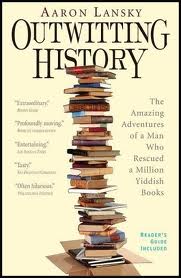
Last week, we spent some time in central Massachusetts–we wanted to buy t-shirts at Hampshire College, and maybe a few children’s books at the Eric Carle Museum of Picture Book Art. We’ve traveled in this area before. Although we’d noticed the shetl-style architecture of the Yiddish Book Center on the same campus, we never visited. It was a picture-perfect summer day in New England, and the last thing I wanted to do was spend any time indoors, but I inside “just for a few minutes.” I could have spent all day. In fact, I spent the next two days reading Outwitting History, written by Outwitting Historythe center’s founder and leader, Aaron Lansky. The book’s subtitle provides only a glimpse of what Lansky, and the Center, has accomplished, and will do: ‘The Amazing Adventures of a Man Who Rescued a Million Jewish Books.’

Much of the book is devoted to Lansky, his friends, co-workers, and friends collecting the inheritance–the books collected by Jews who had brought their culture from Eastern Europe, and other places, often overcoming obstacles before they landed in their small apartment in Brooklyn, the Bronx or New Jersey. Getting to know these people one by one, Lansky would load his rented truck with shopping bags and cartons of books, often from people whose next step was a retirement home. Just about every visit came with an obligatory range of dishes “cooked special for you” so “you shouldn’t be hungry.” In a typical spread, there would be onion bagels and lox, kasha varnishkes, potato latkes, and lokshn kugl (noodle pudding), plus herring, chopped liver, and other traditional dishes. And conversation. Lots of lots of stories, one about every book, the times, the culture, the memories. In time, Lansky learned to travel as one of a team of three people: “two do do the shlepping and the third to be the Designated Eater. the latter was the really hard job. While the others carried boxes, you had to sit with the host at the kitchen table, listening to stories, sipping endless glasses of tea, and valiently working your way through a week’s worth of dishes cooked ‘special’ just for you…”

Over two decades or so, Lansky and his colleagues accomplished the impossible–they collected a million copies of Yiddish books. The best ones are now safer than they have ever been; they’re housed in a carved-out mountain that was built as a military facility (remarkably, it’s less than a mile from their Hadley, Massachusetts headquarters). The Center has supplied about 500 university and research libraries with Yiddish book collections (before the Center, only six such collections existed anywhere in North America). If you’re in the area–between Amherst and Northampton, Massachusetts–you can look at any of thousands of books, and you can buy most of them (there are more than enough extra copies around). Some titles are Yiddish translations of popular works by Shakespeare, Hemingway, Poe, Dickinson, and other popular writers. Many are original Yiddish works of fiction, plays, poetry, history books, cookbooks, children’s books, and more. And if you can’t make your way to Massachusetts, you can visit the Steven Spielberg Digital Yiddish Library, an online collection of more than 10,000 Yiddish titles, with each book page scanned (most of the original books were published on pulp paper, and some tend to disintegrate with each page turn, so digital technology saved the day).

New Yiddish Library's most recent title: Moshe Kulbak's The Zelmenyaners, translated by Hillel Halkin. One of the great comic novels of the twentieth century, The Zelmenyaners describes the travails of a Jewish family in Minsk that is torn asunder by the new Soviet reality.

New Yiddish Library’s most recent title: Moshe Kulbak’s The Zelmenyaners, translated by Hillel Halkin. One of the great comic novels of the twentieth century, The Zelmenyaners describes the travails of a Jewish family in Minsk that is torn asunder by the new Soviet reality.

There is, of course, one problem. The books are written in Yiddish, and must be read in the original language. The Center has a deal with Yale University Press, and some titles are now available in English translation, in book form. More are on the way, but this solution is a minor one.

The major one, of course, is that role of Yiddish has changed, and the people who knew, know, and can claim literacy in Yiddish has been greatly diminished. At one time, more than eleven million people spoke, read, and communicated in Yiddish. That time was 1939, a year before the devastation by the Nazis, and a decade before the the shift into modern times, suburbia, and beginning the end of the old Jewish neighborhoods that once defined so much of New York City, Philadelphia, Baltimore, Boston, Chicago, and other cities where Yiddish was common currency.

When Lansky was a graduate student in search of a few Yiddish books for graduate school, when he traveled by truck to collect books from crumbling old publishing warehouses and Jewish community centers in the neighborhoods where many Jews once lived, his focus was saving books. Now, the agenda for the Center is even more compelling: books continue to arrive, but the people who can translate them, with appropriate cultural context, are few. It’s one thing to translate the words, quite another to present the story in ways that are both true to the original sensibility and sufficiently interesting to contemporary readers. Yiddish was always a people’s language, informal and spoken at home, never the official language of state affairs or religious ceremonies. As Lansky points out, time and again, all of his scholarship, all of the scholarship gathered by his many friends and associates, all of it pales in comparison with the ninety-year-old man who is sitting in his small Newark apartment, sharing tea and Entenmann’s crumb cake, shopping bag full of books at his side, ready to part with his lifetime of favorite Yiddish novels, books he loves because they were so much a part of his life.

His books are safe now. They will be treated with loving care. They will find a new home. Some will be translated into English so that even those of us who cannot read Yiddish can understand the basics of what they have to say. The work will be done by human translators, and in time, perhaps, by digital translators, too. The love, the sense of what the world was like, the passion, the feeling for the characters and situations created by the great Yiddish writers, poets, playwrights, stage performers, radio performers, singers, these will be more difficult to capture and store inside a mountain in Massachusetts.

yiddish-book-shelvesAt the very least, Lansky, his friends, his co-conspirators, the Center’s network of scholars and friends and donors, the network of zammlers (two hundred people who collect books worldwide for the Center) have taken the first step. We now have the books, and nobody is going to take them away from us. And they’ve taken the second step: the books are now available, through various re-disribution schemes, to people everywhere. The third step is the mind-bender. How to republish the works, maintaining the integrity and magic of their original words and ideas in a world where (a) the whole book publishing industry is trying to figure out its digital future and path to thrival (my made-up word that goes beyond survival into thriving); (b) few people read Yiddish; (c) Yiddish culture is becoming  historical fact rather than a cultural reality; and (d) as interested as I may be, I don’t think I have every read a single Yiddish book, and apart from Sholom Alechem (whose work was the basis for Fiddler on the Roof), I don’t think I can name a single Yiddish author.


That will change, of course. Shame on me for missing this part of my cultural education.

Thank you, Norman Temmelman of Atlantic City, Sorell Skolnik of the Mohegan Colony, Mr. Kupferstein, Marjorie Guthrie (Woody’s wife), and Sam and Leah Ostroff, for helping Aaron Lansky. And thank you, Mr. Lansky for opening the door for me. As I read the books, I will pass them along to friends, to my father and my sons, and attempt, in my small way, to be a link in the chain. I suspect there is a Yiddish proverb beneath all of this, or, at least, a few Yiddish words to describe what’s on my mind, but those words are lost to me. Perhaps I will find a few of them along the way.

yiddish-type

Unitasking

With an iPhone in one pocket and an iPad in another, my shoulder bag allows me to work pretty much anywhere. I work in the car (Bluetooth headphone when I’m driving; iPad when my wife drives). I grab a free half-hour and knock items off my OmniFocus master task management system, which syncs, completely and reliably, the lists on my iPhone, iPad, and iMac. I read a lot of books and articles. I suppose my life runs toward busier-than-average. After a vacation week without email, and the use of iPad only to homebrew detours around nasty interstate backups, I’ve given some thought to the clear benefit of unitasking.

My auto-correct just underlined the word “unitasking” because the computer did not recognize it. I checked with Merriam Webster; my search for “unitasking” returned “the word you’ve entered is not in the dictionary.” When I checked “multitasking,” the first sense read: “the concurrent performance of several jobs by a computer” and the second read, “the performance of multiple tasks at one time.”

Google Search: "multitask" returned these and many other images.

Google Search: “multitask” returned these and many other images.

Of course, computers and humans multitask all the time. Computers run multiple operations at high speeds, some simultaneously, some sequentially. As I write, I run my fingers along the keys and press buttons at surprisingly high speeds; I read what I am writing on the screen; and I think ahead to the next few words, and further out, to the next setup for the next idea; I am aware of grammar, clarity, flow and word choices; and I make corrections and adjustments along the way. As I write, I am also aware of the total word count, keeping my statements brief because I am writing for the internet (so far so good–my current word count is 279).

To ease the writing process, I listen to music. For six dollars, I recently purchased a 6-LP box of Bach Cantatas on the excellent Archiv label, and I am becoming familiar with them by playing the music in the background as I write. I do not find this distracting, but the moment the telephone rings when I’m in mid-thought, I become instantly grouchy.

I wonder why.

When I write, I focus on the writing, but writing is not a continuous process as, for example, hiking a mountain might be. I write for a few seconds, perhaps cast a phrase, then pause, listen to the soprano or the horns for a moment, then write a few sentences in burst of energy, then pause again to collect thoughts. I am thinking sequentially, not requiring my brain or body to do several things at one time. So far, this morning, the scheme seems to be working (441 words so far).

Do I multitask?

You betcha, but not when I write because writing requires so much of my focused attention.

Just before vacation, I attended a meeting with two dozen other people, all seated for discussion around a large rectangular hotel conference room in a Chicago airport hotel. Most of the participants were CEOs or people with similar responsibilities. From time to time, half of the people in the room were sufficiently engaged in the discussion to lift their eyes from their iPads (few used computers; most used iPads). Most of the time, just a few people were deeply engaged. Part of the problem: the meeting was similar to the meeting held last summer in the same location discussing the same topics. If there’s low engagement, then the active brain fills-in with activities promising higher degrees of engagement, and the iPad provides an irresistible alternative to real life. Of course, if more of the people looked up from their iPads and engaged in the conversation not-quite-happening in the room where they are seated, it might well be worthy of more of everyone’s attention. This raises the stakes for those who plan such meetings–if the meeting does not offer sufficient nourishment, minds drift.

Once again, that makes me wonder about the value of multitasking. Each of spent a good $1,000 to meet in Chicago, to discuss matters of importance in the company of one another. During the few times when the whole group was fully engaged, the engagement was not the result of multitasking. Instead, there was a single topic presented, and a single, well-managed discussion. In short, we engaged in a unitasking activity.

One final though before we all drift back into our bloated to-do lists. On vacation, I like to read a good story, well-crafted fiction by an author who really knows how to write. This time, I tried Jeffrey Lent’s A Peculiar Grace. Reading in the car, in the hotel room late into the night, whenever a good half hour’s free time presented itself, I found myself thinking about the characters, the story, the setting, the overall feeling of the book, even when I was not reading it. This was accomplished, of course, by the unitasking that a good book demands and deserves.

So why isn’t unitasking in the dictionary? And what do we need to do in order to bring this word into common use, and this way of thinking into common practice?

Thanks, Bill!

GinLane

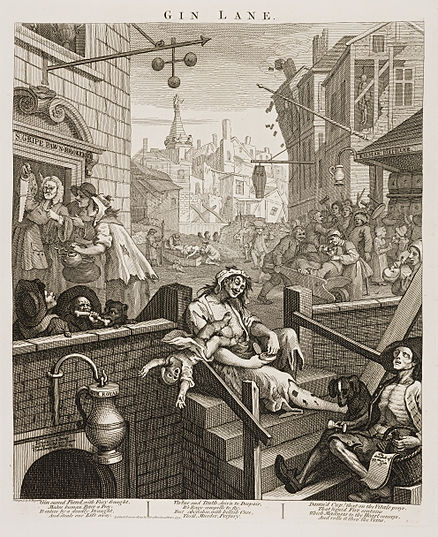
Hogarth worked out every minute detail of even image: the angle of the robe behind the gin-soaked mother so that the eye is draw directly to her head; the leering muncher of the large bone, the position of the pawnbroker’s sign above their heads as a kind of upside down religious symbol; the distant grey of the growing city in which these denizens would never take part; so much more. That was the painter, and illustrator, William Hogarth’s intent: to tell remarkable, compelling stories through a series of images sold in a subscription series. His work was widely pirated.

If Bill Hogarth’s father, Richard, was alive today, he’d probably be writing a blog, cleaning up Wikipedia articles, and spending far too much time watching TED Talks. He was always busy writing what he hoped would be a popular play or a textbook for schoolchildren. As a boy, Bill tagged along with his father as he made the rounds from one coffee house to another, for that’s where the printers tended to meet their clients, customers, and friends. In a word, coffee houses in 1700s London were places to network. In time, Richard Hogarth managed to sell of his manuscripts to a a London printer named Curll; it would become a book that would “bring joy to learning through the playing of games” enabling (a then-radical) idea of learning without the direct assistance of a teacher. With tears of joy in his eyes, Richard Hogarth signed the publishing contract, and that, as would be inevitable in a story of this sort, was his undoing. When Curll demanded money to pay printing costs, Hogarth could not pay the bill, could not fulfill the requirements of a contract that he clearly did not understand. Richard Hogarth was placed in debtor’s prison, a nasty place where bribery could, at least, secure better living quarters for the fledgling author and his small family.

Son William was fortunate to secure an apprenticeship with an engraver, made some contacts, eventually earned some money, and became quite popular as both a painter and a storyteller. His prints, including the one pictured at the top of this article, were published in series, offered by subscription. The originals made money, but they were often copied (pirated) by unscrupulous printers throughout London. As he worked his way up London’s economic and social ladder, William Hogarth became a very popular painter, busy with commissions until the very last years of his long career. Battling syphilis (a very common theme in stories of this era), frequently lusting after young women (especially in his younger years), Hogarth often considered the fate of his father, and devoted much of his life to steering clear of any such problems.

Benefitting from his upscale connections, Hogarth began to pursue a new law, one that would protect creative people from piracy.  At the time, this was extraordinary; in London, and elsewhere, piracy was simply part of the system. Nobody much questioned the many illegal copies of an artist’s work. Printers published whatever they wanted to publish.  Standard business practices were uncommon. An artist who fought the system ran the risk of speaking truth to power, and could well end up in debtor’s prison, or worse (that is,  murders under dark bridges were extremely common at the time).

Hogarth had been painting, on commission, for a Select Committee of Parliament as they investigated gaols (now: “jails”). Hogarth painted the deliberations of the committee, made a friend of Sir Archibald Grant of Monymusk. In time, Hogarth visited the influential man in his home, and over tea and gooseberry tarts, they considered a plan. There was an act of Parliament from Queen Anne’s time that protected writers, so Sir Archibald, in his strong Scots accent, thought aloud:

The connection to the other Act is gud. They like laws that build on other laws.”

Sir Archibald wrote letters to several important people in Parliament. Hogarth hoped that James Oglethorpe would be one of them, but his London home was boarded-up. Sir Archibald explained that Oglethorpe was in the colonies, founding a new one called Georgia. A short time later, Oglethorpe returned, and Hogarth gained his support:

Of course, I’ll support you. The book trade is run by scoundrels and idle incompetents. Always has been, always will be. But we’ll fire a few shots at them, eh, Hogarth?…Show me where to sign!”

Hogarth’s Law eventually passed and became law. Of course, his very next set of prints were his poorest sellers to date–he probably made more money on the previous subscription series, even with the piracy. And then, of course, there was the matter of enforcement of the new law–uneven because there was no system to police the bookseller’s constant practices. Still, times did change, and we benefit from Mr. Hogarth’s good work today.

So: the next time you’re in London, make your way to Leicester Square (Leicester Fields in his day), and take note of the statue of the man who made the world safe for creative professionals.

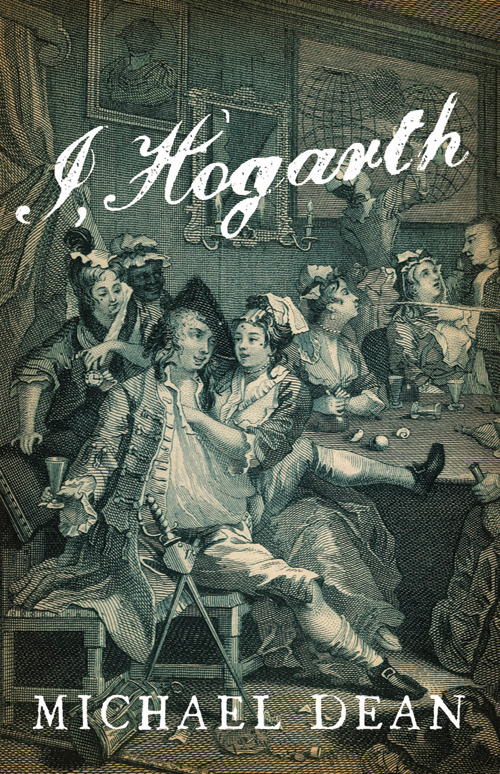
And, if the story intrigues you, pick up a copy of a lovely novelization of his life entitled I, Hogarth by Michael Dean, from which this article is derived. There is much more to Hogarth’s story–a lusty one, in parts–intentionally reminiscent, in its way, of early British novels that were developing at the same time Bill Hogarth was telling his stories in pictures.

I-Hogarth-1-copy

The Big TV, Part Two

Yesterday, I wrote about big TVs in general. Today, it’s the specific–the 60-inch screen that we now watch every day. It’s a Samsung plasma screen with many of the latest features.

The most important feature is, of course, the screen itself. It’s extraordinary. Great color, great detail, wonderful contrast, never a ghost image, rarely any digital lag (sometimes a concern with fast-moving sporting events and slower-moving processors).

Second most important is sound. As I’ve written previously, most large TVs are made with the assumption that an external system will be added. This particular TV is fine, but on some frequencies, there’s a bit of distortion. Doesn’t happen often. Shouldn’t happen at all. A common problem, but it goes away with an external sound system. (Note the loudspeakers below.)

Samsung-2013-interfaceThird most important feature is the interface–the ways that we interact with the TV set. This requires some explanation.

Mostly, we work with two remote controls. One is used to switch the cable channels, a feature we’ve never quite mastered within the Samsung interface, so we simply switch the channel on our original cable remote and put it aside. The main remote is the Samsung, and like most TV remotes, it takes a bit to understand most of the features, and, like most remotes, it contains buttons and features that I will never take the time to comprehend. Mostly, it’s useful for volume up-down, and for maneuvering a cursor around the on-screen interface.

This interface is a point-and-click design, limited in its alphanumeric capabilities. Mostly, we select an app from the Smart TV interface, then scroll through a series of visual menus to find the movie or TV show that we want to watch. There’s an Amazon Prime app that we’ve used to watch every episode of “Arrested Development” at no additional charge, and there’s a Netflix app that we use to watch “House of Cards” and the strange assortment of movies and documentaries that is rich in niche material and (happily!) lacking in major mainstream movies. These work well enough, but everything falls apart with the oh-so-promising YouTube app–no fault of Samsung here, for YouTube develops its own software. It’s one of those circa-1983 interfaces where you must use the up-down-left-right arrows on the remote in order to choose each individual character, each space, each deletion of an error. For YouTube, with its many idiosyncratic titles, it’s simply dreadful.

There are some other useful apps–one to watch TED Talks videos, another to check the weather, another which provides access to what may be the slowest internet web browser I have ever encountered. In truth, these criticisms are beginning to melt away because each year’s models tend to improve upon the (few) weaknesses of predecessors, and here, I’m discussing a 2012 TV set, ancient in current technology terms.

If you look closely at the above picture, you’ll see that the 2013 Samsung interface is clean, easy to use, and features a tremendous number of apps (you can add or delete them at will). You are, of course, looking at the future of TV on this screen. There’s an app for YouTube and CNBC, another for USA Today and TED, one for HBO GO, and one for Netflix. Each of these is an independent experience essentially unaffiliated with Samsung, but it’s all here, all easily accessible in its “am I a TV channel or a web site? glory? There is so much video, so many images, so much text to be read on a screen that offers abundant clarity and contrast. It is now reasonable to read the Sunday paper on your TV set, stopping to check in, via Skype, with relatives calling from far away, checking email, doing all of that. At long last, we have arrived in the future, and so far, it seems to work pretty well. (See my comments about processing power in the yesterday’s post.)

And then, there’s 3D. This mystifies me. Yes, there are 3D glasses. Yes, they feel really silly. Yes, the effect is still that vaguely grainy, slightly out-of-phase experience. No, I have not felt much of a need to watch anything in 3D for anything more than a family demonstration. Maybe some time in the future.

How much does all of this cost? Less than $2,000, even for a larger screen.

So what else is new? The answer is clearly articulated, with only a modest amount of marketing-speak, on this page from Samsung’s website.

The Big TV, Part One

Overwhelming.

That’s the word we used when we first watched a 60-inch television set take over our family room.

No way would this TV set remain in the room. We had made a dreadful mistake. Living with this monster, even for a week, was simply unacceptable.

And then, we watched. Watching favorite movies, we noticed details in the background that we had never seen before. We’d darken the room and the experience felt superior to all but the best motion picture theaters. For the first time, we could clearly read every closed-caption, every sports score. In short, the experience was far better than we could have imagined.

Of course, the 60-inch TV set is not going anywhere. We’ve explored slightly smaller alternatives, but none offers the satisfying experience of the sheer size, scale and impact of the 60-inch screen.

Figuring out which screen type, which manufacturer, which features–all of that was useful research. Here’s the rundown.

Given the choice of plasma or LED technology, my eyes prefer plasma. I find the LED color palette to be too vivid, less lifelike, too difficult to adjust to my liking. Others may feel differently. During the inevitable research phase–which is not easy to do in the likes of Best Buy, but instead, far more successfully done in small, specialist shops because the sets are properly tuned and aren’t fighting big box store lighting–I found myself drawn to the plasma screens. Their reputation for greater power consumption, heat, reflectance and a darker room has proven to be a non-issue in our setup, which is, already, slightly darker than other rooms in the house. We have not noticed any change in our electric bill. If there is any substantial heat being generated, we simply haven’t noticed it.

Once the plasma decision was made, the choice of manufacturer became much easier. There’s a website that keeps up with the somewhat limited plasma industry, and apparently, there are just three companies in the consumer game: Samsung, LG, and Panasonic. The links in the previous sentence turn out to be quite useful. Each of these manufacturers offers their plasma wares in series form: the higher-end series include more features (3D, smart interfaces, etc.) and the lower-end series offer remarkably good image quality but less of the newest technology (improved black levels are a good example of what the higher priced devices offer that the lower priced models do not).

led8000_marquee_bullet1

“Smart TV” brands Samsung’s interface and feature package. Other manufacturers offer a similar suite of enhanced features. Buying a large-screen TV also involves selecting the best feature package for your needs. This can be complicated, but CNET and other specialist websites can simply the process. Often, reliable journalistic websites offer better, more up-to-date advice than you will find in a large retail store. Smaller specialty stores offer a better combination of well-trained sales personnel and a more home-like viewing environment.

In truth, the image quality on all of these plasma television sets is so extraordinary that individual reviews or product tests can describe only incremental differences. The details available on a true HDTV set are extraordinary, and the color rendition, especially on the plasma models, given proper adjustment, are just terrific.

The sound quality is a different matter. This is the one place where the beautiful, giant TV sets fall short. The reason, usually, is speakers that point in the wrong direction (down toward the floor or cabinet, not toward the listener) and are also too smaller to provide the fidelity that should be commensurate with the picture experience. (For more about this, see my previous blog post about audio systems for big screens–some of the specific products may no longer be current, but it’s easy enough to research newer models.)

None of these sets are easy to set up. They are all large, and require great care. A professional installer is recommended, especially for a set as large as 50 or 60 inches (remember, the measurement is on the diagonal). They are very well-made, but you want to be very careful about twisting or torquing the screen (or dropping it!).

Available as an accessory, the Samsung television keyboard serves as both a remote control and an input device with full alphanumeric entry. It also includes a touch pad. When the Bluetooth connection works properly, this is a wonderful addition to a smart television viewing experience.

Available as an accessory, the Samsung television keyboard serves as both a remote control and an input device with full alphanumeric entry. It also includes a touch pad. When the Bluetooth connection works properly, this is a wonderful addition to a smart television viewing experience.

Back to set-up. Each of these sets is a sophisticated computer and a TV set, and each offers a remarkable range of software features. The interface relies upon a fairly traditional TV remote control, and, increasingly, upon a screen interface that is navigated, mostly, by up, down, left and right arrows, or entry of numbers. This is a woefully inadequate way to control a device with so many features.  A touch-pad is a far better idea, and, in fact, a full wireless keyboard is an even better idea–when the Bluetooth feature works well enough to enable flawless communication between the TV set and what amounts to a rather large remote control.

Set-up also requires a level of coordination with other devices, including a DVD player,  an audio system, your wireless network, and, in the most-likely-t0-be-troublesome department, the cable box that is not specifically designed for use with such a modern TV set.

Of course, our original intention was simply to watch TV on a larger, prettier screen. We, like so many other consumers, were so self-assured when we insisted that the extra features were completely unnecessary, not at all interesting. Naturally, we spend nearly all of our viewing time with those special features. For the most part, they are the television equivalent of the iPad’s apps, but in the smart television world of 2013, those apps are, in essence, video-on-demand channels that provide access to a stunning amount of movies, television programs, and much more. These apps are also available on the newest Blu-Ray DVD players, game systems, and on other devices. On TV sets, the critical factor is the computer processing power built into the TV set. As a matter of common practice, TV manufacturers do not provide sufficient processing power to allow the apps to operate quickly and efficiently, so performance is often adequate, but could be so much better with only a small incremental price adjustment. The newer videogame systems offer both the same apps and also the increased processing power. Of course, you can plug any of those systems into the big TV and bypass the built-in apps entirely. Apple TV, which costs $100, serves the same purpose; similar products from Roku are also low-cost solutions.

So what’s it like to watch such a big TV? Stay tuned for tomorrow’s show, er, blog article.

Wallet, Cash, Phone, Keys – What Did I Forget?

OLED technology allows for flexible phone design. For more, click on the link to read a good article in TechWhiz.

OLED technology allows for flexible phone design. For more, click on the link to read a good article in TechWhiz.

It’s 2013. Why are we still asking that question? Why are we still messing around with credit cards and driver’s licenses, house keys and office keys, and so much more. No need. Not any more. It’s time for somebody to invent one slim, pocketable slab that takes care of everything. Here’s my plan. Feel free to patent it and make a fortune. As I’ve thought about this–a perfect thing to do on a rainy Saturday afternoon–I’ve come to realize that the elimination of my wallet may, in fact, provide the necessary tipping point for several large industries.

How big should it be? When cell phones became very popular, the coolest ones, like Motorola’s Razr, were about the size of a credit card, and maybe four times as thick. (I just checked Wikipedia: Razr was about 4 inches high, 2 inches wide, and about a half inch thick; a credit card is about 3 1/4 inches tall.) I think that’s a good basic size because it’s so pocketable.

On one side, I think I’d want a touch-senstive display that could also respond to my voice commands. The display probably uses OLED technology so that it is flexible, and easily expanded or reshaped. On the other, I want solar cells so that I can recharge the phone whenever I am near sunlight.

Pretty much, that’s the design. Add the usual extras: camera lens, flash, microphone (detachable for some advanced Bluetooth use and stow-able within the device so it doesn’t get lost, and can be charged with the unit), speaker, AC adapter of some sort.

Can I leave my wallet and other stuff at home? Or toss it all in the trash?

Yes, but not immediately.

Let me go through my wallet first. Just about everything is associated with data–credit card or debit card, both about to go the way of the drive-in movie theater and the men’s handkerchief. My AAA membership card, health care card, drug card, and public library card can all go away; they are nothing more than physical manifestations of an account number. Pictures of my dog, and, oh right, my family, all are printed versions of digital images.  Okay, fine, I no longer need the wallet. Except for the part that, so far, Google has not been able to build a viable digital wallet business–and neither has anyone else. (The reasons: lack of public acceptance for Near Field technology [NFC], and the control exercised by the credit card companies.)

How about cash? Really, I use it only at the local farmer’s market or for a quick slice of pizza. If everybody else is using data instead of cash, I will too. So let’s just make the decision, together: no more cash or coins!

Presumably, the phone is the easiest one to eliminate. Do I need a separate wallet and phone? Nope. If I can combine a phone and a camera and an email system and VPN access, I can certainly live without a standalone phone. Gone!

Keys! There’s the problem. Yes, I have a digital key to my office. It’s the smallest thing on my keychain. Car keys are already digital, but they still resemble keys. A truly reliable digital lock, sufficiently inexpensive to serve consumer needs, remains just a few steps in the future. Recently, Gizmodo reported on a company called SmartLocks: “August is the lock that requires no key, only an invitation…” The video, below, lays out the plan.

For those who travel often, the old concept of a Passport that’s the size of an old savings passbook needs some rethinking. It should be digital, but that probably introduces all sorts of opportunities for bad guys. (Though it’s difficult to imagine how a larger vs. smaller passport would matter much.)

So what are we missing? Real-world stuff, I suppose. A few weeks back, I wrote about the real world (fun to do that, from time to time, on a blog that’s called Digital Insider) and explored the usefulness of multi-tools. It turned out to be my most popular blog article of all time, so I’m pretty sure we’ll keep those around for awhile. Which means we will still require pockets, or belt loops, or some other way to carry stuff around.

Still, wouldn’t it be nice, just once, to leave the house without asking the dog, “do you have any idea where I put my keys?” Assuming the dog’s chip is working properly (let’s assume every dog would have one; many already do), he or she would simply cause your phone to ring, which would allow you to grab your keys and your money and your flashlight and your phone on the way to the veterinarian’s office. To which the dog might bark–“aren’t you forgetting something?”