Did you hear what I said?

Here’s what I want from a Bluetooth headset: (a) you can hear me, (b) I can hear you, and (c) hassle-free phone pairing. For those of us who rely upon these devices, it’s tough to find happiness. And, it’s difficult to comprehend the experience of the other person on the line, the one who is supposedly listening to the conversation. It’s on item (a) that many headsets fall below expectations, but unless you ask, you have no way of knowing what the other person is (not) hearing.

I decided to experiment with two of the most highly-rated  Bluetooth devices.

Blue Ant's Q2 looks great in any color. It's small, well-designed, and sounded good to me.

Sure enough, I fell in love with its small size and wonderful incoming sound quality of the nifty Blue Ant Q2. Pairing with my iPhone: easy. Noise cancellation: in theory, great, in practice, not so great (even a gentle breeze was a problem). Fit and style: terrific; the device just hooks over the ear and looks sleek. Little button to press when making or receiving a call: sometimes, a bit hard to find, but okay with practice. Several voice control features added to a positive experience: terrific! I can ask the phone, “am I connected?” or to “redial” or to repeat all available menu commands. Finally, here’s a smart device that sounds good, looks good, and works properly. Or so  my great expectations imagined.

When I started asking people how I sounded, the comments were, at best, noncommittal and often, negative. Most often, I was told that the sound was “a little weak” and that they were hearing “some but not all of the words” and that they heard “a lot of background noise.” The more negative comments I heard, the more I experimented–trying different locations, different phones, interior, exterior, quiet, slightly breezy, in cars and trains, out walking the dog, etc. No change in the comments I received.

Since I could hear the other person so clearly, at first, I questioned the other person’s phone system, ears, sanity, whether they were using an inadequate phone or earpiece on their end, and so on. More than a month’s calls led me to the sad conclusion: although I could hear the other person, they could not hear me, not clearly, and, often, not completely.

So, I continued my Goldilocks routine by returning to an headset I had used before with some complaints. I liked the clunky big-battery-behind-the-ear, big-boom-microphone Plantronics PRO when I owned a previous model, but the incoming volume was unacceptably low. For most of February, I’ve been using the newer PRO HD, and found two improvements much to my liking. The first improvement is a better incoming sound system: every call is loud enough, and every call is clear. The second: I like the sensor that tells the headset when it is actually on my ear (if it’s not on my ear, it won’t take the call; if it is on my ear, it will answer calls automatically without requiring me to press a button).

Of course, the big test is not what I can hear, but what you can hear when you call me. I was really hoping for good results on that score–and sure enough, the PRO HD came through. Several people asked me whether I was actually on a headset because the sound was so clear. So far, not one person has complained about sound quality. For me, that’s extraordinary; I’ve been hearing complaints about my Bluetooth headsets for years.

Wind noise? Yeah, that’s still there. Better than the Blue Ant Q2, but a breezy day is a problem for an exposed microphone. On the Pro HD, the boom microphone is long and large enough to accept the equivalent of the wind muffle that location video shooters use–a soft furry condom to catch the wind–maybe that teeny accessory is on its way? And while we’re on the topic of accessories, even the PRO HD is really small, and really easy to lose. I sure wish Plantronics would develop some sort of carry-everywhere accessory to minimize the loss of its $100 device (so far, I’ve lost two of them).

This blog post is already on the long side. I’ll review Blue Ant’s Q4 speakerphone in a separate article.

Links:

Blue Ant Q2

Plantronics PRO HD

A clear explanation of the TV spectrum auction

http://a.tiles.mapbox.com/v3/fcc.Unavail_20111007_2/mm/legend,zoompan,tooltips,zoomwheel,zoombox,attribution,bwdetect,share.html#6/37/-96

Congress has approved a law that Obama will likely sign. That’s the first step in a long, complicated process. A national plan would be a good idea, but this adventure may take shape market-by-market, station-by-station instead.

What does this mean for the American people? Well, it’s probably the beginning of the end of broadcast television. If the FCC and lawmakers work together, they can probably construct a sensible transition to a robust IPTV-based system. Along the way, they must address the significant public interest concern of free access to information. The version of the future in which Comcast, Verizon and (probably) Google control all information is probably not in our best interests, but their investments are probably required to make ubiquitous broadband multimedia a reality. The alternative more closely resembles the information superhighway (remember the term?) version of the interstate highway system. This is not the way most people are thinking, but strong arguments will move in this direction, and soon.

Here’s the article as it appeared on February 17, 2012 in TVNewsCheck (link at end of article). It’s called Incentive Auction Headed for Obama’s Desk, and it was written by Kim McAvoy.

—–

After more than two years of political wrangling, Congress on Friday signed off on legislation authorizing the FCC to conduct an incentive auction of broadcast TV spectrum.

The measure is contained in a major legislative package that would extend payroll tax cuts and unemployment benefits.

Both the House and Senate approved the package, which now goes to President Obama, who is expected to quickly sign it into law.

The legislation permits the FCC to hold auctions and share the proceeds of them with broadcasters that voluntarily relinquish their spectrum.

However, for TV broadcasters who chose not to give up their spectrum, the measure contains safeguards against their suffering any loss of service.

Before the FCC conducts an auction, it has much to do. Implementing the law could take as many as three separate rulemakings. Some believe it could take five to 10 years to get to get to an auction.

A key element of the FCC’s March 2010 National Broadband Plan, the incentive auction is a mechanism by which the FCC hopes to reallocate up to 120 MHz of spectrum from TV to wireless broadband carriers.

The NBP believes the reallocation is necessary to meet what it believes will be a severe shortage of broadband spectrum as more and more Americans use smartphones, tablets and other mobile devices to access the Internet on the go.

The incentive auction language in the spending package is based on legislation authored by House Communications Subcommittee Chairman Greg Walden (R-Ore.) and has the backing of the National Association of Broadcasters.

NAB has been pushing hard for specific safeguards fearing that the FCC’s incentive auctions might damage the broadcasting business.

Among the key provisions is a requirement that the commission make “all reasonable efforts’’ to preserve … the  coverage area and “population served’’ of broadcasters who don’t participate in the incentive auction.

For local TV broadcasters, it is paramount that any legislation guarantee that their service areas will remain unaffected by the channel reassignments or “repacking” that will occur as a result of the auction.

Broadcasters are also pleased that the legislation would set aside $1.75 billion to compensate TV stations (and cable operators) for costs associated with repacking — the wholesale switching of channels that would occur after the FCC identifies the spectrum it will have to auction and consolidates it into large swatches that can be more easily auctioned.

Originally, Walden’s bill allocated $3 billion to a relocation fund, but House Democrats complained about the amount and argued that the fund should be only $1billion as recommended by the Congressional Budget Office.

The legislation also makes it easier for those broadcasters that are thinking about leasing excess spectrum to wireless carriers. According to the legislation, in lieu of reimbursing stations for the costs of repacking, the FCC may grant stations waivers to use some of their spectrum for services other than broadcasting. Such a waiver would remain in effect only while the licensee provides at least one free, over-the-air television program stream.

The measure also prevents the FCC from moving stations from a UHF channel to a VHF channel or from a high VHF channel to a low VHF channel.

And it makes clear that this is a one-time auction with a 10-year sunset on the FCC’s authority to repurpose broadcast spectrum.

Under the legislation, only full-power TV stations and Class A low-power stations can participate in the incentive auction.

It states that the FCC must use a “reverse auction system’’ as a means to establish a price at which TV stations would give up their license and then conduct a “forward auction’’ of the TV spectrum.

Most important, if the proceeds are insufficient to cover the incentive payments and relocation costs, the auction fails. And stations that participate in a channel-sharing arrangement retain must-carry rights.

NAB is also pleased about the provisions directing the FCC to address issues that could affect TV stations with service areas bordering Canada and Mexico before it relocates those broadcasters to another channel.

Those provisions were authored by Reps. John Dingell (D- Mich.) and Brian Bilbray (R- Calif.).

There is also language in the measure that allows an unhappy broadcaster that is being displaced by the incentive auction, or any interested party, with the right to go directly to court.

“The bottom line is, instead of protesting a license modification at the commission first, you could go to court,” says a source familiar with the legislation.

Although broadcasters would get a cut of the incentive auction proceeds, the bill intends for most of the revenue to go to the federal treasury and to help fund a nationwide communications network for first responders.

The CBO is estimating that $15.2 billion will be raised by the incentive auction.

House Republicans wanted to include the auction language in the payroll bill as way to help cover the costs associated with extending those tax breaks.

Overall, the measure was being hailed on and off Capitol Hill.

“We struck a fine balance to make more efficient use of the airwaves while also providing necessary protections for broadcasters,” said a statement released by Chairman Walden and House Commerce Committee Chairman Fred Upton (R-Mich.).

NAB President Gordon Smith said: “NAB salutes the tireless efforts of Congress to ensure that local broadcasters have a vibrant and robust future.’’

Smith applauded the efforts of  Chairmen Upton and Walden “for steering this bill to conclusion, and … Reps. Dingell and Bilbray for a critically important amendment guaranteeing continued viewer access to TV station signals along the Canadian and Mexican borders.’’

Over at the FCC, Chairman Julius Genachowski was also pleased with the news of impending congressional action on the incentive auction proposal. The FCC chairman has been a chief proponent of the incentive auctions, believing that TV spectrum is underutilized and would be put to better use for wireless broadband services.

“I’m pleased that Congress has recognized the vital importance of freeing up more spectrum for mobile broadband, both licensed and unlicensed, although the legislation could limit the FCC’s ability to maximize the amount and benefits of recovered spectrum,” Genachowski said.

The wireless industry, which has been leading the charge on Capitol Hill to get the incentive auction bill passed, called today’s vote “a resounding victory for consumers and the American economy,’’ in a statement from CTIA-The Wireless Association President Steve Largent.

“Making spectrum available will make it possible for America’s wireless carriers to offer consumers better, faster, more ubiquitous wireless broadband service,” Largent added. “The release of additional spectrum also will spur the investment and job creation that our economy needs.”

Vinyl for sale


As LPs continue to gain popularity, here’s a list of stores that sell used LPs. Fair prices (mostly, around $5, some as low as $1-2, as high as $7-8). Very good to excellent condition (free from noisy scratches, sometimes, a nice sheen). Jacket with significant rips, marks or other degradation. Check your local yellow pages–most urban areas support at least one good used record store. Please comment additions or corrections, and I will update the list from time to time.

Some favorites and recommendations I have not yet visited. Some of these stores stock only vinyl, and some mix it up with CDs:

Princeton Record Exchange – Princeton, NJ

The Bop Shop – Rochester, NY

Record Archive – Rochester, NY

Siren Records – Doylestown, PA (near Philadelphia)

Jerry’s Records Pittsburgh, PA

Stereo Jack’s – Cambridge, MA

Bull Moose Records – Portsmouth, NH

The Sound Garden – Baltimore, MD

Encore Recordings – Ann Arbor, MI

Grimey’s New and Preloved Music – Nashville, TN

Waterloo Records – Austin, TX

Dave’s Records – Chicago, IL

Twist & Shout – Denver, CO

Music Millennium – Portland, OR

Amoeba Music – Berkeley, CA, and both San Francisco and Los Angeles (I haven’t been there in a few years– are the prices still reasonable?)

Jive Time Records – Seattle, WA

One good web source for new vinyl:

Soundstage Direct

Not White

When Mike Nichols was directing the Broadway musical, Annie, one scene that was supposed to be funny was failing to get laughs. He tried everything. Nothing worked. The audience watched the scene, but didn’t laugh. So, Nichols asked a fellow director, Jerome Robbins, to take a look. Then, Nichols asked Robbins how to fix the scene. Robbins pointed to a white towel hanging on the back of the set.

“The towel should be yellow,” Robbins explained.

“That’s it? That will make the scene work?” Nichols thought, but did not say aloud.

Nichols changed the towel. From then on, the scene got laughs.

When it comes to creativity, everything is subjective. Except when it isn’t.

(From The Creative Habit by Twyla Tharp)

(Almost) Paperless Office

I’m not 100%, but I’m close. My working life is now mostly on-screen. And, as of yesterday, there’s no longer a five-inch stack of business cards on my desk.

Truly, I don’t use my full-sized color laser printer more than once a month. I carry around very few file folders, often, none at all. Just about everything is digital, easy to find, easy to search, Dropbox-able and email-able.

The biz cards presented a conundrum. This stack from a trade show, that one from four years of office meetings. My old systems–looseleaf notebooks with plastic insert pages, and a desktop filebox–were overwhelmed.

So I took the ultimate step: scanning business cards into some sort of database (in my case, Bento).

It worked. Not perfectly, but well enough to rate a good solid B-plus.

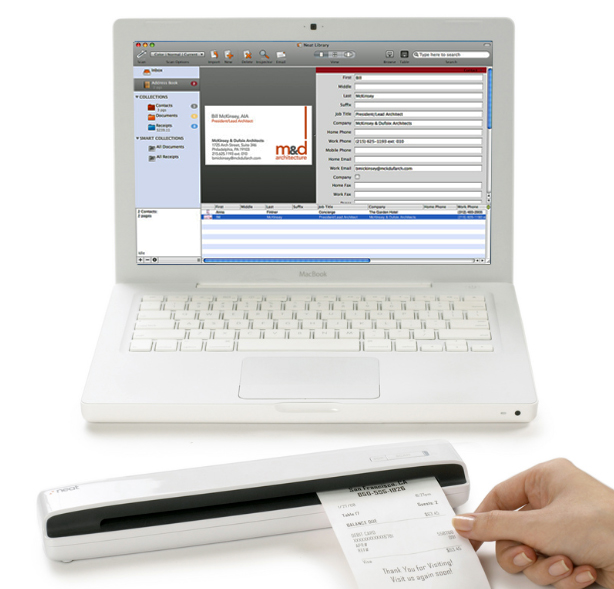
There are several available systems. I used the Neat Receipts Mobile Scanner for Mac. The scanner is about nine inches wide, maybe an inch high and two inches wide. There’s a large open slot that can be used to scan 8.5 x 11 pages (a nice convenience), receipts (hence the product name), and, for me, business cards. Each card is individually placed into the slot, and there’s a button marked “scan”–easy enough. I had some trouble because I connected the mini-USB cable to my Mac keyboard; the scanner requires more power than the keyboard can provide, so it must be plugged directly into the computer (an inconvenience).

The software grabs the image, quickly implements an OCR run (Optical Character Recognition), and places each bit of information in an appropriate field in its database. For some cards, the OCR does a perfect job. Usually, there are a few missteps, easily corrected because (a) the card is displayed alongside the database record, and (b) just about any item on the card can be manually dragged (and re-recognized) into your choice of database fields.

My several work sessions were amazingly productive–for three reasons. First, I was able to scan several inches of cards into the database in just a few hours (including my output from the Neat database to my Bento database). Second, the process itself required me to edit the batch of cards, to throw some of them away. Third, as soon as some cards were scanned, I copied the information and wrote a re-introduction email (“Hi, we met in 2008, thought I’d get back in touch…”)

And, perhaps best of all, I’m no longer accumulating random business cards in rubber-banded piles. Now, as soon as I collect a few cards, I scan them into the database.

Oh–one more note–if a business card presents a hyperactive multi-color design, don’t bother scanning because Neat will become completely flustered. Just type the information into the database.

Again, I’m not 100%, but the combination of hardware, software, and a new compulsion keep everything in order gets me closer to a 21st century workflow.

Corning’s Clear View of the Future

Interesting concept video by Corning Glass.

Boring? Yeah, that’s what I thought, too. I was wrong.

Turns out, screens are / will be everywhere. And, Corning knows that those screens will be made of… you guessed it.

Nielsen: TV isn’t changing so quickly, after all

Traditional television viewing completely dominates viewing habits. New behaviors are evident, but they are slowly shifting the landscape.

The latest from Nielsen’s periodic Cross Platform Report (formerly, the Three-Screen Report):

90% of US households subscribe to cable, satellite and similar television services. This number is NOT dropping. It is stable.

75% of US households pay for a broadband connection.

5% are “broadcast/broadband households” – that is, they do not subscribe to cable or satellite services, instead watching either broadcast channels and internet video (and, presumably, a lot of DVDs from Netflix). This group is growing. In comparison with Q3 2010, there are 23% more today. It’s still a very small portion of US households.

81 million US households pay for cable plus broadband.

22 million US households subscribe to cable or satellite, but not to broadband.

Looking at the total population, we’re still watching about 35 hours of television per week–still an astonishing 7 hours per day (do you actually know anybody who watches 7 hours of television a day–I know one person, but she’s pretty much housebound). About 2 of those hours are recorded on a DVR or VCR. Compare that with just 4 weekly hours of internet use (really? most people I know use the internet a whole lot more than 4 hours a week). How much internet TV viewing? About a half hour per week (seems about right to me).

Yes, there are generational differences, but the swings are not huge. Adults 18-24 watch 25 hours of television per week–over 3 hours a day. And they watch about 45 minutes of internet video. People 50+ watch about 45 hours per week, actually about twice as much TV as those 18-24. Teens 12-17 behave very much like the 18-24 crowd, but teens watch about a third less internet video than the college and post-college crowd.

Or, so Nielsen claims. Although Nielsen presents itself as the authority on television viewing, nowhere in the report is the survey base explained–no numbers of people or households surveyed, no demographic breakdown, no description of the sample used. Remember: Nielsen’s work is based upon surveys and samples–that is, Nielsen uses one household to represent perhaps 5,000 households. Of course, Nielsen claims that over time, the households come and go, but the survey results are very consistent. Look closer and examine Nielsen’s base–not all age groups, not all communities, not all zip codes, not all household incomes or ethnicities are measured.

Is something changing? Of course–everything is changing in every possible direction. Babies born in 2010 and baby boomers born in 1950 are watching “TV” on iPads and phones. Movies are available through so many sources, but these viewing habits aren’t really captured in Nielsen’s survey. Neither are videogames. So what we have here is a somewhat unreliable, but perhaps directional, study of a particular (though undefined) population of viewers who may or may not be evenly sampled or represented. A healthy skepticism of anything published by Nielsen should be part of any critical thinking exercise related to media and its transformation.

Nielsen-Cross-Platform-Report-Q3-2011

You Bought the Camera. Now Buy the Book.

You spend $300, maybe $400, on a feature-rich digital camera. You start by shooting in automatic mode, then experiment with aperture or shutter priority, white balance, low light shooting and maybe a few special effects.

You want to understand image manipulation, image processing, image retouching, but these are not easy to learn, and they are difficult to master.

There’s a large gap between (a) what today’s cameras and software can do, and (b) our understanding of these features and how to use them.

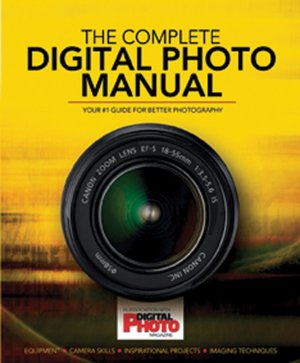
After a Goldilocks routine (too artsy, too techy, etc), I found a wonderful guide in The Complete Digital Photo Manual. Just the right balance for me–written in plain language with lots of helpful diagrams and photographs.

The book begins with an illustrated section about compact cameras–higher end models like Canon’s G10, cameras built for extreme conditions, super zooms–followed by a walk through various types of DSLR cameras and the most common features. There’s an important sidebar about image sensors. Then, it’s on to a similar section about lenses.

Next, the book explains how to set up the camera, explaining each of the features commonly offered on digital camera menus. The are good, clear explanations about metering patterns and histograms, white balance and image sharpness.

And then, about 1/3 of the way through the book, comes the best stuff. Every significant Photoshop tool and menu item is simply explained, often with step-by-step diagrams and abundant examples and illustrations. Two-page spreads include Hue/Saturation, clone Stamp and Healing Brush, Layer Masks, Channels, Hand Coloring, and more.

Then, there’s another group of spreads offering specific direction to, for example, Replace a Boring Sky, Blur Waves with a Long Exposure, lots more.

The last of the truly helpful sections explains how to make good use of RAW images, a feature viable on most serious cameras.

The Complete Digital Photo Manual was produced in association with England’s Digital Photo Magazine.

The book costs less than $25 at Barnes & Noble (and other fine retailers). Think about it: you spent how much on the digital camera? Why wouldn’t you make this investment?

The Ultimate Road Trip

It’s the biggest thing we’ve ever built–bigger than the pyramids of Egypt, about a hundred times as long as the Panama Canal, easily eight times the length of The Great Wall of China. It’s newer, too. And, soon, we’ll probably build it all over again.

As Earl Swift explains in The Big Roads: The Untold Stories of the Engineers, Visionaries and Trailblazers Who Created the American Superhighways, the U.S. interstate highway system is forty-seven thousand miles long, and it is the “greatest public works project in history.”

Messy as our current dilemma about infrastructure may seem, life was worse before the interstates, before modern roads. In the good old days, New York City’s horses output 2.5 million pounds of manure every day, plus 60 thousand pounds of urine. In 1893, the agriculture department got things rolling with a new Office of Road Inquiry, whose boss, a Civil War veteran, declared Americans “have the worst roads in the civilized world.” Still, intrepid automobiling pioneers attempted a cross-country race in 1903 (one car included a dog, Bud, who wore goggles and “became a hit in every town they visited.”) This was the beginning of an industry, complete with sales stunts on a grand scale: Carl Fisher, whose early days were consistently colorful (and completely crazy), “rigged a Stoddard-Dayton roadster to a massive balloon and flew it over Indianapolis, vowing to drive it back into town from wherever he landed.” (Actually, Fisher stripped the floating car and drove home in a look-a-like spare). Not long after, Fisher partnered with two other car crazy businessmen  and built the Indianapolis Speedway. Fisher was among the first to campaign for a big interstate highway system.

A half-century later, in 1956, “nearly $2.6 billion had been committed to the work… contracts had been awarded on more than a thousand bridges… construction was under way or about to begin on nearly two thousand miles of highway.” Half the book is about the wrangling, the engineering and politics, the slowdowns due to the Great Depression and World War II, and all sorts of rational and irrational arguments about the nature of the undertaking, the roles of the states versus the Federal government, the best ways to pay (tolls? gas tax? Federal funds? State funds?), and much more. In fact, the weakest part of the book attempts to describe this wrangling–Swift (great name for the author of a book about fast highways, BTW) does his to craft a story from his astonishing collection of arcane research. With Detroit pumping out over 5 million cars per year (1 in 3.5 citizens owned a car), America had a mess on its hands. Far too many cars driving on roads that were designed decades earlier. Trucks made the situation worse, both by contributing to congestion and also by damaging roads never built for a big truck’s combination of weight and speed. “Snarls at New York’s George Washington Bridge were traced back eighty-four miles–seriously, eight-four miles–to Monticello, New York.”

Even in these early stages, Swift explains that the highway system had its critics: Lewis Mumford published articles and books about the loss of city neighborhoods, and the economic destruction of towns and villages across the nation. By the 1960s, the environment movement gradually imposed restrictions on engineers who were once able to construct interstate highways pretty much anywhere, regardless of impact on animals, ecosystems, even city parks. Several Baltimore neighborhoods fought tremendous battles, and today, there is no interstate highway system cutting across Baltimore–the local activists won their battle. Visitors to Baltimore’s lovely old Fell’s Point neighborhood can thank those activists–if the interstate was built as planned, that neighborhood would be gone.

Swift goes on the record to give credit where it’s due, often to government functionaries who exceeded the call of duty, but his writing is far more interesting when he’s on the road himself, or when he’s telling the (too-brief) stories of how Howard Johnson’s or other roadside co-conspirators grew to be a part of American life on the road.

What’s more, I wish he had told us more about the next fifty years, or perhaps, the next twenty. Apparently, the interstate highway system was built for about a half century’s useful life. It has not been properly maintained. As the most dedicated of the government figures, Frank Turner, pointed out, “Highways grow old and wear out at a fairly predictable ages and lifespans, and therefore must be replaced or restored.”

Swift explains, “One federal study suggested that all levels of government should spend a combined $225 billion a year for the next fifty years to rehabilitate surface transportation…they’re currently spending just 40 percent of that, in a country that does 96 percent of its traveling by car and truck.”

So begins a brief discussion about dedicated truck lanes, alternative fuels and other incremental improvements. The bigger question is potentially world-changing and certainly mind-bending, so I offer it as the basis for Swift’s next book. A century ago, visionaries came up with the idea of cars (and trucks), and then, a connected interstate highway system to move people and goods in a safe, reliable, cost-effective way. By the time the interstate highway system was completed in the late 1960s, most of those people were either gone or too old to drive. Given the astonishing public good, the modernization of America, and the tremendous downside associated with our current system, I wish Swift would encourage a discussion so we can decide whether to, and how to:

(a) spend another $11 trillion ($225 x 50 years) to fix and upgrade a highway system conceived before television, McDonalds, cell phones, FedEx or the internet, or

(b) come up with an equally bold conception of transportation that could sustain us until, say, 2112?

Here’s the photo of author Earl Swift as published on the literary festival’s website.

Looks like a strange, unimaginable number, that 2112, but in 1912, when Fisher and his friends were tooling around Indianapolis in their early model cars, 2012 must have seemed as far away, and as impossible, as a 47,000 mile highway system connecting every city and town in what is now called the lower 48 states.

BTW: In researching the author, I found this impressive bit about his interests: “An avid outdoorsman, Swift has through-hiked the Appalachian Trail, circumnavigated the Chesapeake Bay by sea kayak, and traveled the 435-mile length of the James River by foot, canoe, and kayak.” I found it here.

The Big Roads was published in 2011 by Houghton Mifflin Harcourt.

Buy it from Powell’s Books.

A Go-Everywhere iPad/Android Keyboard

Competing against nothing is not easy. Every iPad and every Android tablet comes with an on-screen keyboard that costs nothing and weighs nothing. In fact, I am using one right now. It’s fine for short documents with no formatting, but I prefer a proper keyboard for longer writing sessions.

I use the Apple wireless keyboard that came with my iMac (I use a wired keyboard on my desk, so this one was a spare. I invested in a durable slipcase from www.sfbags.comfor $29. and I carry an extra pair of AA batteries, just in case the Bluetooth eats too much power. Mostly, it works as well as any Bluetooth device. It’s a bit taller than the iPad, but then, it is a full-sized computer keyboard. Weight of keyboard, case and two sets of batteries: one pound. I do not carry it everywhere.

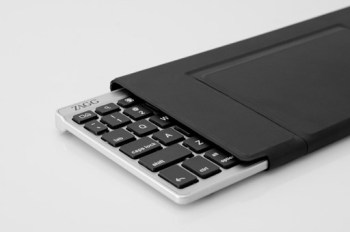
The new ZAGGKeys FLEX is about 3/4 as long as the Apple keyboard, so the keys are closer together. It weighs about 3/4 of a pound, but it is much more compact. Power is provided via USB, not AA cells. Special buttons on the keyboard are used for undo, cut, paste, and search. The keyboard easily switches from Apple to Android mode. One button pairs the keyboard to either device.

The niftiest part is the stand that doubles as the case. It’s lightweight and very stable–more firm that Apple’s magnetic iPad cover.

The keyboard is a little clunky and a little noisy–convenient but Apple’s keyboard is both elegant and silent.

Cost: Apple wireless keyboard ($69) + SF bags slipcase ($29) + a year’s batteries = $100.

Cost: ZAGGKeys FLEX: about $80.

At the recent Consumer Electronics Show, there were dozens of iPad accessory-makers on the show floor. I like ZAGG–they seem to come up with clever solutions. Here, they’ve got a good idea, but $20 and a quarter pound are not enough to overcome the significant quality advantage of the Apple / SF Bags solution.