What’s News?

Photo by Norbert Nagel, Mörfelden-Walldorf, Germany via Wikipedia –Creative Commons Attribution-Share Alike 3.0 Unported license.

When a dog bites a man that is not news, but when a man bites a dog that is news.
Charles Anderson Dana, American journalist, 1819-1897

News is what somebody somewhere wants to suppress; all the rest is advertising.
Lord Northcliffe, British publisher 1865-1922

Okay, that’s a good start. We define news as information that is (i) novel, and (ii) potentially disruptive. A more modern journalist broadens the definition to its breaking point:

Well, news is anything that’s interesting, that relates to what’s happening in the world, what’s happening in areas of the culture that would be of interest to your audience.
Kurt Loder, American journalist, b. 1945

So I guess (iii) is, pretty much, anything at all.

Right now (8:48PM on the east coast of the US on Thursday, September 27, 2012), top news stories include:

  • A Florida woman who lost her leg to an alligator
  • A dog who is the only full-time employee (?)  of a New Mexico police force
  • Israeli Prime Minister Netanyahu’s United Nations speech about Iran
  • The launch of a new Facebook service that allows users to send gifts
  • An office shooting in Minnesota in which two people where killed
  • Curiosity, the Mars Rover, finding an ancient stream
  • The imminent opening of the opera La Boheme in Philadelphia

Obviously, these stories represent a small sampling of the day’s news. Most of the stories are (i) novel because they don’t happen every day; but few are (ii) potentially disruptive in a meaningful way. And, per Kurt Loder’s definition, just about all of this would amuse an audience (particularly, and sadly, the alligator story). And that may the point: news as entertainment. Maybe a higher standard is unreasonable, and perhaps, undesirable, but just the same, let’s give the higher standard a try.

So about that alligator story…How many alligator-related accidents occur each year? Turns out, this woman was 84 years old, lived in a trailer park, fell into a canal, and the alligator did the rest. Accidents happen, but how often? The story tells of two other alligator amputations: one hand (a man) and one arm (a teenager), both earlier this year. Are there laws or common sense rules about living near alligators (beyond the obvious, don’t go near them). Why do we allow people to live near alligators? Why do we allow alligators to live near people? Is this a problem specific to Florida? Anyway, that’s what I want to know. But I’m not sure whether that’s news–and the likes of Yahoo! News seems happiest when there are LOTS of news stories, lots of spicy little items to peruse. All of it, you know, “new” because that’s what news (the plural of new) is all about. And I’m pretty sure “new” should not be primary criteria by which ABC News ought to determine the stories that should be told, or the resources it ought to muster in order to keep us informed.

What about highlights of Netanyahu’s U.N. Speech. Why bother reading it? It’s just the story of a politician going on about his country’s foe. Did you click on the link? I wasn’t going to click on it, but I did. And, it turns out, Reuters did a darned good job. Why? Because Reuters chose not to build the story from script excerpts–which is the normal news treatment. Instead, Reuters explained the story in context, and provided just enough history for me to understand why Netanyahu delivered the speech, why he did so today, what he hoped to accomplish, how the rest of the region would likely respond, and what it all might mean. It’s not just a headline with some bland repetitive crap underneath. It’s a story written by Arshad Mohammed and edited by Todd Eastham. Mohammed is a Reuters foreign policy correspondent, and you can read other stories he has written here. The page includes a small bio so that we know something about Mohammed’s professional credentials and their relevance to his written work. Much of what Mohammed wrote in this story is not new. Instead, he uses today’s significant event and explains its importance. This would be the high standard described earlier.

What might happen if every story, by some sort of people’s requirement, was as well-researched and well-told as Mohammaed’s? Well, for one thing, we’d know a lot more about the unfortunate 84-year old woman’s life, and life in a trailer park, and we’d know a lot more about alligators. The higher standard lifts the sensational “man bites dog” headline from the lowest level of human consumption (lust for the novel) to a far more interesting place where we learn something meaningful about the human and gator conditions.

Extend the high standard and the storytelling becomes rich and, perhaps, more deserving of our time. Facebook gifts–how is this likely to change our gift economy and the faceless interactions made so convenient by Facebook? What’s so special about La Boheme? What else does Mars Rover likely to find, and what does this mean in terms of our understanding of the universe? Should we be looking into the increase in public shootings, and insisting that law enforcement approach the problem in new or different ways, or is there reason to be comfortable with current practice?

I sure would like to know a lot more than I’m being told. If it’s new, I really don’t care. If it’s new and important, tell me why so that I will understand.

What’s the best way to accomplish this? (a) Fewer news stories, but more meat on the bones of the ones that are published; (b) More news stories, presented in greater depth and with greater attention to audience needs; (c) Greater attention to advertiser and funder needs? I don’t know, but there’s a lot to discuss in future articles.

Cowboys & Indians

Remington’s got the story right. See below.

Mortal enemies, right? The basis for zillions of all-American children’s games. And, more or less, utter nonsense. It’s amazing how thoroughly we buy into the distortions that media provides each and every day.

Nobody knows how many Native Americans lived in North America before the enemy showed up and killed most of them. In what become the United States, there were probably between 5 and 10 million native people. The vast majority of these natives were killed by European settlers, not “out West” (by which we mean, mostly, the Great Plains), for those deaths came in the 1800s, toward the end of the story. Far more were killed first by the European diseases carried by explorers and traders, and then, by a century of U.S. military actions. By 1871, the U.S. government no longer bothered with Indian treaties–they had already won the war and decimated the native population. Our images of cowboys on the open plains are circa 1880, and by that time, the “Indian problem” was mostly resolved by Manifest Destiny. (Prior to the final third of the 19th century, there wasn’t much of a cattle industry, so there weren’t many cowboys).

Remington had the story right: his painting, above, A Dash for the Timber, U.S. militia–not cowboys–shoot at the Apaches (see in the rear).

Sure, cowboys battled Indians (or, if you prefer, Injuns), but much of the action occurred courtesy of wildly imaginative Wild West Shows operated by the likes of Wild Bill Cody Hickok and Buffalo Bill Cody. As pure show business, these spectacles were extremely popular, and provided a nascent motion picture industry with the necessary creative impetus to produce “Westerns,” most often featuring some version of cowboys and Indians (not so much, “smallpox and Indians,” or “U.S. Army troops and Indians”–cowboys made more sense as entertainment). And with all of that, we’ve bought into this elaborate mythology: our native people were primitive, violent (when provoked with loss of land, family, and health, but that part is forgotten), a class of warriors who deserved no better than their present fate.

It’s a bit of a reach, but not too much of a reach, to wonder about a retelling of the Civil Rights movement through the magic of CGI, or a reconstructed version of Weapons of Mass Destruction emerging from a Jeb Bush White House in 2016 or so. The alternative truth is easily constructed, sold on the big screen and through immersive videogames, and if the stage management is effective, and the bits are in the right places, most people can be made to believe what they know not to be true.

We’re better than this. I sure wish we are smarter today than we were as kids playing cowboys n’ injuns. It’s not about getting the historical facts right–not a bad start, but not the point, either–it’s about teaching our children (and our adults) what really happened, why it happened, and why we might rethink the subject matter that becomes the basis for our entertainment or our children’s games.

Just in case you missed it, here’s a tale about The Battle of Little Big Puck, for thirty years an annual hockey game between Cree Indians and the local cowboy population. The referee is a local Mountie. Here’s the backstory:

“The roots go back to a hot summer day in July where a couple of cowboys and a couple of members of the Nekaneet band met in the old Commercial Hotel over a cold beer,” he said. “And as good friends do, they got to bickering good naturedly as to who could ride the rankest horses, and rope the quickest, and pretty soon it came down to, ‘We can darn sure beat you guys at hockey.’”

BTW: If you can figure out how to write the last sentence of this blog, please post your closing sentence as a comment below. I’m completely at a loss for the best way to close this one out.


Watch This! – and Listen to Everything Differently!!

Julian Treasure spends a lot of time listening. What he hears is, often, different from you hear and I hear. He listens to environments, acoustics, classrooms, hospital rooms, offices, city streets, conference rooms, and other places where poor acoustic design and ambient noise make listening very difficult indeed.

He describes, for example, a cleverly designed modern school building with open-walled classrooms where, for the most part, students could not hear the teacher. He describes the stress levels associated with teaching due, almost entirely, to ambient noise, and their related impact on heart disease. He describes errors in hospitals due to high noise levels (twice as high as they were decades ago, which makes healing more difficult to achieve). He’s convinced that poor school performance is directly connected with poor behavior due to noisy, stressed environments.

He wonders whether the architects who design with their eyes ever use their ears.

And he does all of this in a marvelous–and fairly brief–TED Talk that everyone ought to watch. You’ll find it here.

And, for that matter, you’ll also find Mr. Treasure in several other TED Talks conveniently listed beside his 2012 video.


New Cameras – The Best of Photokina

Every two years, Cologne, Germany hosts the world’s greatest photography trade show. This is the year, and these are my notes on the most interesting of cameras that are small, lightweight, and extremely capable. Over time, I will write about some of these products in more detail. Most are announced but not available in stores.

One of the coolest new cameras: Sony’s Cybershot DSC-RX1. The sensor is “full frame”–that is, the size of a 35mm film negative (about an inch high). At just under $3,000, it’s beyond the budget barrier for most of us. But don’t lose hope: 2012’s state-0f-the-art may well be 2014’s under-$1,000 camera. We’re seeing more and more full frame sensors, and prices are coming down. So why is this camera worth so much money?  Lenses are not interchangeable: your investment buys a single 35mm lens (f/2) attached to a 24 megapixel camera. It’s a small camera with superior build quality, and, if it performs as promised, quite good in low light situations. For more, see Digital Photography Review’s preview.

For several years, Sony has been producing cameras in the NEX range: small APS-C sensors in thin, sleek bodies with outsized lenses. The NEX-6 is priced at $999, offers 16 megapixels, and offers some features unavailable in Sony’s higher priced NEX-7.

Two years ago, at Photokina 2010, Fujifilm introduced a state-of-the-art, retro-in-look-and-feel camera fixed lens camera called the X100. The lens was a wide angle, the color rendition was extraordinary, and it offered a built-in hybrid viewfinder (easy switching between optical and electronic viewfinder). A year or so later, Fujifilm built on the franchise with an interchangeable lens system for serious amateurs and professionals, the XPro1. Now comes the XE-1, similar to the XPro1 but smaller, lighter, and an electronic (but not optical) viewfinder. It’s a 16 megapixel camera that costs about $1,400.

The Fujifilm XF1 in brown. Also available in black or red.

Just about everyone will want the new, simple, high quality Fuji XF1 with its 4x zoom and 12 megapixels. Why? It’s small, fast, and looks great. Small: 4.2 inches wide, 1.2 inches thick, 8 ounces. Fast: largest aperture is f/1.8, so you can shoot in reasonably low light without a flash. Looks great: yes, it’s a bit of a fashion accessory (see the website), but it’s also a straightforward camera for a serious photographer. It’s a 12 megapixel model, and it costs about $500.

For those with greater ambition, some tolerance for a slightly heavier camera, and more available cash, Fujifilm’s X-E1 is an interchangeable lens camera with a lower price than Fujifilm’s much-coveted X-Pro1. This is, arguably, mirror-less digital photography at its 2012 peak. The X-Pro1 includes an optical/digital hybrid viewfinder; the XE-1 offers only the electronic version.

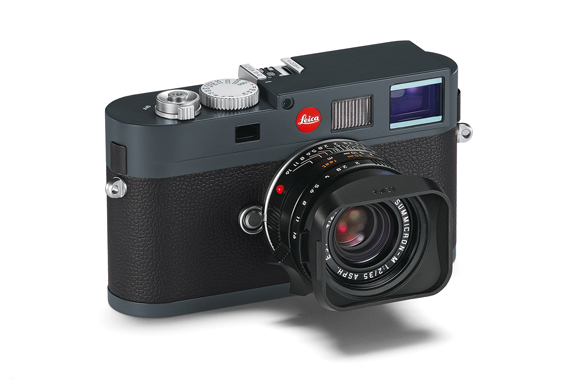
The new Leica M-E digital camera.

Leica’s new M-E provides a Leica-universe starter camera priced at 3,900 Euros (about $5,000). It’s a full frame 16 megapixel camera. Even more pricey is Leica’s new full frame digital M camera with 24 MP and an available external viewfinder. For more about Leica’s new M camera, and their current digital camera philosophy, read this interview with Leica product manager Jesko von Oeynhausen.

Over at Canon, I found two new, intriguing models. The EOS-M is sleek and small MORE. The latest in an impressive line of self-contained (no interchangeable lenses) models is the G15, now with a faster F1.8-2.8 les. It’s less bulky than the current G12, but dispenses with the handy pull out / pull up / pull down “articulated” rear screen.

Nikon has added orange colored cameras to its Nikon 1 line.

Panasonic’s GH3 was recently announced.

At Panasonic, the GH3 is the big news–a full-featured DSLR style camera, and although its mirror-less design suggests smaller size, it’s about the size of an entry-level DSLR. The GH3 is a more versatile multimedia performer than most cameras in its class. It shoots in several video formats, MP4, MOV, AVCHD or AVCHD Progressive. WiFi connectivity allows the camera to be operated from a computer. No specific pricing yet, but the camera will probably cost between $1,500 and $2,000.

The OM-D was released by Olympus earlier this year.

Olympus is again getting things right. For serious photographers, there’s the new-ish OM-D and for smart amateurs. This smallish camera offers an ideal combination of reasonable price, very good color rendition, a built-in viewfinder, lessons learned from several excellent PEN model cameras, and the promise of a new line of professional cameras that can be carried anywhere without worry about weight or size. What’s more, the video quality is quite good, and the camera handles beautifully. This is camera that you ought to consider against just about any of the others in this article. And if the OM-D is more camera than you need, Olympus offers several good options in the PEN line with interchangeable lenses and a nice range of accessories. New at Photokina 2012, and soon to be in stores, there’s a revised version of two lower priced PEN models (which use the same lenses as the more sophisticated OM-D): PEN Mini (E-PM2) and PEN Lite (E-PL5).

Samsung has been making serious inroads. The NX210 replaces the NX200, offering both style and ergonomic improvements and 20 megapixel resolution, and some useful new features, including wifi connectivity for image transfers to your computer. Samsung is a relatively new name in the photo industry, so it’s easy to overlook the huge advances these guys have made in a systems approach to photography–there are lots of lenses and accessories available for the growing NX line, fashionable cameras in white, very good ergonomics, interesting features, lots more.

The new Hasselblad Lunar.

Hasselblad ‘s new Lunar is a luxury camera that resembles one of Sony’s NEX models, and, in fact, uses the same A-mount lenses that you’d use on the NEX cameras. This is a very high-tech 24 megapixel camera with a very fast processor and a blingy exterior (there are a variety of handgrips made from exotic woods, etc.). It costs 5,000 euros (about $6,500)–a price that may be difficult to justify in the era of cameras that remain state-of-the-art for just a year or two. For more about Hasselblad’s approach, see this article in the British Journal of Photography.

Well, that’s quick overview. If you’re looking for a more extensive roundup, you can visit the largest booths (stands, in Europe), virtually, by exploring the Digital Photography Review section on Photokina 2012.

After many productive (35mm film) years with a Canon A-1, I decided, just before the digital deluge, to invest a really good film camera. The year was 2000. I kept the Leica catalog, and found my written notes inside the back cover. I was considering the Leica M6–one of the finest 35mm cameras every made. The cost of the body was about $2,000. Each of the three lenses cost $1,000-2,000. Total package price: about $7,000. (I ended up spending a lot less money for a wonderful used Hasselblad 501CM with two lenses). At the time, I had the feeling that my investment would stand the test of time. A decade later, film photography is retro fun, but digital rules the day. Now, I wonder whether a $2,ooo camera will stand the test of time. And I’m less secure now than I was in 2000. And I still spend far too much time thinking about cameras, and far too little time actually taking pictures.

See also:

https://diginsider.com/2012/03/20/the-quality-camera-that-goes-everywhere-part-1/

Immersive Storytelling

From the Toverlandarn site, an example of a magic lantern image… immersive entertainment from the 1800s.

At its simplest level, immersive storytelling requires nothing more than a good book, or, in simpler form, a really good storyteller, preferably on a chilly night near a campfire.

Immersive storytelling is hardly a new idea. In the days of magic lantern shows (which preceded nickelodeons and movie theaters), a storyteller would captivate an audience in a dark room with his narration of projected images. (For more, here’s a wonderful web site about magic lantern shows that includes thousands of images.) As early as the 1700s, magic lantern shows were popular–and scary–entertainment. At about the same time (give or take a few decades), Daniel Defoe was concocting written tales in novel form, an art perfected by Charles Dickens, whose immersive tales of dreary London captured the attention of large audiences. As theater, and movies, and videogames, and other forms evolved, they have done by building on fundamentals established by these early immersion artists.

Today, the power of computing can provide spectacular realism and the promise of deeply interactive experience–in which the individual participant and the story framework become one. That’s the area that author Frank Rose explores in an interesting new-ish book entitled, appropriately, The Art of Immersion. The more I read, the more I realized that Rose’s interpretation of immersion is more closely aligned with internet communities than large-scale digital immersion on, say, a James Cameron scale.

For much of the book, Rose tells stories about commercial ventures into lite forms of community engagement related to media. These stories are fun to read, and in some cases, familiar, but the intensity of the immersive experience is, often, both minor and fleeting. For example, he tells of Dunder-Mifflin’s virtual employees, paid in Schrute bucks, over a quarter of a million people in all, many more if you count the YouTube video of JK Wedding Entrance Dance. Rose muses on the relative importance of Dr. Horrible’s Sing-Along Blog, Quarterlife, and other early attempts at a web-based version of web-based TV shows with a twist. The discussion continues with various YouTube, Twitter, and, at last, interactive gaming experiences–and that’s where the immersive concept starts coming together. Viewing comedy or music on a modest screen doesn’t quite do it for me, not as immersive storytelling. Dr. Horrible is funny, but not immersive. Immersive takes me a different place, and alters my sense of reality in a convincing way.

My first dose of modern immersion was probably a cineplex viewing of James Cameron’s Titanic. Without the benefit of 3-D, I was on that ship, able to feel the motion, the king of the world freedom, the pull of the sinking ship. It was more than a motion picture. It was an experience that filled my senses. I was in awe. One member of my family were in the bathroom, overcoming a difficult-to-explain feeling which resembled seasickness.

As it turns out, immersion through dramatic audi0-visual presentation or community interaction is the least interesting part of Rose’s book… but it takes over 250 pages to reach the “good part.” The book takes off when immersion is defined not by the external experiences that are manufactured with technological trickery, but by the intense, simple manipulation of mental mechanics… the advanced psychology associated with addiction, game theory, decision science, and emotion–the domains of science fiction innovator Philip K. Dick, and twisted author Lewis Carroll, and, when at his very best, Alfred Hitchcock. Mastery matters. Authenticity overrules realism. Movies do it well. Videogames of the future will do it better than we ever thought possible. The combination of the two is on its way–probably preying more on emotion and psychology than the now-easier-to-achieve realist simulations of fantasy environments. It’s character that drives the narrative, and when you become that character, you won’t shake off the experience in an hour or two. It will take days, and maybe weeks. An immersion vacation.

And that brings us back ’round to the charlatans of the 1700s who could draw their victims into a dark cave, project an unexplainable ship on the wall, and wrap all sorts of spooky storytelling around the mysterious image. One image, perhaps four slides in sequence, not so different from the ocean-going graphic that has been distracting your attention since you started reading this article. We are drawn to these images, drawn in by the darkness and the storyteller’s inescapable magic. Twitter isn’t quite the same thing, and it’s difficult to imagine an internet community with this kind of intense power. Then again, we’ve only seen the start of massively multiple player games, and we’ve only begun to understand what happens when a community of LOST or Star Wars fans authors its own encyclopedia (the Lostpedia and the Wookiepedia, in case you didn’t know). As these worlds collide, as deep information, worlds of characters, movie-making magic, and gaming combine, the era of immersion shall begin to change the way we think about modern storytelling. But that’s the future. The present, sadly, is best represented by the likes of the new TV series, Revolution, and so, we’ve got a ways to go.

Teach Your Children Well

Madeline Levine, Ph.D. is a California psychologist, a woman who understands child development with refreshing clarity. Her candor may upset parents and children whose focus is abundant personal accomplishment. Her priorities reside elsewhere.

For example, she addresses the vitality of self-esteem as the positive result of a child’s own decisions and accomplishments. In opposition, she expresses grave concern about the distortion of self-esteem as narcissism, self-indulgence and materialism, which results in a higher level of distortion related to entitlement, grade inflation, and sad misconceptions about self-worth.

She takes on present day insanity: “…the kind of overblown panic I am seeing today has its roots in an extraordinary marketing campaign designed to convert normal parental concern into frenzied anxiety about what it will take to be successful in the twenty-first-century global economy.” she continues: “We have been sold a bill of goods and that bill of goods has clouded our common sense and judgement.”

And here’s the core idea of her book:

Here’s the reality: kids who are pressured, sleep-deprived, and overly focused on by parents convinced that without significant oversight and intervention, their children are not likely to be successful, [and] are at high risk for emotional, psychological and academic problems.”

Inexplicable trends tied to seemingly boundless cheating, stress behaviors including substance abuse and cutting, family ties stretched beyond their limits, the overwhelmed, overworked, consistently unhappy patterns now commonplace… They all make sense when explained in context. It’s time to stop this madness.

So begins a refreshing 21st century course in child development that acknowledges, incorporates and often celebrates technology, learning differences, and natural processes that hyperactive parental meddling are not likely to overcome. Teach Your Children Well: Parenting for Authentic Success is a brilliant book, essential in the ways that What to Expect When You’re Expecting has become for the first years of life.

It’s all about helping children to find and nurture friendships; to encourage them to maintain the connection between learning and fun; assisting in the construction of self-identity; and practical specifics about, for example, the healthy benefits of sufficient sleep. Often, Dr. Levine’s sane advice makes sense not only for children and teens, but for adults, too. Her advice regarding good sleep habits:

– Consistent bedtime
– A quiet half-hour ritual prior to bedtime, with dimmed lights
– No caffeinated drinks in the afternoon or evening
– No digital device use before bedtime
– Absolutely no social networking before bed

Dr. Levine insists upon appropriate roles for children and for parents, appropriate relationships that may differ from the daily realities in your home or in the households of relatives, neighbors or friends. She’s clear on the ways in which technology can, should, and ought not be part of the picture. And even though you, me and our kids rely upon our modern tools, she makes it clear that neither these tools nor the social interaction nor the increased productivity are worth much…certainly not nearly as much as the direct, moment-to-moment personal interactions that matter so much more than anything else in the world.

Gee, I really like this book. It’s the kind of book I want all of my friends to read, that I want every parent and student to read. Given that her previous book was reprinted some seventeen times, maybe everyone will.

And on this Rosh Hashanah evening, I can think of no better way to begin a new year than to recommend a book by an caring author who is making a difference. L’shana tovah.