Three New Quality Cameras for Spring

‘Tis the season for some new $500+ plus cameras, one from Sony, one from Panasonic, and, at about twice the price, one rumored for upcoming release from Olympus.
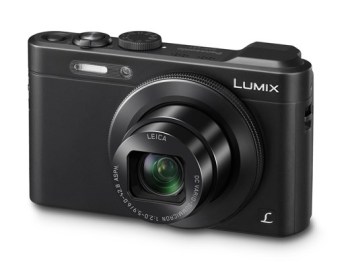
Panasonic LF1kPanasonic’s newcomer DMC-FL1 is sleek, black, and conveniently sized. It  comes with a 7x optical zoom and a fast 2.0 lens (at the widest angle setting). The 12 megapixel camera includes a built-in EVF (electronic viewfinder), a far better way to compose images than the LED panel found at the back of every digital camera. It’s the kind of camera that any serious photographer ought to keep in a pocket or shoulder bag, and, for convenience, it’s possible to use WiFi to export images.

For a more detailed rundown, click on the picture of the camera and read the Digital Photography Review preview of the camera.
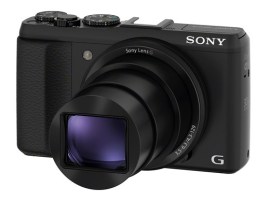
Once again, Digital Photography Review is the best source of info about new cameras. Click on the photo to read their feature on the Sony HX50V.

Once again, Digital Photography Review is the best source of info about new cameras. Click on the photo to read their feature on the Sony HX50V.

For the same price, Sony’s newest entry in this category, model HX5oV includes a 30x digital zoom–an idea that I’ve never loved because I’d rather the camera do the optical work and that the digital magnification be done on the computer, where greater control is possible.  This camera records JPG images, but not RAW images. Taken together, the digital zoom and the lack of RAW images suggest that this camera is intended for a more of an amateur photographer who simply wants to shoot handsome images without spending much time perfecting them on a computer.

There is no electronic viewfinder, another indication of its super-amateur status. Still, this is a 20 megapixel camera that includes both WiFi image transfer and GPS. And, there’s image stabilization. On the downside, you can’t record RAW images with this camera, only JPG.

Both cameras offer some level of exposure control, and both shoot HD video. On just about any sort of a journey, either camera would be a superior companion.

Olympus_ep5_zps5b4bee21As for my personal choice, I remain a big fan of Olympus interchange lens cameras in the micro-four thirds format, and for the next month or two, the buzz in that world will be about the upcoming EP-5. It’s a retro design reminiscent of the much-loved Olympus PEN film cameras, and an update of the popular EP-3. If the rumors are accurate (and we’ll know that within the next two weeks), this will be a 16MP version with the same sensor found in Olympus’s equally well-regarded EM-5. No electronic viewfinder included as part of this model, but a new add-on viewfinder is, apparently, coming, too. Here, my favorite source of things to come is 43 Rumors (the 43 refers to the micro four thirds format, an image sensor size that’s generally now fairly common for cameras in the $500-$1,000 range). For more, and for updates on these intriguing rumors, click on the Olympus EP-5 camera from the 43 Rumors site.

If You Give a Child a Cookie…

20130425-101009.jpgMiss Bartell (my fourth grade teacher): Would you rather have one cookie or four cookies?
Me: Four! I want four cookies!

(Miss Bartell shows me one enormous cookie and four tiny cookies.)

Me: (sheepishly) Miss Bartell, may I change my answer? I think I want one cookie.

Miss Bartell: Are you sure you want the one big cookie? You may change your mind, but only this once!

Me: Is this a trick?

(Room filled with the chuckles of fourth grade classmates)

Me: Are they both the same cookies? Does the big cookie taste the same as the small cookie?

Miss Bartell: Good question! Why don’t you taste them both and you tell me?

Me: I can try them both?

Miss Bartell: Yes, I will allow that because you asked the right question!

Me: (tasting) Well, the small cookie is sublime, a dense and chewy combination of what seems to be the finest Valrhona Classic Dark Chocolate, notable for its complex and balanced flavors…

Miss Bartell: And the big one?

Me: Tastes like Suzanne’s smelly armpit!

Suzanne: Hey! Be nice!

Me: Okay, okay, sorry. It smells kinda funny. The cookie tastes like it was made in a factory. It’s stale, the chocolate is flavorless, the dough is gummy…

Miss Bartell: Suzanne, please distribute one of the small cookies to each of your classmates.

Suzanne: (sneering at me) Yes, Miss Bartell.

Me: Miss Bartell?

Miss Bartell: Yes?

Me: Thank you for teaching me never to accept the obvious first answer, to always ask the second question, and to seek context for the information I receive from you and others who routinely attempt to control my mind.

Miss Bartell: Don’t talk with you mouth full.

4K TV – Sooner Than You Think!

A few days ago, I was on the phone with the FCC and an interesting question came up. Will broadcast stations have enough over-the-air bandwidth to provide 4K service to the public? I was struck by the question because 4K is such a new idea, and because I’d never really thought about it as broadcast idea.

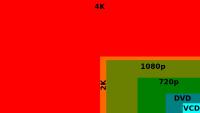
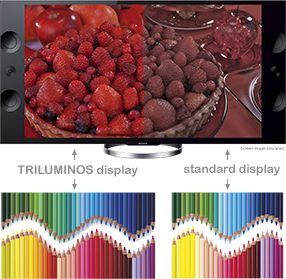
Compare 1080 pixels (dark green0 with 4000 pixels (red) and you get a sense of how much more picture information (resolution, detail) is available on the new 4K TV sets.

Compare 1080 pixels (dark green0 with 4000 pixels (red) and you get a sense of how much more picture information (resolution, detail) is available on the new 4K TV sets.

What’s 4K TV? It’s a much higher-resolution version of HDTV. And the first 4K TV sets are arriving soon (see below0. In order to provide all of that picture information, more data is required, which means larger storage devices, and, in order to provide that data to connected TV sets, more bandwidth is required, too. That’s the basic theory, but it’s important not to think about 4K in terms of the current systems because of that always-astonishing digital magic trick: compression. Yes, 4K requires a lot of data and a lot of bandwidth. But “a lot” is a relative term. And yes, there are new digital broadcast standards on the way. Good news for consumers and for broadcasters, who will be able to pack more and prettier program material into their TV signals, not-so-good news for broadcasters who are attempting to build a coherent strategy related to the upcoming FCC TV spectrum auction, in which many stations will trade their licenses for cash, or for the opportunity to share a channel with another broadcaster in the market.

panel2_imageAnyway… I woke up this morning to an announcement from Sony… with all sorts of enticing promises: improved detail, improved color rendition, better audio, screen mirroring so what’s on your tablet can be viewed on your new TV (albeit it in lesser detail, a service currently available to Apple users).

How much? $5,000 for the 55-inch model, and $7,000 for the 65-inch model.

What are you going to watch? Well, yeah, that’s always the problem at this stage. Here’s a terrific article about “upscaling” the currently available media, which seems to require 24x improvement. More data will require more robust local storage, and so, we move closer to a complete convergence of television, home network, home digital storage devices in sophisticated home library systems, and, perhaps far more likely, streaming solutions in their next phase: advanced versions of Netflix, Hulu, and so forth, tweaked to serve big files for 4K TV sets.

Which brings us back around to the TV station wondering about its 4K future. Sure, it’s technically possible to broadcast 4K, but in the few years remaining for the current broadcast standard, this seems fairly unlikely because (a) it will be expensive for television stations to install in their master control facilities, and (b) relatively few people will leap from their new-ish HDTVs to 4K sets in the next year or two.

Sony-4KTVDo we want or need even more resolution than 1080i HDTV sets provide? Maybe for microscopy or astrophotography or other science work that demands the highest possible resolution. Do I think ESPN is investing in a whole new 4K operation–cameras, video switcher, storage, transmission, etc. so I can watch baseball in even higher resolution. You know they are, or will soon be, doing just that. And when they do, we’ll buy the sets because, you know, people will come…

Encouraging Schools to Join the 21st Century

Darryl WestConventional public schools are “arranged to make things easy for the teacher who wishes quick and tangible results.” Furthermore, “the ordinary school impress[es] the little one into a narrow area, into a melancholy silence, into a forced attitude of mind and body.” No doubt, you’ve had a thought similar to this one: “if we teach today’s students as we taught yesterday’s, we rob them of tomorrow.”

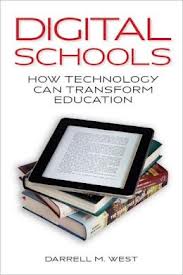
There’s a reason for the old school language. The words were published in 1915 by educator John Dewey. A century later, the situation has begun to change, mostly, according to Brookings Institute vice president Darryl M. West, as a result of the digital revolution. Mr. West advances this theory by offering an ample range of examples in his new book, Digital Schools.

Quite reasonably, he begins by considering various attempts at school reform, education reform, open learning, shared learning, and so on. Forward-thinking educators fill their office shelves with books praising the merits of each new wave of reform, and praise the likes of Institute for Play, but few initiatives taken hold with the broad and deep impact that is beginning to define a digital education.

digital schoolsBlogs, wikis, social media, and other popular formats are obvious, if difficult to manage, innovations more familiar in student homes than in most classrooms, but the ways in which they democratize information–removing control from the curriculum-bound classroom and teacher and allowing students to freely explore–presents a gigantic shift in control.

Similarly, videogames and augmented reality, whether in an intentionally educational context or simply as a different experience requiring critical thinking skills in imaginary domains, are commonplace at home, less so in class, and, increasingly, the stuff of military education, MIT and other advanced academic explorations, and, here and there, the charge of a grant-funded program at a special high school. More is on the way.

Evaluation, assessment, measurement–all baked into the traditional way we think about school–are far more efficient and offer so many additional capabilities. No doubt, traditional thinkers will advance incremental innovation by mapping these new tools onto existing curriculum, perhaps a step in the right direction, however limited and short-sighted those steps may be. The big step–too large for most contemporary U.S. classrooms–is toward personalized learning and personalized assessment, but that would shift the role of the teacher in ways that some union leaders find uncomfortable.

The power behind West’s view is, of course, the velocity of change in the long-promising arena of distance learning. During the past ten years , the percentage of college students who have taken at least one distance learning course has tripled, and  passed 30 percent in 2011. Numbers are not available, but I suspect we’ve now passed the 50 percent mark. The book does not address the stunning growth of, for example, Coursera. Kevin Werbach, a Wharton faculty member, taught over 85,000 students in his first Coursera course (on gamification)–students from all of the world. Indeed, the current run rate is 1.4 million new Coursera sign-ups per month.

Mimi Ito is one of the more influential thinkers about modern education and its future. Click to read her bio.

Mimi Ito is one of the more influential thinkers about modern education and its future. Click to read her bio.

The author quotes education researcher Mimi Ito:

There is increasingly a culture gap between the modes of delivery… between how people learn and what is taught. [In addition to] the perception that classrooms are boring… students [now] ask, ‘Why should I memorize everything if I can just go online? … Students aren’t preparing kids for life.”

Is this a ground-breaking book. No, but it is useful compendium of the digital changes that are beginning to take root in classrooms across America. Yes, we’re behind the times. In many ways, students are far ahead of the institutions funded to teach them. The book serves notice: no longer are digital means experimental. Computer labs are being replaced by mobile devices. Students are taking courses from the best available teachers online, and not only in college. Many students are enrolled nowhere; they are simply taking courses because they want to learn or need to learn for professional reasons. Without formal enrollment, institutions begin to lose their way. The structure is beginning to erode. Just beginning. And it can be fixed, changed, transformed, amended, and otherwise modernized. And so, the helpful author provides an extensive list of printed links for interesting parties to follow.

Just out of curiosity, I called up Darrell M. West’s web page–it’s part of the Brookings Institution’s site–and, as I expected, he is a man of consider intellect and accomplishment.  And so, I hoped I would find the above-cited links as a web resource. I looked for Education under his extensive list of topics of interest but it wasn’t there. (Uh-oh?) I did find a section on his page called “Resources,” but the only available resource on that page was a 10MB photograph of Mr. West. I couldn’t find the links anywhere. Perhaps this can be changed so that all readers, educators and interested parties can make good use of his forward-thinking work.

Sorry–one more item–I just found a recent paper by Dr. West, and I thought you might find both the accompanying article and the link useful.

Here's a look at 42-year-old John Dewey in 1902. To learn more about him, click on the picture and read the Wikipedia article.

Here’s a look at 42-year-old John Dewey in 1902. To learn more about him, click on the picture and read the Wikipedia article.

U.S. Education by the Numbers

Today, more students are enrolled in school than ever before. And the trend is accelerating. In fact, all of the population numbers in this article have increased by about ten percent in the past ten years; in the next decade, the acceleration will increase. For the moment, let’s focus on the U.S., and, in time, in future articles, the view will expand. Note that much of his information comes from the National Center for Education Statistics.

Before we dig deeply, I suppose it’s interesting to note that there are about 99,000 public schools (including just over 5,000 charter schools), plus more than 33,000 private schools.

640px-College_graduate_studentsThis year, there are slightly fewer than 50 million public school students, including about 15 million high school students in public school. Add another 5 million students in private school, including over 1 million in private high schools.
Each year, about 4 million students start high school. (Actually, the number is about 3.7-4.0 million). Remember that number: it’s the basis for some arithmetic below.

There are many ways to calculate high school graduation rates, and the Federal government has been improving the reliability, accuracy and precision of these metrics. Distribution is uneven: students in some ethnic groups, who live in some states or cities or districts, may fare better or worse (as poorly as 1 in 2 graduating, for example).

In our simple (and, perhaps, simplistic) calculation, it would be fair to assume that about 4 million students start high school and about 3 million finish high school.

About 2 in 3 males, and about 3 in 4 female, enroll in college.

Each year, just under 2 million bachelor’s degrees, plus just short of a million earn an associates degree. And although not everybody earns a bachelor’s degree in four years or an associate’s degree in two years, on average, the vast majority of people who graduate high school–that is, about 3 in 4 of the people who started ninth grade–earn a college degree.

What’s more, nearly one million advanced degrees (masters, doctorate) are awarded every year. It’s fair to assume more than a half million people earn these degrees each year–or about 1 in 6 f the people who graduated high school.

Taking this into the workplace, in 2010, nearly 3 out of 4 college graduates were employed, in comparison with just over 1 in 2 people with only a high school diploma. On average, those college graduates also earned more money: over $45,000 for the college graduates compared with just under $30,000 for high school graduates without a college degree.

All of this sounds terrific, but I wonder whether the numbers are correct.

Last spring, The Atlantic published an article that placed just over 40 percent of 18-24 year olds in college, and offered a graduate rate (within a generous six years) of just 56 percent. If I understand this story correctly: roughly 20 percent of 24 year olds earn a college degree. The Atlantic story was inspired by a report prepared by Reuters.

So why does the National Center for Education Statistics report 1.8 million bachelor’s degrees per year? (I may not be comparing [teacher’s] apples to apples, but this discrepancy seems to be quite large.)

The purpose of this article is not to challenge these sources, but instead, to try to get a fix on the actual numbers, and the state of U.S. education today. Why? If 3 in 4 people are indeed graduating high school, then we’re working on the right problem, especially if the vast majority of high school grads finish college and earn a good wage. However, if only 3 in 4 high school grads are attending college, and only 1 in 2 of them are actually finishing college, that only 1 in 4 Americans are college graduates.

Gee, those numbers seem wrong to me–the number of college graduates is probably over fifty percent–so why don’t the numbers add up?

(Help?)

On Other People’s Bookshelves

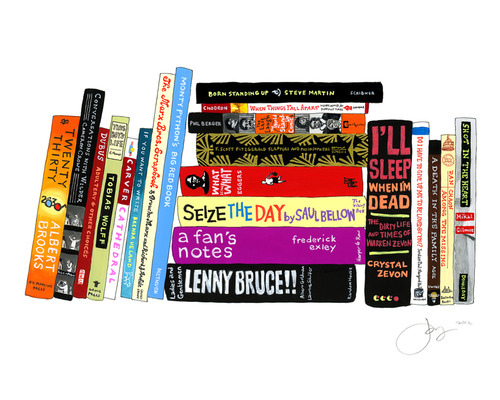
During the past few months, a clever oblong book entitled My Ideal Bookshelf has been widely covered in the media. Each two-page spread contains a brief essay about books and reading by a cultural somebody, and a painting of that person’s favorite books arranged as they might appear arranged on a shelf (in fact, not one of the painted arrangements includes an actual bookshelf).

Browsing the groupings of favorite books, I did what I always do. I took some notes, and made a list of books I would like to read someday.

I have wandered through a vast number of books about food and cooking, but so far, I have not taken on Larousse Gastronomique. So, thank you to chef and cookbook author Hugh Acheson for that reminder, and to chef Thomas Keller for suggesting the same book.

From author Junot Díaz, a recommendation for Divided Planet: The Ecology of Rich and Poor.

apatow_bookshelfJudd Apatow, famous for his comedy movies, surprised me with James Agee’s A Death in the Family, and reminded me of a popular book about comedians that I wanted to read, but never did: The Last Laugh.
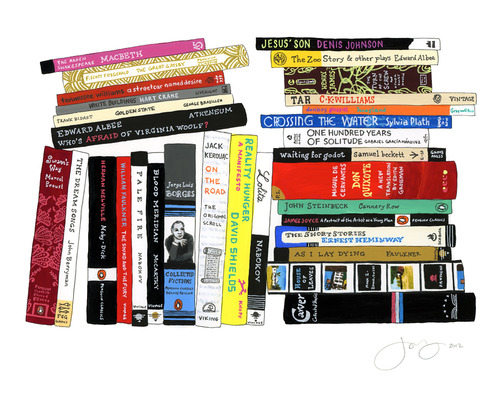
I was happy to see Dave Eggers highlight Edward P. Jones’s The Known World, a story about American slavery that I finished this winter, and now look forward to reading Denis Johnson’s book, Jesus’ Son which is “short, funny and impossibly lyrical…a book nobody doesn’t like.”

It was fun to see some of my all-time favorites, especially the obscure ones, on other people’s shelves: Chuck Klosterman likes Four Arguments for the Elimination of Television and Rudy Rucker’s The Fourth Dimension, and designer David Kelley likes The Care and Feeding of Ideas by Adams and the compendium, An Incomplete Education, and I do, too.

franco_bookshelfJames Franco wins for the most cluttered bookshelf, also the one with the most books. From his stacks, I think I will pick up another set of Raymond Carver stories, and the original scroll version of Kerouac’s On The Road. I suppose I should read Melville’s Moby Dick, which I have avoided so far for no good reason. Ditto for writer Philip Gourevitch’s suggested A Good Man Is Hard to Find by Flannery O’Connor and Dostoevsky’s The Idiot.

I am among the many who believes Professor Lawrence Lessig to be brilliant, so I was anxious to explore his bookshelf. Mostly, it was the scholarly law stuff that appealed to me, but it was encouraging to see Neal Stephenson’s Snow Crash sitting just below The Federalist Papers. 

Writer / designer / photographer Ben Schott included Dylan Thomas’s Under Milk Wood, but I think I will listen to Richard Burton on the BBC rather than reading it in book form. Patti Smith reminded me that I have not gotten my copy of Allen Ginsberg’s Collected Poems, 1947-1980. Editor Lorin Stein’s list includes Chuck Amuck by Warner Brothers animation director Chuck Jones, which I know I will enjoy.

It was interesting to see one of my architectural favorites, A Pattern Language, on chef Alice Waters’s list, and I suspect we both found it by browsing the same source, years ago, The Whole Earth Catalog. Pretty much, I want to read her entire bookshelf, from M.F.K. Fisher’s Consider the Oyster to Maria Montessori’s The Secret of Childhood.

rosanne_cash_bookshelf

Rosanne Cash’s mix of E.B. White, Mallory and The War of Art (another of my favorites, it’s way over on the left), and Tennyson and Solzhenitsyn was among the most intriguing collections.

Finally: good for William Wegman for including not only two Hardy Boys novels, but also bits of the World Book encyclopedia, The Golden Book Encyclopedia, and Girl Scout Badges and Signs.

I was very pleased, and felt very smart, when I saw so many of my personal favorites on other people’s shelves. And, I felt woefully illiterate when I realized just how many of the books–sometimes, whole bookshelves–with both authors and titles that were completely unfamiliar to me.

(So many books. So little time.)