The Multiplier Effect

Quickly now… If you multiply 633 by 11, what’s the answer?

No doubt, you recognize the pattern, and you may recall the mental math process:

633 x 10, plus 633 x 1, or 6,330 plus 633, or 6,963, which is the answer (or, in terms used by math teachers, the “product”).

There is another way to solve the problem, a faster way that assures fewer computational errors, and does not involve any sort of digital or mechanical device. It does, however, involve a simple rule and a different way to write the problem down.

The rule is: “write down the number, add the neighbor.” The asterisk just above each number is there only to help you to focus. If you prefer, think of it as a small arrow.

Here’s how it works:

Mult by 11

Try multiplying 942 x 11  and you’ll quickly get the hang of it.

Do it once more, this time with a much larger number: 8,562,320 x 11. It goes quickly, as you’ll see.

Multiplying by 12 is just as easy, but the rule changes to: “double the number, add the neighbor.” Here, my explanation includes specific numbers.
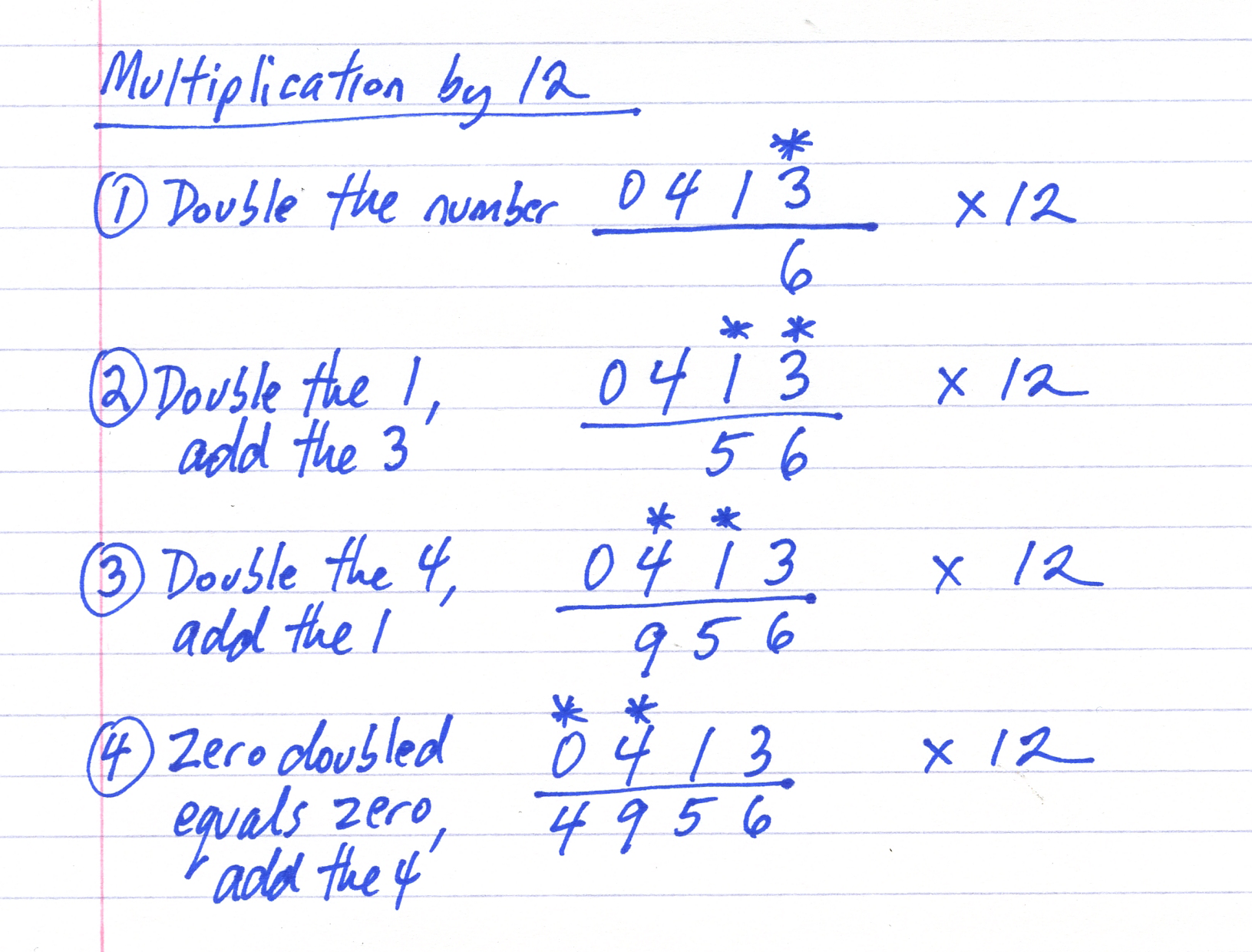
Mult by 12

In fact, there is a similar rule for multiplication by any number (1-12). And there are rules for quickly adding long, complicated columns of numbers, as there are for division, square roots and more.

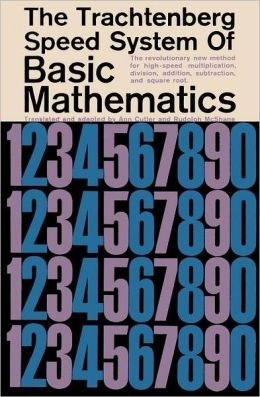
These rules were developed by a man facing his own demise in the Nazi camps during the Second World War. Danger was nothing new to him…this is the story and the enduring legacy of Jakow Trachtenberg, who first escaped the wrath of the Communists as he escaped his native Russia, then became a leading academic voice for world peace. His book, Das Friedensministerium (The Ministry of Peace), was read by FDR and other world leaders. His profile was high; capture was inevitable. He made it out of Austria, got caught in Yugoslavia, and was sentenced to death at a concentration camp. To maintain his sanity, Trachtenberg developed a new system for mathematical calculation. Paper was scarce, so he used it mostly for proofs. The rest, he kept in his head.

Madame Trachtenberg stayed nearby, in safety. She bribed officials, pulled strings, and managed to get Jakow moved to Dresden, which was a mess, allowing him to escape. Then, he was caught again, and was moved to Trieste. More bribes and coercion from Madame. He escaped. The couple maneuvered into a more normal existence beginning at refugee camp in Switzerland. By 1950, they were running the Mathematical Institute in Zurich, teaching young students a new way to think about numbers. A system without multiplication tables. A system based upon logic. A system that somehow survived.

A system that, against all odds, made it into my elementary classroom. One classroom in the New York City school district. For one year. The parents were certain that the teacher was making a terrible mistake, that the people in my class, myself included, would never be able to do math in the conventional way again. Of course, we learned a lot more than an alternative from of arithmetic.

And now, after decades out of print, in an era when arithmetic hardly matters because of calculators and computers, the original book is back in print. The brilliance of system remains awesome, and the book is worth reading just to understand how Trachtenberg conceived an entirely fresh approach under the most extraordinary circumstances.
20130113-222930.jpg

Snow Fall: Two Ways to Tell a Story

Several weeks ago, in the midst of a busy holiday season, The New York Times attempted to understand its future by telling the story of an avalanche. The story requires about a half hour of your time, and it is best experienced in a quiet room with a reasonably large screen.

Snow Fall

The place to begin is with the text-ish story, the one that requires a lot of on-screen reading, the one that includes various animated maps that show just where, how, and why the avalanche happened. Short videos (each one about a minute long) illustrate the story, and bring the people in the story to life. There are audio files of the emergency calls to Ski Patrol. There are slide shows that help us to understand the life of each skier. The writing is strong and skillful. The whole presentation is an impressive demonstration of how we might experience news and features in the rapidly-advancing future.

It feels like an experiment. The writing is long, more like a NY Times Magazine story than a web story. I felt myself drawn into the story and its environment, and found myself pressing the “volume up” buttons on my keyboard in expectation of some sort of soundtrack to accompany the reading of the text.  Short videos satisfied some of the craving for additional stimulation; they were nicely integrated into the flow of the story and the text presentation. The slide shows that introduce each character are a more awkward fit because they require the reader to leave the chronology of the intense storyline–which is told, mostly, in shades of grey–and to consider each character’s past life–which is told, mostly, in vivid digital color. The visual shift is jarring, made worse by the inclusion of completely irrelevant advertisements that are large enough to disrupt the entire experience (for this type of storytelling, I think I’d prefer a micropayment or subscription model, but I wouldn’t mind seeing an opening, mid-break and closing sponsorship presentation).

After I read, looked at the pictures, followed the maps, watched the short videos, and so on, I felt that I understood what happened at Tunnel Creek.

And then, I watched the 11-minute video documentary that told the whole story. I was struck by how much more effectively the documentary told the same story. The story was tight, the characters were crisply defined, the maps and visuals made more sense because they were narrated, the pace was brisk, the emotions were sharp and devastating. Less was a whole lot more. The documentary made the print-pictures-video-maps presentation feel like a bunch of reporters’ notes and script drafts. I felt certain that the doc had been produced by another team, but no, it had been made by the same New York Times staff.

And all of that confused me. I love to read (less so on the screen, moreso from paper), and I was very impressed by the quality of storytelling in the multimedia format. But after watching the documentary, I found myself wondering whether we’re making too much of this transmedia idea, and whether a well-produced audio-video presentation might provide a more reasonable multimedia future.

Sure, this is just one example, and an early one at that. I’m anxious to see what Atavist has online, and will write about their multimedia storytelling in the next few weeks.

In the meantime, do take the take to explore the NY Times presentations. They’re well worth your time and attention.

My Website Doesn’t Look So Good (on my mobile phone)

You’ve got a perfectly good website, looks great on any computer. The only problem: fewer and fewer people are seeing your website on a computer. More and more, it’s the way that the website looks on a mobile device that matters. Oh, sorry, one more problem: there are at least a dozen different mobile devices, and your website will not look the same on any two of them. Some text wraps, some does not. Some graphics are shown, others are cut-off. What a mess?

Check out the images below, and click on any of them to see a more complete picture with even more devices. Try it with your website, and then, either find a pre-made solution (WordPress offers one for blogs, for example), or start thinking about a secondary website design for your business, etc.

Every week, it’s a brave new world.

Diff view of website

Blueprint 2013 – Philanthropy in a Digital Age

Bernholz reportBy her own admission, Lucy Bernholtz is “…a philanthropy wonk…trying to understand how we create, fund, and distribute shared social goods in the digital age – what she calls the future of good…”

As with everything else in our increasingly digital world, new ways of thinking are transforming the philanthropic industry. Younger donors behave differently from other populations. Kickstarter and other internet project-based giving are now a meaningful trend. Kiva and other micro-giving concepts have gained tremendous traction. For those working at non-profits, and at foundations, these trends are very familiar. For the rest of the population, it’s time to take note of the large role played by the philanthropic and nonprofit structure in education (particularly, but not exclusively, higher education), health care (hospitals, and more), arts and culture, social services, and so much more.

This is a report worth reviewing, and it’s a free download. (But not from this link… you need to answer a few simple questions before you receive the download).

And, it’s probably worth knowing more about Ms. Bernholtz, whose thinking is helping to guide change in what has become a very important part of contemporary society.

The Fourth Good Idea (The One That Works!)

Good idea #1 – On every iPad, Apple includes a slot for an SD card. That way, I can copy a file from my computer, insert it into the player without any fuss, and edit a document or watch a movie.

Didn’t happen.

Good idea #2 – Recognizing the error of its ways, Apple introduces a $30 accessory called the Camera Connection Kit. It includes two small white blocks, one of which allows the insertion of an SD card into an iPad. But only for transferring pictures. Forget about editing a Pages or Numbers file, or watching a movie.

Good idea #3 – Seagate introduces GoFlex, a lightweight, portable disk drive that connects, wirelessly, to any iPad. The secret is a wireless network created by the device; that’s how the connection to the iPad is made. The capacity is 500GB, a very healthy amount of space for all sorts of files. Unfortunately, Seagate’s interface technology proves difficult to use, and, at least for me, it seems to work less often than other devices. (Seagate has provided help, not once but several times. New Year’s Resolution: Since I love this idea, I will try again and get it right.) It costs less than $200.

AirstashGood idea #4 – Maxell introduces AirStash. It’s a small wireless network, and it worked the first time. There are three parts, well-integrated. The first is an app, clean and simple, just a list of files organized by file type (movies, etc.) The second in an SD card (up to 32GB). You insert the SD card into your computer, load it up with files, and plug it into the third part. That’s a device roughly the size of a large cigarette lighter. On one end: an SD card slot. On the other, well, nothing you need to make the connection (more on that in a moment). You find the AirStash network in the list of available wireless networks, make the connection, return to the app, and just watch the movie (or whatever it is you want to do). From time to time, you need to recharge the AirStash battery–that’s the third part, a USB plug that you insert into any computer or USB/AC adapter for the recharge.

My test device was loaded with several good films: I watched The King’s Speech and Inception, and both played flawlessly.

Sorry, but I can’t resist:

Good idea #5: AirStash is updated so that it can be used without shutting down the WiFi network that you usually use. Right now, that’s a flaw. I hope it will be fixed.

So, that’s the story. AirStash is a product that really works. And it’s simple enough that I was able to write an article about half as long as usual, simply because, well, this really is a simple product to use, and to explain. Whoever made this happen, good work! (And thank you for solving the problem that Apple never should have created in the first place!)

AirStash Phone

Here’s a look at the AirStash app for the iPhone. Simple, straightforward and intuitive.

Chopping Down the Tree of Knowledge

So, during the past few weeks, I’ve been thinking a lot about the visual mapping of ideas.

Scott McCloud suggested that I have a look at the animation being done by Cognitive Media. You’ve probably see their work. I especially enjoy their lectures, often associated with TED-Ed, and their RSA work.

Back to mapping. I’ve been struggling with the tree of knowledge–and its modern equivalent, the mind maps now found in so many places on the internet and in classrooms. This means of structuring information provides the basis for the often-awkward corporate organization chart, now as often undermined by concepts of matrix reporting (you report to me, but we both also report to a lot of other people, kinda, sorta). I’m experimenting with several mind mapping programs, and one (Curio) is especially promising. That’s coming in a later post.

A few years ago, I worked with some folks from Wharton on a new approach to organizational design in which everybody is responsible to everybody else. I liked the idea because (a) I thought it represented what happens in a modern organization with greater precision, and (b) it represented the kind of productive, modern place I wanted to work. The design was a simple circle with about 100 points–and every point was connected to every other point. The concept: simple. The illustration: ridiculously complicated and difficult to understand.

So back to Cognitive Media. They’ve produced a nifty cartoon that helped me to understand the inadequacies of the tree-based design, the plusses and minuses of the network design, and the need for a universal design.

Watch it:

Dream of a Nation: Inspiring Ideas for a Better America

DONCover

Happy new year.

We are the ones we have been waiting for.

That sentence, and the ideas below, are parts of a book entitled Dream of a Nation: Inspiring Ideas for a Better America. Here are some of those ideas:

Shift the rules for campaign financing so that most of the money comes from most of the people. Currently, one-third of one percent of the people provide 90% of campaign funds. This drives special interests, and encourages a system based upon lobbyists that was never a good idea. And, while we on this track, let’s reduce the ratio of lobbyists to legislators: the current ratio of 23:1 (lobbyist to legislator) is probably too high by half (or more).

Let’s take control of our Federal budget (and, in time, our state budgets, too). In Porto Allegro, Brazil, a “citizen participation” approach to budgeting resulted in a 400% percent increase in school funding, and a dramatic increase in funds for clean water and sewers. Budgeting by citizen participation is a new movement that we want to encourage.

If Americans cut bottled water consumption by 80%, then the number of bottles, laid end-to-end, would circle the equator just once a day. Right now, we can circle the equator with bottles every 5 hours.

If each of us thinks more clearly about what we spend, and where we spend it, then the people living in an average American city (say, 750,ooo population) can add over 3,000 new local jobs and shift about $300,000 more into the local economy. How? By spending just 20% more on local, not national, businesses. Go to the local hardware store, the farmer’s market; don’t go to Wal-Mart or Walgreens. In the end, you’ll be richer for it. We all will.

Recognize that the high school drop out crisis is costing the U.S. at least half a trillion dollars each year. Every 26 seconds, a student drops out of school in the U.S. Encourage your legislators to take the time to fully understand the problem and to work with states and school districts to end this problem. The problem is not just the schools: it’s the support systems that do not provide sufficient support for lower-income families. An astonishing one in four American children live in poverty. We know how to change this: we need to focus on what worked during the LBJ years and the Clinton years, and do more of it. And, along the way, we need to invest about $360 million to fix crumbling school buildings. This priority pays off in so many ways: GDP, elimination of crime, family stability, reduction in prison population, so much more. We should no longer accept the idea that 25% of earth’s prison population resides in a U.S. prison–an outsized number for a nation with just 8 percent of the world’s people. Similarly, we should no longer accept the high price of education and the middling results that we achieve with those dollars. Other countries do better because their systems are more reasonable. We need to change the way we think about all of this, and we need to make it clear to legislators that this will be their last term if they do not accomplish what we need done.

Let’s get started on two substantial changes in the ways we work with our money. First, let’s start thinking in terms of a V.A.T., as most Western nations do. If the book’s calculations are correct, this should increase our available funds by about 13%. And second, let’s eliminate the 17% (average) payroll tax, reducing hiring costs for employers, as this model is proving to be more effective than our current approach. For more about this, Get America Working! (not the easiest website for clear presentation of ideas; the book is better).

In Canada, they spend $22 per person on noncommercial educational media (we call it public TV, public radio). In England, they spend $80 per person per year. In the U.S., we spend $1.37 per person per year (less than a bottle of water). If we increase funding to a more reasonable level, of, say, $75 per person per year (one bottle of water per week), we get something as good as the BBC for ourselves and our children. Noncommercial matters.

There’s much longer discussion about carbon footprints, waste, overconsumption, and the need for cars that average 100mpg. And another about rethinking just about everything related to the outsized defense budget and its underlying strategies. We haven’t got the health care concept down yet, but moving it into the public goods shopping cart seems to be a step in an appropriate direction.

We should all become familiar with, and promote, the 8 Global Millennium Development Goals that aim to:

  • Eradicate extreme poverty and hunger
  • Achieve universal primary education
  • Promote gender equality and women’s empowerment
  • Reduce child mortality
  • Improve maternal health
  • Combat HIV/AIDS, malaria, tuberculosis, and other diseases
  • Ensure environmental sustainability and better access to water and sanitation
  • Create a global partnership for development

So that’s a start. It’s going to be a busy year. And, I hope, one of our best.