Food, Wales, Delicious!

Sure, I knew about Welsh Rarebit, and sure, I knew about cockles. Kinda sure, anyway, so let’s begin there.
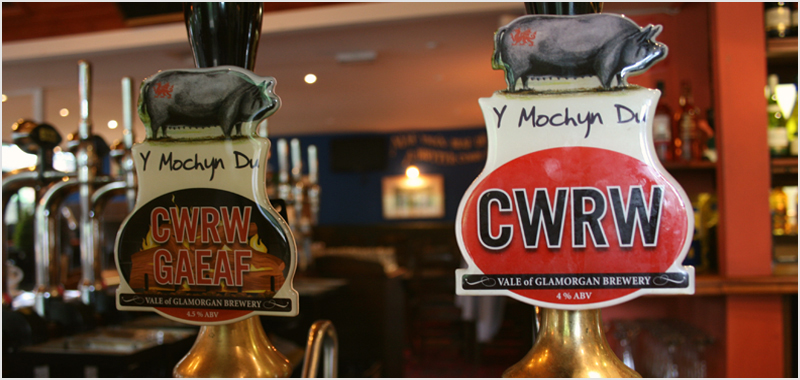
My choice of good local ales at the Mochyn Du, I chose CWRW.

The term “rarebit” is not a corruption of rabbit, but is, instead, a kind of open faced grilled cheese sandwich. Its ingredients include toasted bread (rye, or any other substantial loaf), melted cheddar (preferably thick strands, not slices, with good ale, salt, fresh pepper, a bit of mustard, Worcestershire, and more bits of good Welsh bacon (more like a cross between American grilled ham and Canadian bacon). Cockles may be associated with mussels (but then, that would be in Dublin’s fair city, not in Wales). Here, as there, cockles are small clams, found throughout the world in saltwater. In Wales, they may be served in combination with well-buttered toast, and bits of Welsh ham, and they may be quite tiny. Both Welsh Rarebit and cockles are best enjoyed with a good pub ale; I did just that in Cardiff, just before the 9PM kitchen closing time, at Y Mochyn Du (The Black Pig), and then enjoyed some fresh sea bass, while my compadre, Paul Harris (local guide and expert on Wales; owns See Wales) enjoyed Honey Roasted Ham with a pair of free-range (we would call then sunny side up) eggs.

The laver cake anchors a good Welsh breakfast consisting of wonderful smoked salmon and my gigantic fluffy omelette.

I will now recall Cardiff as the site of the fluffiest omelette I’ve ever eaten–and I could eat only about half of it. The place: Lincoln House Hotel, just a few blocks from the center of town, on a beautiful old (and probably, once, quite wealthy) Cathedral Avenue. The next morning, I opted for the perfect smoked salmon as my main dish. Both mornings, my favorite tastings were small, round, and local to Wales. The Welsh Tea Cake, about 3 inches round, a cakey cookie similar to a fruit scone (raisins or currants inside) dusted with granulated sugar, but only about half an inch thick (like a cookie). Laver is a seaweed and oatmeal cake, meaty enough for a meal, slightly salty and sea-tasty, I loved it from my very first taste.

My big breakfast turned out to be a problem because I had intended to visit the Pettigrew Tea Rooms located in Cardiff Castle’s old gatehouse. Fortunately, the Castle tour was long enough for me to work up a bit of an appetite, so I enjoyed a perfect peppermint tea (with full leaves, not flakes) and another Welsh speciality, a cake called Bara Brith, loaded with tea-soaked raisins.

Bara Brith cake at the Pettigrew Tea Rooms, just beside Cardiff Castle

With a consistency similar to carrot cake, the taste is pleasantly spicy and fruity, and, apparently, this is quite traditional. Time limitations kept me away from St. Fagan’s, another Cardiff location where the baked goods are made fresh, and with love, so I missed out on the revival of Shearing Cake. That’ll wait until next time.

On the other side of southern Wales, the far western side, I spent a day walking around Skomer Island, and saw the (fabulous!) puffins. And I spent about two days in the seaside towns Saundersfoot and Tenby. Before a day of coastal hiking, a hearty breakfast can be just the thing; it’s part of the package at Saundersfoot’s Claremont House (and Sue is terrific at home cooking!). I tried my first serious version of fish and chips at a charming old restaurant, down some medieval stairs (not far from an equally charming bookstore). Among the many very good fish restaurants in seaside Tenby, I’m confident that you will enjoy Plantagenet as much as I did (be sure to ask your server to see the very tall Flemish chimney, large enough, at its base, to fit two large dining tables).

Fish, chips and mashed peas at Plantagenet in Tenby, Wales.and chips at a Tenby restaurant well-known for its fresh fish: Plantagenet. And I’ve learned that fish and chips comes with fresh and yummy mashed green English peas. Lunch at Mulberry’s, with its Dutch chef, provided my introduction to whitebait, a two-inch fish that’s served in bunches, battered and fried, and also, a snapping fresh shrimp dish involving butter, garlic, parsley, a scampi of sorts.

My high-class respite on the inevitable rainy afternoon was St. Bride’s, a spa hotel with a wonderful restaurant located just across a windy street from the Claremont in Saundersfoot. I sat for hours, watching day become night, harbor lights below, big sea and sky view with tiny sailboats in the mid-ground and larger, industrial vessels further out at sea. I started with tea–after a rainy afternoon outdoors, British tea tastes so right–then warmed my still-chilled innards with a nice squash soup (ingredients from a nearby farm). Then, the perfect Welsh lamb, crispy and properly spiced on the outside, red enough to be slightly lukewarm at the center, again from a source just down the road. St. Bride’s turned out to be a special part of my Saundersfoot experience. I so enjoyed the view, the table, and the relaxed ambience, I returned for a second night, hoping to enjoy Gressingham Duck, or Dover Sole, or free-range chicken from not-far-away Fishguard, perhaps topping off with a Sticky Toffee Pudding or a Warm Treacle Tart with Clotted Cream, but I had to admit the truth.  I was still quite full from my fish and chips lunch, so I went for smoked salmon and a cooling Iced Apple Parfait with Bramble Sauce (a red and purple berry sauce).

Big disappointment: I was hoping to visit the well-regarded ffresh, located in the spectacular Cardiff Millennium Center (a performing arts center), but I was there on a Monday, and it was closed. Sigh.

Useful iPad Stuff

(This turned out to be a popular blog post, but I neglected to mention a favorite product, so I’ve revised the article. See below.)

A collection of products that I’ve been meaning to write about…

First–and this one is free–is the 150-plus page iPad Buyer’s Guide from iLounge. If any one publication is the definitive iPad guide, this must be it. It begins with a very complete guide to every iPad model on the planet–very useful for those who are considering a purchase, a skip-over for those who already own one–then digs into articles about iPad innovators, including Inkling (which makes the interactive travel guides I wrote about last week). Just about every aspect of the iPad culture is explored, including some decidedly weird comments from the doubters (I thought we were past this negative stuff, but obviously, they do not). There are pages and pages about useful accessories, top apps, lots more. What’s more, everything is presented in a punchy, fun-to-browse way. It’s available for your computer screen in one-page or two-page-spread format, or in one-page specifically for the iPad. Nice work!

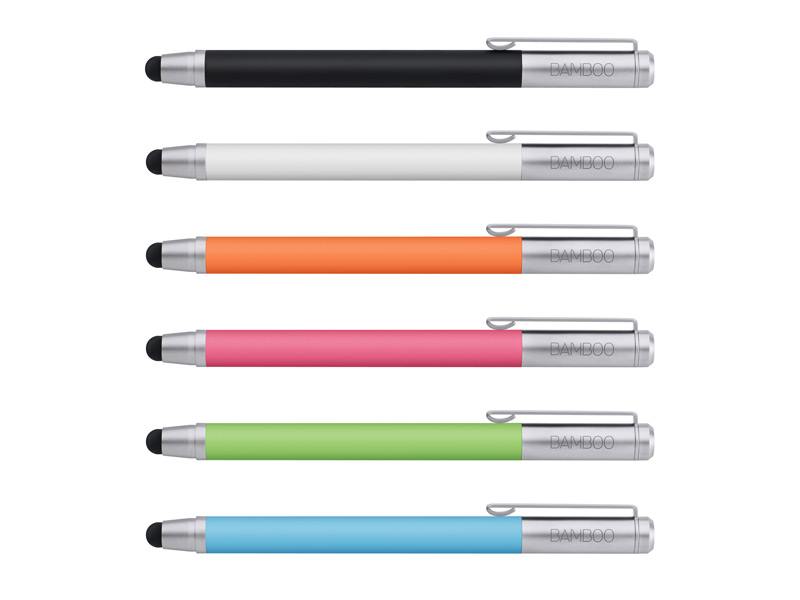
Second, a surprise, at least to me. I’ve used an iPhone for years, and an iPad for a year or so. The input device is my finger, and until yesterday, that worked just fine. Just for fun, I tried an iPad stylus. I liked it. A lot. There are lots of iPad styli available–including the colorful series of Bamboo stylus products from Wacom, and the one I used, the AluPen from Just|Mobile. The AluPen is about four inches long, and feels like a fat crayon. The rubber tip makes contact with the screen’s surface with surprising accuracy. I was able to execute every iPad function more smoothly (and with no fingertip oil or friction), so the experience seemed smoother, quicker, and more precise. Consistent with current trends, stylus makers now offer two models, one with a built-in pen (the kind you use to write on paper, the kind with ink). The AluPen Pro uses Pelikan ink, which seems consistent with Just|Mobile’s higher-quality approach to their whole product line. Before you buy, be sure to explore the extensive text, pictures and video on The Verge.

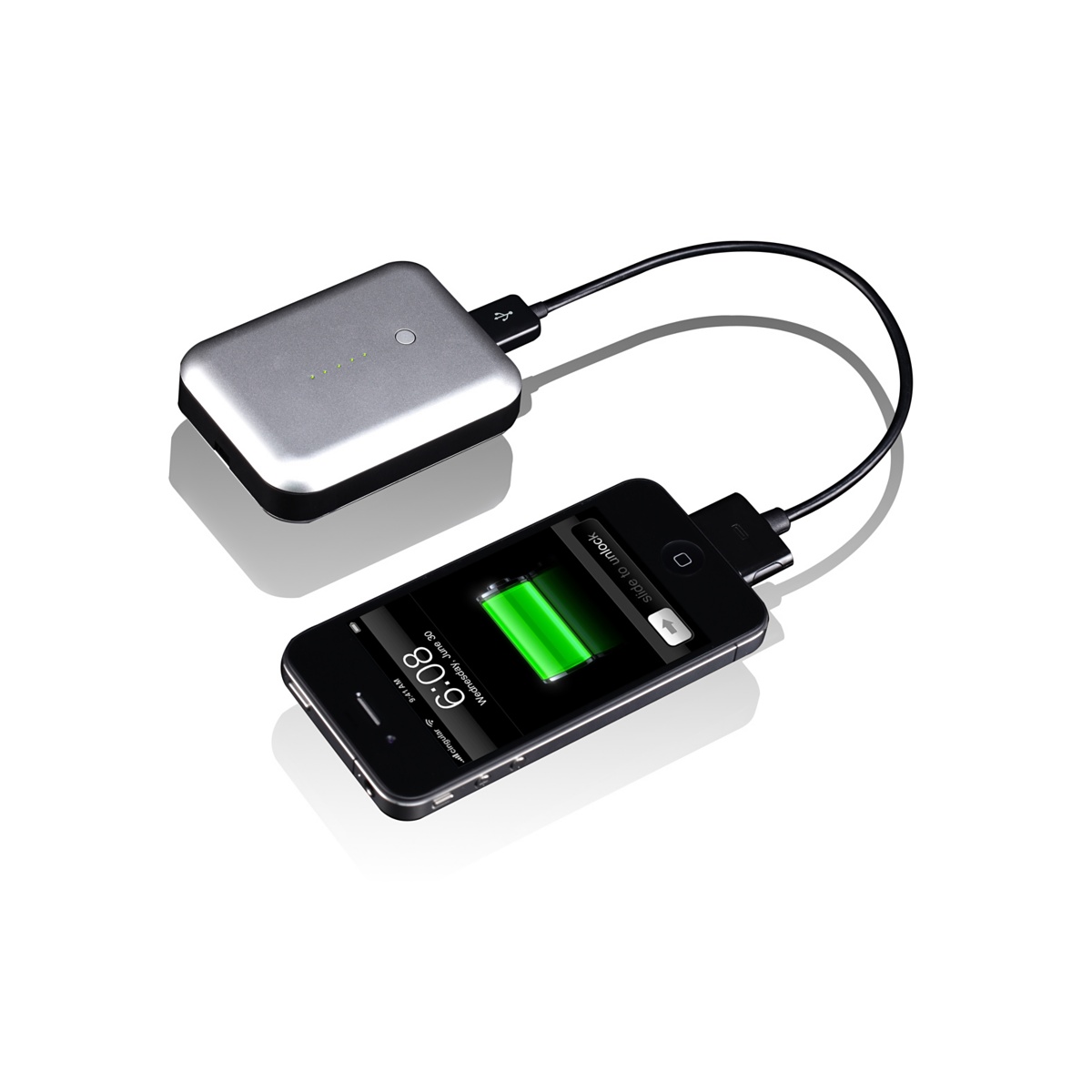
Third, remote power. At January’s Consumer Electronics Show, lots of companies were showing remote power accessories for both iPhone and iPad. Once again, I was impressed by the Just|Mobile products, despite their odd name: Gum. The Gum Plus is the smaller unit, designed mostly for the iPhone (which it can charge several times without being refreshed), and, in a pinch, you can use it to charge the iPad, if not fully, then enough to keep working for a while. For the iPad, you’ll want the larger, and somewhat heavier, Gum Max, which carries enough portable power to completely recharge an iPad, and then, an iPhone. The way this works: you plug the GUM into your AC outlet, fill it with power, and then, carry it with you. When you need the power, you plug your iPhone or iPad into the portable GUM unit. Then, when time and access permit, you recharge the GUM, and, presumably, your iPhone and iPad, too. Some people will use these devices regularly. If you plan to use the Gum only sometimes, you must remember to discharge and recharge the unit for best results.

Fourth, remote storage. Apple designed the iPad so that its local storage would be limited… and the cloud would provide the rest. Unfortunately, even 64GB is not enough local storage for those who rely upon the iPad as their primary portable device, and there is no such thing as a USB Flash Drive or SD Card to augment storage. I am very impressed with the idea of the Seagate’s GoFlex Satellite Drive, and as soon as it’s up and running, I will report back to you.

I reposted because I forgot my favorite new iPad accessory. It’s an eraser. But it doesn’t erase ink or pencil. It erases the ridiculous smudges that magically appear on every iPad screen. I use it often, especially on sunny days when the reflected finger grease (sorry) makes it difficult to see the screen properly. So, here’s the solid plastic 3-inch by 4-inch white plastic eraser with a specially-made black bottom…my best friend when the smudges become annoying on an otherwise beautiful day. The company is Best iProducts. The iEraser costs $14.95, and it’s proudly made in America. They can imprint company logos. It works on a bare screen, but not with a screen protector. All of which is nice to know, but what I really like is that this little eraser really works. First time, every time. Smudges gone! And it couldn’t be simpler. Small company, good product, who could ask for anything more?


Gestures in a Virtual World

This slideshow requires JavaScript.

Two interesting articles, each overlapping the other, both worth reading because they may change your thinking about the ways we interact with computers and the virtual world.

The first article, from the BBC, is about surgeons in a London hospital who are learning to use voice commands and hand gestures to control medical instruments. The process, based upon Microsoft’s Kinect technology (more on this in the second article), allows greater precision and higher efficiency while eliminating some sterilization issues. For certain procedures, this “touch-less” approach to medicine is likely to become the norm within the next 10 years or so.

The second article, from the NY Times, is about Microsoft’s shift from “does not condone the modification of its products” and would “work closely with law enforcement . . . to keep Kinect tamper-resistant…” to an understanding that Kinect was going to become something greater than a videogame input device, and that Microsoft might not control the ways in which Kinect would be used in the marketplace. Eventually, Microsoft decided to release a non-game version of Kinect, still bound by a range of rules that are hopelessly out of step with today’s open-everything tech development world. The story is longish, and worth reading because, well, the article’s author said it so well:

The idea of a loosely knit band of outsider creative coders forcing a massive company to rethink a crucial new product is appealing.

I suspect both articles are the result of Microsoft’s publicity machine, both supporting an expanded view of Kinect specifically and Microsoft generally. No matter. Both are interesting, and the trend is worth a few minutes of your time. As the heat in this area increases, the keyboard, mouse, and other 20th century input devices become less likely to survive, at least in their present conception.