It’s the biggest thing we’ve ever built–bigger than the pyramids of Egypt, about a hundred times as long as the Panama Canal, easily eight times the length of The Great Wall of China. It’s newer, too. And, soon, we’ll probably build it all over again.
As Earl Swift explains in The Big Roads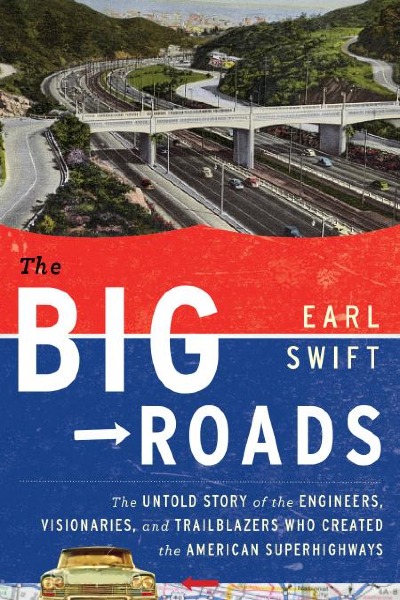 : The Untold Stories of the Engineers, Visionaries and Trailblazers Who Created the American Superhighways, the U.S. interstate highway system is forty-seven thousand miles long, and it is the “greatest public works project in history.”
Messy as our current dilemma about infrastructure may seem, life was worse before the interstates, before modern roads. In the good old days, New York City’s horses output 2.5 million pounds of manure every day, plus 60 thousand pounds of urine. In 1893, the agriculture department got things rolling with a new Office of Road Inquiry, whose boss, a Civil War veteran, declared Americans “have the worst roads in the civilized world.” Still, intrepid automobiling pioneers attempted a cross-country race in 1903 (one car included a dog, Bud, who wore goggles and “became a hit in every town they visited.”) This was the beginning of an industry, complete with sales stunts on a grand scale: Carl Fisher, whose early days were consistently colorful (and completely crazy), “rigged a Stoddard-Dayton roadster to a massive balloon and flew it over Indianapolis, vowing to drive it back into town from wherever he landed.” (Actually, Fisher stripped the floating car and drove home in a look-a-like spare). Not long after, Fisher partnered with two other car crazy businessmen and built the Indianapolis Speedway. Fisher was among the first to campaign for a big interstate highway system.
A half-century later, in 1956, “nearly $2.6 billion had been committed to the work… contracts had been awarded on more than a thousand bridges… construction was under way or about to begin on nearly two thousand miles of highway.” Half the book is about the wrangling, the engineering and politics, the slowdowns due to the Great Depression and World War II, and all sorts of rational and irrational arguments about the nature of the undertaking, the roles of the states versus the Federal government, the best ways to pay (tolls? gas tax? Federal funds? State funds?), and much more. In fact, the weakest part of the book attempts to describe this wrangling–Swift (great name for the author of a book about fast highways, BTW) does his to craft a story from his astonishing collection of arcane research. With Detroit pumping out over 5 million cars per year (1 in 3.5 citizens owned a car), America had a mess on its hands. Far too many cars driving on roads that were designed decades earlier. Trucks made the situation worse, both by contributing to congestion and also by damaging roads never built for a big truck’s combination of weight and speed. “Snarls at New York’s George Washington Bridge were traced back eighty-four miles–seriously, eight-four miles–to Monticello, New York.”
Even in these early stages, Swift explains that the highway system had its critics: Lewis Mumford published articles and books about the loss of city neighborhoods, and the economic destruction of towns and villages across the nation. By the 1960s, the environment movement gradually imposed restrictions on engineers who were once able to construct interstate highways pretty much anywhere, regardless of impact on animals, ecosystems, even city parks. Several Baltimore neighborhoods fought tremendous battles, and today, there is no interstate highway system cutting across Baltimore–the local activists won their battle. Visitors to Baltimore’s lovely old Fell’s Point neighborhood can thank those activists–if the interstate was built as planned, that neighborhood would be gone.
Swift goes on the record to give credit where it’s due, often to government functionaries who exceeded the call of duty, but his writing is far more interesting when he’s on the road himself, or when he’s telling the (too-brief) stories of how Howard Johnson’s or other roadside co-conspirators grew to be a part of American life on the road.
What’s more, I wish he had told us more about the next fifty years, or perhaps, the next twenty. Apparently, the interstate highway system was built for about a half century’s useful life. It has not been properly maintained. As the most dedicated of the government figures, Frank Turner, pointed out, “Highways grow old and wear out at a fairly predictable ages and lifespans, and therefore must be replaced or restored.”
Swift explains, “One federal study suggested that all levels of government should spend a combined $225 billion a year for the next fifty years to rehabilitate surface transportation…they’re currently spending just 40 percent of that, in a country that does 96 percent of its traveling by car and truck.”
So begins a brief discussion about dedicated truck lanes, alternative fuels and other incremental improvements. The bigger question is potentially world-changing and certainly mind-bending, so I offer it as the basis for Swift’s next book. A century ago, visionaries came up with the idea of cars (and trucks), and then, a connected interstate highway system to move people and goods in a safe, reliable, cost-effective way. By the time the interstate highway system was completed in the late 1960s, most of those people were either gone or too old to drive. Given the astonishing public good, the modernization of America, and the tremendous downside associated with our current system, I wish Swift would encourage a discussion so we can decide whether to, and how to:
(a) spend another $11 trillion ($225 x 50 years) to fix and upgrade a highway system conceived before television, McDonalds, cell phones, FedEx or the internet, or
(b) come up with an equally bold conception of transportation that could sustain us until, say, 2112?

Here’s the photo of author Earl Swift as published on the literary festival’s website.
Looks like a strange, unimaginable number, that 2112, but in 1912, when Fisher and his friends were tooling around Indianapolis in their early model cars, 2012 must have seemed as far away, and as impossible, as a 47,000 mile highway system connecting every city and town in what is now called the lower 48 states.
BTW: In researching the author, I found this impressive bit about his interests: “An avid outdoorsman, Swift has through-hiked the Appalachian Trail, circumnavigated the Chesapeake Bay by sea kayak, and traveled the 435-mile length of the James River by foot, canoe, and kayak.” I found it here.
The Big Roads was published in 2011 by Houghton Mifflin Harcourt.



 Digital Insider