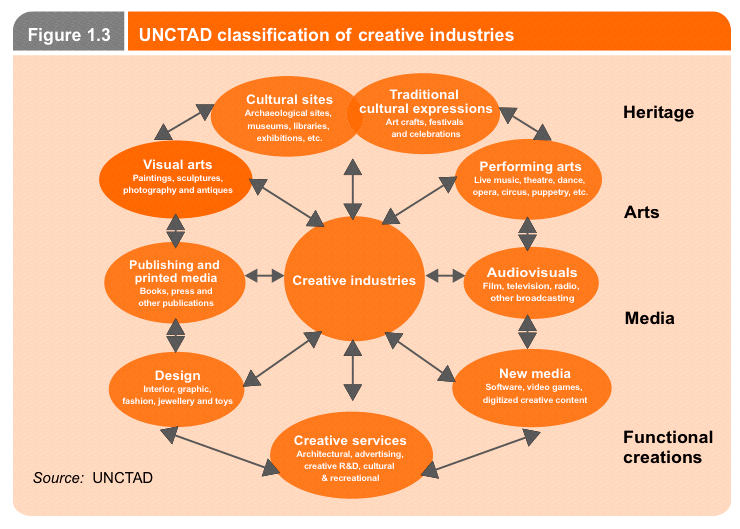
Above, an elegant way to think about the global creative economy, as presented in a 400+ page United Nations report.
1 in 25 people–that’s the revised figure for 2010–work in creative industries in the U.S. More than doctors, lawyers, even accountants. Industry sectors above, details below.
In the United States, roughly 150 million people work full-time. Six million of us work in creative professions. We’re writers and performers; musicians and visual artists; marketers and strategists; architects and specialists who invent, improve, or bring ideas to life. In total, more people work as creative professionals in the U.S. than doctors (700,000), lawyers (800,000), accountants (1,300,000), and engineers (1,600,000) combined. The number of creative professionals exceeds the number of teachers (3,500,000 teachers pre-K through high school, plus 1,700,000 more who teach in colleges and universities).
Our output–which provides employment for lawyers, accountants, executives, retailers, and many others–is responsible for more than ten percent of the U.S. Gross Domestic Product.
A reasonable global workforce estimate would exceed 10 million creative professionals. Nations with significant creative economies include Germany, the United Kingdom, France, Italy, the Netherlands, Ireland, Japan, China, India, Canada, Australia, and, among countries with developing industries, Mexico, Thailand, Indonesia, Argentina, Singapore, and Chile. According to the United Nations Creative Economy 2008 report, the export value of creative in 2005 was over $300 billion, or about 2-3% of the global economy. (Yes, I am reviewing the 423 pages of the 2010 report to update these figures–overall, trends are up).
The long list of creative industries was nicely summarized in the 2008 U.N. report, presented at a United Nations Conference on Trade and Development. The orange version, above, makes it all that much more clear.
Within each of these clusters, the professional model is similar. Projects are developed, produced, and distributed. Mostly, revenues are generated through direct transactions with individual consumers (movie admissions; DVDs; iTunes downloads;physical goods such as jewelry), sometimes through subscriptions; or by advertising to consumers who receive goods and services by paying only a modest transaction fee (magazine subscriptions), or no fee at all (most internet sites; broadcast radio and TV).
You can download the 2010 UN report here. (Yes, I will update my 2008 numbers when time permits.)


 Digital Insider